
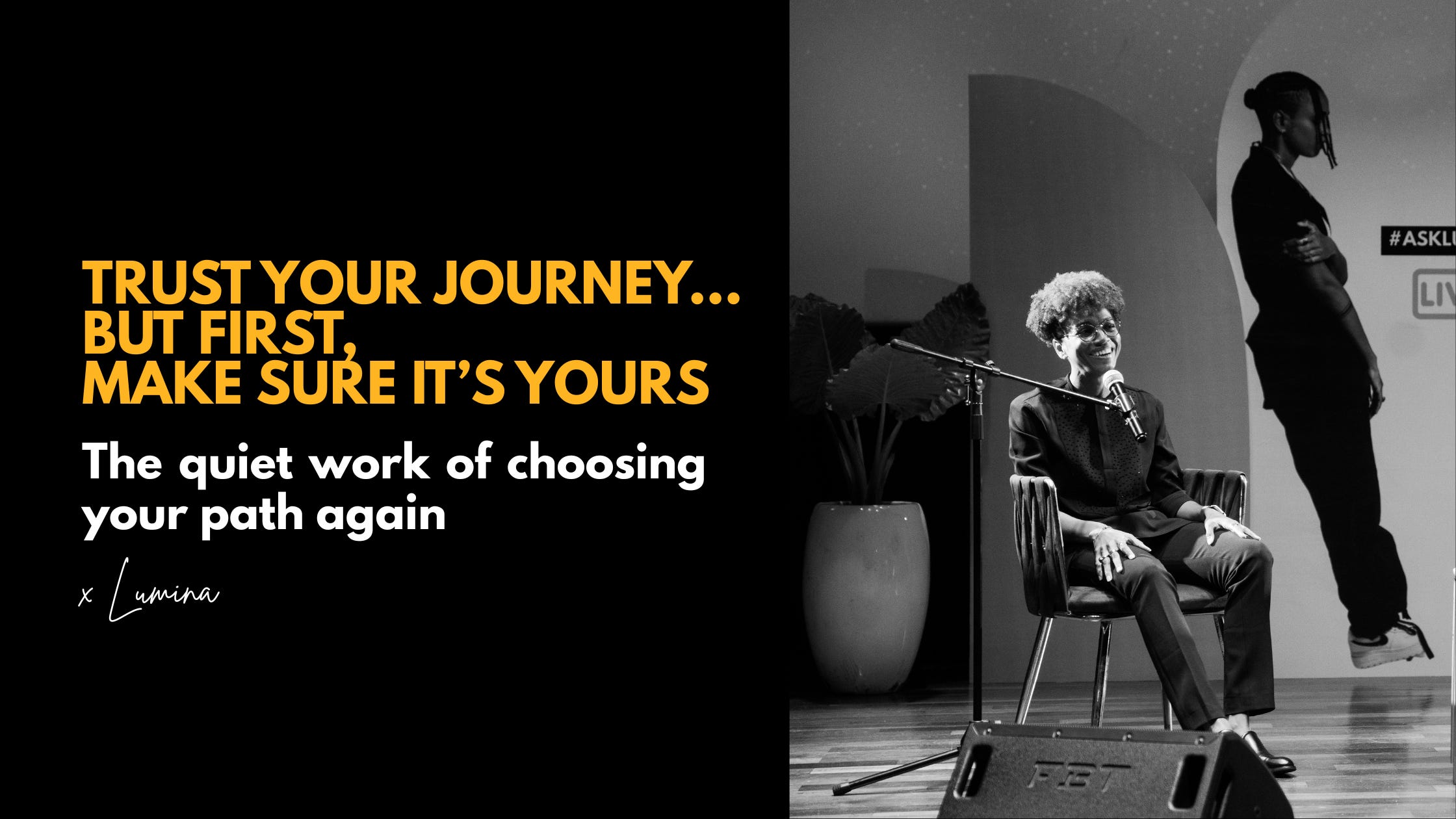
We hear it all the time: “Trust your journey.”
It sounds comforting. Like something you’re supposed to hold onto when things feel uncertain or slow. And to be fair, I understand the intention behind it. Life isn’t linear, and growth takes time. Not everything makes sense when you’re in it. But…
What if trusting your journey only works… when you’re actually on the right one?
Because nobody really talks about what happens when you’re not.
There are seasons in life that aren’t just “slow.” They’re misaligned. You’re moving, but it doesn’t feel like you. You’re doing what makes sense on paper, what looks good from the outside, what people expect of you — but something feels off when you’re alone with it. And in those moments, “trust the journey” can become a very gentle way of staying stuck. It sounds wise. It sounds patient. But sometimes, it’s just avoidance dressed up in better language.
I remember someone telling me about a period in her life where she stayed in a career she didn’t enjoy for years. Every time the discomfort came up, she would tell herself, “Maybe I just need to trust the process.” But the truth was, she already knew. She wasn’t confused. She was just avoiding what it would mean to change direction. Because changing direction is not a quiet decision. It disrupts your identity, and forces you to question who you’ve been. It might disappoint people. It might require you to start again in ways you didn’t plan for. So she stayed. And “trust the journey” became a soft place to hide from a harder question:
Is this still my journey?
I’ve seen this play out in so many ways. The entrepreneur building something they no longer believe in. The Creator showing up online in a way that doesn’t feel true anymore. The student pursuing a path that makes sense logically, but not internally. From the outside, it all looks like discipline, consistency, and resilience. But underneath, there’s a quiet misalignment. And that’s the part we don’t talk about enough. Because we live in a world that praises consistency so loudly, we sometimes forget to check direction. But consistency in the wrong direction doesn’t lead to fulfillment. It just takes you further away from yourself.
So maybe the question isn’t just:
Do I trust my journey?
Maybe it’s:
Have I taken a moment to ask if this is still mine?
This doesn’t mean you abandon everything the moment it feels hard. Every meaningful path will stretch you, and every real thing will come with resistance. But there’s a difference between discomfort that is shaping you… and discomfort that is signaling something deeper.
One expands you.
The other drains you.
And learning to tell the difference is a quiet kind of wisdom.
Staying power is important, but so is discernment. It’s not just about sticking with things. It’s also about recognizing when something has run its course in your life. Not everything deserves a lifetime commitment just because you started it. Sometimes growth looks like continuing. And sometimes, it looks like letting go.
So maybe “trust your journey” needs a little more honesty around it.
Trust your journey… but check if it’s still yours.
Trust your process… but don’t silence your intuition.
Trust your timing… but stay aware of your direction.
The goal isn’t to stay loyal to every path you step onto. The goal is to stay honest with yourself while you’re on it. And honesty will ask different things of you at different times. Sometimes it will ask you to keep going. Other times, it will ask you to turn around quietly — without drama, without guilt, just clarity.
So if you’ve been questioning things lately, that doesn’t make you lost. If something feels off, that doesn’t make you ungrateful. And if you’re realizing you’ve outgrown something, that doesn’t make you inconsistent. It might just mean you’re paying attention. And paying attention is often where a better direction begins.
x Lumina
No posts
Comments
Nothing yet. Say the first thing.
Sign in to join the conversation.