
Sorry for the long hiatus! On May 18, 2026, President Trump and the federal government entered into a “settlement agreement” under which the government agreed to contribute $1.776 billion to the newly created “Anti-Weaponization Fund.” The Anti-Weaponization Fund was charged with doling out money to victims of “Lawfare” and “Weaponization,” defined as “the sustained use of the levers of government power by Democrat elected officials, political and career federal employees, contractors, and agents in order to target individuals, groups, and entities for improper and unlawful political, personal, and/or ideological reasons.”
The Anti-Weaponization Fund proved to be politically controversial, wherefore the Acting Attorney General testified to Congress that it would not proceed. Still, litigation over the Anti-Weaponization Fund soldiers on. A federal district court in Virginia issued a preliminary injunction against the Anti-Weaponization Fund, and the parties continue to litigate whether the Fund is legal. Meanwhile, the federal district court in Florida that was presiding over the purportedly settled lawsuit issued an order that, among other things, banned both sides from “referring to the purported ‘settlement agreement,’ or using, offering, admitting, or citing any of its provisions in any judicial, administrative, regulatory, arbitration, or any other official proceeding as evidence of a ‘settlement’ reached in this matter.”
Today’s post will offer some commentary on the Anti-Weaponization Fund and the satellite litigation it has spawned.
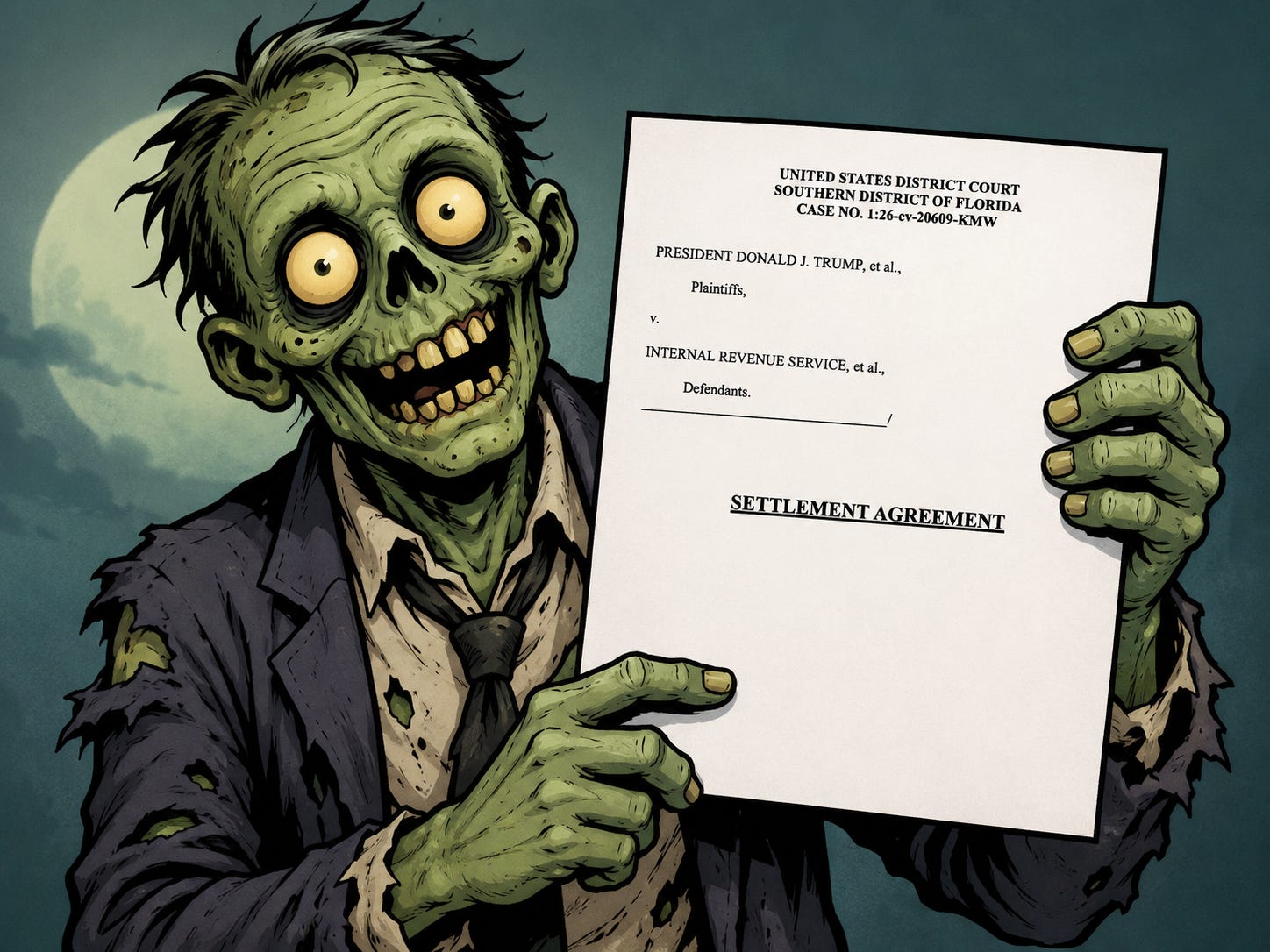
I’m going to start with some uncontroversial table stakes: the Anti-Weaponization Fund is illegal.
The Anti-Weaponization Fund is the product of a settlement of a lawsuit and two administrative claims brought by the President. Let’s start with the lawsuit. In 2020, during the first Trump Administration, an IRS contractor, Charles Littlejohn, leaked thousands of people’s tax return information, including President Trump’s, to the news media. Littlejohn was charged, convicted, and sentenced to five years in prison.
On January 29, 2026, President Trump (along with his older sons and the Trump Organization LLC—I’ll call the plaintiffs “President Trump” for short) sued the IRS, bringing two claims: one under the Internal Revenue Code’s express cause of action for unauthorized disclosure of tax returns, and the other under the Privacy Act. President Trump sought a mere $10 billion in damages.
This lawsuit had many weaknesses, most notably that it was time-barred. The Internal Revenue Code requires that a cause of action be brought “within 2 years after the date of discovery by the plaintiff of the unauthorized inspection or disclosure.” Privacy Act claims must be brought “within two years from the date on which the cause of action arises.” That means the critical date—two years before the filing of the lawsuit—is January 29, 2024.
The New York Times published its story in September 2020. In December 2022, Ken Griffin sued the IRS based on the exact same leak. In October 2023, Littlejohn pleaded guilty, admitting he leaked President Trump’s tax returns. Alina Habba, President Trump’s attorney, attended the plea hearing and spoke on behalf of the President, saying, among other things:
MS. HABBA: Thank you, Your Honor, for the opportunity to be heard. As an attorney, I find that I should probably state I am not licensed in this state, in the District of Columbia. I’m here on behalf of President Trump who was a victim, as we just heard, of this atrocity. … This was an egregious breach by an agent of the IRS who targeted the President of the United States, among others, for political purposes and personal gain. As we just heard in the statement of facts read into the record, President Trump’s returns were turned over to the New York Times right before an election. As I also learned today, his were turned over before everybody else’s.
Some of you may remember the song “It Wasn’t Me” by Shaggy, which was released 26 years ago (?!). The plot of this song is that Shaggy advises his friend Rikrok to insist that he (Rikrok) did not cheat on his girlfriend even though she not only witnesses the entire event but also records it on camera. This is not too different from the legal theory undergirding Trump v. IRS, which hinges on the argument that the President had not yet discovered the unauthorized disclosure of his tax returns at a time when the President’s lawyer publicly declared in open court at the perpetrator’s plea hearing that the President was the victim of that very unauthorized disclosure.
The settlement agreement that gave rise to the Anti-Weaponization Fund covers not only President Trump’s lawsuit against the IRS, but also two tort claims that were pending at the administrative level.
One was a claim arising out of the Mar-a-Lago search in August 2022. This claim has lots of weaknesses for reasons AI will be glad to explain, but even setting those aside, the claim sought a mere $15 million in compensatory damages—two orders of magnitude less than the $1.776 billion Anti-Weaponization Fund settlement.1 The other claim—described in the settlement agreement as arising from “the Russia-collusion hoax”—does not seem to be available online, but the New York Times reports that it was lodged in “late 2023.” Given that the Mueller report came out in 2019, the claim was likely filed well after the expiration of the two-year statute of limitations.
So we’ve got two likely time-barred claims and one claim where the theoretical maximum recovery was $15 million, which does not bode well for a large recovery. But the President did have one thing going for him, which is that he controls the Department of Justice. And so, on May 18, rather than defending against the lawsuit, the normally tenacious Department of Justice agreed to settle the case for the patriotic sum of $1.776 billion, to be doled out to third parties by the “Anti-Weaponization Fund.”
Article I, Section 9, Clause 7 of the Constitution provides: “No Money shall be drawn from the Treasury, but in Consequence of Appropriations made by Law.” Thus, for the Anti-Weaponization Fund to be legal, there has to be a Law—an Act of Congress—authorizing $1.776 billion to be spent. The government has pointed to the judgment fund statute, 31 U.S.C. § 1304, which appropriates “necessary amounts” to pay “compromise settlements.”2 The government’s theory is that it entered into a “compromise settlement” with the President, opening the door to the $1.776 billion payment.
There are (at least) two problems with this argument:
There is no “compromise settlement” here.
Even if there were, there’s no statutory authorization to create the Anti-Weaponization Fund.
First, there is no “compromise settlement.”
The concept of a “compromise” involves two independent actors, with separate interests, that compromise on some intermediate position. You cannot compromise with yourself. Yes, I have seen Inside Out, in which Joy and Sadness achieve a negotiated resolution that allows Riley to resume playing hockey, but even there, Joy and Sadness are separate characters with separate voice actors. This case is more like Joy compromising with Joy.
The settlement agreement recites: “The corpus of The Anti-Weaponization Fund’s funding does not represent the value of any current claim by Plaintiffs, but rather is based on the projected valuation of future claimants’ claims.” I view that as more or less an open admission that the settlement agreement isn’t a “compromise settlement” of the President’s claim. A “compromise settlement” reflects an assessment of the value of the claim, discounted for chances of success, attorney’s fees, the time value of money, and so forth. If the government pays an amount of money that has nothing to do with the value of the claim, it’s not entering into a “compromise settlement” of the claim.
The settlement agreement then goes on to recite: “[T]he corpus of The Anti-Weaponization Fund’s funding is not taxable income as to Plaintiffs, who receive no economic benefit from this Settlement Agreement.” The premise of a “compromise settlement” is that the plaintiff gets some money, and in exchange for getting that money, drops the claim. That’s what the appropriation is for: paying off the plaintiff in exchange for the plaintiff dropping the claim. There’s no “compromise” with the plaintiff when the plaintiff doesn’t get anything.
(There’s also another document dated the next day and signed by the Acting Attorney General, who did not sign the settlement agreement, purporting to give amnesty to the President, Donald Trump Jr., Eric Trump, and the Trump Organization from future government investigations. This document also raises some intriguing legal issues that I won’t get into. But for present purposes, I don’t think the amnesty provision is consideration for the plaintiffs dropping the claim? If it is, then I withdraw this particular point.)
If the “compromise settlement” theory were viable, then the President’s challenges in persuading Congress to appropriate funds would be magically resolved: the President could just sue himself and convince the Justice Department, under his control, to “settle” the case by spending taxpayer money on whatever he wants. For instance, the President does not need to convince Congress to spend $1 billion on ballroom security. He could simply sue the federal government for some completely unrelated thing and then immediately direct the Acting Attorney General to “settle” the case by doling out $1 billion from the judgment fund for ballroom security. The value of the lawsuit need not have any correlation with the settlement amount—the explicit premise of the Anti-Weaponization Fund is that the $1.776 billion fund has no relationship to the value of the President’s claims.
There is another problem with the Anti-Weaponization Fund. The Judgment Fund statute is an appropriations statute. It authorizes the spending of money. That’s it. The settlement agreement doesn’t just create a Fund. It creates a kind of new executive agency with new authority: to spend the money in the Fund as dictated by the settlement.
To set up a new agency like the Anti-Weaponization Fund, you need an Act of Congress. The President can’t create a new agency with new powers merely by suing, and “settling” with, the Attorney General. Suppose there’s a future administration in which the President would really like to create a new Department of Climate Change charged with spending taxpayer money to alleviate the climate emergency. Suppose Congress demurs. Should the President be able to create this new agency unilaterally by: (1) suing his own administration over some unrelated thing, and (2) convincing his own Attorney General to “settle” the suit by creating the Department of Climate Change in exchange for his gracious decision to drop his lawsuit? This is more or less what happened here.
The Members of the Anti-Weaponization Fund also aren’t entitled to exercise authority to dole out funds. The Constitution prescribes the process for appointing people who exercise significant governmental power. Under the Appointments Clause, the President has the power, “by and with the Advice and Consent of the Senate,” to appoint “Officers of the United States, whose Appointments are not herein otherwise provided for, and which shall be established by Law: but the Congress may by Law vest the Appointment of such inferior Officers, as they think proper, in the President alone, in the Courts of Law, or in the Heads of Departments.” I view the Members of the Anti-Weaponization Fund as principal (not inferior) officers, which means that (1) their offices must be “established by Law,” (2) they must be appointed by the President, and (3) they must be confirmed by the Senate, none of which is occurring under the settlement agreement. Even if the Members of the Anti-Weaponization Fund are inferior officers, the Attorney General can’t appoint them unless Congress authorized the Attorney General to do so, which it never did.
Does the President have the inherent executive authority to create the Anti-Weaponization Fund, even without an Act of Congress and even without following constitutional appointment procedures? I think not. The Federalist Papers address the Legislative, Executive, and Judicial Branches in detail. By contrast, according to AI, only one part of one Federalist Paper contemplates that the President can create a fourth branch of government by suing and settling with his own Attorney General for purposes of paying taxpayer money to his supporters without congressional approval. Even there, only Alexander Hamilton was a supporter, with James Madison and John Jay tentatively opposed. So even originalists should oppose the Anti-Weaponization Fund.
Doubtless because of public concern over the proper interpretation of the judgment fund statute, a hubbub arose over the Anti-Weaponization Fund. And, of course, people sued.
On June 2, the Acting Attorney General testified before the House of Representatives that the Anti-Weaponization Fund wouldn’t proceed. In the least surprising development of all time, the litigation did not stop.
Several lawsuits were filed; I’ll focus on Floyd v. Department of Justice in the Eastern District of Virginia. A group of plaintiffs sued the government, seeking to enjoin the Anti-Weaponization Fund. Now you may wonder how the plaintiffs would have standing to seek such an injunction. After all, a plaintiff can’t get an injunction unless it suffers a particularized injury, and “the government is spending taxpayer money illegally” doesn’t count. But the plaintiffs have a creative theory.3 Remember how the settlement agreement defines Weaponization as “the sustained use of the levers of government power by Democrat elected officials”? Well, the plaintiffs say that they were victimized by Republican elected officials, and hence (they claim) are ineligible for payments from the fund. That’s discrimination! And it’s particularized discrimination, because (they claim), they, personally, would be ineligible for payouts. Wiping out the Anti-Weaponization Fund wouldn’t get them any money, but it would eliminate the sting of unequal treatment, they say. Like it says on the Supreme Court building: Equal Justice Under Law.
The government responded, among other things, that the case was moot in view of the Acting Attorney General’s House testimony that the Anti-Weaponization Fund was dead. But on June 12, the district court granted a preliminary injunction halting the operation of the Anti-Weaponization Fund. In response to the government’s mootness claim, the court invited the defendants (the Acting Attorney General, Associate Attorney General, and Secretary of the Treasury) to “file a declaration under the penalty of perjury that they will not take any action to create or operate the Anti-Weaponization Fund, and that the Anti-Weaponization Fund will not proceed in any manner, or under any name.” Per the court, if they filed such a declaration, the lawsuit would go away; if they didn’t, the lawsuit would stay in place and the injunction would remain in force.
Wait a second. We’re talking about a settlement here. On Earth-One, one side of a settlement cannot unilaterally declare that the settlement will never be carried out. Like, if Alice sues Bob and Bob agrees to pay Alice $1 million and Alice drops the case in exchange, and then Bob announces “actually sorry I’m not going to pay the $1 million,” one would not say, “OK, I guess we can be certain Bob’s not going to pay the $1 million!” Instead you would say “I guess Alice is going to sue Bob for the $1 million, have fun losing in court Bob!”
Yet here, the government takes the position that once the defendants declare the Anti-Weaponization Fund to be dead, it’s dead. The concept of the plaintiffs enforcing the settlement does not cross anyone’s mind. This suggests that this isn’t a “compromise settlement.” But remember that the statutory basis for the Anti-Weaponization Fund was that the government entered into a “compromise settlement,” thus unlocking the Judgment Fund door! If there’s no actual “compromise settlement,” the Anti-Weaponization Fund is illegal.
Still, the district court was willing to declare the case moot based on declarations from only one side of the settlement. This was an easy ask from the district court. It would have been literally a one-line declaration reciting that the thing that the Acting Attorney General told Congress is, in fact, true.
Still, the government refused to submit the declarations. It gave two reasons:
The declarations were “unnecessary” because the Acting Attorney General had already made these statements to Congress, and the lawyers had signed briefs reporting those statements, so who needs sworn declarations anyway?
“The compelled testimony of senior officials from the Executive Branch implicates serious separation of powers concerns.”
The government’s justifications are not persuasive. On the first point, it was reasonable for the district court to insist on sworn declarations from the defendants before dismissing the case as moot.
The way litigation normally works is, if a party wants to convince the court that a particular fact is true, the party submits a declaration saying it’s true. The district court was entitled to apply ordinary procedural rules.
To be sure, when we’re talking about official government actions, usually the government is allowed to submit official government documents. The problem is that there isn’t an official government document rescinding the Anti-Weaponization Fund. The original documents are still up on the DOJ’s website!
The settlement agreement says: “This Settlement Agreement may be modified only with the written agreement of the Parties.” There’s no written agreement of the Parties. Indeed, at the House hearing where the Acting Attorney General made the very comments that, according to the government, mooted the litigation, the Acting Attorney General explicitly refused to put anything in writing:
GRACE MENG: Thank you, Mr. Chairman. Um, Mr. Attorney General, I want to thank you for verbally committing to not moving forward with the so-called, um, Anti-Weaponization Fund. I just want to make sure, are you going to issue a new memo in writing rescinding that May 18 memo?
TODD BLANCHE: I'm not committing to putting anything in writing. And I said it over and over again.
GRACE MENG: Nothing in writing. OK, thank you.
TODD BLANCHE: I mean, I don't know what the purpose of putting something in writing, I'm telling you what we're doing. Meaning, like, what’s the -- why do I need to put something in writing if I'm telling you what we're doing?
Any practicing lawyer will tell you that sometimes judges will ask you to do things that you think are unnecessary. That’s life. It’s their courtroom, they get to decide. Unless you have a really good reason to refuse, you do what they tell you to do. You don’t say “Well, I think this is unnecessary, so I just won’t do it.”
The government’s second justification is that the district court’s request raised “separation of powers” concerns. It did not. Separation-of-powers concerns arise when the court forces high-level government officials to sit for depositions or take other burdensome steps. But here, the court wasn’t forcing any high-level government official to do anything. It was just saying: “if you want me to dismiss the plaintiffs’ case as moot based on your unilateral representations, you’re going to have to submit evidence to the court in the way people ordinarily submit evidence to courts.” That is reasonable.
Reasonable or not, the government didn’t submit the declarations, and so the injunction remained in place and the litigation continued. Most recently, the government filed a motion to dismiss. It’s still refusing to submit any sworn declarations, but it argues (among other things) that the case is moot for the additional reason that the Acting Attorney General said at his confirmation hearing that the Anti-Weaponization Fund isn’t going forward. I’d load up NO on Polymarket for the government winning on that one.
Why did the government refuse to submit the declarations? I have no idea. On principle? The principle of “we should be able to get cases dismissed without submitting evidence” is not the hill I would die on. Because it doesn’t like being told what to do by a court? That’s sort of what courts are there for. Because it secretly planned to resurrect the Anti-Weaponization Fund? Maybe, but the inevitable consequence of refusing to submit the declaration would be a continuation of the injunction, so it couldn’t be resurrected anyway.
Could it be that the government actually desired the injunction? After all, if the government wanted to find a way to kill the Anti-Weaponization Fund without writing anything down, a court order would do the trick. If that’s true, then the government would have used collusion both to create and to cancel the Anti-Weaponization Fund. That has to be some kind of world record.

Let us move on to our second case, which is Trump v. IRS—the lawsuit that precipitated the Anti-Weaponization Fund settlement.
On May 18, following the settlement, the plaintiffs dismissed the case with prejudice under Federal Rule of Civil Procedure 41(a)(1)(A)(i). Under that rule, if the case hasn’t proceeded too far, the plaintiff can drop a case without a court order: the plaintiff just submits a notice of dismissal and the case goes away. So it looked like the case was completely done. But on May 27, a group of former federal judges asked the court to set aside the dismissal and reopen the case because the dismissal was a “fraud on the court.” The President’s attorneys submitted an appropriately dyspeptic response.
On July 13, the court issued an order imposing sanctions. The court didn’t reopen the case as the former federal judges requested (I doubt it had the authority to do so). But the Supreme Court has held that courts are authorized to impose sanctions based on litigation conduct even after a case is voluntarily dismissed, so that’s what the district court did.
The court concludes that the plaintiffs brought a collusive lawsuit for an improper purpose. Under Article III of the Constitution, federal courts lack jurisdiction to hear cases unless the parties are adverse. The court holds that “Plaintiffs and Defendants are not adverse because one party controls this litigation.” It explains that the President, the plaintiff, enjoys complete control over the Defendants, who are government officials under the President’s supervision. It also points out that the government fought other, similar lawsuits arising from the tax leak but threw in the towel in this case.
The court has harsh words about the settlement, finding that “the extraordinary award fashioned by the Parties for claims that were never litigated, and have yet to be defined, on behalf of unidentified third parties whose future remedies bear no relationship to the claims in this case, indicates that real adverse interests were never before the Court.” The court also notes that the Acting Attorney General previously served as the President’s personal lawyer, while the Associate Attorney General previously represented January 6 defendants who might have benefited from the Anti-Weaponization Fund, and “instead of either recusing because of their previous representations or vigorously defending this lawsuit as required to do so by DOJ policies and procedures, these lawyers agreed to a ‘settlement’ involving a staggering amount of money potentially benefitting former clients.” The court makes some additional spicy points, such as that “the conferral of possibly millions of dollars in tax relief and corollary benefits potentially violates Article II, Section I of the United States Constitution, a limitation surely known by former White House Counsel and the current Acting Attorney General.”
The court finds it “so obvious and so insurmountable” that the parties were not adverse that “this matter was brought for an improper purpose—to gain the imprimatur of judicial legitimacy for a ‘settlement’ that had no viable basis in law or fact.” This finding of “improper purpose” unlocks the door to sanctions.
Federal Rule of Civil Procedure 11 permits the court to impose sanctions for improper filings. The court sanctions the plaintiffs’ lawyers, Alejandro Brito and Daniel Epstein, by referring Mr. Brito to the Florida Bar and stating that Mr. Epstein’s pro hac vice applications in the Southern District of Florida will be denied for one year.
As a practicing lawyer, I get squeamish whenever a court imposes sanctions on a lawyer. There but for the grace of God. Actually, there are many factors other than God’s grace that explain why I personally was not sanctioned for orchestrating the Anti-Weaponization Fund. Still, I have some sympathy for the President’s attorneys here. It’s not their fault that their client controls the government!
It’s not clear to me that, at the time the suit was filed, the attorneys were aware that the Anti-Weaponization Fund was on the horizon. Perhaps they knew at some level that the lawsuit might get weird, but as far as I can recall, neither my law school professional responsibility class nor the MPRE offered specific guidance on what to do when you, the President’s personal lawyer, are asked to file a lawsuit against the IRS. The court observes that Mr. Epstein signed the settlement but never filed a pro hac vice application, which (in the court’s view) supports the inference that he “was aware that he would never need to appear and litigate the merits of Plaintiffs’ claims.” That strikes me as uncharitable.
The court also issues the following sanction:
The Parties are prohibited from referring to the purported “settlement agreement,” or using, offering, admitting, or citing any of its provisions in any judicial, administrative, regulatory, arbitration, or any other official proceeding as evidence of a “settlement” reached in this matter, Case No. 26-cv-20609-KMW (S.D. Fla. 2026).
I can see why the court is doing this: using the word “settlement” implies there was once a real lawsuit with adverse parties, which (in the court’s view) there wasn’t, and the court doesn’t want the parties misrepresenting what happened in her courtroom. Still, I question whether the court had authority to issue this order. It’s not really a sanction in the traditional sense of punishing prior misconduct or preventing misconduct from recurring. (The court isn’t banning the parties from future collusive litigation.) Nor does it protect the integrity of the judicial proceedings before the Florida court—those proceedings are over. Perhaps it is intended to protect the integrity of other official proceedings, but I am not sure the court, after a self-executing dismissal, has the authority to dictate how parties characterize an extrajudicial document in proceedings before other tribunals. If the parties want to talk about the “settlement” in some other court, then the other court can decide whether to take them seriously. Finally, the sanction applies to both parties, but it was the plaintiffs that filed the complaint and the dismissal. I’m skeptical that the court can impose this restriction on the defendants under Rule 11 if they didn’t file anything.
I’m also unsure how this sanction will work in practice. It seems to ban the defendants from characterizing the settlement agreement as a “settlement” in the ongoing Virginia case. But the defendants’ motion to dismiss in the Virginia case, which post-dates the sanctions order, is peppered with references to the settlement agreement and treats it as a bona fide “settlement.” E.g., the motion argues that the plaintiffs lack standing because “exclusion from a targeted, settlement-derived compensation scheme does not pose any harm to ‘a legally protected interest.’” Maybe that statement is OK because it doesn’t specifically refer to the litigation in Florida?
Also, does the sanction apply to Anti-Weaponization Fund proceedings? Yes, the Acting Attorney General said the Fund wasn’t proceeding and the Virginia court enjoined it, but put aside those technicalities. The sanction applies to “official proceedings,” and Anti-Weaponization Fund proceedings seem official to me. The court says in footnote 63 that it’s not deciding whether the Anti-Weaponization Fund is illegal, so presumably the order isn’t enjoining the Anti-Weaponization Fund itself, but it does prevent the parties from referring to the “settlement” in those proceedings, which is tricky. Perhaps the government lawyers manning the Anti-Weaponization Fund would have to learn to speak in delicate Victorian euphemisms, kind of like how “a meeting” used to be a euphemism for dueling.
Finally, the court issues monetary sanctions under its “inherent authority.” It invites parties who filed amicus briefs to submit a request for reimbursement of their attorney’s fees out of the plaintiffs’ pockets. If I were the amici, I would have sought $1,776 (or maybe $177,600) in fees from this fledgling Anti-Anti-Weaponization Fund. But the amici who submitted the May 27 brief ultimately sought only $1 in fees plus $4,606.83 in costs, while another group of amici sought $39,000. Too bad.
The time has come for me to wrap up this article by offering thoughtful commentary on what this episode reveals about the Law.
I’m not sure what to say. Does it demonstrate how the independent judiciary is bravely preserving the rule of law? Sort of, but the Acting Attorney General cancelled the Anti-Weaponization Fund on his own. And I’m not sure the Florida order affirmed the rule of law, exactly.
Maybe the whole ordeal is a vindication of Article III? Article III’s requirement of a “case or controversy” predicts the pathologies that arise from collusive litigation. Its prohibition on litigation arising from generalized grievances predicts that the political process can address concerns of excessive or unauthorized Executive Branch spending. Those predictions wind up looking good. The Founders win again.
The best I can come up with is an AI-generated rhyming acrostic spelling “Anti-Weaponization Fund” which is 22 characters by 22 characters:
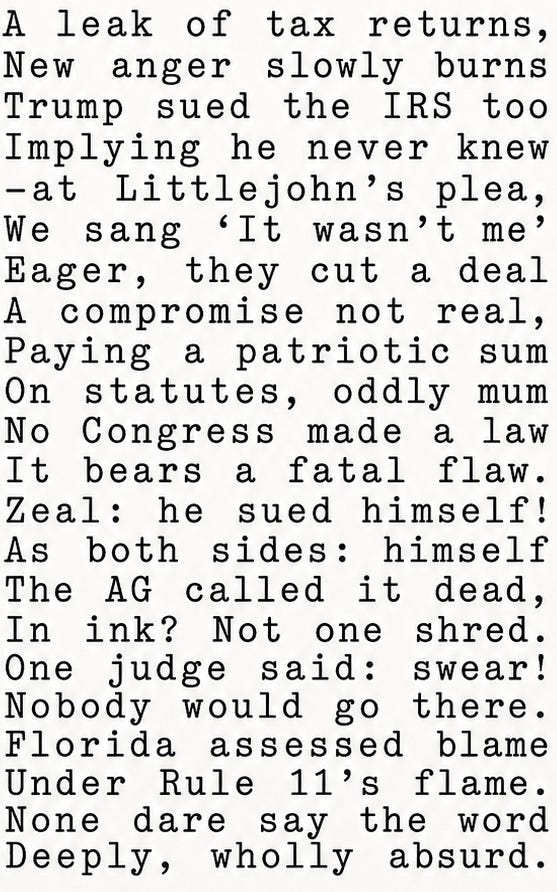
Fable notes: “Lines 13–14 rhyme ‘himself’ with ‘himself’—an identical rhyme, which is ordinarily a poetic sin, but here it’s the entire point: you cannot compromise with yourself, and the couplet shouldn’t be able to either.” Eh. Maybe Mythos would do better.
The claim also sought $100 million in punitive damages, but punitive damages aren’t available under the Federal Tort Claims Act.
The judgment fund analysis is simplified a lot. The statute is complicated.
They have some other theories too.
No posts
Comments
Nothing yet. Say the first thing.
Sign in to join the conversation.