
The crisis of global heating will take many forms and we may imagine it in different ways.
Hitherto, I tended to think in terms of dramatic scenarios. Hurricanes and storms bulked large in my imaginary.
This July in Paris, I felt something else, something quite different: the suffocating, blanketing, smothering, suppressing force of really high temperatures. Not the 50 degree plus that some places have suffered in the Middle East, but something that, nevertheless, felt unmanageable, like drying or cooking in your own skin, or both at the same time.

Extreme Temperatures Around The World@extremetemps
HARSHEST HEAT WAVE IN HISTORY 52c DAY/39c NIGHT World climatic history is being rewritten in Middle East 52C KUWAIT CITY all time record after a MIN. of 38C Crazy MIN 38.7C Delhoran IRAN 35.0 Makkah,SAUDI ARABIA (August record) Record also in The Sahel Min 29.5 Nguigmi,NIGER

3:42 PM · Aug 12, 2026 · 45K Views
174 Reposts · 494 Likes
The difference that struck me is that whereas my previous vision of the climate crisis had been dynamic - huge forces unleashed in roaring winds and irresistible storm surges - this experience of extreme heat was the opposite: immobility, silence and emptiness.
Under the “pressure” of the sun, no one and nothing moved. Or at least sane people didn’t. The impact on street life, footfall, small businesses in Paris was dramatic. It was like a heat-imposed COVID lockdown.
Are we ready for this? No we are not.
Casting around for interpretations, I found in Le Monde a grim interview with one of France’s leading experts on “building energy performance”. He described France’s housing stock - particularly the late 20th century additions that are well insulated but offer no ventilation - as death traps. They heat up and the heat has nowhere to go.
Apparently the slang term for such hot box apartments is, “whistling kettles”. Kettles with people inside them. A vision straight out of Hieronymus Bosch's visions of hell.

European insurers have long been in the forefront of trying to translate the cost of the climate crisis into manageable risks. But what El Nino has delivered this year goes far beyond anything that can sensibly be covered by individual insurance. In May this year, Allianz, the large Munich-based group, published a report that gave some measure of just how extreme the costs may turn out to be.
The economic transmission of heat stress is non-linear, with a critical threshold around 30°C beyond which productivity losses intensify sharply. Below this level, warming reduces heating costs and is associated with modest productivity gains. Above this level, the relationship reverses and both channels worsen with each additional degree. The dominant effect operates through labor: output per hour declines by approximately USD1.3 (constant PPP, ~3% of mean hourly output in our 2014-2024 sample) for every degree across the 30-35°C range. Wage adjustments follow productivity with a lag, so the short-run cost falls disproportionately on firm profitability before gradually transmitting to household income and consumption. A second, smaller channel runs through energy: consumption rises by around 1.2% per degree, raising firms’ input costs at exactly the temperatures where labor productivity is falling.
To gauge the macroeconomic stakes, we construct a stress scenario in which the five hottest years observed in each country between 2014 and 2024 are replayed in ascending order over 2026–2030 – the fifth-hottest year in 2026, the fourth in 2027 and so on, culminating in the country’s hottest year on record in 2030. Under this trajectory, cumulative implied GDP losses (2026 – 2030) could reach 5–7% for the most exposed economies: USD240bn for France, USD354bn for Japan, USD147bn for Italy, USD131bn for Germany and USD120bn for Spain. More consequentially for long-run growth, in such a scenario the decline in fixed capital formation systematically exceeds consumption losses, reaching 8% on average across affected countries: As heat compresses expected returns on capital, investment falls, reducing future productive capacity in a self-reinforcing drag. Moreover, stagflationary dynamics should be expected, with rising prices alongside rising unemployment, placing monetary authorities in a binding trade-off that is especially acute in the Eurozone, where a single policy rate must serve economies with sharply diverging climate exposures.
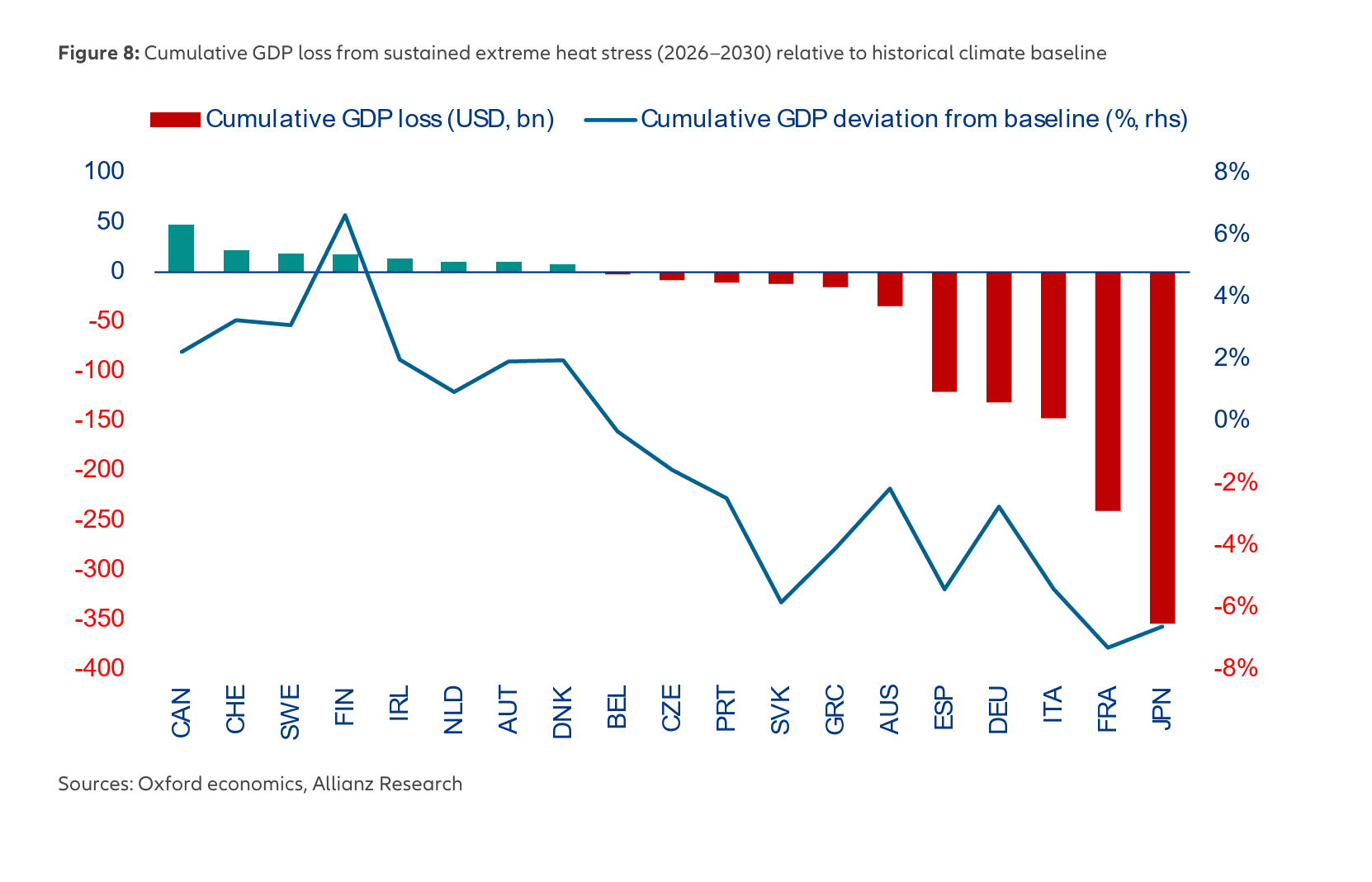
As good Europeans, the economists at Allianz then went on to spell out the fiscal burden.
The fiscal consequences fall most heavily on the economies least able to absorb them. The loss of economic output due to heat reduces tax revenues: Estimated annual losses would reach 1.8% in France, 1.3% in Italy and Spain and 0.7% in Germany – partly because progressive tax systems mean revenues tend to fall faster than output itself, amplifying the fiscal drag beyond the headline GDP loss. Simultaneously inflation-indexed transfers, healthcare costs and emergency infrastructure repair raises public expenditure. Fiscal balances deteriorate by around 0.5% of GDP annually on average. Italy and Spain risk breaching the Maastricht deficit ceiling (again) once heat-related pressures are incorporated. France, already carrying a projected deficit of −4.9% of GDP, faces additional heat-related pressure of 2.2%.
As Allianz sensibly remarks:
Insured losses remain a small fraction of total damages, reflecting a structural mismatch between what heat destroys and what conventional insurance was designed to cover.
Europe is going to need far more thorough-going adjustments requiring coordinated action on four fronts:
labor regulation,
buildings,
public finance
and households.
A workable occupational regime needs binding temperature thresholds, automatic work restrictions when those thresholds are crossed, paid compensation for lost hours and coverage that reaches fixed-term, seasonal and platform workers. No major European economy has all four, and the gap is concentrated on the last: protections were designed around standard contracts and leave the workers most exposed to heat largely outside the regime. Prevention itself is also underused, with shifted hours, partial mechanization and indoor cooling still rare. For buildings, four pieces have to fit together: overheating standards in new construction, mandatory passive cooling in renovation, cooling access for vulnerable households as a social entitlement and grid-adequacy planning that accounts for coincident summer cooling demand and the thermal derating of generators. The revised EU Energy Performance of Buildings Directive delivers the first; the gap is the other three, where indoor temperatures, mortality and peak electricity demand are actually held down. On fiscal architecture, every major European economy has a national adaptation strategy but almost none has translated it into a multi-year budget envelope, so the response defaults to ad-hoc emergency packages – and each episode quietly consumes the fiscal space that ex-ante adaptation would have used to lower the next. The missing layer is households. EU households hold almost EUR40trn in financial assets, including a very large stock of deposits, while much of Europe’s housing stock remains poorly adapted to hotter summers. Mobilizing even a small, well-targeted share – through incentives for retrofit, passive cooling and affordable parametric cover – could close part of the gap that public budgets alone cannot reach. But this is not a private-finance solution: the households most exposed are often not those with the greatest liquid savings, so public guarantees, subsidies and distributional safeguards are what turn household wealth into resilience rather than into inequality.
Of course that will not prevent private capital attempting to profit precisely from what cannot be properly insured. As the FT reports there are hedge funds rushing to mobilize money, betting that there are profits to be made from the unanticipated effects of this year’s El Nino.
Investment firm Moreton Capital Partners is raising money for a new fund with an unusual focus: profiting from the El Niño cycle of temperature changes in the Pacific Ocean. The hedge fund wants to exploit what it reckons is a failure by other investors to appreciate the market implications of the El Niño event that started in recent weeks and is expected to drive extreme weather events across multiple continents. But Moreton is far from alone in paying attention to this issue. Prices of commodities such as coffee and cocoa have been soaring in recent weeks as traders anticipate blows to harvests in Asia and Africa. Investment banks have been publishing primers for clients on how to navigate the market impacts, and the World Bank is warning that the event may push up international food prices.
El Niños are naturally recurring events, but this year it is “layered” on top of 1.4C of human-driven warming relative to the pre-industrial era and the disruption of global fertilizer flows due to the US-Israel war on Iran, with “with serious implications for crop output — notably in developing nations that are expected to suffer some of the worst impacts from El Niño.”
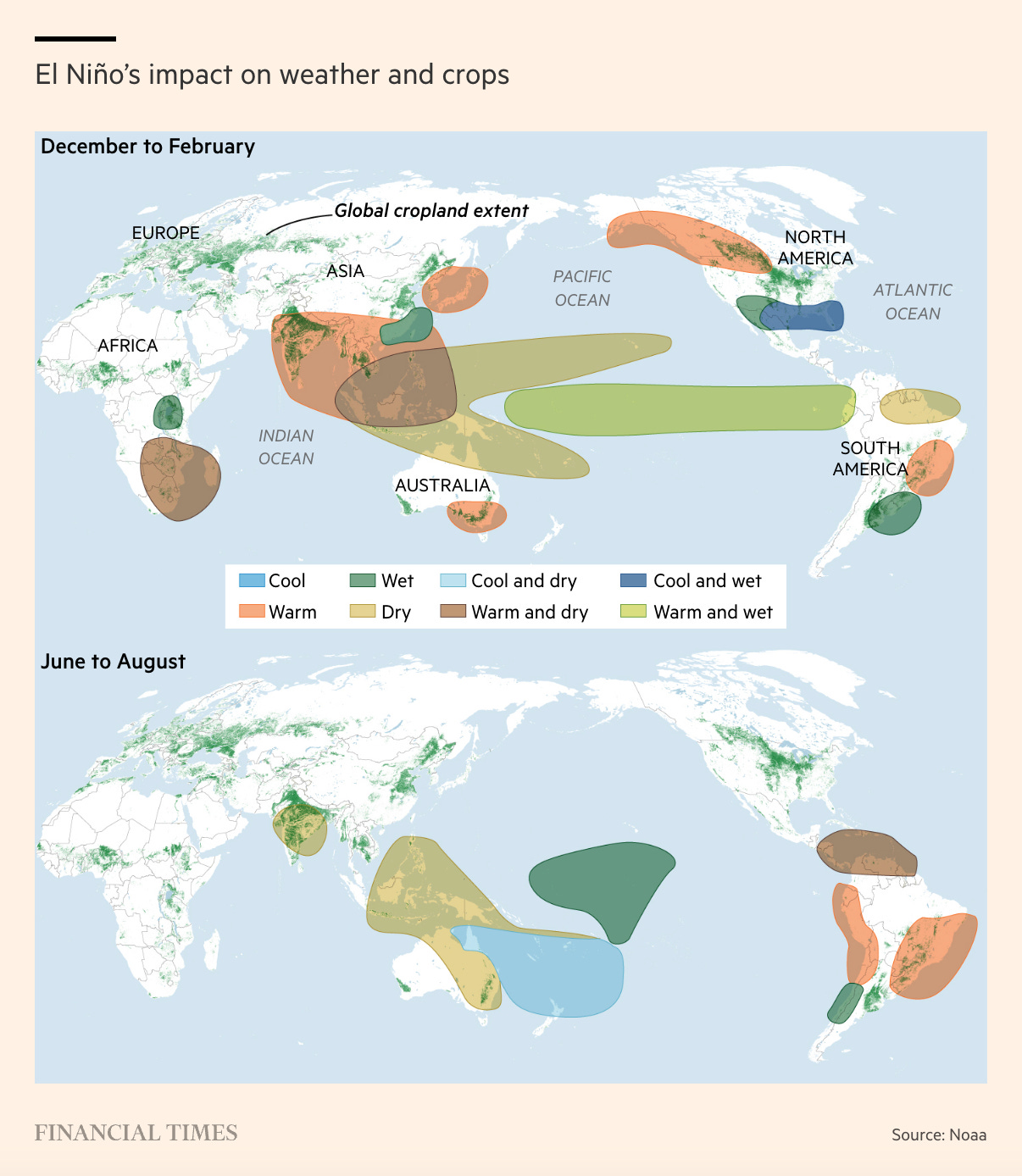
As west African cocoa producers face an elevated threat of drought, prices of the chocolate ingredient have risen 37 per cent since the start of June. Arabica coffee prices are up 26 per cent, as Brazilian producers anticipate a harvest reduced by excessive heat and volatile rainfall. Wheat production in Australia and rice output in India face serious threats from El Niño’s negative effects on rainfall, according to UN Food and Agriculture Organization chief economist Máximo Torero. Rainfall in India’s crucial monsoon season has so far been more than a tenth below the average level. A blow to Indian production may push up global sugar prices, reckon analysts at Morgan Stanley, while copper mining could be disrupted in Zambia by drought and in Chile, in contrast, by flooding. El Niño could also interfere with trade logistics — notably if drought in Central America reduces the depth of the Panama Canal, as has happened previously. Auction prices for slots to navigate the canal’s busiest lanes have jumped to record highs, the FT has reported, with factors including new restrictions on passage amid concerns about falling water levels.
How big will the impact be in global markets? The hedge funds must be betting they will be huge. The big banks think the drama may be overstated:
Morgan Stanley’s team reckons the impact on major global stock markets is likely to be limited, noting that El Niño has historically had little effect on indices such as the S&P 500. Recent analysis by Capital Economics, meanwhile, found no clear relationship between El Niño events and global food price inflation. Yet to focus only on these global statistics is to ignore the serious impacts that El Niño events can bring at the national and regional level.
As the FT points out, the most severe impact on agriculture and incomes is likely to be felt not in Europe, or the rich countries that were the focus of the Allianz study, but in the developing world.
Capital Economics warns that there’s a clear risk of significant food price rises in lower-income countries in south Asia and sub-Saharan Africa resulting from this year’s event. This event threatens to push at least 49 mn more people into food insecurity, the World Food Programme warned last week. And the economic impacts may be more serious and long-lasting than is commonly appreciated. A 2023 study in Science found that major El Niño episodes had a severe effect on growth rates in dozens of countries, with income losses persisting for years after each event.
The Science paper by Callahan and Mankin shows truly dramatic impacts from El Nino events across much of the “Global South”
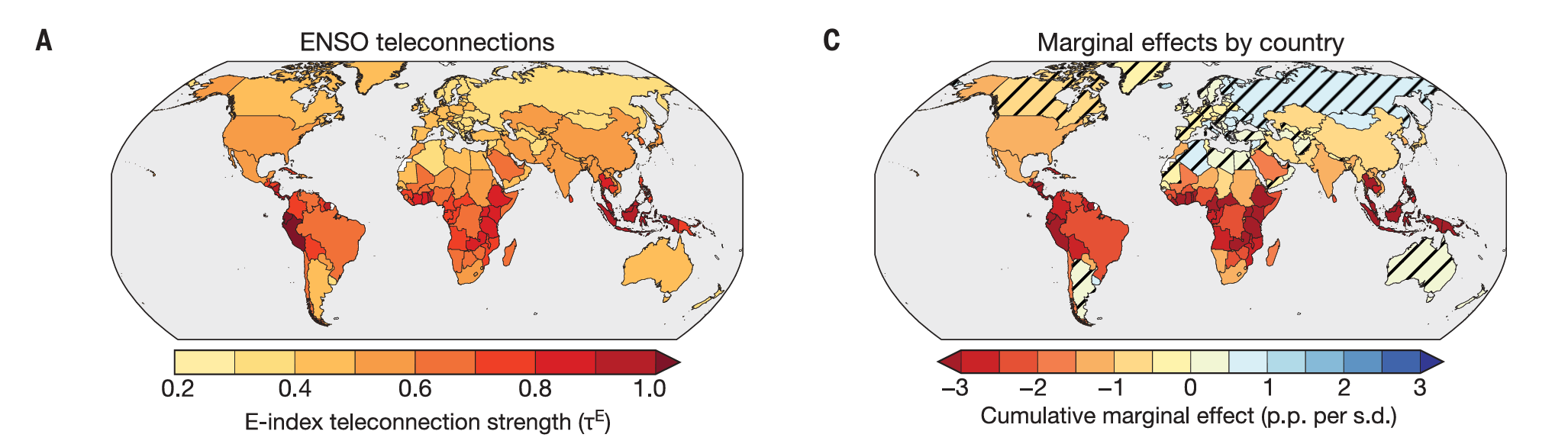
Consider strongly teleconnected (i.e. ocean current-climate affected) Peru (tE = 1.18): Its GDPpc declined in 1998 and stagnated for three more years (Fig. 2A). Given the 1997 financial crisis, Peru’s slower growth in 1998 is not entirely attributable to ENSO, but Peru’s economy would have grown more quickly had the 1997–98 El Niño not occurred (methods). Income for the average Peruvian would have been some $1,246 greater 5 years later in 2003 absent the event (CI: $853 to $1,793), a 19% increase (Fig. 2A). Other tropical countries such as Ecuador, Brazil, and Indonesia lost anywhere from 5% to 19% of GDPpc (fig. S11). We estimated global losses from the 1982–83 and 1997–98 events to be trillions of dollars each (Fig. 2B and fig. S11). Our estimates exceed previous ones because we accounted for ENSO’s growth effects: One study placed the total costs of the 1997–98 El Niño at $36 billion (35). Our accounting has losses from the1997–98 event rising to two orders of magnitude more than that estimate, some $5.7 trillion by 2003 (CI: $2.3 trillion to $9.2 trillion). The earlier 1982–83 event tallied $4.1 trillion by1988(CI: $2.3 trillion to $6 trillion). The greater costs of the 1997–98 event resulted both because it was a stronger ElNiño and because the global economy was larger. Absent the compensating benefits of the subsequent La Niñas, the Callahan et al., Science 380, 1064–1069 (2023) 1983(1998) event would have produced losses of $4.4 trillion ($8 trillion) .
As the FT laconically comments:
The heightened financial market interest in the El Niño phenomenon probably won’t be much help to those worst affected by it.
One feeedback loop that may bring this home, if not by way of the financial markets, is by way of migration. According to the analysis of the World Food Program, the most dramatic impact on food security from El Nino will be in Central America, the main source of migration pressure on the Southern borders of the USA:
Latin America and the Caribbean could see one of the sharpest rises in food insecurity with more than 16 million people affected. Particularly, Central America is projected to have the largest proportional increase (83.1%) of all analyzed areas.
East and Southern Africa face substantial risks, particularly where upcoming rainy seasons are critical for food production. More than 18 million people could see their food security deteriorate, representing a 26 percent increase. Southern African countries are particularly exposed because many households depend on rain-fed subsistence agriculture.
Asia and the Pacific could see significant impacts in several already vulnerable countries with an estimated 8.2 million additional people facing acute food insecurity.
West and Central Africa are also at risk with food insecurity projected to increase by 12 percent, affecting nearly 6 million additional people.
I love putting out Chartbook. I am particularly pleased that it goes out for free to thousands of subscribers around the world. But, writing this newsletter takes a lot of work. If you are enjoying it and would like to support the project, sign up for one of the subscription options here. It is the equivalent of a fancy cup of coffee per month!
No posts
Comments
Nothing yet. Say the first thing.
Sign in to join the conversation.