
Welcome back to 14th & Colorado. It’s hard to believe it’s February. January at the Texas Supreme Court was interesting. Today’s post focuses on two issues under the new rules of appellate procedure: whether the Court’s schedule will change and the importance of a strong introduction to your petition at the Texas Supreme Court.
Grants without a conference?
The ’25-26 Term argument calendar is set. The Court granted 65 cases for argument, with three consolidated cases in the March sitting (63 argument slots) (I’ve counted several times, but if I’ve made a mistake, let me know!).1 January ended a little light, with only four arguments. In early January, I posted on LinkedIn that February was also not filled. Typically, cases are granted on the Friday orders after conference. But the January 27 conference was too close to the February argument sitting for the Court to grant cases. It seemed as if the Court may leave February unfilled, as well.
In a surprising twist, the Court granted five cases on the January 16 orders list for the February and March sittings. Lawyers I’ve spoken with wondered whether it was a scheduling issue—the cases had been voted out of conference in December, but the Court had yet to schedule the argument dates. That seems unlikely. The ordinary course for that situation is for the Court to list the grant after conference and note that oral argument will be scheduled at a later date:

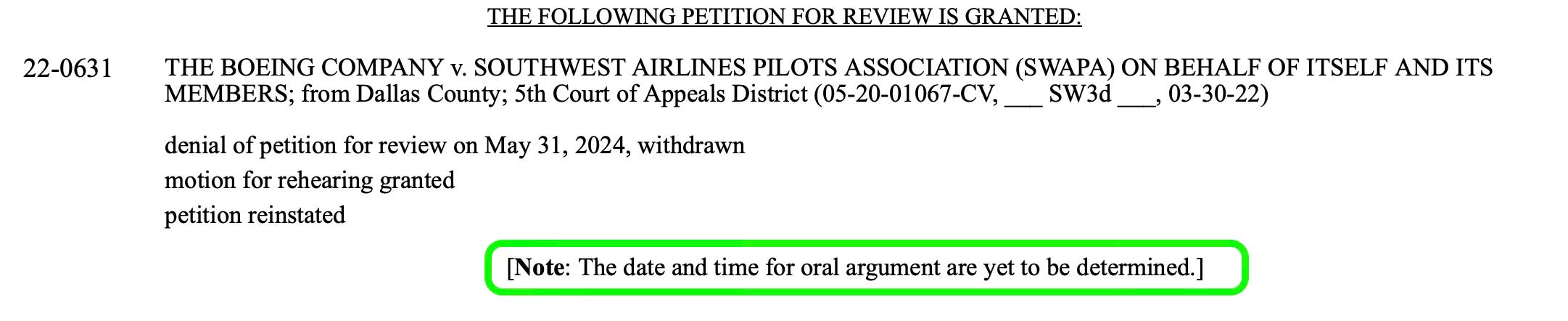
Here the Justices granted and scheduled argument without a conference.
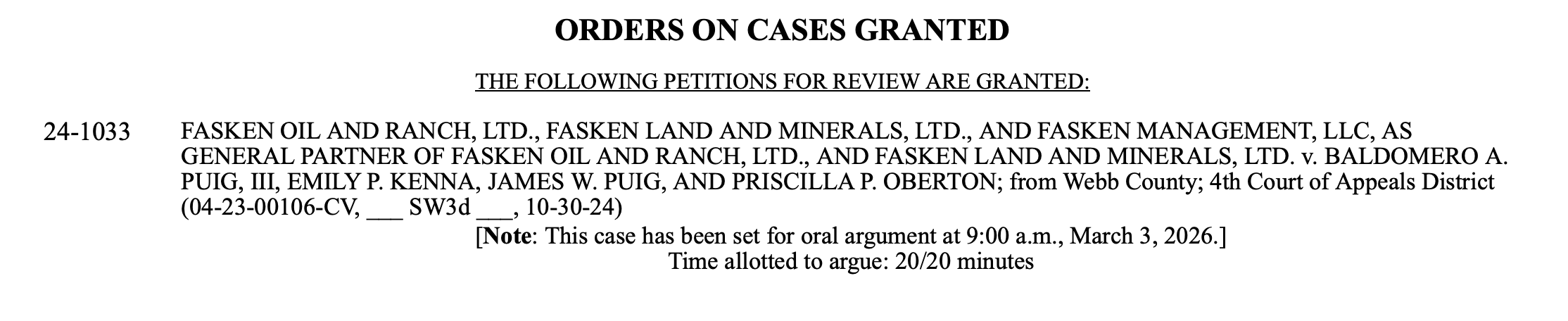
This sticks out to me because the new petition process may require adjustments to the Court’s schedule that could require granting cases at some time other than a conference or increasing the number of conferences.
Until close to the end of the term, the Texas Supreme Court has only one conference per month. In contrast, the U.S. Supreme Court has two to three conferences per month—around the beginning, middle, and end of the month. Presumably, part of the reason for that Court’s frequent conferences is the number of petitions it has to get through compared to the number at SCOTX (~8,000 vs. ~1400). Petitions also typically go through multiple conferences at SCOTUS before they’re granted. Indeed, John Elwood’s widely read “Relist Watch” chronicles relisted cases as a way of forecasting potential grants. But having multiple conferences is also helpful when briefs are written in the time between the Court’s order granting the petition and oral argument.
Under the prior rules, the Court was limited in when it could schedule an oral argument only by courtesy—the court typically gave advocates 3-4 weeks notice to prepare for the argument. But with briefs coming after grants now, a conference at the beginning of a month can provide two or three extra weeks in the briefing schedule. While, the Texas Supreme Court briefing schedule is 75 days, in contrast to SCOTUS’s 105 days, it tends to receive and grant lengthier extensions. Extensions at SCOTUS are often for an extra week or two. In contrast, SCOTX often grants 30 day extensions. And the new guidance suggests the Court will try to give one full extension per brief, unless doing so would put the due date for a reply brief within two weeks of argument. More frequent conferences will allow the Court to schedule more cases during the same term they are granted.
A related consideration is when arguments are heard in the term. SCOTUS hears argument much later in its term. It will hear cases as late as late-April this term. In contrast, the last sitting this year at SCOTX is the first week of March.
Under the current schedule and the new rules, the November conference is the latest the Court could grant a case for argument in the same term.
The Court could adjust its conference schedule, argument schedule, or both. I’d expect the Court is more likely to add conferences or add some form of “petition conference” (or maybe grant without conference was we saw on January 16), than add late arguments sittings. But, absent a change, we could see a significant shift in the conferences producing the most grants. Historically, December produced a number of grants. That is likely, in part, because December was a key conference for filling out its Winter/Spring argument sittings. Under the new rules, I’d expect that will drop off some as the Court feels less pressure to grant cases in December that would not be argued until the next term.
Thanks for reading 14th & Colorado! Subscribe for free to receive new posts and support my work.
In defense of the new “Introduction”
Look…if you had…one shot…or one opportunity…
To seize everything you ever wanted…in one moment…
Would you capture it or just let it slip? - Eminem, Lose Yourself
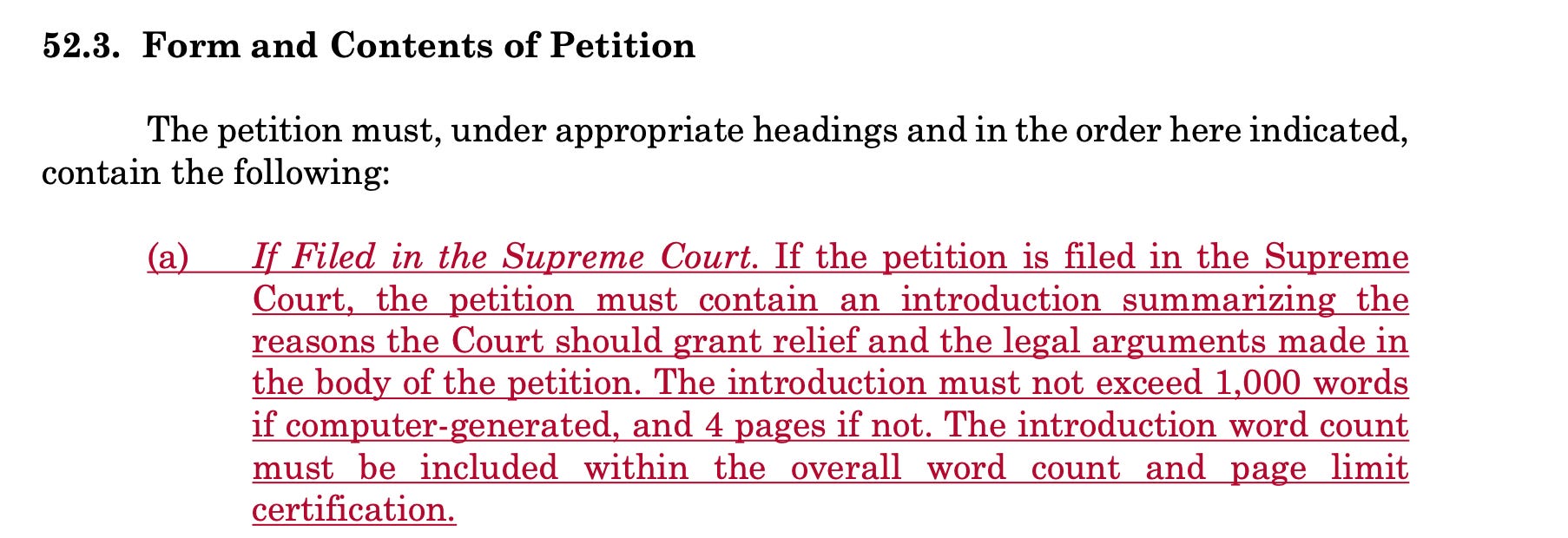
We’re just six weeks into the new petition process. The pages of Texas Lawbook, Law360, LinkedIn, and elsewhere have been abuzz with commentary on the new process. Recently, I came across an article on “AI and the Limits of the New ‘Introduction’ Rule in Petitions for Review.” According to the author, “[t]he main benefit of a required introduction is to give the court a quick overview of the case and the reasons review is warranted. The need for such a summary is great if the only other way to get that overview is to scour the many pages of argument that follow.” But that is, purportedly, not the case anymore because AI can also generate summaries of a brief. The article, which assumes AI’s use at the Court, suggests that “[i]n a world shaped by generative AI and search-driven reading habits, the traditional importance of the appellate introduction is already fading.” Thus, according to the author, the “perceived benefit [of the new introduction] may be illusory.” The author therefore cautions spending too much time on the introduction or placing too great an emphasis on it. Introductions “still require skill to write well, and they still provide benefit as a summary and overview. But the introduction bears far less load than it once did. . . .” I strongly disagree.
First, I think this article overstates the use of AI at and by the Court by either the mostly Gen-X Justices or even the mostly Gen-Z law clerks. And, in reality, there is no need to rely on AI-generated summaries. A good table of contents provides a similar overview to what AI is likely to spit out. But, more importantly, the Justices read so many petitions that they develop a feel for them. And they can get through a petition quickly. Then-Chief Justice Hecht once remarked that in reviewing a petition, “the judge can look at it in 90 seconds and realize that there is not a chance in the world that anybody on this Court is going to be interested in granting this case.” Other Justices say they spend a maximum of 15 minutes per petition package, which includes reviewing the petition, the court of appeals’ opinion, the response (if any), a reply brief in support of the petition (if any), and any amicus submissions. From my own experience, you can get a feel for a petition fairly quickly by looking at a handful of pages (e.g., table of contents, issues presented, introduction/reasons to grant review) and get a good sense of whether the petition merits further attention. So uploading the petition to AI, getting a summary, and doing some minimal amount of work to assess the accuracy of that summary takes close to as long as just doing the work.
Second, and more importantly, I think this vastly overstates the Justices’ willingness to shirk their obligation to review every petition, given their promise to the bar. One of the big selling points of the 1997 changes to the Rules was ensuring that the Justices reviewed every petition, rather than rely on memos from their law clerks. The 2026 changes make it even easier for the Court to meet its obligation to the bar. As I mentioned in a prior post, Justice Young has been a big proponent of the “elevator pitch” introduction. In his view, reading that elevator pitch satisfies the Justices’ obligation to “read every petition.”
If you cannot persuade a justice of the Supreme Court with that type of an invitation to turn the next page, the petition should be denied. I think that would discharge the court’s promise to the bar.
Perhaps that is the reason for putting the introduction before even the identity of parties and counsel. It would be surprising if the Justices felt comfortable just uploading the petition to AI and relying on its output in deciding whether to read further. And, if the Justices felt a continued obligation to read every petition, they’d have to read the intro or the rest of the petition (if they rely on AI-generated summaries in place of the intro) anyway. Thus, the author’s contention that “the introduction is no longer the controlling feature of a legal brief” misses that it may be the only portion of the brief a Justice is willing to guarantee they will read.
Given this reality, it strikes me that there is little risk in abiding in the wise words of Marshall Mathers (Eminem) and seizing your one shot, one opportunity, to get everything (your client) wants. So spend the time on the intro. Hone it into something that will entice the Justices to see it your way on “grantworthiness” and maybe even convince them you’re right.2 True, there are tradeoffs given finite time. You don’t want to spend so much time that the rest of your brief suffers. But that seems little chance from someone conscientious enough to read these pages or the author’s article.
Until next time…
Thanks for reading 14th & Colorado! This post is public so feel free to share it.
The petition for writ of mandamus in, 25-0098, In re Michael Searcy has been abated under TRAP 7.2(b) because the judge and associate judge retired. The rules provide for abatement for the newly appointed judge to consider the discovery dispute and decide whether to adopt the challenged order.
The revised and implemented rule for introductions no longer requires the “why I’m right” piece, presumably in response to Andrew Gould’s letter flagging that such a requirement created some redundancy with the “Summary of Argument.” But I’m not convinced that completely abandoning that piece in the introduction is right for the same reason that the introduction is the only piece the Justices may be guaranteed to read. Surely it’s not something that should be too long—you have limited words—but skipping it altogether may be risky.
Comments
Nothing yet. Say the first thing.
Sign in to join the conversation.