
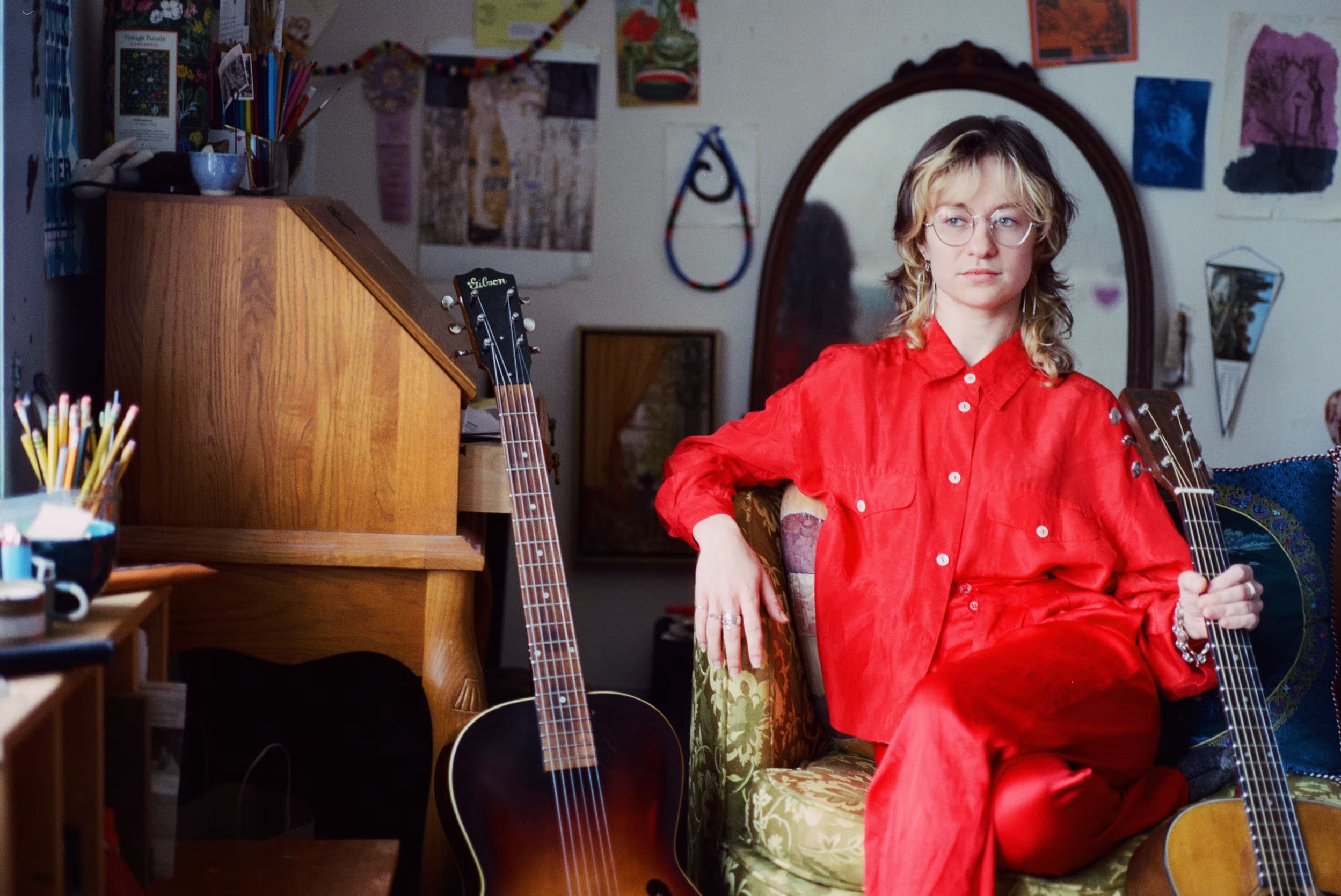
Earlier this month, Acoustic Guitar hosted a live Patreon workshop by a musician whose name was unfamiliar to me: the guitarist, fiddler, singer, and percussive dancer Sophie Wellington. In the session (the replay is available to supporters here), Wellington demonstrated how ideas from old-time fiddle playing can be applied to the flat-picked guitar, and I was struck not only by the originality of their approach but the clarity with which they explained it.
But I was even more impressed when I listened to Wellington’s latest album, Her Bright Smile Haunts Me Still, co-produced by Grammy Award winner and Acoustic Guitar contributor Cathy Fink. The sensitivity and rhythmic verve of Wellington’s guitar playing are immediately apparent, but the album also reveals an unusually broad musical imagination. In their hands, traditional fiddle tunes and ballads take on new dimensions through subtle reharmonizations, while their percussive dancing adds rhythmic complexity and timbral color. But most of all, the performances convey the sense that Wellington has lived with these tunes for years. Rather than sounding like a collection of influences, the music feels unified and unmistakably their own.
Raised in Staunton, Virginia, by parents who were in both the classical and old-time music worlds, Wellington grew up immersed in a community where music and dance were inseparable. After studying vocal jazz and American Roots Music at the Berklee College of Music, they developed an approach that draws organically from both traditions, drawing on jazz harmony and improvisation while remaining deeply rooted in the melodic language and forms of fiddle tunes and traditional ballads.
I reached out to Wellington to learn more about the album and their approach to music. We talked about growing up in Virginia, the intersection of jazz and old-time music, how percussive dance has shaped their guitar playing, working with Cathy Fink in the studio, and why community is at the heart of everything they do. Following the conversation, you’ll also find my transcription of their beautiful arrangement of the traditional fiddle tune “Scolding Wife,” the album’s opening track.
You grew up in Virginia with a concert pianist for a mother and an old-time musician, dance caller, and children’s musician for a father. I’m curious to have you talk about that musical upbringing and what each of your parents gave you, coming from such different traditions.
They both have incredible ears, and they’re both very good at connecting with other people through music as a community thing. My mom also plays Irish fiddle and old-time fiddle—that’s how they met—but her profession is classical music.
I feel like when you grow up in a community like that, it’s a real privilege to get to know people through your parents and their existing friendships and connections. It’s been special to feel more connected to myself and my parents through our shared community, which I think sets this kind of music apart from a lot of other spaces.
Having parents with such different skill sets and professions also allowed me to see them as independent musicians and creative people. I never had an illusion of a family band or anything like that. They’ve been hustling their own stuff for a long time, and they met later in life.
I used to be much more involved in what they were doing. I kind of steered onto my own path once I started doing more jazz and went to Berklee for jazz singing. That’s a different path than they took. Before that, I sang in the baroque performance academy my mom runs and directs, I did more school shows with my dad, and I was more involved in contra dancing.
What they’ve allowed me to experience is that there are great ways to connect with community through music and dance, and there are a lot of different ways to do that with regard to genre, space, reach, and cultural differences.
Comments
Nothing yet. Say the first thing.
Sign in to join the conversation.