
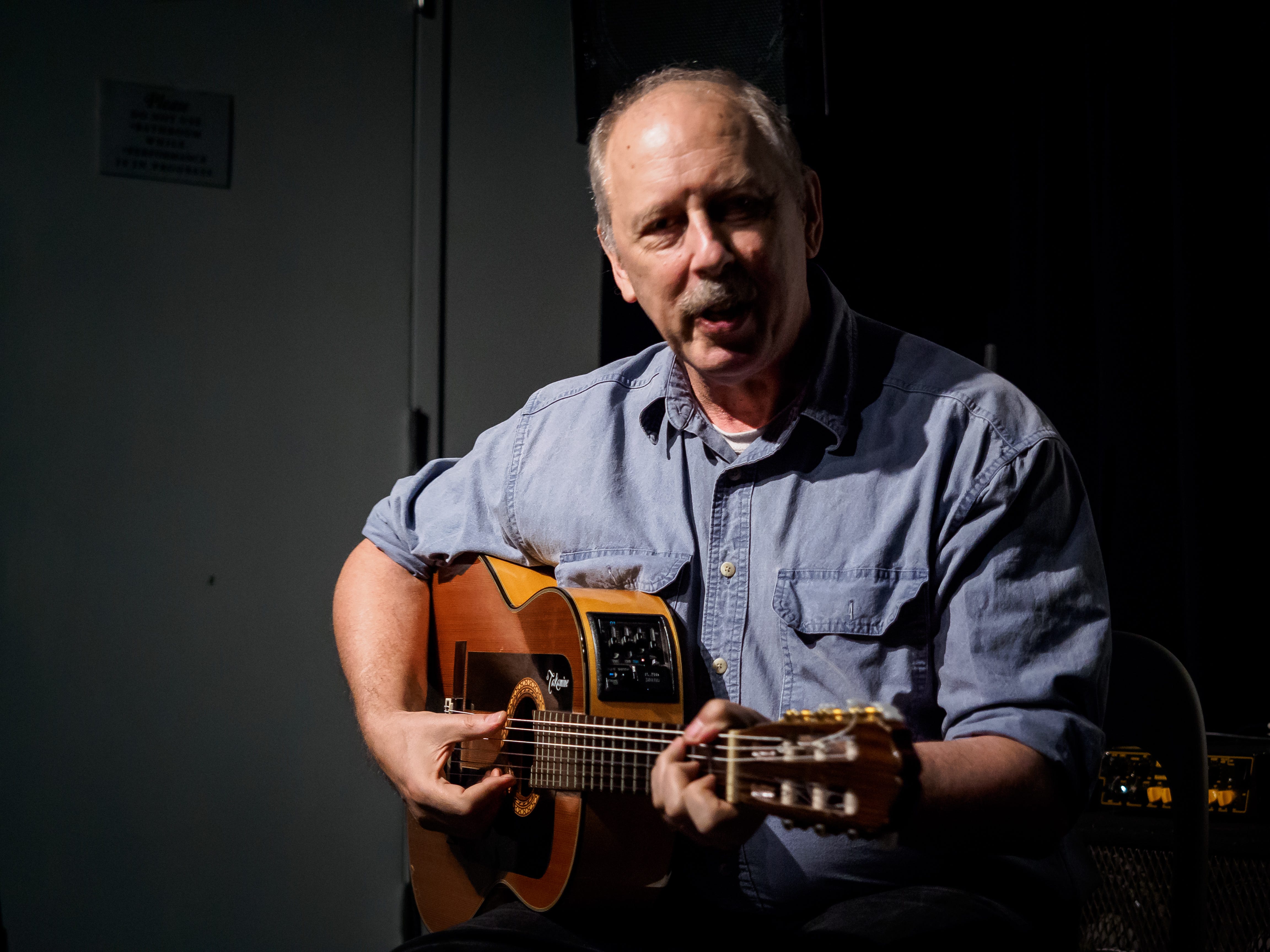
Of all the fingerstyle guitarists to emerge over the last five decades, few have followed a path as wide-ranging as Richard “Duck” Baker. Equally at home with old-time music, ragtime, swing, Irish traditional music, modern jazz, and free improvisation, Baker has spent much of his career pursuing whatever music happened to catch his ear—and then figuring out how to make it work on the guitar.
After immersing himself in blues and folk music, along with ragtime, early jazz, and other largely neglected American styles during his formative years in Richmond, Virginia, Baker moved to San Francisco in the early 1970s. There he played bluegrass, learned swing from older musicians on the traditional jazz scene, and absorbed ideas that would shape his approach for decades to come. At the same time, he began arranging some of that repertoire for solo guitar, continually revisiting and reimagining it over the years, while also composing original pieces, of which there are now hundreds.
Baker’s curiosity led him in many directions—from the New York improvising scene, where he worked with musicians such as Eugene Chadbourne and John Zorn, to the United Kingdom, where he immersed himself in Irish and other traditional music. Along the way he recorded more than three dozen albums as a leader, along with 11 duo recordings, and documented many of his ideas in books and instructional videos.
Among the highlights of that discography are his debut, There’s Something for Everyone in America (1976), a collection of old-time tunes and arrangements accompanied by a tablature book; Kid on the Mountain (1980), a pioneering album that appears to have been the first solo-guitar recording devoted entirely to Celtic music by a single artist; and two personal favorites, Spinning Song (1996), devoted to the compositions of the brilliant and underappreciated jazz pianist Herbie Nichols, and Duck Baker Plays Monk (2017), a deeply personal exploration of the music of Thelonious Monk.
When my friend Teja Gerken, a former editor of Acoustic Guitar magazine, recently mentioned that Baker was retiring and suggested I feature him on this Substack, I realized we had somehow never spoken. That seemed worth correcting. In the conversation that follows, edited and condensed for clarity, Baker reflects on a long career spent following musical interests wherever they happened to lead, and on a life that, while never especially lucrative, has been rich in music, friendships, and experience.
Coming of age in Richmond, Virginia, what was your path into music and fingerpicking?
Well, I came out of the folk scene and playing in rock bands and electric blues bands when I was a teenager. The musician who probably influenced me most wasn’t a guitarist at all. He was a ragtime piano player named Buck Evans.
This would’ve been around 1965 or ’66, and nobody was paying much attention to ragtime then. The big revival hadn’t happened yet. It wasn’t until Joshua Rifkin’s records started coming out around 1970 that everybody suddenly got interested in Scott Joplin. Buck was way ahead of that. He got me listening to ragtime and early jazz and reading about it. Jelly Roll Morton and all that sort of thing. He opened up a whole world for me.
When I first got interested in fingerpicking, I learned from other kids hanging around coffeehouses. One of them, Larry McCullough, was a really good acoustic blues player and showed me a lot of things I wouldn’t have figured out on my own. Beyond that, I was mostly self-taught. I was playing guitar six hours a day and trying to figure out how things worked.
One thing that probably made me a little different was that I never thought I was supposed to sound exactly like other people. There was a Willie Brown piece called “Mississippi Blues” that a lot of players tried to reproduce note-for-note from the recording. I never really saw any reason to do that. I just thought of it as a piece of music. If I wanted to change a phrase or alter something, I did.
Now, I don’t mean to suggest that’s the only way to approach things. There are lots of great musicians who came through more formal study. Somebody like Ralph Towner. Somebody like Julian Lage. Nobody could complain about the results they’ve gotten. But I came straight out of fingerpicking and folk music that had been defined by older blues players, as well as people like Dave Van Ronk and, to a large extent, Merle Travis.
One thing that never made much sense to me was the idea that if you wanted to become a better musician, you were supposed to go study classical music. A lot of people felt that way, but it wasn’t really my path. I was trying to expand the folk approach I already had. I started learning swing chord changes and making fingerstyle arrangements of tunes I had been playing in a duo setting.
People like Charlie Byrd were important to me because they seemed to point toward another possibility. Charlie’s father ran a little country store where local musicians—including Black musicians from the area—would gather and play on the porch, and Charlie knew Joe Maphis when they were boys. He came out of a musical world that made sense to me.
Once I started playing swing, I thought, well, I’m supposed to be improvising solos. So I began trying to improvise while keeping the bass going. That’s really what I’ve always been trying to do. For more modern jazz, somebody like Thelonious Monk or Herbie Nichols, it often works better if the bass moves in half notes instead of an alternating-bass pattern. As long as you’re playing that alternating bass, it tends to sound like swing or ragtime.
That’s why the idea that I should go study classical guitar or work with a jazz teacher never made much sense to me. Obviously there are great musicians who took that route—Julian Lage would be an example—but it wasn’t how I got there.
Comments
Nothing yet. Say the first thing.
Sign in to join the conversation.