
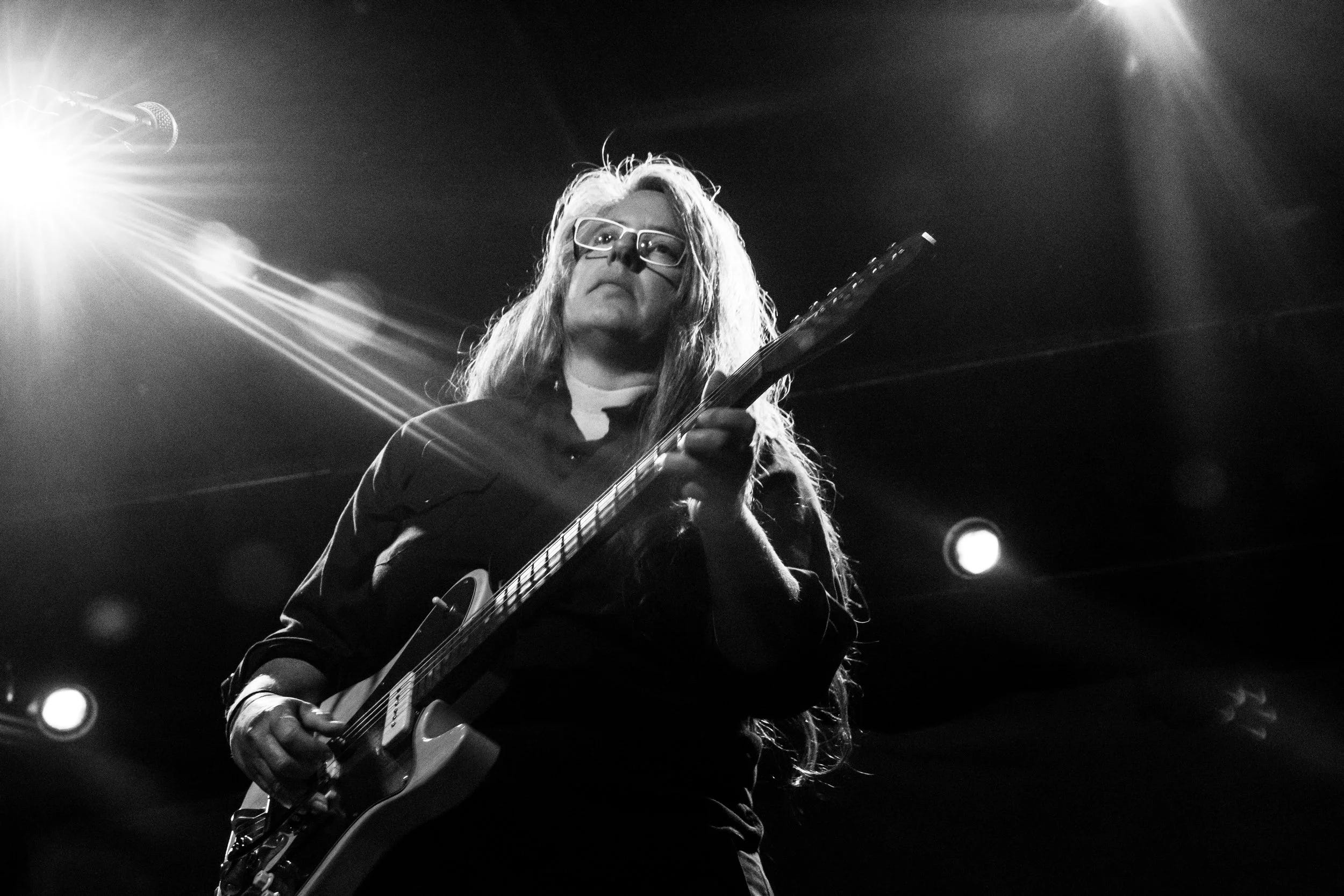
Harry Smith’s 1952 collection Anthology of American Folk Music introduced generations of listeners to the richness and oddity of American traditional music. Less familiar is Smith’s personal record collection, which extended far beyond the United States to include recordings from across Asia, Africa, the Middle East, and elsewhere. During a visit to the Bob Dylan Center in Tulsa in 2022, guitarist Marisa Anderson encountered those records and found the starting point for her latest album, The Anthology of UnAmerican Folk Music.
Based in Portland, Oregon, Anderson has spent much of her career moving between acoustic and electric guitar, standard and open tunings, fingerstyle and slide, while drawing on folk, country, blues, classical music, free improvisation, and musical traditions from around the world. Rather than treating tradition as something to preserve intact, she approaches it as a conversation—listening deeply, absorbing what she hears, and responding in her own musical voice.
For the album, Anderson immersed herself in recordings from regions shaped by American wars and foreign policy during her lifetime. She listened, transcribed, read, experimented, and gradually transformed those source recordings into nine original performances that carry traces of their origins while remaining unmistakably her own.
I recently caught up with Anderson over Zoom to discuss the project, from the experiences that repeatedly reshaped her relationship with the guitar to the listening, research, transcription, and experimentation behind the album. She also breaks down her arrangement of “Sarvi Simin,” transcribed at the end of this piece, discussing the rhythmic feel, right-hand approach, and sympathetic resonances that shape her performance.
You’ve previously mentioned that you learned the guitar three different times in your life—first through classical music, then through folk and improvisation, and finally by leaving standard tuning behind. What did each of those stages contribute to your playing?
Technique, really—a focus on technique. Along with that came learning when to use correct technique and when to discard it. There are times when what’s called for is to play outside of technique, but there are reasons technique exists, both for the health of your body and for the economy and efficiency of understanding the fretboard, how to move around it, and right-hand technique. Just hours and hours of practicing arpeggios—there’s nothing that will ever compare. It’s like being an athlete.
From the classical world, I also learned how to practice, how to focus, and how to run a passage over and over again, from slow to fast until it feels ready. That probably covers the first eight or ten years of my playing.
The second stage was learning how to improvise within the context of a song. How do you take a break in the middle of a tune? How do you build a solo? I also learned how to syncopate—to play blues, country blues, ragtime, and music that requires more feel than can be read from a page. There’s a thing with classical players where you get good at the notes and can read off the page, but if the page is taken away, you don’t know what to do. So that second learning of the guitar was learning to play without the page in front of me and learning to use my ears to give me information my eyes can’t.
What I left behind from that period was standard tuning. I moved into playing almost entirely in tunings based around open D: D–A–D–F♯–A–D, D–A–D–F–A–D, and even D–G–D–F♯–A–D on one piece from the new record, which is quite an odd one. I’ll also use a hybrid like E–A–D–F♯–A–D, so I get the bass notes from standard tuning but the sustain and ringing open strings of an open tuning.
Open D is my home tuning, though I’ll move it up or down a half or whole step and build arrangements around it. That really came out of exploring how to play as fully as possible as a soloist. There are plenty of people in standard tuning who sound incredibly full. If I think of the flamenco tradition, it’s about as full as a guitar can possibly sound. But what drew me was dissonance, sustain, and the ability to bend a fretted note against an open string to create something a little deeper than just dissonance. Dynamically, that was really attractive to me.
I also really focus on playing songs, not tunings. When I’m playing in open D, I’m not thinking about the tuning. I’m thinking about the song. “Sarvi Simin,” for example, is in a minor mode, but I don’t change the tuning. It’s the same challenge anyone faces in standard tuning: How do you make this song work? You have to understand the music and make a pathway through it. I focus on playing songs, not tunings.
Comments
Nothing yet. Say the first thing.
Sign in to join the conversation.