

Last week: the thing I lost in a win. This week: the thing I did to someone else while I was losing it.
Under the amphitheater, I was rewriting his deck.
The office was one of those Santa Monica places — open plan, floor-to-ceiling windows, ocean light coming in from the side.
A wide amphitheater-stair built into the middle of it for all-hands. Google-style. People sat on the treads themselves.
The AV nook was tucked beneath the stair structure above us, in the shadow.
Matt was at his laptop. His direct manager on one side. Me on the other.
He was supposed to be practicing the clicker.
We were not letting him.
Get rid of this.
Don’t say that.
Why did this change.
He had practiced. He had the what’s in it for me worked out. He had a few slides that took effort to understand — but he knew them.
He was two years out of college.
Above us, the treads were filling up.
I could hear the company taking their seats on the structure directly over our heads. Footsteps. Bodies settling onto step-edges. The muffled rise of voices.
They were sitting on the ceiling of the room we were standing in.
And I was telling a 24-year-old to cut the slide he had rehearsed to cut last.
I was alone in the middle of it. The CFO was gone. The sponsor was gone. Every direction pulled on me and none of them pulled with me, and the deck in front of me had five minutes left on it.
The script I have run my whole career runs hardest in a room like that one: if you want it done right, you do it yourself. It does not feel like arrogance from the inside. It feels like being the adult in the room. Each cut felt like a small rescue. One less thing that was going to embarrass us out there.
His smile firmed into stoic posture.
He held it longer than I would have thought.
Then his face changed. The smile was gone. He said something like you’ve changed the entire presentation and I’m about to get up there with something I didn’t practice.
I felt my body animating itself for me.
The hum a body makes when it has been left holding something no one above it will carry, and it knows.
When we ran out of time, we walked out from under the amphitheater. Matt took his position at the bottom of the tread-seating, in front of the screen. His manager and I slipped into the front row to the side, close enough to see his face.
And the people we had been hiding from became the people we were sitting with.
I’ve had seven years to figure out what I was doing down there in the nook.
I only found the words this week.
The project was a multi-million-dollar enterprise rollout. New systems. New processes. A whole new way of doing things.
I had been handed it years earlier, when the CFO who championed it was still in the building.
By the time we got to go-live, that CFO was gone.
The executive sponsorship had walked out with him.
The vendor we had selected couldn’t deliver what they had sold us.
And I was the name attached to the project at every level where a name could be attached.
I had responsibility I didn’t actually control.
That sentence is the whole thing.
I think some version of it is true for you too.
Responsibility you don’t actually control. It is the room that thins good people faster than anything I know.
It’s what’s happening to the middle manager who can’t get the VP to make a call.
It’s what’s happening to the pastor holding a congregation through a split she didn’t cause.
What it does — this kind of room — is it takes your best motive and turns it into a claw.
My best motive had been there for years.
I cared about the work landing well. I believed — maybe more than I should — that creating value was what I was for.
The late nights were real. The vendor fights were real. The heroic effort was real.
I was not faking my way through that project. I was pouring myself into it.
And here is the thing I have only been able to admit this week:
I need to provide value out of fear that I am not valuable.
The drive and the fear are not two things.
They are one movement wearing different clothes.
When value-creation is working, the fear stays quiet underneath the production, and all you see is a person who is very good at making things land.
When value-creation gets foreclosed — when the room makes it impossible — the fear comes up.
And the fear doesn’t announce itself. It expresses itself through whatever tools you have. In my case, the tools were competence, sharpness, editorial rigor. The capacity to see what was weak in a deck and say so.
Those tools had built my career.
They were the architecture of the value I had spent twenty years providing.
When the project could no longer be saved, the fear reached for those same tools.
And the tools became claws.
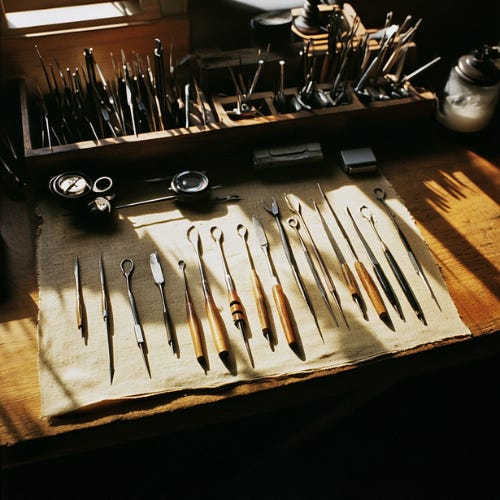
I have been trying for seven years to find the right word for what I was in those last five minutes under the amphitheater.
I have tried pathetic.
I have tried weak.
I have tried tired.
None of them are right.
The image that finally landed is this one:
I was a cat thrown into a swimming pool, scratching the eyes of even those trying to save me.
A cat in a pool is not cruel.
A cat in a pool is in pure terror, running the only survival algorithm its nervous system has — claw at anything that touches you, because anything touching you might be the thing drowning you, and there is no time to tell friend from threat when you are inside the drowning.
The cat doesn’t know it is scratching the eyes of the person trying to save it
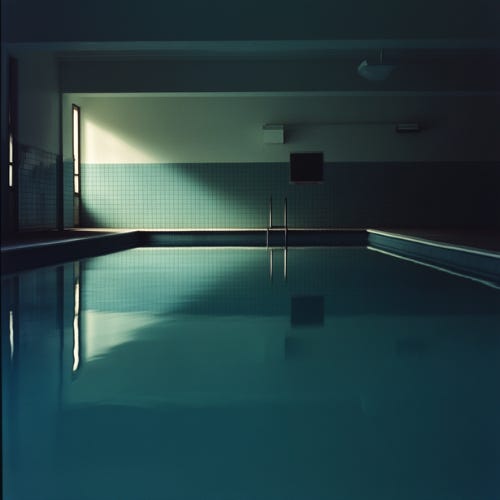
The scratching is the shape terror takes when terror has claws and is surrounded by water.
Matt was not just a young teammate I was harsh with.
Matt was the last person in that building who was still on my side.
The executives had left. The sponsor had left. The vendor was adversarial.
Matt was the one person still showing up. Practicing his deck. Willing to stand at the bottom of the amphitheater and present a rollout no one wanted. Holding the reputational risk of being the face of it.
Because he trusted me.
He was the last hand reaching into the pool.
And I scratched his eyes.
Then I slipped out from under the stairs, took a seat in the front row, and watched him deliver the deck I had just thinned.
I could see his face.
A year later, I had to read him a script.
COVID had hit. The company was doing layoffs.
Not the kind where leadership sits down with an org chart and asks what the core business is and who needs to support it. The kind where HR hands down a quota. A number. We need this many. And the number gets pushed down through management layers until it lands on someone’s desk as a list of names.
I was the someone. Matt was on the list.
I did not choose him. I was not asked whether he should be on the list.
I was handed the list, handed a script, handed a presentation deck to read from, and told to deliver it to the people whose names appeared on it.
Matt was still inside my operating structure. I had not been close to him since the rehearsal.
Something had changed between us that neither of us named.
I read the script.
He was gracious. He was fine. He thanked me.
I felt my throat tighten.
The first time, the room had me drowning.
The second time, it had me reading from a script someone else had written.
The body knew both times. Both times the room used me anyway.
The fear didn’t go away when the project ended. It just stopped clawing and started closing doors.
For seven years, the memory of what I did in that nook was a door in my house I walked past every day without turning the knob.
It wasn’t that I had forgotten.
My body knew exactly where the door was. I could feel its shape the way you feel a room with a closed door — you always know which door it is, you just don’t turn the knob.
Turning it would mean looking at what I did to him.
Looking at what I did to him would mean confronting what it might mean about me.
And I had one word for what it might mean. Pathetic.
The word was unbearable enough that I preferred walking past the door forever to turning the knob even once.
So I walked past.
Every day, for seven years.
I am writing this on a Saturday afternoon in April.
Yesterday, I sat down to think out loud with someone who kept asking me questions about what happened under the amphitheater.
I had not talked about it in that much detail in a long time. Ever, actually.
Somewhere in the questions, I stopped walking past the door. I didn’t open it all the way. I just stopped walking. I stood in front of it and let someone ask me what was behind it.
And while I was standing there — while I was letting myself look — something in my chest began to loosen.
It felt physical. Specific. Like a thing that had been lodged in the wrong place was starting to move.
When I told my wife about it later that day, the word I used was hairball.
A matted thing that had been sitting where it shouldn’t have been sitting, for seven years, quietly blocking what was trying to move through. And while I was standing in front of the door letting someone ask me questions, the hairball began to come loose.
And here is where the strange thing happened.
While the hairball was still loosening — while I was still mid-sentence, still inside the looking — my hand opened LinkedIn.
I did not decide to.
I was not aware I was going to.
I typed his name. I found him. We were not connected. I sent the request.
And only afterward — after the request was already gone — did the rest of me catch up to what my body had just done.
The part of me that catches up said:
oh.
If he doesn’t accept, you are going to have to sit with the fact that the person you scratched has looked at your request and chosen not to reconnect with you.
You are going to have to confront the scratches as a present-tense decision, not a memory.
You are going to have to put what he thinks of you, right now, in April 2026, on a table in front of yourself — and you do not get to control what’s there.
You would not have done this if you had slowed down.
You would have found a reason.
The loud voice would have reassembled and told you it was a bad idea, and the bad-idea reasoning would have sounded like wisdom, and you would have closed LinkedIn and gone back to walking past the door.
But I didn’t slow down.
For a narrow window — inside the loosening, inside the looking — the loud voice was not holding the microphone. And my body did the one thing the loud voice had been preventing for seven years.
It put the scratches in front of him, for his actual judgment, with no protection.
I have not heard back.
I do not know if I will.
I do not know what I will say if he accepts.
And I do not know what I will do if he doesn’t.
The hairball is out. The answer is not.
Both are true.
So let me ask you something.
Is there a door in your house you have been walking past?
Not the hard parts of your job. Not the general difficulty of being a person in the world.
The specific door. The one you know which door it is, even though you never turn the knob. The memory you can feel the shape of but will not look at directly.
You didn’t even need me to finish the sentence.
And inside that room, there is a name.
A person who was close enough to get scratched when your best motive became a claw — because you were carrying responsibility you didn’t actually control, and the room was thinning you, and what came out of your hands was not what you meant to come out.
You know the name. It arrived before you asked.
I am not going to tell you to reach out to them.
What I learned yesterday is that the reaching is not something you plan.
The reaching is something your body does when you finally stay inside the looking long enough that the hairball starts to loosen. And your body does it before the part of you that is afraid has time to stop it.
Which means the practice is not decide to reach out.
The practice is stay inside the looking.
What helped me was a conversation with someone who asked me questions instead of solving my problem.
What matters is that something holds you in front of the door long enough that you stop walking past.
The looking is uncomfortable. That’s not a flaw in the practice. That is the practice.
And I have to be honest with you about the other part, because if I leave it out, I’m lying.
If you do stay inside the looking, and the hairball does start to loosen, and your body does something you didn’t plan — you will have to sit with the risk of what your body just did.
The reaching is not safe.
Sending a message, turning a knob, saying a sentence you have been unable to say — these all expose you to answers you do not control. The person on the other end may confirm the worst thing the loud voice has been saying.
That possibility is not a reason to not do it.
It is part of the thing.
The loud voice has been protecting you from exactly this — from the possibility of confirmation — for as long as the door has been closed. The looking is what loosens its grip. The reaching is what exposes the scratches to their witness. The waiting is where the practice actually lives.
This is not an insight you arrive at and then you’re done.
It is a practice. Which means it comes back. Tomorrow, and next week, and the week after.
The practice is how you find out who you are when the loud voice is not holding the microphone.
With you in this,
— Adam
P.S. The door you just thought of — you don’t have to tell me which one. But if you want, hit reply and tell me one word for what the loud voice behind it has been calling you. Mine was pathetic. One word is fine. I read everything.
No posts
Comments
Nothing yet. Say the first thing.
Sign in to join the conversation.