
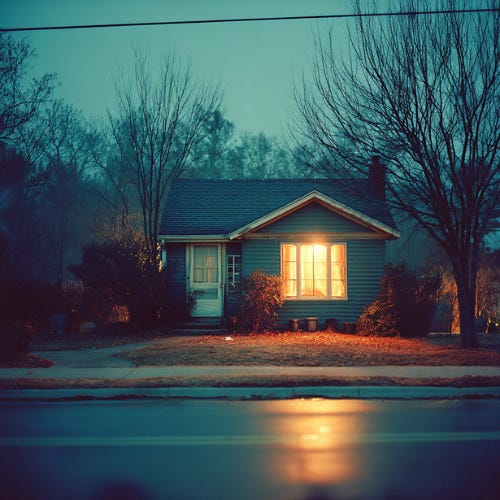
Two days ago I dropped my alarm clock.
It’s a battery-powered one we got at LACMA — simple, does the job without overdoing it. Batteries fell out.
I set the time.
I couldn’t be bothered to reset the alarm.
I used to get up at 4:45 with something close to excitement.
Light the candle — the house is dark, eyes not adjusted, no overhead light. Make coffee. Sit with a body scan meditation.
Start to turn the house on with soft music through the Sonos. Sometimes I could hear the rooster already awake in the backyard.
The morning was mine before anyone else’s day started. It was an invitation to openness.
Lately it’s been a wall.
My son woke me up two days in a row last week.
The first morning, I felt a small warm hand grab mine.
“Dad, it’s time to get up.”
His voice had this mix of sweetness and competence — he’d dressed himself, was ready for school, and was waking me up. He’d never had to do that before.
The second morning he didn’t say anything.
He just laid on top of me.
A dead man hug.
Chest flooded. Full. Heavy.
Something had changed.
And it wasn’t the morning.

Six months ago I built a system.
I was writing essays about something I cared about. The work felt urgent. It deserved to be seen.
So I did what you’re supposed to do: I built a content strategy.
I remember the Google Doc — “2026 Complete Activation Content.” Tabs and tables. Color-coded. Time-stamped. Daily posts mapped across four platforms.
I was proud of it. It felt like having a plan. Like the work finally had a vehicle.
It never really felt generative. But the engagement metrics were intoxicating.
Views climbing. Comments coming in. I could see effort translating into numbers. And the numbers felt like progress.
I could also see like-minded people — connections worth making. My friend Theo, who had me on his podcast.
The quality of those connections mattered. But the quality required more contact than LinkedIn could hold.
The platform introduced us. The relationship needed a different room.
The follower counts were soaring. The same ideas kept getting reposted in different fonts.
The platform was much better at rewarding the performance around the work than moving anyone into the work itself.
I started to realize the whole thing was terminal.
I tried to remember the last time I’d felt an impulse to post.
There wasn’t one. Not once.
In the early days of social media, I remember being inspired by the movement of slugs and their trails on sidewalks. Berry bushes on my way to work.
Those were impulses. Things I noticed because nothing was overriding my attention.
LinkedIn was never an impulse. It was a show.
Cheerful was the projection. It never felt cheerful in the body.

Spring break. We took the kids to Hocking Hills — wooded mountains in southern Ohio, caves carved into rivers’ edges. No WiFi. No cell service.
Our Airbnb was perched on a steep hill, windows open to a treeline of tall pines. A U-shaped property with a hot tub where my kids were splashing, asking me to join.
And the thing organizing the morning — for my family, on vacation, in caves carved by water — was the WiFi back at the Airbnb.
The safe place the system trained me to return to.
I rearranged my family’s morning around the content machine.
I didn’t choose that. The infrastructure chose it for me.
I had built a system that trained my body to mistake platform activity for contribution — so the platform started to feel like the only place the work was real.
Maybe it’s not a content strategy for you. Maybe it’s a reporting structure. A budget cycle. A meeting cadence nobody questioned.
The system you built with good logic that now builds your mornings for you.
In organizations, this is what happens when the dashboard starts deciding what counts.

The same week, I went to the library. It opens at nine.
I sat at a corner table, propped my laptop on a copy of Neal Preston’s Exhilarated and Exhausted — a rock photography book. Headphones on. Bottle of water. No deadline.
I was writing an email to a collaborator — a thinker whose work intersects mine.
We’d been exchanging ideas about how systems narrow under pressure and what it takes to rebuild them.
Not performing. Thinking together.
I was two hours in before I realized I was still writing.
Each version was good. Could have sent any of them.
But then I’d find small questions, potential inconsistencies, connections with other work.
Not grinding. Finding.
There’s an electricity in sharing it, applying it, participating with it. Seeing the connections. Deepening relationships.
In one of our first exchanges, I was almost overcome by waves of excitement — thinking this is it, I can’t believe I actually get to think about stuff like this.
I could feel the energy regenerating in me.
Two mornings in the same week. One rearranged my family around WiFi. The other kept me writing for two hours without noticing — laptop propped on a book called Exhilarated and Exhausted.
Same person. Same work. Same week.
The difference wasn’t effort.
It was what the room was asking for.
Then I looked at the data.
My best LinkedIn post that week — seventeen reactions, nine comments, strong engagement rate.
Zero link clicks.
Not one person crossed over to the work itself.
The channel I’d given everything to — the one that reorganized my mornings and consumed my family’s vacation — had produced nothing.
The metrics that looked like progress were a closed loop. People engaging on LinkedIn, staying on LinkedIn.
The platform was not failing to distribute the work. It was succeeding at keeping the energy inside itself.
Enclosed systems are good at converting care into activity that never leaves their walls.
Meanwhile, Substack — the place where I just wrote what was alive, with no daily cadence, no voice specs, no growth hacks — was where seventy percent of new readers were finding me.
I didn’t even know the metric existed.
An audience was forming in the one place I wasn’t trying to build one.
Not an angry voice telling me I’d wasted time.
Just permission.
Something loosened in my chest. Not triumph. Relief.
I stopped posting daily. I started writing when something was alive.
Today was the first morning I actually did that — and I couldn’t believe how much I got done when I wasn’t fighting the friction of a plan I’d set for myself.
I built what a person builds when they care about something and don’t know how to get it seen: a system.
A beaver builds a dam because that’s what beavers do under pressure. The dam creates a pond. The pond determines what can live there.
It just built what a beaver builds.
The system became the room. The room consumed the mornings. The mornings consumed the thing the mornings used to be for.
I built the strategy while the performer was in charge.
Then the strategy started building my mornings to keep the performer in charge.
That’s the loop.
Not dramatic. Not a crisis.
Just — the alarm goes off, and the body doesn’t want to answer it anymore.
And the part that knew — the part that felt the small hand grab mine and couldn’t get out of bed — that part hadn’t gone anywhere.
It was waiting for the system to stop consuming the space it needed to speak.

This morning I woke up early. Very early. Then fell asleep on the couch.
I woke up again to my kids sitting next to me, faces to their devices. Taking advantage of my temporary lethargy.
The alarm clock is still sitting on the nightstand with the batteries out. I haven’t reset it.
I’m not sure that’s a problem anymore.
The question I keep carrying now is simpler than any strategy:
What room am I building?
What used to be yours before the system took it?
A morning. A walk. A kind of thinking. A way of being with your kids.
You probably still remember what it felt like. You probably assumed it was gone.
It’s not gone. The room just stopped asking for it.
If something came to mind while you read this, hit reply and tell me what it was. One sentence. I’ll tell you about my alarm.
And if someone else came to mind, forward this to them and ask:
What room is building your mornings?
Next week: the season when the system made sense — and the moment it stopped.
Comments
Nothing yet. Say the first thing.
Sign in to join the conversation.