
I was lucky enough to take a couple of art history classes with James Snyder. He was a wonderful teacher who so clearly loved his field that you could not help but get carried along. His specialty was Northern Renaissance art; he authored a definitive textbook on the subject, but he also told us, “I love Flemish art, but I’d rather live in Italy.” He was funny and told wonderful stories. His humor made whatever he was teaching more memorable.
I will share a story that he told in 1986. While he was studying in Italy, he ran into his professor while visiting the Uffizi. They met in the Sala delle Maestà, which famously contains three enormous paintings of the Madonna and Child: Giotto’s Ognissanti Madonna (1310), Cimabue’s Santa Trinita Madonna (1290-1300), and Duccio’s Rucellai Madonna (1285). If you love this type of art, the experience of standing before these three paintings is similar to being with Monet’s Water Lilies at MOMA or at the Rothko Chapel.
Snyder spoke with his professor for a few minutes and left him to visit the rest of the museum. After finishing his visit, he decided to take one more look at the Ognissanti Madonna. His professor was still there, having moved from the first to the second painting in the room. “That is how you look at art,” Professor Snyder told us. (He has just given us an assignment to go to the Philadelphia Museum of Art, choose one painting, and write a 1000-word description.)
Although I never approached Snyder’s knowledge or his professor’s patience, I do appreciate paintings of the Madonna and Child. The appreciation may come from an adapt or perish response: my parents brought me to so many museums that if I hadn’t adapted, I would have died of boredom. Sarah and I were recently at the Nasher Museum of Art at Duke University. I called her over to look at a painting, and she said, with just a hint of exasperation, “You always like these.” So here are two Madonna and Child paintings that live in my phone.
An object of devotion by a forgotten master
The first was the one at Duke. It is from Northern Italy, probably Florence, made by an unnamed master. We can call it medieval, Gothic, early Renaissance, whatever. These are common; most large museums have a room or two filled with them. Their ubiquity and lack of attribution tempt you to ignore them. It is true that many of them are of borderline quality and not particularly interesting. But good ones, like this one, are special.
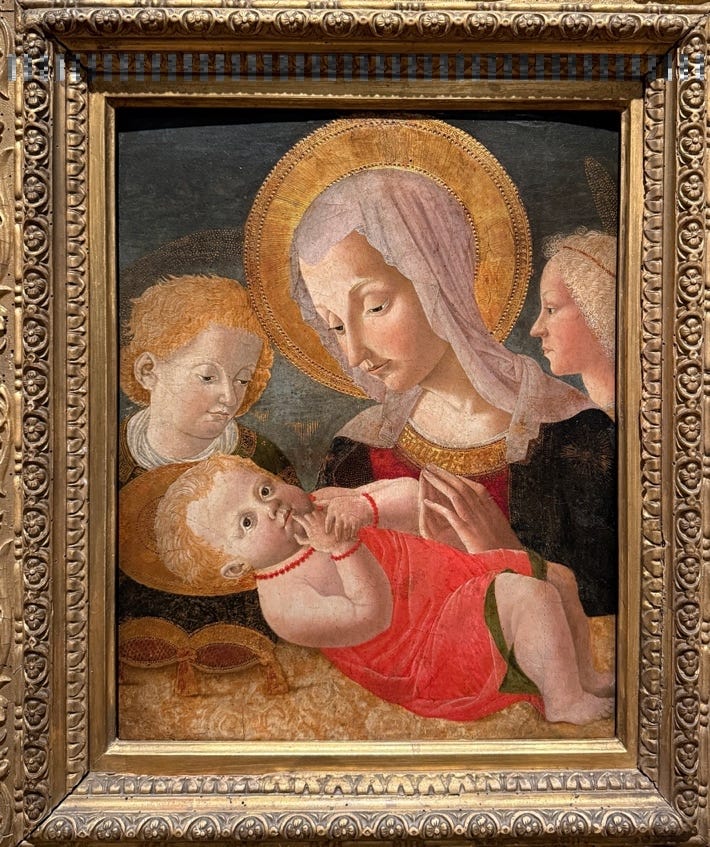
I have come to see them more as objects than paintings. They were devotional pieces, rather than works to be appreciated for their artistic quality. They are formulaic, but there is much to enjoy within the formula. Mary’s gold halo is an incredible work of craft, tooled by an expert. This carries on to her collar and to Christ’s halo. Here is a link to a full-size image of this painting if you want to nerd out and zoom in.
While the secondary figures are often anonymous, almost cartoonish, it is usually worth spending some time with Mary. In this work, the virgin mother certainly isn’t realistic, but zoomed in, the chin and mouth are remarkably true to life. The nose is inhuman perfection. I can imagine concentrating the adoring eyes during a period of devotion.
To the right, the profiled face is remarkably specific. Sure, the line is too heavy, and the hair is a bit ridiculous, but I feel like I know this woman. Did I see her in the clinic last week? Maybe I bought a coffee from her? She is probably the person who commissioned the work (more likely wife thereof), so she might be the one real person in the painting.
A Bellini masterpiece
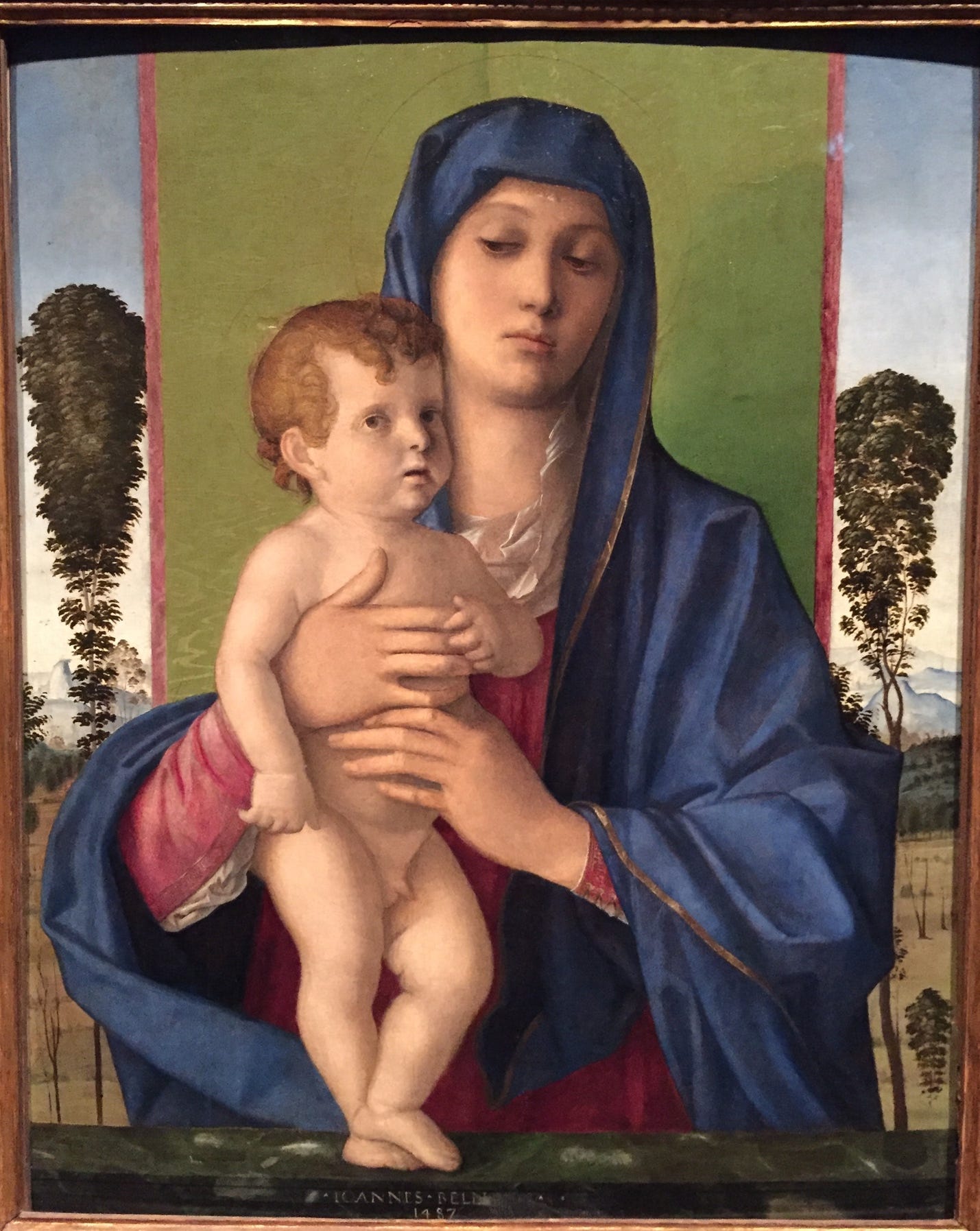
I have carried this painting in my phone for the last eight years. For a while, it served as my home screen. This painting has nothing in common with the first work. We know the artist, Giovanni Bellini, and it is a work of art rather than a devotional object. Thought is given to the structure: the central figures positioned before a neutral background; the (bizarre) trees offering balance; the plinth at the bottom that frames the image and allows Giovanni to show off his ability to show the weight of this pre-ambulatory child.
I appreciate Mary’s three layers of robes – red, white, and blue. The white scarf is especially great. But what entrances me is her expression. It is a look that I feel like I’ve seen on adolescent girls. I imagine she is someone Bellini met at a local market and paid a few ducats to get her to sit for him.
At times, I see the expression as that of a too-young mother looking a bit conflicted about her son, a boy she loves but who exhausts her and has stolen her youth. She could be a woman from a Springsteen song, maybe Janey from Spare Parts.
Other times, I see her face as it was probably meant to be, the all-knowing mother of the Christ child, too aware of what the future holds. Just barely holding it together, foreseeing future grief. The expression on the child, which is a whole lot less convincing, should reassure her. He knows what is ahead and is ready to face it bravely, even at eleven months.
I’m thankful for the power of the church in the early centuries of the second millennium. There are thousands of Madonna and Child paintings. Go into just about any museum, and there they are, just waiting to occupy a few minutes (or a few hours).
No posts
Comments
Nothing yet. Say the first thing.
Sign in to join the conversation.