
If things go according to plan, at 2pm today, pretty much every phone in Australia will blast a shrill siren. That’s AusAlert, our new national emergency warning system. And the science behind it is a genuine upgrade on the current system.
At 2pm AEST on Monday 27 July (1.30pm in SA and the NT, midday in WA), millions of Australian phones will sound a 10-second siren and display a message reading
“This is a TEST alert of AusAlert, Australia’s new emergency warning system. NO ACTION IS REQUIRED.”
Silent mode will be powerless to stop it. Do not disturb … please … do not bother. This alarm will interrupt any call you are on, any meeting you are in, if the timing gods are sufficiently cruel, that Monday nanna nap.
The gentle siren’s call will go a little something like … actually, exactly like … this;
0:00
-0:10
(”Warning Siren”: National Emergency Management Agency)
Your phone should get the alert if it is reasonably modern: iPhone 11 or later on current iOS, Android 12 or later, plus some recent Apple Watches. iPads, tablets, laptops will not be screeching.
This is no recent development. AusAlert was born out of the tragedy of the 2019-20 Black Summer bushfires. The resulting Royal Commission called for a nationally consistent warning system after patchy, delayed alerts left communities in the dark.
From its full launch in October, AusAlert is intended to cover bushfires, floods, cyclones, public safety threats, biosecurity incidents and health emergencies.
It raises an obvious and really interesting question. At a time when telecommunications could be down, how do you send an emergency alert?
Our existing state-run emergency notification systems send warnings by SMS. The process is best described as “store and forward”. A message centre holds the message, looks up phone numbers, and delivers it one recipient at a time.
Now in a disaster setting, with a network already groaning under panicked call traffic, adding thousands of messages to the queue can slow delivery to a crawl, even a full stop.
AusAlert instead uses cell broadcast. Cell what? A technology that has been minding its own business, quietly nestled inside mobile phones since the 1990s and is now used by more than 30 countries. Rather than sending one message to one number, a mobile tower broadcasts the alert on a dedicated control channel, separate from the channels carrying calls and texts. Every compatible device within range picks it up simultaneously.
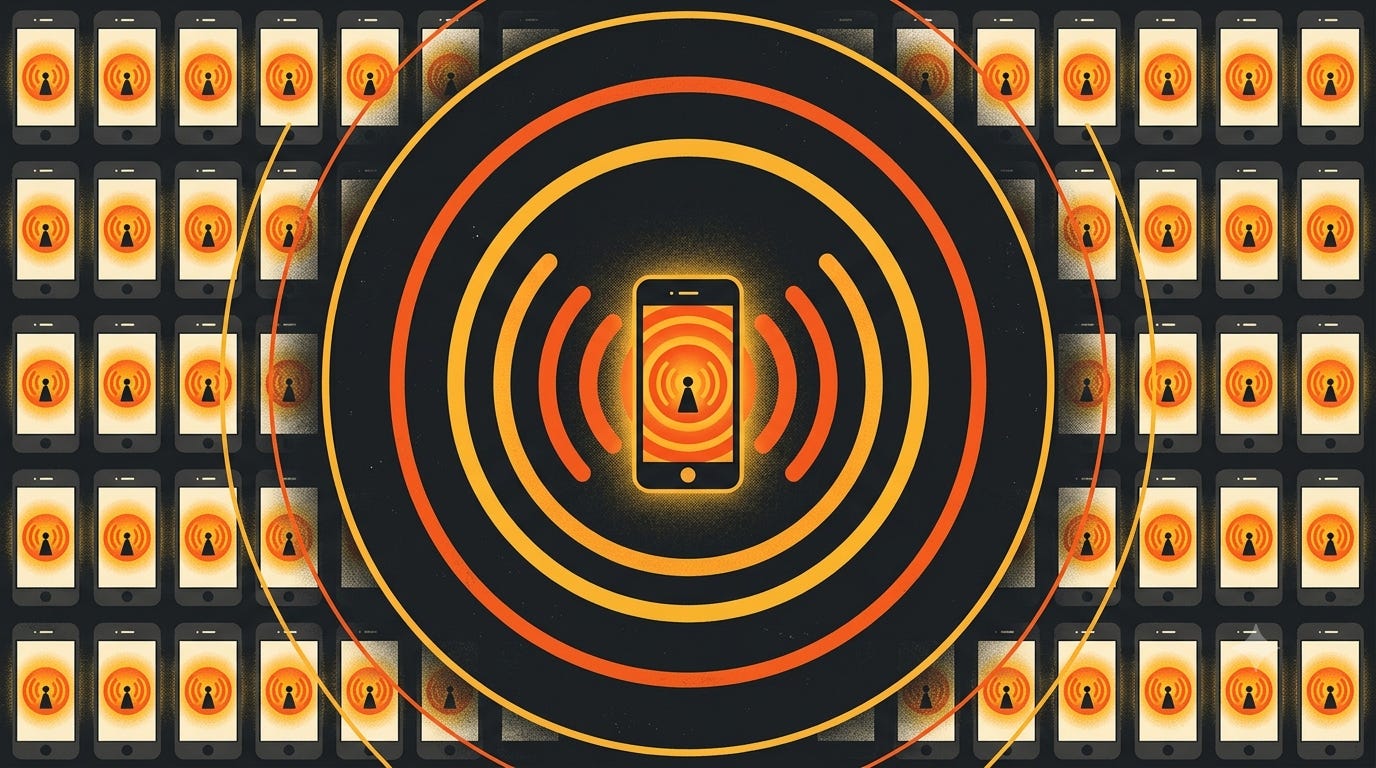
Think about the way 100 radios on a street can all tune in and receive the sound from a given radio station at the same time. Those non-stop blocks of rock sound just as good to your ears when all your neighbours are also listening.
The system uses no phone numbers, requires no queue, and creates no congestion. Japan’s earthquake warning system uses the same approach to push alerts to millions of phones within seconds of a tremor being detected.
The other superpower is geo-targeting. If everyone in a state received a warning about a particular river bursting its banks, or a dangerous but small bush fire, people would soon stop paying attention. With AusAlert authorities choose which towers will broadcast. An alert can go nationwide like today, or be fenced to a suburb, or even a few streets.
Simultaneous broadcast direct to multiple devices also means that in receiving an alert, your phone is not identified or tracked. Your privacy remains intact.
The AusAlert test comes at a time when the robustness of our emergency systems is under a bit of a cloud. The recent Telstra and Optus network fails have been accompanied by serious, perhaps fatal, compromise of the triple-zero service.
AusAlert is not intended to replace triple-zero. They are different beasts. 000 is an inbound system for people calling for help.
Cell broadcast hardens the outbound side. An alert system that does not rely on call routing, message queues or targeting individual numbers has far fewer potential points of failure. Especially when the network is under stress.
Fewer, but not none. A powerless tower, perhaps in a bushfire, cannot broadcast. So AusAlert will run alongside existing systems rather than replacing them. Radio, sirens, doorknocks and your local ABC all still matter.
Not surprisingly, when this has been trialled overseas the results have been, … mixed. Our Kiwi neighbours were rudely awoken at 1:30am. A 2022 test in Germany arrived 20 minutes late for many, and the “all clear” never showed up at all. Welsh speakers copped a spelling error – which, if you’ve ever tried to read anything in Welsh, ain’t that hard to imagine.
Doubtless AusAlert will encounter a few Aussie gremlins, which is exactly the reason we test these things. Where are the black spots? Are some handsets incompatible? Do settings matter? Best to know all these things before you’re in a genuine emergency.
“We’re obviously interested in hearing if people haven’t received the message.” —Pat Hetherington, interim coordinator general, National Emergency Management Agency.
Of course an alert that reaches every phone in range also reaches phones that were never meant to be found. For someone who keeps a secret “safe phone”, a blaring siren could be a problem. NEMA, family violence workers and other experts advise anyone in this situation to turn that phone completely off. Preferably for a 24-hour window around test time.
If you’re more worried about disturbing a work meeting, funeral, even a romantic moment, a two-hour visit to ‘aeroplane mode’ should be enough.
I’d love to know how your day went down. Did your phone get the alert? Did you know it was coming, or did it scare the daylights out of you? Did it ruin a meeting, a movie, a private moment? Did anyone’s phone stay stubbornly silent?
Drop your feedback in the comments. Consider it a bit of Monday afternoon citizen science.
• “Every phone in Australia will get the same text on Monday. That’s if it works”, Mike Foley, The Sydney Morning Herald, 2026.
• “AusAlert test will blast emergency warning siren over most phones in Australia on Monday. Here’s what to know”, Josh Butler, The Guardian Australia, 2026.
• Behind the scenes of the Optus Triple Zero outage, Tom Williams, Information Age (ACS), 2025. https://ia.acs.org.au/article/2025/behind-the-scenes-of-the-optus-triple-zero-outage.html
• Some Triple Zero calls impacted, minister confirms, as Telstra says software glitch caused major outage, SBS News, 2026. https://www.sbs.com.au/news/article/telstra-down-outage-crash-network-signal-australia-2026/4sdj6c7ho
No posts
Comments
Nothing yet. Say the first thing.
Sign in to join the conversation.