
I ran the first of a series of book club sessions with performance coaches on Monday this week. We’re studying Gilbert Enoka’s “Become Unstoppable.” One thing that’s become clear to me, as a long-time student of the New Zealand All Blacks, is that their sustained excellence has never been fully explained by the tactical, strategic, physical, or mental. There’s a meaning element, an emotional element, a spiritual element that most teams miss, most performance books skip past, and most conversations about high performance never reach.
Owen Eastwood writes about whakapapa in “Belonging,” the Māori concept of lineage and shared identity, and the way it gave the All Blacks a story to live inside. It connected them to something bigger than the current squad, the current season, the current scoreboard. Meaning at that level operates differently than a psychological skill or a process framework. Most coaching conversations don’t know how to build it.
Viktor Frankl survived years in Nazi concentration camps watching people live or die. He saw the pattern directly: people with a reason to keep going, kept going. He built a therapeutic framework, logotherapy, around the claim that meaning is the primary human motivator, above pleasure and above power. His work was about survival. But the principle extends anywhere humans are being asked to push through something hard.
The question I keep returning to is why high performance culture, which has spent decades building sophisticated frameworks for the tactical, physical, and mental, still treats the spiritual and the meaningful as an afterthought, or an embarrassment, or someone else’s department.
The performance coaching conversation has moved in a clear direction over the last decade, toward data, process, psychological safety, and evidence-based practice. These are real and important corrections to cultures that needed correcting.
But somewhere in that shift, meaning got quietly deprioritized. It is harder to measure, harder to build into a periodization plan, harder to put on a slide deck. So it gets acknowledged and then skipped.
Amy Wrzesniewski at Yale has spent her career studying how people relate to their work. Her research consistently shows that people who experience what they do as a calling, rather than a job or a career, outperform across almost every measure. They invest more, recover faster, and sustain effort longer. The mechanism is meaning, not better incentives or stronger accountability structures.
Martin Seligman’s PERMA model identifies meaning as one of five pillars of sustainable performance. Coaches who have applied it in sport find it changes the questions they ask. You stop asking “how do we build intensity?” and start asking “do these players know why this actually matters to them?”
The sociologist Émile Durkheim studied religious ritual and identified what he called collective effervescence: the surge of energy, unity, and emotional elevation that emerges when a group engages in shared practice with genuine intent. He was not studying sport. But the finding travels. When a group of people gather around something they actually believe in, something shifts in them that individual motivation cannot produce and tactical preparation cannot replicate.
The research on this is consistent. The question is whether coaches are building meaning intentionally, or leaving it to chance.
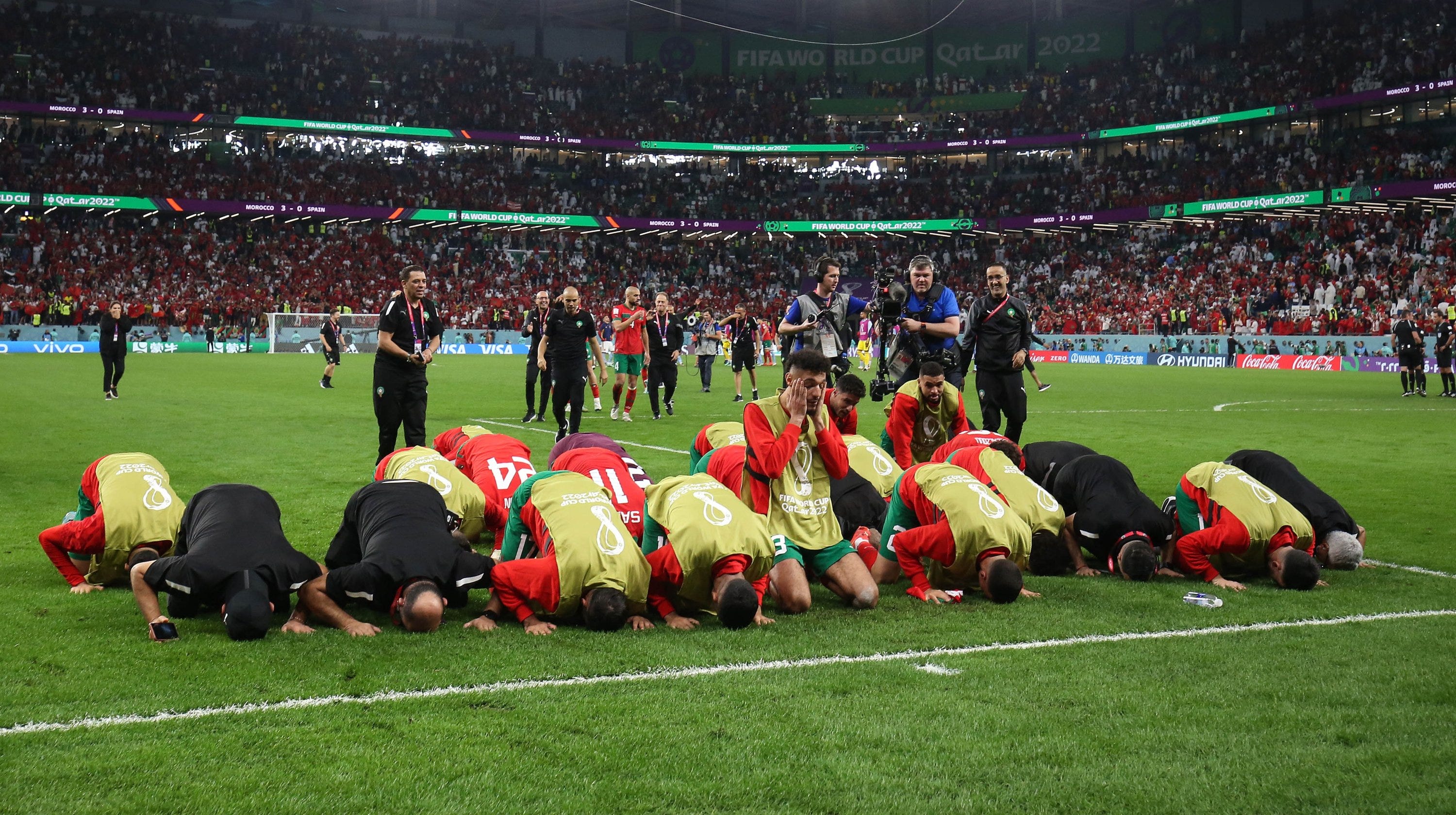
On the same day as the book club, the FIFA World Cup gave me exactly the illustration I couldn’t have scripted.
In their round of 32 match against the Netherlands, Morocco took a tight game to a penalty shootout. Before the first penalty was taken, the squad gathered in a circle and recited Surah Al-Fatiha, the opening chapter of the Quran, making a collective dua, a shared supplication. Head coach Mohamed Ouahbi led them. He has built a culture where prayer replaces the tactical huddle before moments like this.
What it produces is visible in the footage: a kind of stillness, a unified focus, something to step into rather than escape from. Alison Wood Brooks at Harvard Business School has run studies showing that pre-performance rituals, even invented ones, measurably reduce anxiety and improve output under pressure. Part of the mechanism is focus, and part is identity. The ritual communicates something to the group: this is who we are, and this is what we do before we go into something difficult.
For the Moroccan players, the ritual is not invented. It is genuine. A ritual rooted in real shared belief operates at a different level. It does not just focus the mind. It connects each player to something larger than the penalty they are about to take.
They won the shootout and advanced.
The Netherlands were not without their own source of meaning. Cody Gakpo played through the tournament carrying the loss of his and his partner’s unborn child. The Dutch squad carried that weight together. Meaning gathered around a person, a loss, a shared grief, is real and powerful. The result went to Morocco. But both teams showed what happens when a group of players has something more than tactics to play for.
Do your players know what they are playing for beyond the scoreboard?
Most coaches know, somewhere, that meaning matters. They have seen it in a locker room before a must-win game, or in the way a team responds when something personal is on the line.
They have felt the difference between a group that is executing and a group that is alive.
Meaning tends to get created by accident when it gets created at all. A shared hardship, a player people rally around, a coach who happens to frame the mission in a way that lands. Most teams are not building it deliberately.
The All Blacks built it deliberately. Morocco is building it deliberately. The research from Wrzesniewski, Seligman, and Durkheim points in the same direction. Meaning is one of the most significant performance variables available to a team, and the coaching world is largely leaving it on the table.
Until next week,
Caleb Cousens
No posts
Comments
Nothing yet. Say the first thing.
Sign in to join the conversation.