
Dear BWA Shoeshiners and Barbers!
Welcome to Barbershop Whispers…Las Améяicas (BWA), a weekly publication about all things Améяicas. A big and diverse continent that is becoming increasingly important to the global economy. ¡Viva Las Améяicas!
Be sure to also visit Barbershop Whispers…Russia, a weekly newsletter on all things Russia. See the most recent issue:
Chingiz Khan Heir Whispers into the Tsar’s Ear
Follow BWA’s daily posts on X and Blue Sky platform for daily updates and posts.
Thank you for reading “Barbershop Whispers… Las Améяicas (BWA) a product of e8Q Technologies. Subscribe for free to receive new posts.
In last week’s BWA, I discussed why Brazil and Argentina, the two anchor economies of Mercosur, want the same from the institution, and what the bloc's rotating chair says about its resilience.
In this week’s BWA, I discuss what has happened over the past few months since I published Cuba Bankability and the Last Call on Cuban Sovereign Debt in May. In this spirit, I lead my fellow Barbers to the opportunity.
The Cuba Money Opportunity
The Paper: Winnable, Not Collectible | The Destination: Trust Units | The Waterfall That Doesn't Exist Yet | The Trades, Ranked by Risk and Enforceability | The Clocks: Four Dates and a Black Swan
Takeaways
Convergence — The courts opened every door to sue Cuba just as sanctions emptied the Cuban treasury. Judgments now pile up uncollectible at industrial scale, leaving one clearing mechanism standing.
Mispricing — A claims stack potentially worth billions on paper has yet to be priced. The first bid sets the price discovery process in motion, and the unwritten seniority waterfall will govern who gets paid first. Being the first mover on both writes the rules.
Between 1959 and 1968, the Cuban government confiscated American-owned property across the island — refineries, utilities, sugar mills, and docks. Since then, the US government adjudicated the losses and certified 5,913 claims worth $1.9 billion (roughly $8–9 billion with interest) through the Foreign Claims Settlement Commission (FCSC).
In 1996, the Helms-Burton Act’s Title III gave those claimants the right to sue anyone “trafficking” in — commercially using — their confiscated property; every president suspended that right until 2019. Those certified claims, along with Cuba’s defaulted sovereign debt, are the stack my previous piece — “Cuba’s Rocky Road to Bankable.” and “Last Call on Cuban Sovereign Debt” — mapped out.
This piece proposes where they may end up: a claims trust, in which Cuban state assets are transferred to a neutral vehicle and tradeable units are issued to claimants against their paper.
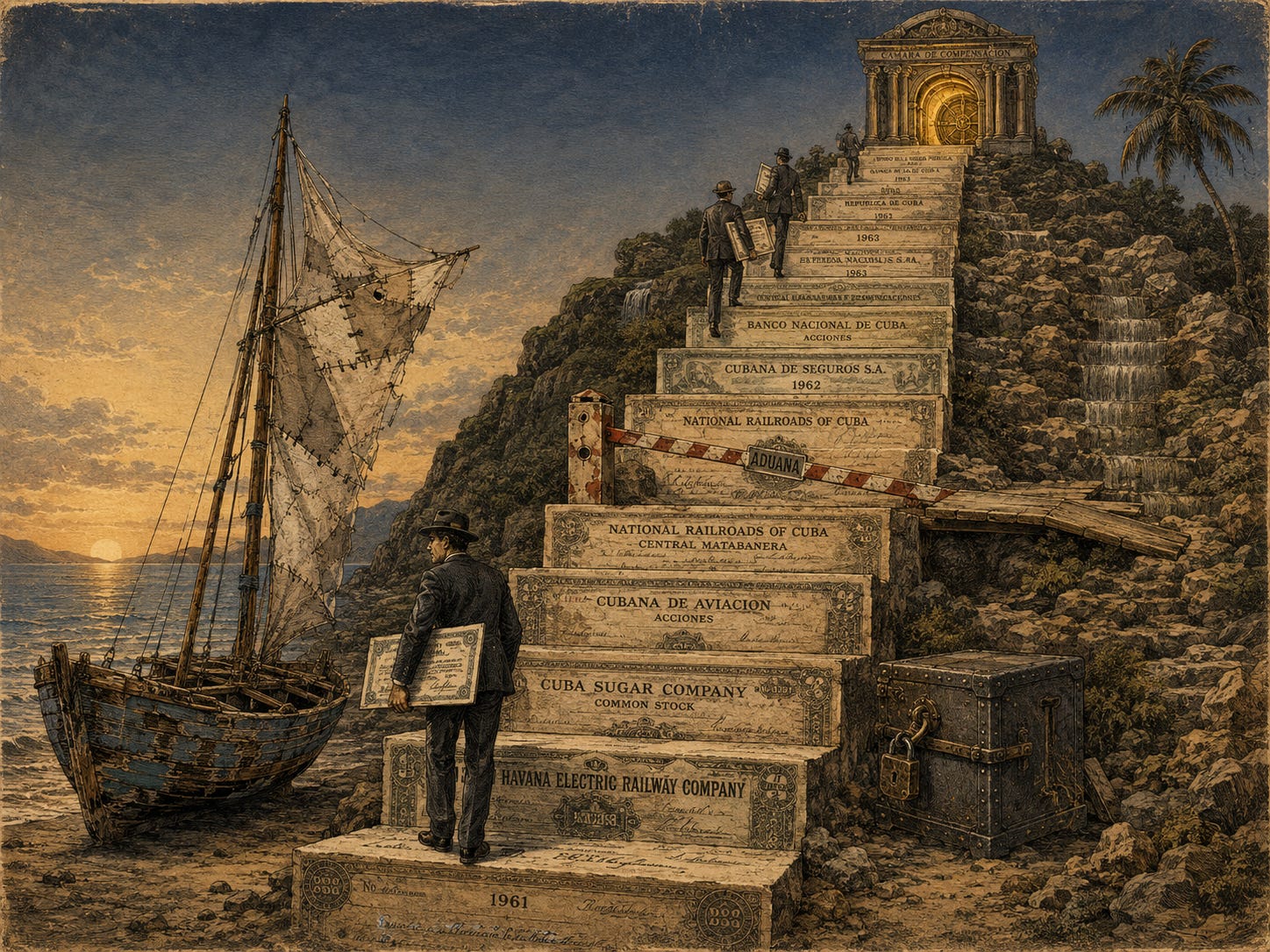
The Paper: Winnable, Uncollectible
Three months since those BWA publications, the US courts, US Treasury, and the corporate exodus have eliminated every avenue for collecting on certified claims — leaving only two endgames: a negotiated structure along the lines proposed here, or the stalemate Cuba has endured for sixty-six years.
For the first time, the stalemate has a countdown clock. The clock is Beijing’s collateral math, Havana’s succession calendar, Washington’s own electoral arithmetic, and the physics of a grid that fails a little more each night.
The Supreme Court ruled in favor of claimants twice.
In Havana Docks (8–1, May 21), it held that a claimant whose underlying rights had long since lapsed — Havana Docks' pier concession would have expired on its own in 2004 — can still sue, because what was confiscated was the docks themselves, not the paper interest in them. Claims the market had written off as expired came back to life, reviving roughly $440 million in judgments against four cruise lines.
In Exxon v. CIMEX(6–3, June 23), it held that Title III itself strips Cuban state-owned enterprises (SOEs) of sovereign immunity.
Together, the two rulings did the work of a decade: they revived a lapsed claim and stripped a Cuban SOE of its immunity — multiplying, in a single term, both the number of live claims and the universe of defendants answerable in US courts. What the rulings could not do is make it collectible. That is the hinge of this piece.
Why can't the winners collect? Four walls. The Cuban state companies being sued own nothing in the United States worth seizing. The Cuban money Washington has frozen is locked, not forfeited — no trafficking judgment can unlock it. The courts of Europe are legally barred from helping. And the Cuban government itself is cash broke: the only assets Cuba has are fixed, illiquid assets - hotels, seaports, airports, and mines - some of which are rotting under sanctions.
Thirty-six days after Exxon, the ruling became a docket number: on 29 July, the Cuban Electric Company — holder of FCSC Claim No. CU-2578, the largest certified claim against Cuba at $267.6 million — sued UNE and Energas (both SOEs) in the DC district court, citing Exxon directly. Sherritt, a Canadian mining company with mining interests in Cuba, a one-third owner of Energas, is identified in the complaint but not joined as a defendant. This is a message that every SOE JV partner, past or present, has liability exposure, whether or not they have exited the island.
Meanwhile, the foreign investment exodus from the island is gaining momentum and critical mass.
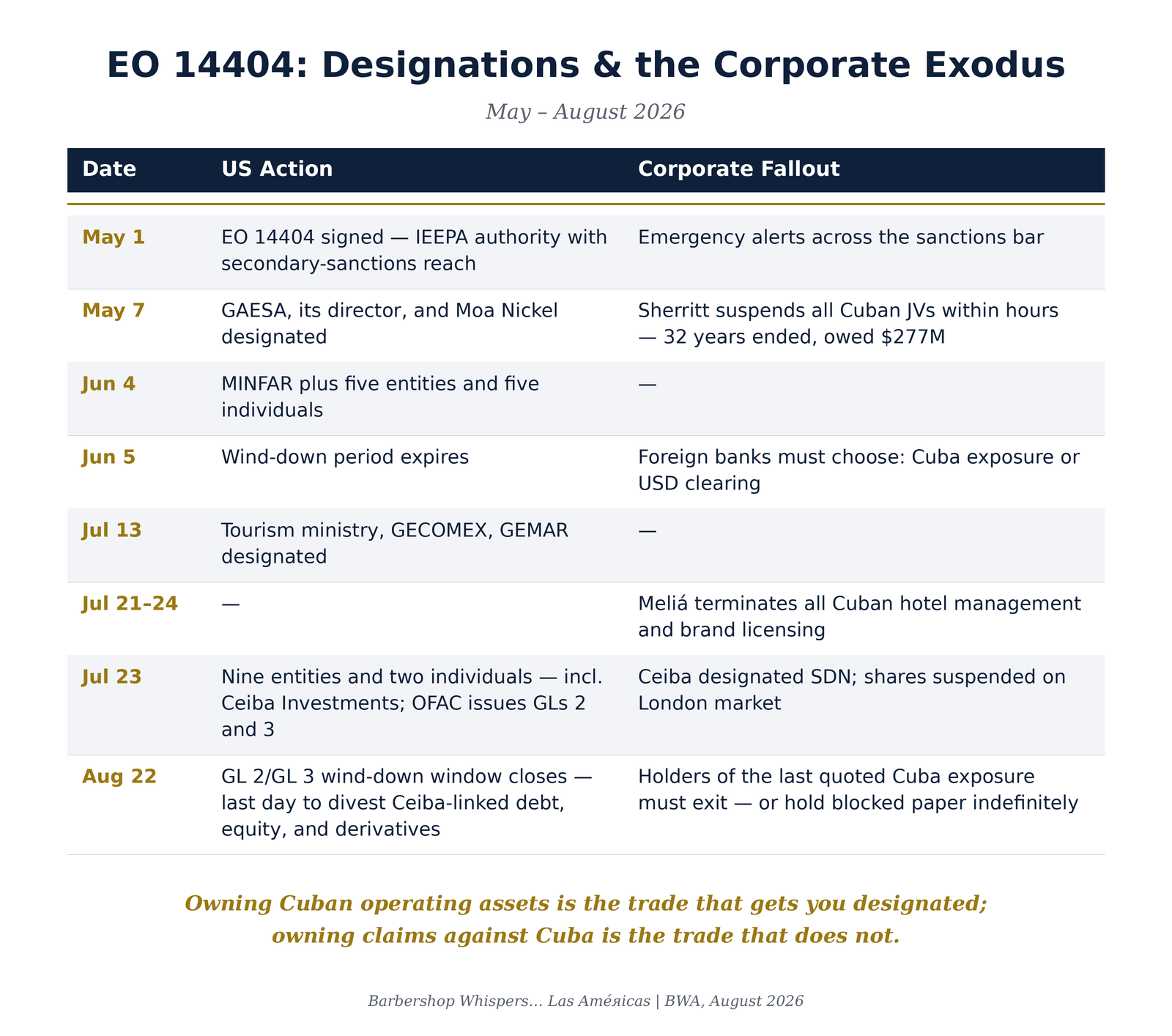
Ceiba Investments itself — the last market-priced Cuba vehicle, listed on the London Stock Exchange (LSE) — has been designated as a Special Designated National by OFAC (SDN) and its shares suspended, with OFAC’s General Licenses 2 and 3 giving holders until 22 August to divest or risk holding illiquid paper for an undetermined period.
Sherritt exited after 32 years as a creditor owed $277 million; Meliá terminated all Cuban hotel contracts effective 24 July, booking €79.4 million in provisions on its exit — and with Iberostar and Barceló also gone, all three Spanish hotel majors have now written off their island.
The lesson is brutal and clarifying: owning Cuban operating assets results in a US Treasury designation, while owning claims against Cuba is merely holding uncollectible debt.
And no, the claims cannot simply be paid out of — or attached to — Grupo de Administración Empresarial S.A. (GAESA) fabled offshore billions. The State Department alleges up to $20 billion in hidden overseas accounts; the Miami Herald’s leaked accounting showed $14.5 billion in unidentified banks; skeptics argue that much of it consists of internal peso entries, not hard currency abroad.
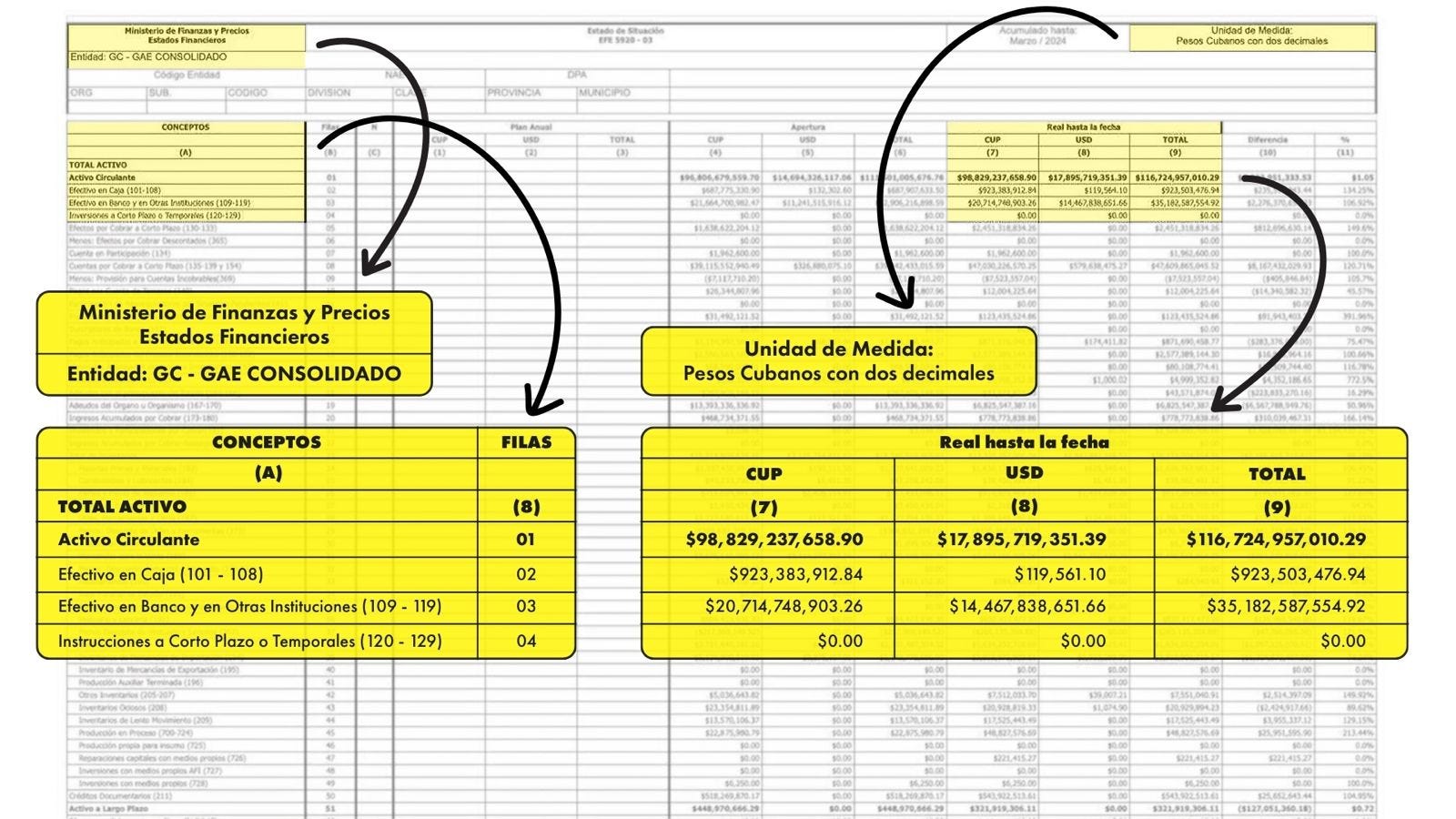
It really does not matter which is true. Blocking reaches only what falls under US jurisdiction — and Havana now routes payments through China’s CIPS cross-border system: non-dollar transactions that are invisible to Western authorities, and outside US jurisdiction.
Comments
Nothing yet. Say the first thing.
Sign in to join the conversation.