
Dear BWA Shoeshiners and Barbers!
Welcome to Barbershop Whispers…Las Améяicas (BWA), a weekly publication about all things Améяicas. A big and diverse continent that is becoming increasingly important to the global economy. ¡Viva Las Améяicas!
Be sure to also visit Barbershop Whispers…Russia, a weekly newsletter on all things Russia. See the most recent issue:
Marching toward the Abyss II: Mobilization
Follow BWA’s daily posts on X and Blue Sky platform for daily updates and posts.
Thank you for reading “Barbershop Whispers… Las Améяicas (BWA) a product of e8Q Technologies. Subscribe for free to receive new posts.
In last week’s BWA, I discussed Cuban certified claims and debts. A follow up to Cuba Bankability and the Last Call on Cuban Sovereign Debt.
In this week’s BWA, I discuss whether Cuba’s humanitarian crisis can trigger another mass maritime exodus on the scale of the 1980 Mariel boatlift. The conditions are largely present. At what point does Fulano de Tal decide that the risk of crossing the Florida Straits is better than simply surviving on the island?
Cuba’s Humanitarian Crisis: Another Mariel?
Cascading Humanitarian Crisis | Exits Are Closing | Two Precedents, One Decision-Maker | Havana’s On/Off Switch | Tripwires | Drift, Surge, or Engineered Exodus | Fulano Sails to Miami?
Takeaways
Pressure: Cuba has nearly every ingredient for another mass exodus on the scale of Mariel 1980: infrastructure collapse, food shortages, closing exits, and a population increasingly desperate to leave.
Permission: Desperation is not enough; mass maritime flight begins only if Havana issues the permission slip and stops policing departures.
Cascading Humanitarian Crisis
On 7 August, Cubans were reported sleeping on mattresses on the ground outside the University of Havana, one of the most symbolically loaded pieces of real estate in the country. One man, let’s call him Fulano de Tal (the American equivalent to John Doe), told a journalist filming the scene that he had gotten used to living without electricity and that what he needed now was to leave:
“What I need is to leave the country. I don’t need anything else”
Five days earlier, the national grid had gone down again, and it went down a second time the following afternoon while crews were still trying to restore it.
Last week Unión Eléctrica, the state utility, forecasted a peak shortfall of 2,347 MW against 3,250 MW of demand, with only 933 MW available — roughly 70% of peak demand unserved. The Cuban Energy Minister Vicente de la O’Levy told the National Assembly that some communities have gone as long as 105 days without electricity, and some Havana circuits are running 20 to 24 hours a day without power.
According to the Universidad de Navarra, the grid’s structural rot can be traced to the collapse of the Soviet Union and a failed 2006 “energy revolution” built on Venezuelan crude (Universidad de Navarra), while others point to the 50 year-old combustion technology. Then, of course, there is the loss of Venezuelan and then Mexican oil shipments.
A power failure is an abstraction until you trace what the electricity powered. About 87% of Cuban water distribution is dependent on electric pumps, and only 135 of 480 critical pump stations are on protected circuits. That ratio converts every blackout into a water crisis. Roughly 2.7 million Cubans face daily water shortages, and the national hydraulic system is running on ~37% of available fuel needs.
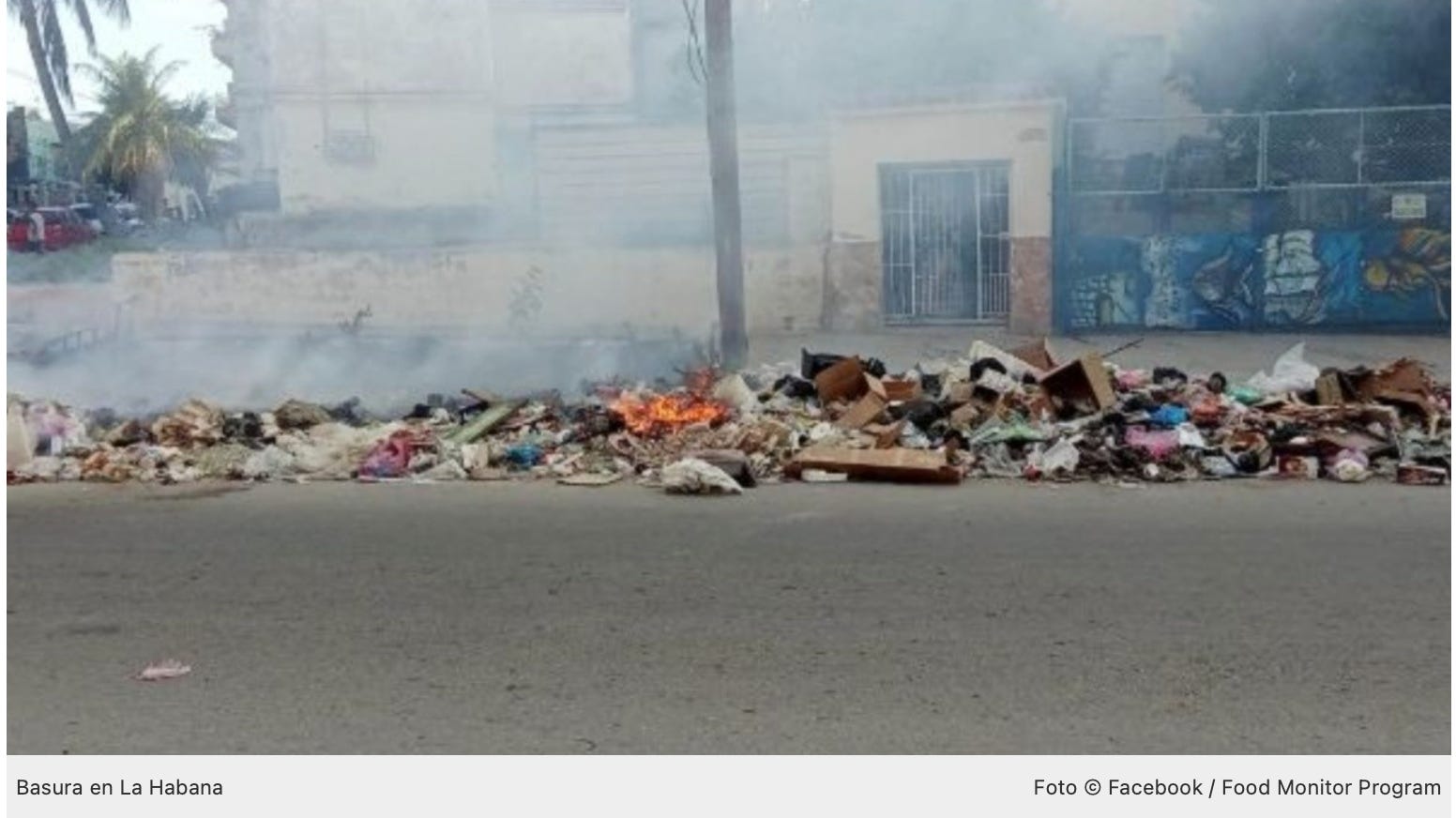
Fuel and pump-station shortages also affect sanitation. Only 44 of 106 garbage trucks were operational in Havana, against 24,000 to 30,000 cubic meters of solid waste generated daily, in a city whose sewer network dates from 1908–14 and was designed for 600,000 people rather than today’s two million.
Poor sanitation has triggered outbreaks of Hepatitis A across the country; the ministry’s own advice to boil or treat water is difficult to follow under twenty-hour blackouts. A deputy health minister warned on state television that with all four dengue serotypes circulating, the country could face an epidemic, naming accumulated solid waste and household water storage as drivers.
Food insecurity completes the humanitarian cascade and makes widening inequality politically combustible. The Food Industry Minister acknowledged that the rationed basket had delivered no cooking oil, chicken or yogurt this year, and the Food Monitor Program — an advocacy-adjacent NGO, not an official statistical body — reports that roughly a third of households experienced recent hunger and that about eight in ten had cooking capacity disrupted by blackouts.
The informal dollar moved from 435 CUP in December 2025 to about 670 CUP by early July, and independent economists put basic monthly needs for one person at roughly fourteen times the average official wage. Households with remittances, generators or solar panels have partly exited the crisis; a single panel costs close to a thousand dollars against an average state salary near seventeen dollars a month, the most visible form of inequality.
Exits are Closing
Cubans have already responded to these conditions, and have been doing so for the past four years. Official statistics record net emigration of 245,264 people in 2025 alone, about 2.5% of the population, with a resident population reported at 9.43 million against 11.24 million in 2017. Independent demographers contest those numbers and place the population closer to 8 million, calling what has happened since 2020 a displacement crisis without a war and a country emptying and ageing.
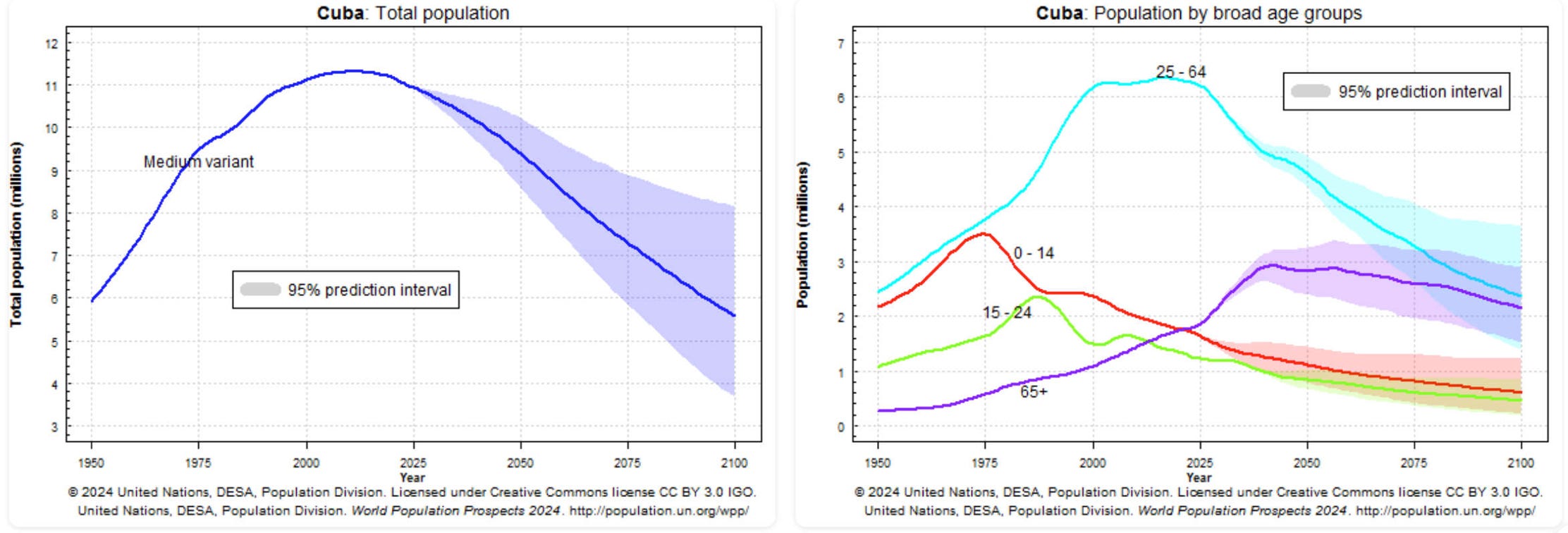
The analytically important point is how they left. Most emigrants left via airports, through Nicaragua and Central America, humanitarian parole and family reunification, and through asylum claims filed across the hemisphere. However, these routes are closing quickly. Nicaragua ended visa-free entry in February 2026, and roughly 600,000 Cubans already in the United States sit in legal limbo. Some have found new routes. For example, Cuban asylum claims in Brazil nearly doubled to 41,919 in 2025 and arrivals in Uruguay rose from 5,870 to 14,959 last year.
Comments
Nothing yet. Say the first thing.
Sign in to join the conversation.