
Dear BWA Shoeshiners and Barbers!
Welcome to Barbershop Whispers…Las Améяicas (BWA), a weekly publication about all things Améяicas. A big and diverse continent that is becoming increasingly important to the global economy. ¡Viva Las Améяicas!
Be sure to also visit Barbershop Whispers…Russia, a weekly newsletter on all things Russia. See the most recent issue:
Follow BWA’s daily posts on X and Blue Sky platform for daily updates and posts.
Thank you for reading “Barbershop Whispers… Las Améяicas (BWA) a product of e8Q Technologies. Subscribe for free to receive new posts.
In last week’s BWA, I discussed technological sovereignty and how this is playing out in the booming data center space in South America. The US and China are battling it out and pressuring countries to choose - Washington or Beijing? But there is a third option.
In this week’s BWA, I discuss the value of Venezuelan oil assets, against the backdrop of ~$159 billion in sovereign debt, as private buyers have begun pricing oil assets while the licenses, signatures, and votes they need remain outstanding.
Audentes Fortuna Iuvat: Venezuela’s Asset Price Discovery Process Begins
Paperwork Caught in the System | Two Columns, One Country | Intangibles, Not bankable | Asset Price Reference | Who Carries the Risk
Takeaways
Price Sequencing — PetroUrdaneta had clean title; the Russian JVs do not. Which buyer prices encumbered Venezuelan equity first, and at what discount?
Conditions Precedent — Woods set four conditions in January and one has been met. Will the other three arrive before the money does?
— Darren Woods, ExxonMobil Chairman & CEO
On 9 January, at a White House meeting on Venezuela’s reconstruction, ExxonMobil chairman and chief executive Darren Woods told the US President that on the legal and commercial frameworks as they stood, “today it’s uninvestable.” He then set out what would have to change: the commercial frameworks, the legal system, durable investment protections, and the country’s hydrocarbon laws. Venezuela reformed its Hydrocarbons Law on 29 January, three weeks later. The other three conditions are still outstanding.
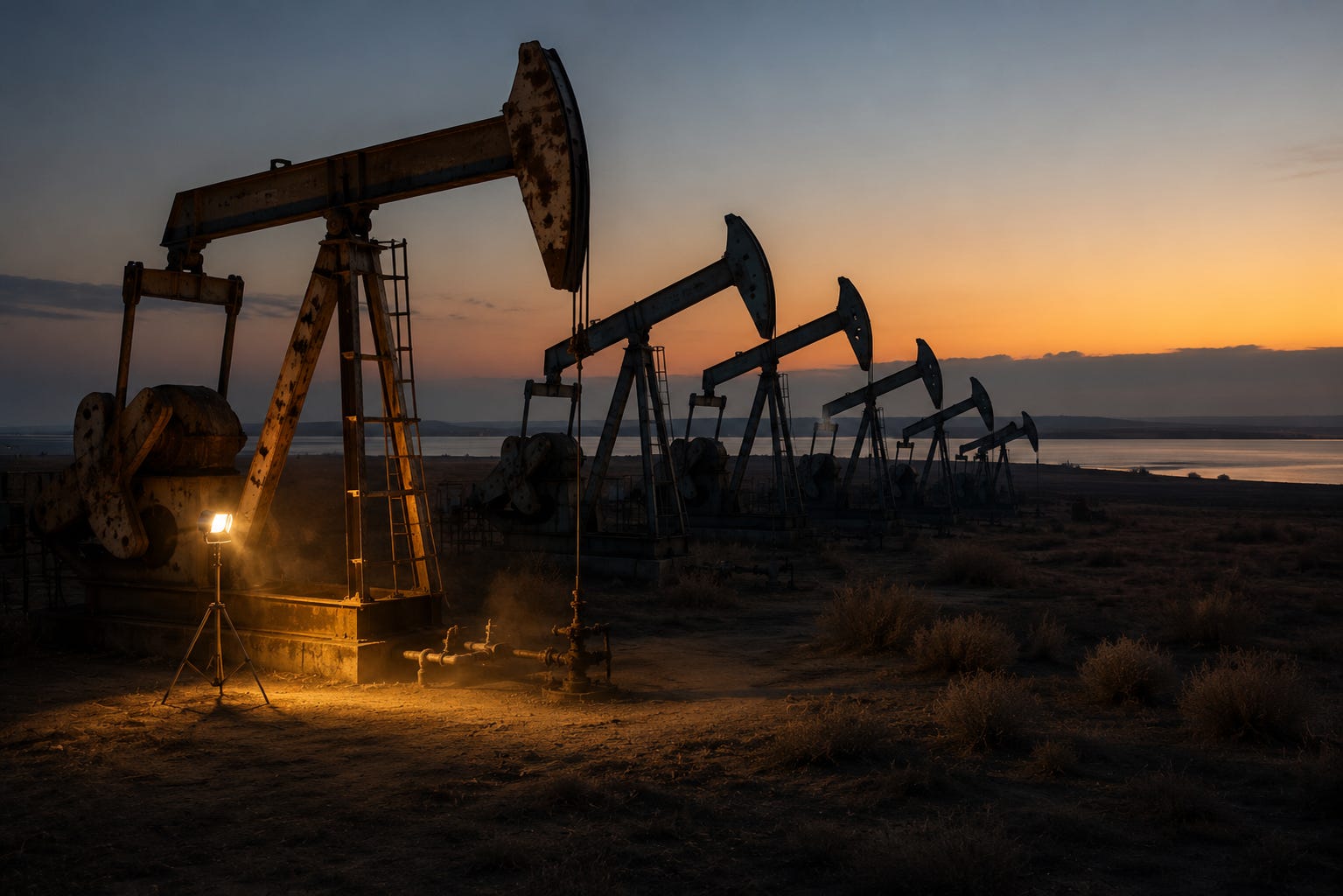
On 15 July, announced five days later, a Miami blank-check vehicle, Lionheart Holdings, signed a non-binding letter of intent to combine with KEO Energy, whose principal asset is an indirect interest in the joint venture holding the PetroUrdaneta Project in the Maracaibo Basin. The letter puts a preliminary pre-money enterprise value of $400 million on KEO Energy. The fields currently produce about 1,300 barrels a day.
Between 9 January and 20 July, the institutional machinery issued broad permissions and then went quiet. The US Treasury’s Office of Foreign Assets Control (OFAC) issued general licenses and extensions through the first quarter, culminating in General License 52 on 18 March, which permitted transactions with PDVSA entities for established US parties and became the legal basis for everything that followed. A separate track of licenses authorized financial advisory work, under which Centerview Partners, a boutique investment firm, was engaged by the Venezuelan government. OFAC has not issued the specific CITGO sale license; the IMF has not completed the debt sustainability analysis (DSA); Venezuela’s readmission to Mercosur remains unresolved; and Venezuela’s presidential elections have not been scheduled. ExxonMobil and ConocoPhillips, the two claimants with the strongest legal standing and the most to gain, remain uncommitted to further investment in Venezuela.
Over those same six months, Venezuelan sovereign bonds rose from $0.33 to $0.55 per $1.00, gaining roughly 67%, while Centerview, which conducted the DSA, added ~$60 billion in domestic obligations. And for the first time since the 1976 nationalization, a Venezuelan oil production asset was priced, albeit not at a hard price.
Typically, sovereign bond prices move in the opposite direction of the debt stack behind them, but in this case they did not, raising the question: Why not?
Three things happened since April that are of intangible value to some and of no value to others. First, the Lionheart non-binding letter of intent (LOI) was signed, but it is subject to diligence. This means the price is not fixed, nor is the equity swap. Second, while a date for convening a joint working agenda on political reforms between the presidents of the 2015 and 2026 National Assemblies has been set for 1 August, it does not represent a commitment to reforms. Lastly, a successful US-Venezuelan joint military operation against Tren de Aragua leadership — the first such collaboration in more than two decades — is a good sign, but it is work-in-progress security.
In May, I identified the four stakeholders whom President Delcy Rodríguez must delicately manage simultaneously — OFAC, the IMF and the World Bank, the Venezuelan military, and Mercosur — each applying a different standard of legitimacy to her government and expressing it in their own way: OFAC issues licenses, the Fund approves an Article IV, Mercosur readmits Venezuela to the bloc, and the majors’ capital committees approve audited reserve reports.
Lionheart is operating under OFAC General License 52, published in March, which permits negotiations with PDVSA, a Specially Designated National (SDN). Any further step — a binding Sale and Purchase Agreement, transfer of title, or settlement — still requires OFAC approval. Everyone operating in Venezuela does so with someone’s permission; what separates Lionheart from ExxonMobil is more about their investment thesis, risk tolerance, and internal decision-making processes and controls.

In Great Laws, Same People, I identified three reasons why foreign investment remains hesitant. The governing institutions that will enforce the new laws remain unreformed; there is no regional legal anchor, and Mercosur readmission remains out of reach; and a future government may deem today’s deals invalid on grounds of odiousness. Those risks remain. What has changed is that an investor class able to navigate and mitigate them has begun putting assets into play by making offers, in short, price discovery. Audentes fortuna iuvat.
The Paperwork Caught in the System
In November, Delaware federal Judge Leonard Stark approved the $5.9 billion sale of PDV Holding to Amber Energy, an Elliott Management affiliate, with $2.1 billion earmarked for PDVSA 2020 bondholders. Eight months later, the sale still has not closed. PDVSA and the Rodríguez government appealed to the Third Circuit in mid-January on conflict-of-interest grounds; the court asked Treasury for its view, but Treasury has not provided one. OFAC has yet to issue the required license, instead repeatedly extending the general license, most recently to 4 August. Gold Reserve’s fully financed $7.9 billion bid, two billion dollars higher, was passed over. Gold Reserve, Siemens Energy, and Valores Mundiales are pursuing appellate remedies. In May, I wrote that once the sale closes, Venezuela permanently loses its most valuable US asset, and every future creditor negotiates without CITGO in the collateral pool. Eight months later, creditors still do not know what is in the asset pool.
Centerview Partners, the New York boutique firm hired by Caracas, completed their DSA, placing Venezuela’s obligations at ~$240 billion. Compared with the $150–170 billion I and others estimated, that looks like a $70 billion surprise, but the devil is in the details. Centerview counted domestic obligations alongside external ones, roughly $159 billion owed abroad and the balance owed at home. My May figure referred to external sovereign and PDVSA debt, and that figure has not changed.
What changed is the number of claimants on total debt. Something like $60 billion in domestic obligations — pensions, public wages, unpaid suppliers — now sits within a debt restructuring that was not modeled and competes for the same cash flow.
Comments
Nothing yet. Say the first thing.
Sign in to join the conversation.