
A Note Before We Begin
This is the closing essay of our series “The Architects of AI”. If you have followed this series from the beginning, this essay is what all seven profiles have been building toward. If you are arriving here for the first time, it stands alone as the argument the series makes in full. Seven extraordinary minds. Seven worldviews shaping the future of human work and human identity. And one structural limitation that runs through all of them, the inability to fully apprehend what they are doing to the humans who will have to live in the world they are building. Read it because the question it raises, who are you, if not what you do, is the most important question of the AI age. And because the people with the most power to answer it are, for specific and documented reasons, the least equipped to do so.
We write about the human side of AI every week. Join the conversation.
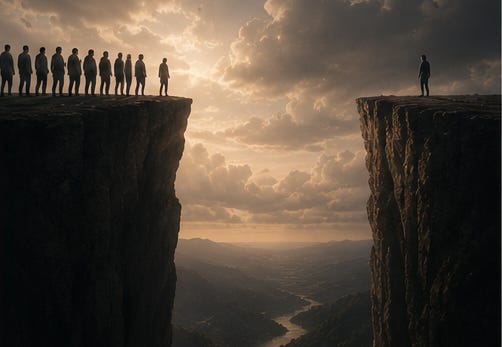
“There are basically two ways to know you have a future. One, you have some vocational training. Or two, you’re neurodivergent.”
These are the words of Alex Karp, CEO of Palantir, speaking in March 2026. He said them plainly, without apparent awareness of what they reveal. The man who studied democratic deliberation under one of the great philosophers of human communication had just told the world that the future he and his peers are building has room for two kinds of people: those who work with their hands, and those whose minds work like his.
Everyone else, the lawyers, the analysts, the writers, the teachers, the coordinators, the communicators, the vast majority of people who built their lives and identities around the exercise of ordinary human intelligence in professional contexts, was not mentioned. Because in the calculation, they do not appear.
That is the argument of this essay. Not that the Silicon Seven are villains. Not that they are deliberately deceiving us. But that the minds building the future of human civilisation are, in a specific and consequential way, structurally limited in their ability to understand the humans who will have to live in it. And that Karp’s statement, offered as career advice, received as a window into the worldview of the people with the most power over our collective future, is the clearest expression of that limitation in the public record.
The Calculation Problem
Every significant figure in this series thinks in systems.
Dario Amodei spent his doctoral years studying how neural circuits produce emergent behaviour, how simple rules at one level of organisation generate unexpected properties at another. Sam Altman frames every major decision as an expected value calculation, the benefit of proceeding multiplied by its probability, weighed against the cost of the outcome if it goes wrong. Peter Thiel built his entire intellectual architecture on René Girard’s mimetic theory, a mathematical model of human desire as imitation and rivalry. Jensen Huang spent thirty years optimising parallel processing architectures, the art of breaking complex problems into thousands of simultaneous calculations. Elon Musk approaches every challenge, from rocket design to the question of human meaning, through first principles reasoning, stripping a problem to its fundamental components and rebuilding from the bottom up.
These are extraordinary cognitive tools. They are also tools with specific limitations.
A system can be optimised. A calculation can be balanced. An algorithm can be refined. But there are things that cannot be optimised, balanced or refined without ceasing to be what they are. Meaning is one of them. Dignity is another. The experience of mattering, of contributing something irreplaceable, of being seen and valued as a person rather than a function, does not exist in the calculation. It cannot be entered as a variable because it resists quantification. And things that cannot be quantified tend not to appear in the models of people who think primarily in quantities.
When Altman describes his ideal AI as a “median human you could hire as a co-worker, one that never sleeps, never asks for a raise and scales infinitely,” he is not being deliberately reductive. He is being precise in the only language his formation gave him. The human being in that description has been distilled to their economic function. What remains after the distillation, the relationships, the creativity, the freedom of thought, the need to matter, was not in the specification because it was never in the calculation.
This is the root of the problem. Not malice. Not deception. A specific and consequential form of blindness that is the shadow side of extraordinary analytical intelligence.
The Neurodivergence Question
Consider who these people are, beneath the wealth and the power and the public profiles.
Elon Musk disclosed on Saturday Night Live in 2021 that he has Asperger’s syndrome, a form of autism spectrum condition characterised by exceptional pattern recognition, systems thinking and a different relationship with social and emotional attunement. He described it as a superpower and a challenge simultaneously. The boy who read encyclopaedias for entertainment. The teenager who retreated into books and computers from a world that bullied and bewildered him. The man who experiences human connection, by his own account, as something he has to work at rather than something that comes naturally.
Alex Karp has spoken openly about his severe dyslexia and the cognitive style it produced, a compensatory strength in abstraction, pattern recognition and nonstandard problem-solving that he credits directly for Palantir’s success. At the Economic Club of New York in February 2025, he said his dyslexia became valuable in the age of large language models precisely because it pushed him toward thinking outside conventional structures. Palantir has since launched a Neurodivergent Fellowship, explicitly recruiting people whose minds work differently from the neurotypical norm.
Peter Thiel became a chess Life Master at twenty-four, reaching a peak rating that placed him among the top players in the United States. Chess is a game of pure logic, long planning horizons and the ruthless exploitation of positional advantage. It rewards the mind that can see ten moves ahead and punishes the one that is distracted by how the other player feels. His described difficulty with social convention and his preference for systems over people fits a pattern that people who know him well have noted, though he has never disclosed a formal diagnosis.
Jensen Huang spent his formative years as a displaced child navigating alien environments, a Taiwanese boy in a Thai school, then a Chinese-American boy in a Kentucky reform school, then an immigrant child in Oregon. The mind that cannot rely on social belonging learns to rely on pattern and logic instead. He cleaned bathrooms for a hundred teenage boys every day and described it as character formation rather than suffering. That is not the emotional processing of a neurotypical child. It is the cognitive style of someone who has learned, out of necessity, to convert experience into abstraction.
Mark Zuckerberg has never disclosed a diagnosis. Multiple people who have worked closely with him over decades have described characteristics consistent with autism spectrum conditions, the flat affect in social situations, the difficulty with spontaneous human interaction, the extraordinary capacity for sustained analytical focus, the relationship with people that seems to operate more like a system to be navigated than a source of warmth and meaning. He has spent billions of dollars on coaches, advisers and communications professionals to help him perform the social and emotional dimensions of leadership that do not come naturally. The MMA training and the reinvention are, among other things, attempts to inhabit an embodied, physical, emotionally legible identity that his natural presentation does not provide.
None of this is a criticism. Neurodivergent minds have produced some of the most important advances in human history. The capacity for pattern recognition, sustained analytical focus and systems thinking that characterises autism spectrum conditions and related cognitive profiles is genuinely extraordinary and has driven breakthroughs that neurotypical minds would not have reached.
But it is also a mind that experiences the world differently from the majority of human beings. A mind that may find it genuinely difficult to apprehend what cannot be systematised, the need to feel seen, the importance of dignity, the experience of meaning that comes from doing work that connects you to other people and to something larger than yourself. These are not edge cases in the human experience. They are central to it. And the people building the technology that will restructure that experience may be, as a group, among the least equipped by neurology and formation to fully understand what they are restructuring.
Karp’s statement crystallises this. He was not being cruel when he said the future belongs to trade workers and neurodivergent people. He was being honest, honest about a future being built by and for minds like his, in which the qualities that make most human beings fully human are not competitive advantages but liabilities.
The question that statement raises is not whether Karp is right. He may well be right about who will thrive in the economy his peers are building. The question is whether a future designed around that answer is one that serves human beings or merely the subset of human beings whose minds resemble those of the people doing the designing.
Next week we start our new series on the meaning of work. Subscribe to follow along.
The Thirteen Thousand Five Hundred Dollar Question
Sam Altman has proposed Universal Basic Income as the structural response to AI-driven job displacement. In 2021 he wrote that AI could generate enough wealth to fund a UBI of thirteen thousand five hundred dollars annually for every adult in the United States. In 2024 he extended this to propose “universal basic compute”, a share of AI processing power distributed to every person.
These are serious proposals, offered in good faith by a man who has thought carefully about the distributional consequences of what he is building. They are also proposals that could only have been designed by someone who has never had to live on thirteen thousand five hundred dollars.
$13,500 annually is $37 a day. In San Francisco, where OpenAI and Anthropic are headquartered, the median one-bedroom apartment costs over $2,500 a month, more than the entire annual UBI before a single other expense is paid. In New York, in London, in any major city where the white-collar jobs being displaced are concentrated, $37 a day does not cover rent. It does not cover food, transport, childcare or any of the other costs of a life in a modern economy.
The calculation balances. The equation works on paper. The number is large enough to register as serious. But the calculator has never had to live inside the equation, has never had to choose between rent and food on $37 a day, has never experienced the specific humiliation of material dependency that is qualitatively different from voluntary simplicity. Altman’s Big Sur land alone, a single asset among many, is worth more than most people will earn across an entire working life.
And this is before the more fundamental question is addressed. The productivity gains from AI will flow overwhelmingly to the owners of the technology and the capital behind it. The wealth concentration data documented throughout this series is unambiguous, the richest one percent already own forty-five percent of global wealth, and that concentration is accelerating. AI will not reverse this dynamic. It will intensify it. The people proposing UBI as the solution are the same people who will capture the majority of the value that makes UBI necessary.
Funding UBI at meaningful scale requires taxing those gains. That requires political will, international coordination and the active support of the people whose gains are being taxed. The wealthiest individuals and corporations have spent decades and billions of dollars lobbying against precisely this kind of redistribution. There is no historical precedent for voluntary wealth redistribution at the scale that would be required. And the people who would need to support it most strongly are the people whose entire formation, from chess prodigy to PayPal founder to rocket builder, has been oriented toward the accumulation rather than the distribution of advantage.
The $13,500 figure is a symptom of the calculation problem. It addresses the economic variable and misses the human entirely. Because even if UBI were funded at a level that covered the cost of living, which it is not, it would not address what the research consistently shows people actually lose when work disappears. They lose structure. They lose identity. They lose the daily sense of contributing something that matters. They lose the social connections that work provides. They lose, in short, the things that make a life feel worth living, none of which appear in the calculation because none of them can be quantified.
The early retirement studies are unambiguous. Lottery winner research is unambiguous. The deaths of despair data from the rust belt and the coalfields is unambiguous. Material comfort without meaning does not produce flourishing. It produces deterioration. The UBI proposal, generous in its intent, is solving the wrong problem, because the minds designing the solution are not equipped to fully apprehend the problem they are solving.
What the Calculation Cannot Capture
There is a distinction that runs through the history of philosophy that the Silicon Seven, as a group, appear not to have encountered or not to have taken seriously. It is the distinction between a problem and a mystery.
A problem is something that can be solved. You identify the variables, apply the appropriate method and arrive at an answer. The problem ceases to exist once the answer is found. Problems are the natural domain of analytical intelligence. They are what systems thinking, first principles reasoning and expected value calculation are designed for. The Silicon Seven are among the most gifted problem-solvers in human history.
A mystery is something different. A mystery cannot be solved because it is not that kind of thing. It can only be entered, lived with, explored and partially understood, and that partial understanding itself becomes part of the mystery rather than its resolution. Love is a mystery. Death is a mystery. The question of what makes a human life meaningful is a mystery. These are not problems awaiting better algorithms. They are conditions of human existence that resist quantification by their nature.
The experience of meaningful work is a mystery in this sense. It is not primarily about income, though income matters. It is not primarily about productivity, though productivity is one of its expressions. It is about the felt sense of contributing something irreplaceable, of bringing to a task a combination of knowledge, judgment, creativity and human presence that could not be supplied by anyone or anything else. It is about being needed in a way that is specific to you. That specificity is the heart of it. And it is precisely what AI, by definition, removes.
When an AI system performs a task previously performed by a human being, it does not merely automate the task. It makes the task generic. It demonstrates that the task did not, in fact, require the specific person who was doing it, that any sufficiently capable system could do it instead. That demonstration, multiplied across the entire white-collar economy, is not primarily an economic event. It is an existential one. It tells millions of people that the primary way they understood themselves to matter, the expertise they spent years developing, the judgment they were proud of, the work that made them feel indispensable, was, in the end, replaceable.
No UBI payment addresses that. No universal basic compute allocation restores it. And the people designing the response to it cannot fully apprehend what needs to be addressed because their own experience of mattering has never been primarily dependent on their professional function. Their identity was always in the mission, the technology, the civilisational project, something larger than any role. They built their sense of self around ideas rather than positions. That capacity, to know who you are beyond what you produce, is something they possess naturally and propose as a solution without understanding how rare it is, how long it takes to develop, and how completely the systems they built have failed to cultivate it in anyone else.
Are They Deceiving Us, or Do They Simply Not See?
The question you have to answer, having spent seven weeks inside the profiles of these seven people, is whether the gap between what they say and what they build represents deliberate deception or structural blindness.
The evidence suggests it is more the latter than the former, though not entirely.
The walkbacks of May 2026, Altman saying he was “pretty wrong” about job displacement, Amodei reversing his white-collar bloodbath predictions at precisely the moment both companies are preparing for public listings, introduce a dimension of calculation that cannot be fully separated from convenience. The timing is too precise. The reversals too complete. The silence about the relationship between the changed position and the changed commercial circumstances too conspicuous.
But the deeper failure , the $13,500 UBI, the median human co-worker specification, Karp’s unselfconscious declaration that the future belongs to the neurodivergent, these do not read as deception. They read as the honest outputs of minds that are genuinely trying to address consequences they are not fully equipped to understand.
Karp is not being cruel when he describes a future reserved for trade workers and neurodivergent people. He is being accurate about the future his cohort is building and honest about who he believes will navigate it. The cruelty, if there is cruelty, is not in the statement. It is in the absence of any apparent recognition that designing a future optimised for a specific cognitive profile, without asking what happens to everyone whose mind works differently, is itself a choice, a choice being made by people whose formation never required them to ask what it costs to be left behind.
This is the deepest form of not understanding the human in human beings. It is not ignorance of facts. It is a kind of experiential gap, the gap between a mind that has always navigated the world through its extraordinary analytical gifts and a mind that experiences the world primarily through feeling, relationship, the need for belonging and the sense of contributing something that matters. The former group is building the future. The latter group is the majority of humanity.
The Planet They Are Burning to Build It
There is one more variable missing from the calculation. The planet.
A single AI-focused data centre can consume as much electricity as one hundred thousand households and up to five million gallons of water daily for cooling. This is not a fringe case. This is the standard unit of infrastructure that the Silicon Seven are multiplying across the landscape at a pace that has no historical precedent.
US data centres alone generated more than one hundred and five million tons of CO2 equivalent in a single year, with 56% of their electricity derived from fossil fuels, a carbon intensity 48% higher than the US average. In Ireland, regarded as a European tech hub, data centres already consume 21% of the nation’s electricity, with the IEA estimating that share could rise to 32% by 2026. In Dublin the figure is already seventy-nine percent.
The carbon footprint of AI systems alone could reach between thirty-two and eighty million tons of CO2 emissions in 2025, while the water footprint could reach between 312 and 64 billion litres, equivalent to the entire global annual consumption of bottled water.
By 2026, the electricity consumption of data centres is expected to approach one thousand and fifty terawatt-hours, which would place data centres fifth on the global list of electricity consumers, between Japan and Russia. Researchers at MIT have concluded that “the demand for new data centres cannot be met in a sustainable way” and that “the pace at which companies are building new data centres means the bulk of the electricity to power them must come from fossil fuel-based power plants.”
Altman’s Stargate initiative alone, $500 billion of AI infrastructure to be built across the United States, represents one of the largest single additions to energy demand in American history, at precisely the moment when the scientific consensus requires dramatic reductions in energy consumption from fossil sources.
The irony is almost too large to hold. A group of people who, by their own account, are building technology to cure disease, eliminate poverty and strengthen democratic governance are, in the process of building it, accelerating the environmental destruction that makes all of those outcomes less likely. The technology that is supposed to save civilisation is being powered, in significant part, by the fossil fuels that are destroying the conditions under which civilisation is possible.
And this brings us to the question that none of the profiles, none of the public statements, none of the essays and manifestos and congressional testimonies have answered.
To what end?
If the displacement is real, if jobs disappear, if white-collar work is automated, if the communities built around professional labour hollow out the way the mining towns and steel cities hollowed out before them, and if the planet is simultaneously being strained by the energy demands of the infrastructure doing the displacing, what exactly is the destination?
Musk wants to die on Mars. Thiel has New Zealand citizenship and has discussed leaving the United States. Altman has land in Big Sur and a bunker’s worth of supplies. Amodei has his entente strategy, a partnership with democratic nations that, in practice, means the technology serves the states that can afford it. Karp has explicitly said the future belongs to two groups of people.
What about everyone else?
The calculation, followed to its logical conclusion, produces a world in which a small number of people, those with capital, those who own the technology, those whose cognitive profiles make them useful to the systems being built, accumulate the gains. Everyone else is offered thirteen thousand five hundred dollars a year and asked to find meaning in something other than work, on a planet whose climate is being destabilised by the infrastructure of the technology that displaced them.
The Silicon Seven are not planning for that world. They are not asking what it looks like, who lives in it, or whether the people left behind would recognise it as a future worth having. The calculation does not ask those questions because the calculator is not going to live in that world. They are going to live in the other one, the one with the Big Sur land and the New Zealand passport and the Mars rocket and the bunker.
This is not dystopian speculation. It is the logical extension of the evidence assembled across seven profiles. And it is the question that the synthesis of all seven leaves ringing in the air, unanswered, because the people with the most power to answer it have never had to.
The human in human beings is the part that asks: what is this all for? What kind of world are we building, for whom, and at what cost to the people and the planet we are building it on?
The calculation has no answer to that question. Because that question is not a calculation.
It is a mystery. And it is ours to live with.
The Planet They Are Burning to Build It
There is one more variable missing from the calculation. The planet.
A single AI-focused data centre can consume as much electricity as one hundred thousand households and up to five million gallons of water daily for cooling. This is not a fringe case. This is the standard unit of infrastructure that the Silicon Seven are multiplying across the landscape at a pace that has no historical precedent.
US data centres alone generated more than 105 million tons of CO2 equivalent in a single year, with 56% percent of their electricity derived from fossil fuels, a carbon intensity 48% higher than the US average. In Ireland, regarded as a European tech hub, data centres already consume 21% of the nation’s electricity, with the IEA estimating that share could rise to 32% by 2026. In Dublin the figure is already 79%.
The carbon footprint of AI systems alone could reach between thirty-two and eighty million tons of CO2 emissions in 2025, while the water footprint could reach between three hundred and twelve and seven hundred and sixty-four billion litres, equivalent to the entire global annual consumption of bottled water.
By 2026, the electricity consumption of data centres is expected to approach one thousand and fifty terawatt-hours, which would place data centres fifth on the global list of electricity consumers, between Japan and Russia. “The demand for new data centres cannot be met in a sustainable way,” researchers at MIT have concluded. “The pace at which companies are building new data centres means the bulk of the electricity to power them must come from fossil fuel-based power plants.”
Altman’s Stargate initiative alone, $500 billion of AI infrastructure to be built across the United States, represents one of the largest single additions to energy demand in American history, at precisely the moment when the scientific consensus requires dramatic reductions in energy consumption from fossil sources.
The irony is almost too large to hold. A group of people who, by their own account, are building technology to cure disease, eliminate poverty and strengthen democratic governance are, in the process of building it, accelerating the environmental destruction that makes all of those outcomes less likely. The technology that is supposed to save civilisation is being powered, in significant part, by the fossil fuels that are destroying the conditions under which civilisation is possible.
And this brings us to the question you have to ask, having followed this series from the beginning. The question that none of the profiles, none of the public statements, none of the essays and manifestos and congressional testimonies have answered.
To what end?
If the displacement is real, if jobs disappear, if white-collar work is automated, if the communities built around professional labour hollow out the way the mining towns and steel cities hollowed out before them, and if the planet is simultaneously being strained by the energy demands of the infrastructure doing the displacing, what exactly is the destination?
Musk wants to die on Mars. Thiel has New Zealand citizenship and has discussed leaving the United States. Altman has land in Big Sur and a bunker’s worth of supplies. Amodei has his entente strategy, a partnership with democratic nations that, in practice, means the technology serves the states that can afford it. Karp has explicitly said the future belongs to two groups of people.
What about everyone else?
The calculation, followed to its logical conclusion, produces a world in which a small number of people, those with capital, those who own the technology, those whose cognitive profiles make them useful to the systems being built, accumulate the gains. Everyone else is offered thirteen thousand five hundred dollars a year and asked to find meaning in something other than work, on a planet whose climate is being destabilised by the infrastructure of the technology that displaced them.
The Silicon Seven are not planning for that world. They are not asking what it looks like, who lives in it, or whether the people left behind would recognise it as a future worth having. The calculation does not ask those questions because the calculator is not going to live in that world. They are going to live in the other one, the one with the Big Sur land and the New Zealand passport and the Mars rocket and the bunker.
This is not dystopian speculation. It is the logical extension of the evidence assembled across seven profiles. And it is the question that the synthesis of all seven leaves ringing in the air, unanswered, because the people with the most power to answer it have never had to.
The human in human beings is the part that asks: what is this all for? What kind of world are we building, for whom, and at what cost to the people and the planet we are building it on?
The calculation has no answer to that question. Because that question is not a calculation.
It is a mystery. And it is ours to live with.
The Question the Series Leaves Open
Seven profiles. Seven extraordinary people. Seven minds shaped by displacement, neurodivergence, ambition, childhood suffering, philosophical formation and the intoxicating proximity of transformative power.
Each of them has, in their own way, asked the question that sits at the heart of this series. Musk asked it from a stage in Paris. Karp asked it in a Philadelphia high school assembly room when he came out about his dyslexia. Amodei asked it in his doctoral thesis about the collective behaviour of neural circuits. Altman asked it sitting around a fire pit at a Y Combinator party, cataloguing his preparations for civilisational collapse.
The question is: what makes a human life worth living when the structures that previously organised it are gone?
None of them has answered it. Because answering it requires a kind of understanding that the calculation cannot provide. It requires sitting with the mystery rather than solving the problem. It requires knowing, from the inside, not from the model, what it feels like to need to matter and to find that the thing you built your mattering around has been automated away.
The steelworker in Motherwell knew what that felt like. The miner in Merthyr Tydfil knew. The entry-level analyst whose role disappeared before they developed the judgment to operate at a higher level is beginning to know. The mid-level engineer whose six-figure salary evaporated when Zuckerberg’s AI replaced them is beginning to know.
They are not neurodivergent. They did not learn to navigate the world through pattern recognition and systems thinking. They experienced it through feeling, through relationship, through the daily accumulation of work that connected them to other people and to a sense of purpose. And the future being built for them was designed by people who, with the best intentions and the most extraordinary intelligence, do not fully understand what they had or what they have lost.
Who are you, if not what you do?
The Silicon Seven are asking this question from a position of almost unlimited power, extraordinary wealth and a self-understanding that was never primarily dependent on their professional function.
For the rest of us, it is not a philosophical curiosity. It is an emergency.
And the people with the most power to address it are the people least equipped, by formation and by neurology, to understand why.
Next week: We start our new essay series, “The Meaning Crisis”. A collection of essays on work, identity, purpose and the deeper human problem underneath the economic one. Each essay builds on the previous one. Read them in order for the full argument, or start anywhere as each one stands alone. The first in the series,"Resistance As An Expression Of Identity" makes the case for why the most experienced professionals in your organisation are pushing back against AI, why treating it as a change management problem is making it worse, and what a genuinely human response looks like.
No posts
Comments
Nothing yet. Say the first thing.
Sign in to join the conversation.