
A Note Before We Begin
The richest 1% of the global population owns 45% percent of all global wealth. Billionaire wealth grew by $2 trillion in 2024 alone. AI will only intensify this. The people building AI are protecting their own children from screens and AI dependency while pushing both into everyone else’s classrooms. This is the fifth essay in our discussion series “The Meaning Crisis.” The previous four essays established that human beings do not work only for money, that the loss of work produces psychological and cognitive deterioration beyond the financial loss, and that the structure, identity, social connection and collective purpose that work provides are essential to human flourishing in ways that income replacement does not address. Read this essay to understand what the wealth concentration problem in the age of AI actually means and why it matters far beyond the economics.
We write about the human side of AI every week. Join the conversation.
In 2024, global billionaire wealth surged by $2 trillion, equivalent to $5.7 billion every single day. By March 2025, the world had 3,028 billionaires, holding a combined $16.1 trillion, up from 2,781 billionaires holding $14.2 trillion the previous year, a 13.4% increase in a single year.
By 2026 that figure had accelerated further. The Forbes annual list recorded 3,428 billionaires holding a combined $20.1 trillion, a further 25% increase in twelve months. On 12 June 2026, Elon Musk became the world’s first trillionaire following the SpaceX IPO, pushing his personal net worth above $1 trillion dollars and making him alone worth more than the combined wealth of the bottom 50% of the global population.
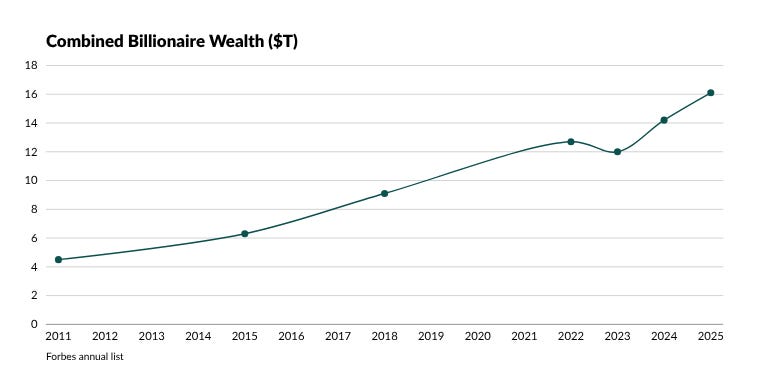
The wealthiest 1% of the global adult population captured 38% of all additional wealth accumulated since the mid-1990s, with annual wealth growth rates for this group reaching 6% to 9% versus a 3.2% average global wealth growth rate. The poorest half of the global population possesses just 2% of total wealth. Since 2015, the world’s richest 1% have gained $33.9 trillion in wealth.
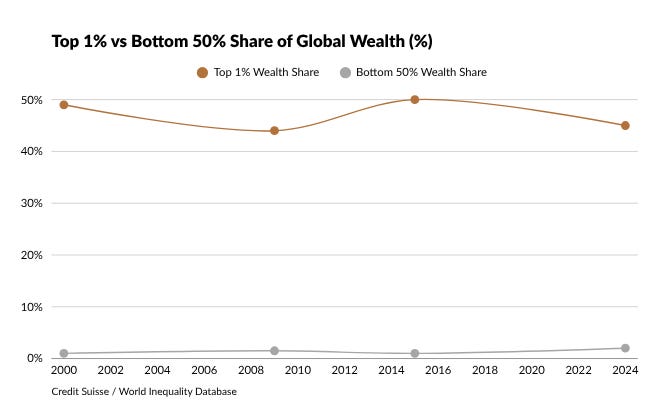
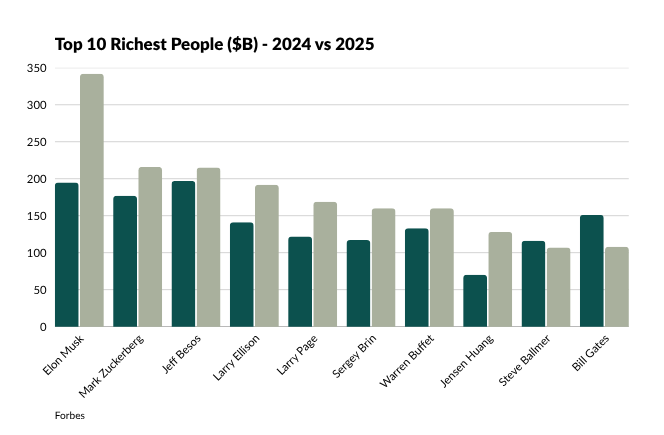
In 2025, the world’s 12 richest men owned more wealth than the bottom half of humanity combined. (https://www.oxfamamerica.org/explore/issues/economic-justice/what-percent-of-the-worlds-wealth-is-controlled-by-billionaires/)
These numbers are not new. Wealth concentration has been accelerating for decades. What is new is the technology that is about to accelerate it further and the specific way in which that acceleration will determine not just who is materially comfortable but who has access to the cognitive and human conditions that make a meaningful life possible.
AI As An Accelerant
The productivity gains from AI will flow overwhelmingly to the owners of the technology and the capital behind it and this is already the observed pattern. The companies building and deploying AI such as the Nvidias, the OpenAIs, the Metas, the Anthropics are concentrating extraordinary value in the hands of their shareholders, executives and early investors. The workers whose tasks are being automated are not sharing in those gains. The communities whose defining industries are being disrupted are not receiving compensation for that disruption.
The UBS Global Wealth Report 2025 found that global wealth grew 4.6% in 2024, but the growth was tilted overwhelmingly toward North America, with more than half of the 56 markets in the sample seeing average wealth per adult decline in real terms. (https://www.ubs.com/global/en/media/display-page-ndp/en-20250618-gwr-2025.html)
This is the pattern that AI will intensify. Technology that increases productivity without redistribution concentrates gains at the top of the wealth pyramid while the displacement costs; the loss of employment, the erosion of the latent functions that work provides, the psychological and cognitive deterioration, will fall on the workers displaced.
The wealth concentration problem does not only compound the loss of the functions of work explored in this series. It determines who has the resources to rebuild those things after displacement, and AI is widening that gap.
The most vivid single illustration of this pattern arrived on 12 June 2026. Elon Musk became the world’s first trillionaire following the SpaceX IPO, the largest in history, which priced at approximately $1.75 trillion and rose 19% on its first day of trading. The mechanism that produced this milestone is worth examining closely because it illustrates the wealth concentration argument more precisely than any statistic.
In February 2026 SpaceX acquired xAI, Musk’s own artificial intelligence company, in what CNBC described as the largest private merger in history, valued at $1.25 trillion. It was a transaction between two companies that Musk controlled. (https://www.cnbc.com/2026/02/03/musk-xai-spacex-biggest-merger-ever.html) The combined entity then listed publicly while the SEC, under a chair appointed by the administration Musk had spent $291 million helping to elect, loosened IPO regulations and granted Wall Street brokers a last-minute exemption from consumer protection rules specifically for the listing. (https://jacobin.com/2026/06/musk-spacex-ipo-sec-regulation)
Senator Elizabeth Warren described Musk’s power as “uniquely unchecked” and demanded the IPO be delayed. A March 2026 analysis found that while Musk led the Department of Government Efficiency (DOGE) and cut federal spending, SpaceX swept 100% of National Security Space Launch contracts awarded through May 2026, worth $1.55 billion, while competitors received nothing. (https://www.ibtimes.co.uk/elon-musk-trillionaire-spacex-government-support-1802598)
Musk’s net worth as a result now exceeds $1 trillion, more than twice the combined wealth of the next two richest people on earth. The productivity gains from AI, concentrated in a company built on government contracts and restructured through a self-dealing merger in a regulatory environment deliberately loosened for the purpose, have produced the first trillionaire in human history.
The Cognitive Inequality Problem
The people who will be most cognitively equipped to navigate the AI transition, to adapt, retrain, find new sources of meaning and purpose, build alternative protective structures are not randomly distributed across the population. They are concentrated among the people with the resources, the education and the social capital to have developed robust cognitive foundations before the transition arrived.
These are the same people that are building the AI that will reshape everyone else’s cognitive lives while, in significant numbers, they are deliberately protecting their own children from it.
The Waldorf School of the Peninsula in Los Altos, California charges $25,000 a year for elementary school. 75% of its students have parents who work in the technology industry. The school bans screens entirely until students reach their teens. No tablets. No laptops. No smartboards. Instead: pens and paper, knitting needles, blackboards, hands-on making, physical activity and face-to-face human connection.
The chief technology officer of eBay sends his children there. So do employees of Google, Apple, Yahoo and Hewlett-Packard. (https://ilac.com/blog/tech-free-schools-for-children-of-silicon-valley/)
Alan Eagle, an executive communications employee at Google, told the New York Times that his fifth-grade daughter attends a Waldorf school and does not know how to use Google. “The idea that an app on an iPad can better teach my kids to read or to do arithmetic, that’s ridiculous,” he said.
Steve Jobs, when asked how his children liked the iPad his company had created, replied: “They haven’t used it. We limit how much technology our kids use at home.”
Chris Anderson, CEO of drone company 3D Robotics and former editor of Wired magazine, described himself and his wife as “fascists” when it came to limiting their children’s technology access. “That’s because we have seen the dangers of technology firsthand,” he said. “I’ve seen it in myself. I don’t want to see that happen to my kids.”
As Adam Alter, author of Irresistible: The Rise of Addictive Technology, observed: “It’s as if the tech execs are following the well-known drug dealer’s credo: never get high on your own supply.” (https://successfulparent.substack.com/p/silicon-valleys-dark-secret-tech)
This essay is part of our Meaning Crisis series. If you’re enjoying it, subscribe to follow along.
What The Neuroscience Shows
While it’s easy to dismiss as paranoia, unfortunately the neuroscience increasingly supports the choices that these executives are making to protect their children from the technologies that they are deploying.
A longitudinal study published in Neuroscience News in December 2025 followed children for more than a decade and found that high screen exposure before age two was associated with premature specialisation in brain networks involved in visual processing and cognitive control which later reduced flexibility during thinking tasks. Children with these altered brain networks took longer to make decisions during cognitive tasks at age eight and a half and reported higher anxiety symptoms at age thirteen. The findings suggest that screen exposure in infancy may have effects that extend well beyond early childhood, shaping brain development and behaviour years later. (https://neurosciencenews.com/anxiety-neurodevelopment-screen-time-30079/)
A 2025 review published in Children, examining studies published between 2014 and 2024, found consistent associations between extended screen time in children and adolescents and attention difficulties, cognitive impairment and potential connections to attention deficit and hyperactivity disorder. (https://www.mdpi.com/2227-9067/12/10/1297)
An MIT Media Lab study found that participants who used AI to write essays showed the weakest neural connectivity of all groups, struggled to accurately recall their own work, and showed cognitive effects that persisted for up to four months after the study.
The picture that emerges from the neuroscience is consistent. Screens and AI dependency, introduced early and used heavily, reshape the developing brain in ways that reduce cognitive flexibility, attention capacity and independent thinking. The cognitive foundations, the capacity for deep reading, sustained attention, independent reasoning, creative problem-solving, that are built through handwriting, physical making, face-to-face interaction and unmediated thinking are not being built when those activities are replaced by digital interfaces.
The people who understand this most clearly are, in significant numbers, the people building the technology. And they are making sure their own children are protected from it.
A Two-Tier Cognitive Future
The pattern that emerges from placing these observations alongside each other is that the children of the wealthy, of the professional class with the resources and the knowledge to make deliberate choices about technology exposure, are growing up with the cognitive foundations that the neuroscience shows are protective. Deep attention. Independent reasoning. Creative problem-solving. The ability to think without a machine doing the thinking for them.
The children of everyone else are growing up in an educational environment that is moving in the opposite direction. Tablets in classrooms. AI tutoring tools. Digital platforms that outsource cognitive work from the age at which the brain’s most important developmental windows are open.
The gap this is creating is cognitive. It is the difference between a mind that has been built, through the slow, effortful, unmediated work of learning to read deeply, to reason independently, to create without assistance and a mind that has been trained to rely on the tool.
In the age of AI, the people who can think without the machine will be the people best positioned to use the machine well. The people who cannot think without it will be dependent on whoever controls it.
The wealth concentration problem, in the age of AI, is not only about who owns the technology but who owns their own mind.
The Meaning Dimension
Our previous essays in this series established that meaningful work requires the exercise of capacities that are specifically human; cognitive, creative, social. The experienced professional who knows when the AI is wrong, understands the context the model cannot see and can make the judgment call that the output is technically correct but humanly inadequate.
The cognitive inequality argument states that the capacity to exercise those specifically human functions; the judgment, the contextual understanding, the creative reasoning that makes a person irreplaceable in ways an AI cannot be, is not equally distributed. It is built over years through specific kinds of cognitive development and the conditions under which that development occurs are themselves unequally distributed, in ways that AI is making more unequal rather than less.
A world in which the children of the wealthy develop full cognitive independence while the children of the displaced develop dependence on AI tools is not a world of equal opportunity in any meaningful sense. It is a world in which the accident of birth determines not just material circumstances but cognitive capability and therefore the capacity for the kind of meaningful, purposeful, irreplaceable contribution that is essential to human flourishing.
The wealth concentration problem, in this framing, extends what has so far been an economic problem or even a political problem to include a meaning problem. It determines who will be able to participate in the kind of purposeful, cognitively engaged work that the research consistently shows is central to a good life. And it is being determined, right now, by choices being made by a small number of people who are making very different choices for their own children than the ones being made for everyone else’s.
What A Responsible Response Would Look Like
A responsible response to the wealth concentration problem in the age of AI would need to address all three of its dimensions simultaneously.
The economic dimension requires genuine redistribution of AI productivity gains, not just UBI, that includes mechanisms for meaningful profit-sharing with workers whose efficiency improvements are driving the gains, and investment in the public infrastructure that can provide the latent functions that work has provided.
The cognitive dimension requires a serious and honest conversation about what kind of education actually develops the cognitive foundations that the AI age will require. The neuroscience points toward the same things the Waldorf school executives are already choosing for their own children; deep reading, physical making, face-to-face interaction, unmediated creative work, the slow development of attention and independent reasoning. The question of whether those things will be available to all children or only to those whose parents can pay $25,000 a year for them is one of the most important educational policy questions of the current moment.
And the meaning dimension requires acknowledging that the capacity for meaningful, purposeful, irreplaceable human contribution, the thing that the research consistently shows is essential to human flourishing, is not automatically preserved by economic growth or technological progress. It has to be deliberately cultivated. And the cultivation has to reach the people who need it most, not only the children of the people who already understand what is at stake.
The drug dealer who does not use their own product knows something important about what that product does.
The question is whether the rest of us will learn the same lesson before it is too late to act on it.
Next week: “If the computer and robots can do everything better than you, does your life have meaning?” Elon Musk, VivaTech Paris 2024. Our next essay takes that question seriously, as philosophy, as policy and as the central challenge of the AI age and attempts an honest answer.
No posts
Comments
Nothing yet. Say the first thing.
Sign in to join the conversation.