
Operating under the assumption that the EU AI Act is strictly a “European problem” is no longer just a misconception, it is a significant regulatory liability. For years, global leaders in Silicon Valley, London, and Singapore have viewed Brussels’ regulatory reach as a distant concern. That era ended in February 2025.
The same pattern keeps repeating: organisations waiting for a “final” global consensus while the EU has already moved the goalposts. The first wave of prohibitions and mandatory requirements is already active. This is not a roadmap for the future; it is a current operational mandate. If your organisation utilises AI, the transition from technical risk to institutionalised regulatory liability is already underway.
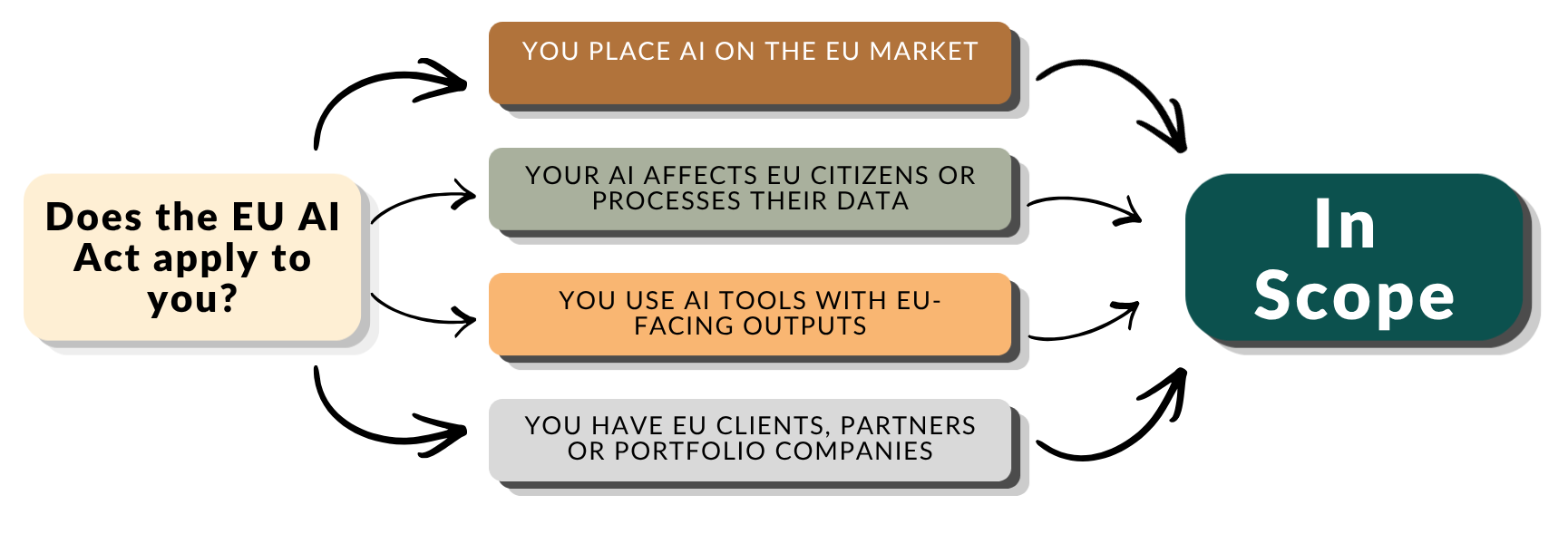
The most critical reality for global leaders is the “Brussels Effect”, the extraterritorial reach of the Act. You do not need a physical presence in the EU to fall under its jurisdiction. If your AI system affects EU citizens, processes their data, or is placed on the EU market, you are in scope.
This reach extends further than many realise. Even if your headquarters are in a non-EU jurisdiction like the UK or the US, your outputs and business interests are subject to these mandates if they touch the European market.
There is a pervasive myth that only the “Providers”, the developers coding the foundation models, bear the burden of compliance. In reality, the Act places heavy obligations on “Deployers” (the organisations using AI tools).
If your firm uses AI for “High Risk” activities, such as Recruitment AI used in hiring decisions or tools for credit scoring and critical infrastructure, you face significant legal mandates. Even if you did not build the tool, you are legally responsible for risk assessments, human oversight mechanisms, and ensuring that those operating the system are properly trained. You cannot outsource your regulatory responsibility to a third-party software vendor.
Since February 2025, AI literacy training has been a mandatory legal requirement. It is no longer sufficient for employees to simply “use” AI tools; the law requires that they understand the underlying mechanics and risks.
A single, generic literacy session is insufficient to meet the standard. Compliance must be individually documented and role-appropriate. During a regulatory audit, you must be able to provide demonstrable evidence that every relevant employee has received training tailored to their specific interaction with AI systems.
True compliance requires a fundamental shift: AI governance must be institutionalised at the board level, moving away from being treated as a technical “IT ticket.” Phase 1 of implementation demands the appointment of a dedicated AI governance lead who reports directly to the board to ensure accountability.
Crucially, this governance must start with a comprehensive audit of all AI systems, both sanctioned and unsanctioned (Shadow AI). Leaders must map every tool currently in use across the enterprise, classify them by risk level, and establish:
Acceptable Use Policies: Defining clear boundaries for AI interaction.
Vendor DPAs (Data Processing Agreements): Ensuring third-party tools meet rigorous EU standards.
Audit-Proof Documentation: Moving beyond simple policy documents to provide traceable evidence of oversight.
The EU has identified an “Unacceptable Risk” category for AI practices deemed a bridge too far for societal safety. These practices have been legally banned since February 2025. Organisations must immediately verify they are not utilising AI for:
Social Scoring: Evaluating individuals based on social behavior or personal characteristics.
Subliminal Manipulation: Using AI to influence behavior beyond conscious awareness.
Real-time Biometric ID: The use of remote biometric identification in public spaces.
Emotional Inference in Work and Education: Using AI to detect or predict emotions in professional or educational settings.
Many leaders are mistakenly waiting for the “Digital Omnibus”, a broader package of digital regulations, believing it will delay enforcement. This is a critical strategic error. The AI Act’s prohibitions are already legally binding.
February 2025 (ACTIVE): Prohibited practices are banned; AI literacy becomes mandatory.
August 2025: Obligations begin for General Purpose AI (GPAI) models. This impacts systems like GPT-4 or Claude when used as foundation models within your architecture.
August 2026: High-risk AI rules take effect and full enforcement begins, including mandatory conformity assessments.
August 2027: Compliance required for AI integrated into regulated products.
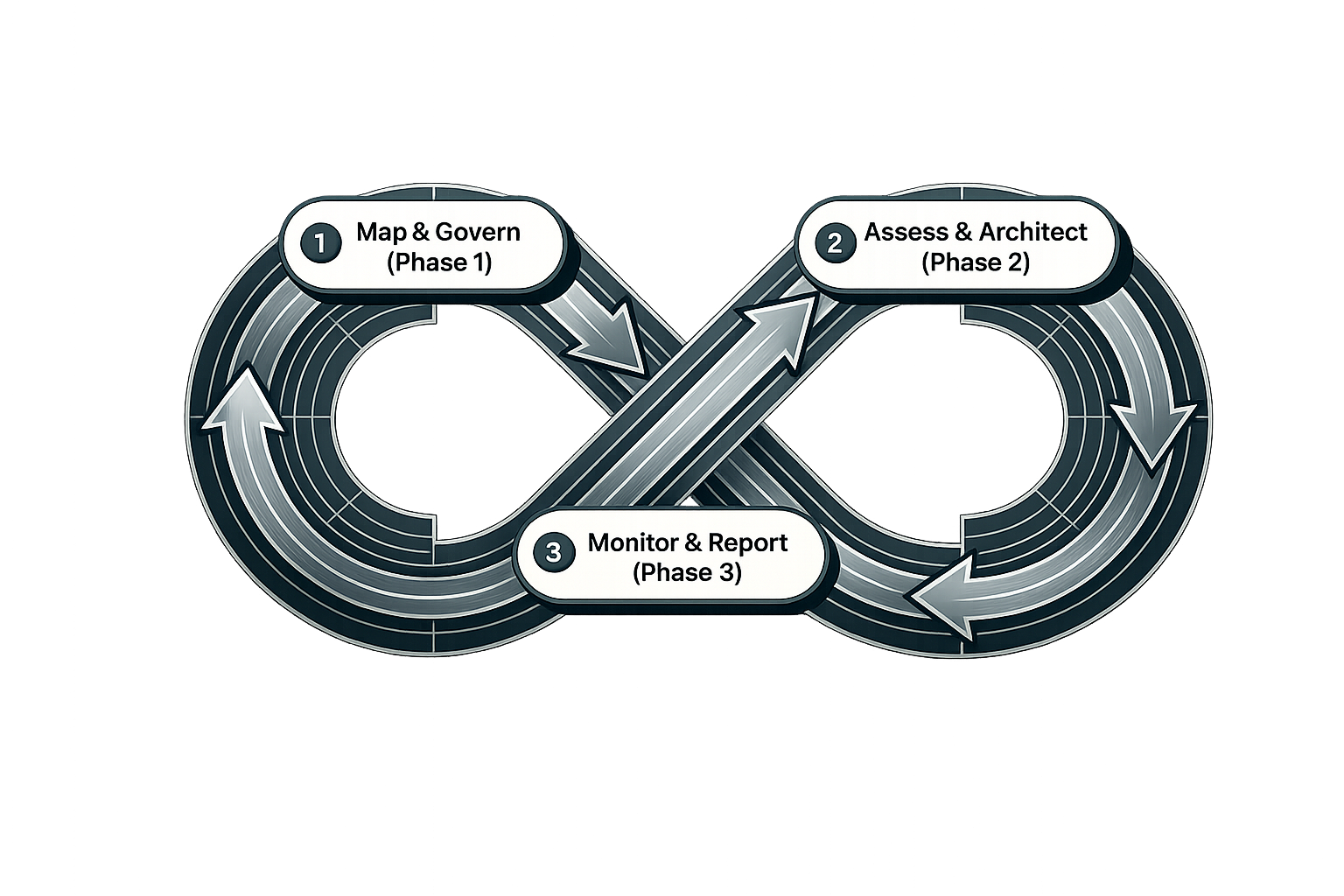
Compliance with the EU AI Act is not a static checkbox; it is a continuous commitment to “audit-ready” transparency. Simply possessing a policy document is not enough to satisfy a regulator. The Act requires demonstrable evidence: audit trails, human-in-the-loop oversight mechanisms, and rigorous bias monitoring.
As you evaluate your organisation’s posture, you must ask: Is our current AI usage classified as “Minimal,” “Limited,” or “High Risk”? If a national surveillance authority demanded your documentation today, could you prove that your “Shadow AI” has been mapped and your staff has been individually trained?
Need help with your EU AI Act readiness? From mapping unsanctioned Shadow AI to building your High-Risk oversight mechanisms, Acuity Data helps firms navigate this transition. We provide everything from initial risk classification and readiness assessments to the creation of final, audit-ready documentation.
Contact: hello@acuitydata.io
No posts
Comments
Nothing yet. Say the first thing.
Sign in to join the conversation.