
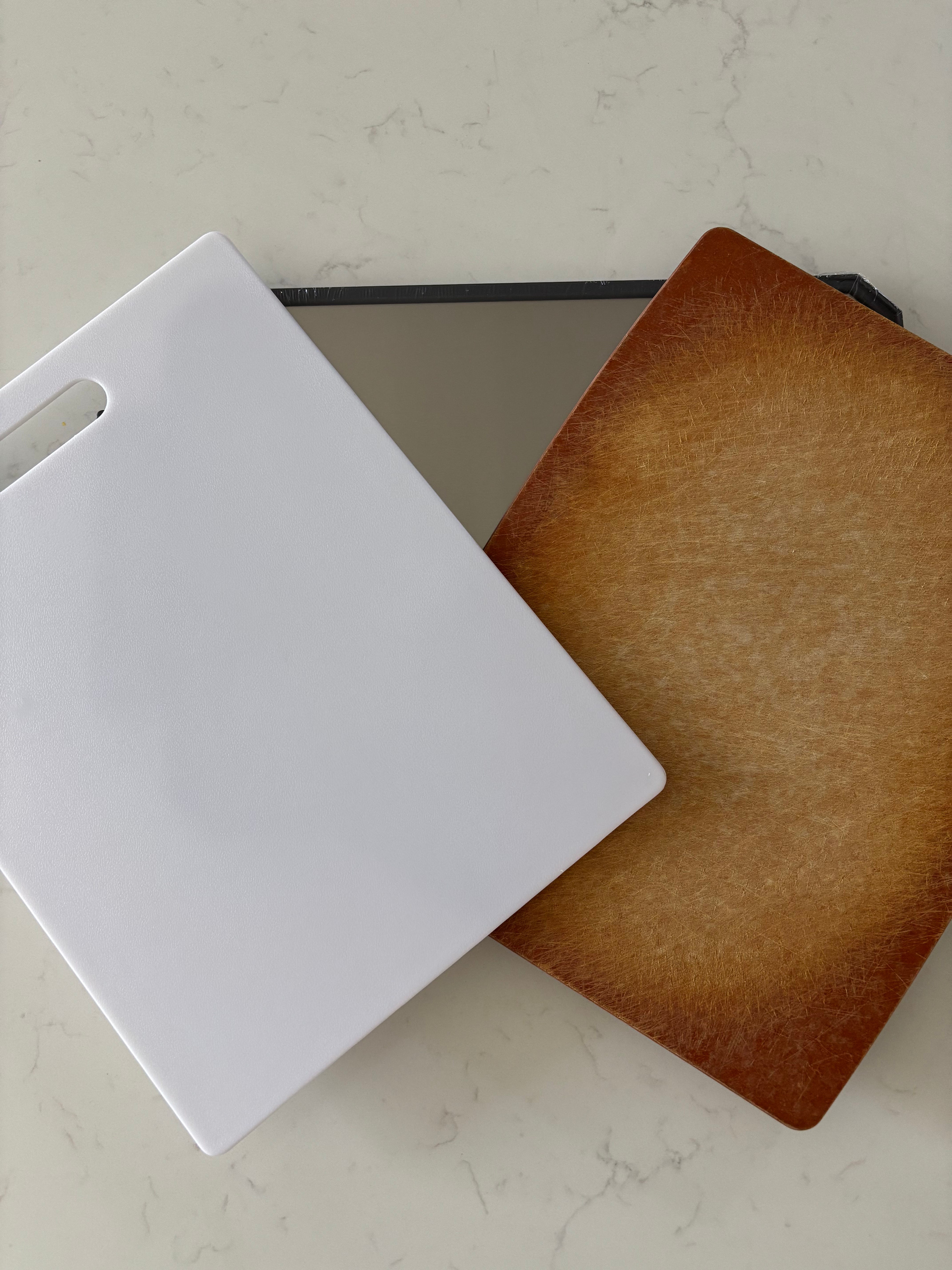
I’ll be honest — I’ve always been a bamboo cutting board person. There’s something that just makes cooking feel right with it. I never really questioned it.
But lately a few clients have been asking me about alternatives, and I figured — I’m in the kitchen every single day. I might as well actually test these things properly and give you a real answer instead of just guessing. So I spent time cooking on all three: stainless steel, plastic, and bamboo. Here’s what I found.
Stainless steel. Let me start here because this one gave me the strongest reaction — and not in the way I expected. If the sound of nails on a chalkboard makes you want to leave the room, this board is not for you. The knife screech is real, and it doesn’t really go away. I tried switching to my ceramic knife and it helped a little, but only a little. The knife also tended to slip more than I’d like, which is worth noting from a safety standpoint. And after doing some research, it seems like over time stainless can dull your knives faster than a softer surface — which matters when you’ve invested in good knives. That said — it is genuinely exceptional for hygiene. Nothing gets trapped, nothing absorbs, it’s odor resistant, and it goes straight in the dishwasher. If cleanliness is your absolute top priority and the sound doesn’t bother you, it’s a solid choice. It’s just not mine.
Plastic. I used these constantly in restaurant kitchens, and I actually love the color-coding system — green for fruits and vegetables, red for red meat, yellow for poultry, white for pantry items. One color per food group, zero cross-contamination. It’s simple and it genuinely works in a busy kitchen. But at home? I’m not a huge fan. They’re lightweight and budget-friendly, which is nice, but they don’t hold up well over time. The knife grooves accumulate fast and are nearly impossible to fully clean — bacteria finds a home in there. And here’s the thing that really got me: microplastics. Every time your knife scores the surface, tiny pieces of plastic can chip off into your food. No one wants that. If you want something cheap that you replace every few months, fine. But I think you can do better.
Bamboo. This has become my personal favorite of the three. It’s more scratch-resistant compared to a traditional wood board. Fewer knife grooves means easier to clean, which means better hygiene overall. It’s also more affordable than a quality wood cutting board, which feels like a genuine win. The only real downsides are that you can’t put it in the dishwasher (it will warp over time) and it’s slightly stiffer than what I’m used to with wood. Neither of those are dealbreakers for me. It feels great to work on, it holds up beautifully, and I find myself reaching for it all the time now. Hand wash it, oil it occasionally, and it will last you years.
At the end of the day, everyone has a cutting board that just feels right in their hands. Some of this is genuinely personal — the weight, the sound, how it looks on your counter. You have to find your own favorite. But if you’re asking me what I’d put in your kitchen right now, it’s bamboo. Every time.
Happy cutting. 🔪
To receive new posts and support my work, consider becoming a free or paid subscriber.
Comments
Nothing yet. Say the first thing.
Sign in to join the conversation.