
From time to time, Action Stations steps outside strictly naval history, a deliberate breathing space to tackle other corners of military history.
As early as 1939, the United States grew concerned about its ability to modernize its arsenal. The military called for the design of modern anti-aircraft weapons, while the US Navy found itself outmatched by Germany’s latest battleships of the Bismarck class, and the Army discovered it had no weapons suited to modern warfare... And so, in June 1940, a National Defense Research Committee (NDRC) was created, tasked with “coordinating, supervising and conducting scientific research on the problems underlying the design, production and use of military mechanisms and devices.” Superseded the following year by the Office of Scientific Research and Development (OSRD), the body directed the work of numerous laboratories engaged in highly secret research: radar, underwater acoustics, the atomic bomb, and so on.

Among the priority research areas, guidance systems featured prominently. The missile had existed for several years, and its technology was advancing rapidly, but engineers kept coming up short on the design of an accurate, reliable homing mechanism. Electronics were still very rudimentary, and existing devices were too bulky to fit inside a missile’s nose. Now, around the same time, the NDRC was approached by Burrhus F. Skinner, an eminent American psychologist, founder of “radical behaviorism”1 and champion of “operant conditioning”2. Having conducted his experiments (the famous “Skinner box”) on pigeons for several years, he knew the advantages these birds could offer: they are small and light, readily available in large numbers, have excellent eyesight and, above all, possess an uncommon capacity for learning. In the summer of 1940, his team at the University of Minnesota carried out preliminary research (funded by the cereal company General Mills!) to validate a rather unusual concept: teaching pigeons to guide a missile to its target.
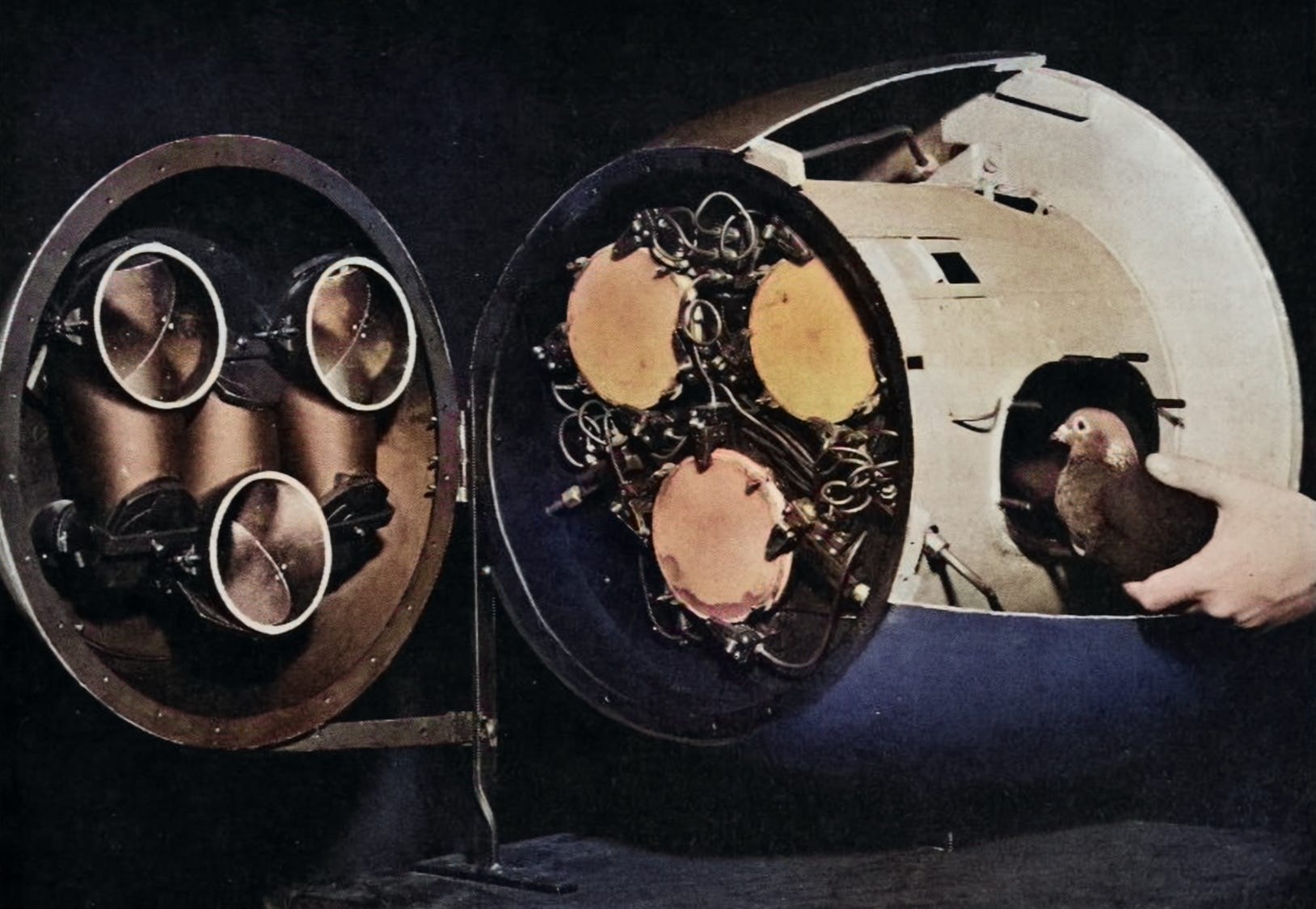
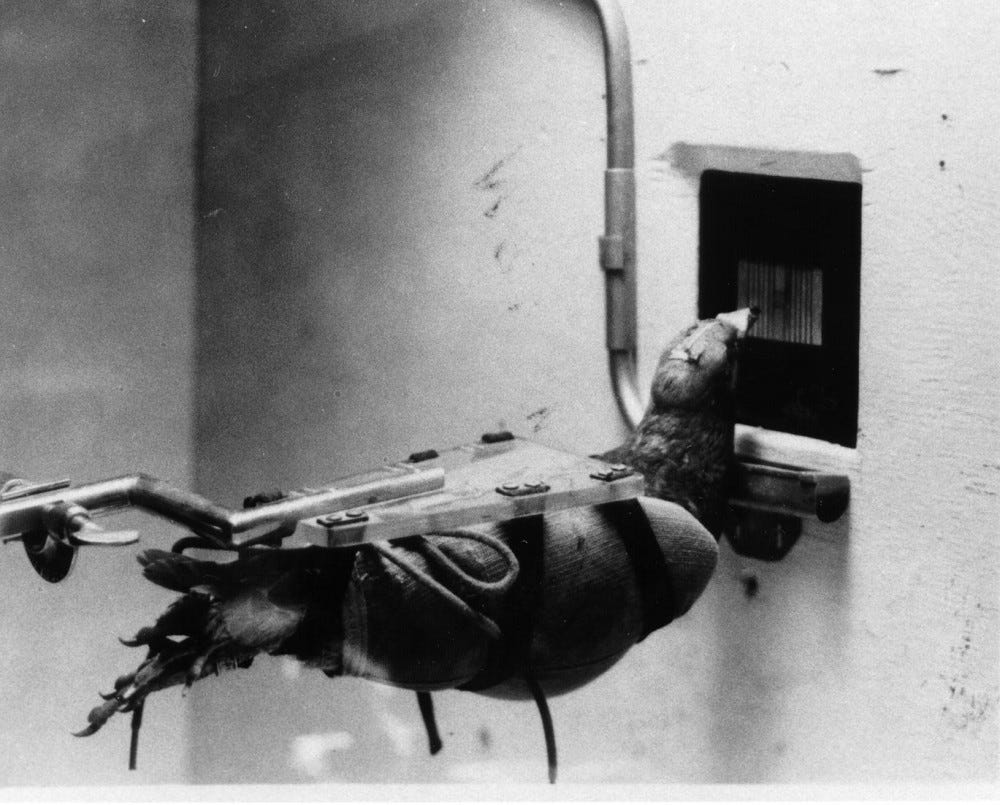
Skinner’s plan was to place three pigeons in a compartmentalized missile nose: each bird was held immobile, only its head and neck free to move. Previously trained (rewarded with a ration of seed) to recognize a particular target, say a German battleship, the pigeon faced a glass screen onto which the view ahead of the missile was projected: when the target appeared on the screen, it pecked directly at the image, steering the missile toward the ship. Pecks at the center of the screen let the missile fly straight, while off-center pecks altered its course. And the pigeons showed no lack of zeal: Skinner recorded that a bird could deliver 10,000 pecks in 45 minutes! He proposed placing three pigeons in each missile cone, with a computer tasked with integrating the birds’ “proposals” by majority rule to derive a suitable trajectory to impact. The early results were encouraging, so Skinner submitted his project to the relevant authorities. It was rejected several times at first, but America’s entry into the war changed everything in December 1941. Military circles finally showed themselves open to the idea, but much remained to be done to convince them of the merits of this “Organic Control” (that is, animal guidance). They had to determine, for instance, which seed best suited the birds’ appetite (hemp), and to test the effects of stimulant drugs, of a sudden surge in oxygen, of high temperatures, of changes in atmospheric pressure, and so on. One test was even filmed for presentation in Washington in February 1943, which unlocked funding: the OSRD gave General Mills $25,000 to continue its research (the equivalent of about $400,000 today).
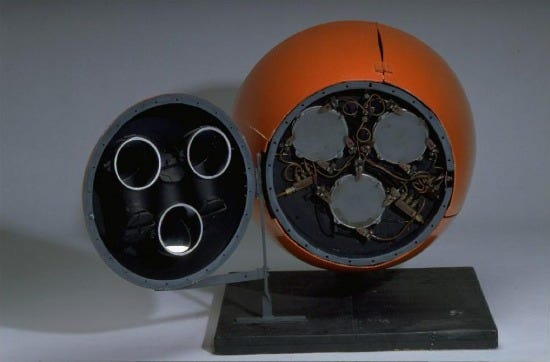
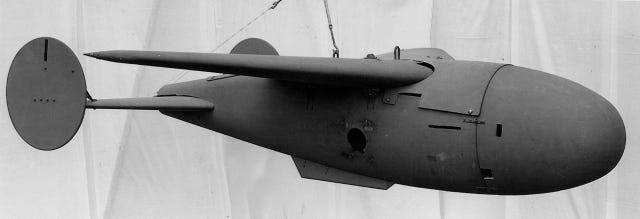
In parallel, in June 1942, engineers were working on an air-to-surface missile that was eventually to include radar homing. But miniaturizing the components proved difficult. The radar system was so bulky that the missile could carry no explosive charge: the device was named Pelican, perhaps because, like the bird of the same name, its bill could hold more than its belly! Why not, then, fit it with Skinner’s Organic Control? Trials with three pigeons per missile were soon carried out successfully in a simulator, but the project was no match for fast-developing technologies like radar. In January 1944 the OSRD froze the contract, which was finally canceled in October. Despite the encouraging results, the military looked askance at these eccentric experiments and feared above all that a hungry pigeon might end up targeting an American ship to earn its seed reward...
Thanks for reading! This post is public so feel free to share it.
As the war drew to a close, Skinner returned to his psychological research, taking his precious pigeons with him. In his spare time, he noticed that they retained their training remarkably well and could still be considered “combat-ready” even several years later! In 1948, the Naval Research Laboratory in Washington contacted the eminent psychologist again to resume this research: the Cold War had reignited the arms race, and Organic Control was still relevant. For while the electronic homing of missiles had made major technical strides, it remained highly vulnerable to enemy countermeasures. New simulated firings of pigeon-guided missiles produced remarkably good results, but insurmountable limitations soon emerged: the system worked only in broad daylight and depended on the birds’ visual contact. It was therefore more limited than radar, whose range extends far beyond anything a living creature could ever see... And so the experiments came to a definitive end in 1953. The only innovation the Navy would take from it was the small glass screen the pigeons had pecked at, which would go on to serve in many radar systems.
Or behaviorism. It is the study of observable behavior as determined by the environment and by an individual’s interactions with it.
The theory that the learning behind an action takes account of that action’s consequences, making the behavior more or less likely to be repeated.
Comments
Nothing yet. Say the first thing.
Sign in to join the conversation.