
Iran doesn't have to beat the US military. They just have to beat the US Treasury market — and that changes everything you think you know about this conflict.
The Strait of Hormuz is the chokepoint for roughly 20% of the world's oil supply, and right now it sits at the center of a geopolitical storm with consequences that reach far beyond the Middle East. In this deep-dive interview, we break down exactly how a Hormuz disruption cascades into oil price spikes, supply chain breakdowns, and a inflation surge that puts the US dollar's reserve status under unprecedented pressure. You'll understand why this conflict is as much a financial war as a military one, what it means for energy markets in 2026, and why Bitcoin's role as a neutral, non-sovereign asset has never been more relevant.
John Polomny has seen empires decline before. He thinks this one’s no different, but just more consequential for us, living in the West. He has already positioned his portfolio accordingly.
This was a fun interview as we dived into topics I normally don’t get asked about. Jeremy is a good guy and should have more subscribers on his Substack. Smart guy.
Recording Date 3-30-2026. In this episode, he lays out a stark and urgent macro view shaped by geopolitical escalation and energy supply disruptions. He argues that the Strait of Hormuz and Red Sea dynamics now dominate global markets, warning that the loss of critical oil flows could destabilize the entire world economy. Polomny frames the current situation as part of a broader era of systemic volatility tied to geopolitical conflict and fifth-generation warfare.
He explains how constrained energy flows are already triggering cascading effects across fuel, fertilizer, and food systems, with severe consequences for global supply chains and emerging economies. Polomny highlights how oil shortages, rising fertilizer costs, and disrupted planting cycles could lead to widespread economic pain and even political instability. From an investment perspective, he emphasizes that this is no longer a traditional market but a high-risk trading environment driven by headlines and policy shifts. He concludes that while short-term conditions are dangerous, major long-term opportunities will emerge, particularly in commodities and hard assets once the crisis stabilizes.
Goldman Sachs explains how the disruptions to the Strait of Hormuz impact the global nitrogen fertilizer market (which accounts for 60% of global fertilizer use), and why the Middle East conflict underscores the role of commodities as a hedge against supply disruptions.
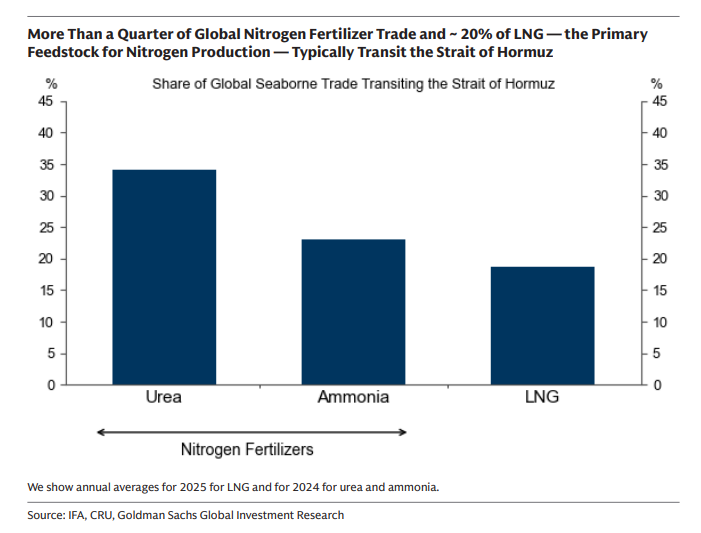
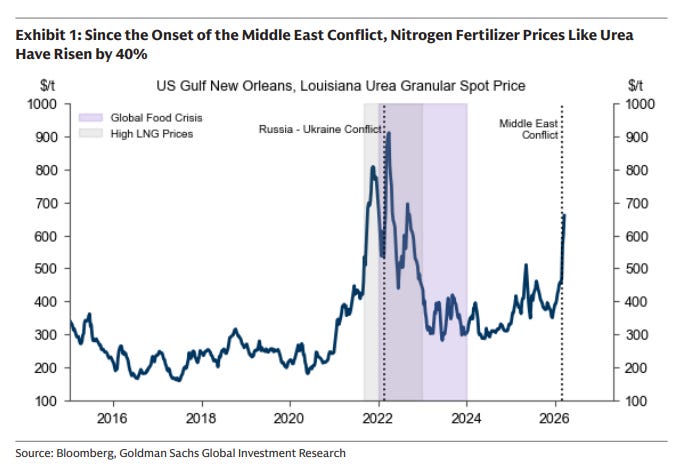
I think the disruption in fertilizer supply and the subsequent rise in fertilizer prices will affect farmers' planting decisions. The problem is that all costs have risen (fertilizer and fuel), while crop prices have not. Is it worth farmers’ time and effort to gamble that higher input costs will be compensated by higher crop prices?
“The door to the American Millionaire’s Club is not locked.”
— J. Paul Getty
I read Gettys‘ book “How To Be Rich”
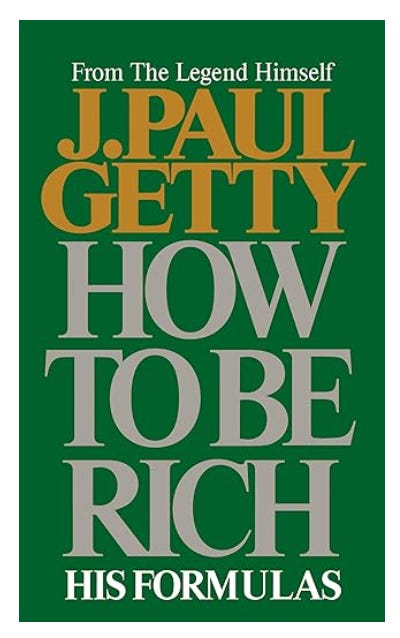
There are plenty of books on making money by men who haven't made much. But if J. Paul Getty, who Fortune magazine called “the richest man in the world,” doesn't know how, who does? Here, the billionaire businessman discloses the secrets of his success—and provides a blueprint for those who want to follow in his footsteps. And he goes beyond the matter of making money to the question of what to do with it.
I have read this book several times. This book is a short read, and I found it useful. Getty is a guy who came up from the bottom. He worked in the oil fields and knew all facets of drilling and producing oil. My kind of guy.
That’s it for this week. Be careful out there.
John Polomny
Comments
Nothing yet. Say the first thing.
Sign in to join the conversation.