

There is only ONE way out of $40 trillion in government debt, and it runs straight through the printing press.
I sat down with Gary Bohm on Metals and Miners to walk through why the Fed doesn’t hold the cards here. Mr. Market holds them, and Mr. Market is about to force the issue:
Interest expense is now the second-biggest line item in the entire federal budget, we are running $2.5 trillion deficits while the economy is still fine, and rates cannot fall when the demand for capital from government borrowing and the hyperscaler capex boom is the largest we have seen in decades.
You cannot suppress yields without debasing the currency, and you cannot let them find their real level without blowing up the bond market.
I also explained why energy is the single most mispriced corner of this market.
The paper barrel market is 40 to 50x the size of the physical market, the SPR sits at 43 year lows, and energy is barely 3.5% of the S&P while heading toward 20% of its free cash flow. That gap does not stay open forever.
And I laid out why gold sentiment hitting literal ZERO three weeks ago was the signal, why the miners are set up to lead this move, and why the entire AI buildout is shaping up to be housing bust 2.0.
The easy way out is to print, and they always take the easy way out.
It took the US 200 years to reach its first $1 trillion in debt. It took 95 days to add its last.
After several weeks of build up, today the Treasury announced that total public debt surpassed $40 trillion for the first time, after jumping by over $60 billion in one day, and has now surged by $1 trillion in just over three months, and by a third of the total in less than five years, as US lawmakers continue to ignore calls to contend with historically wide fiscal deficits.
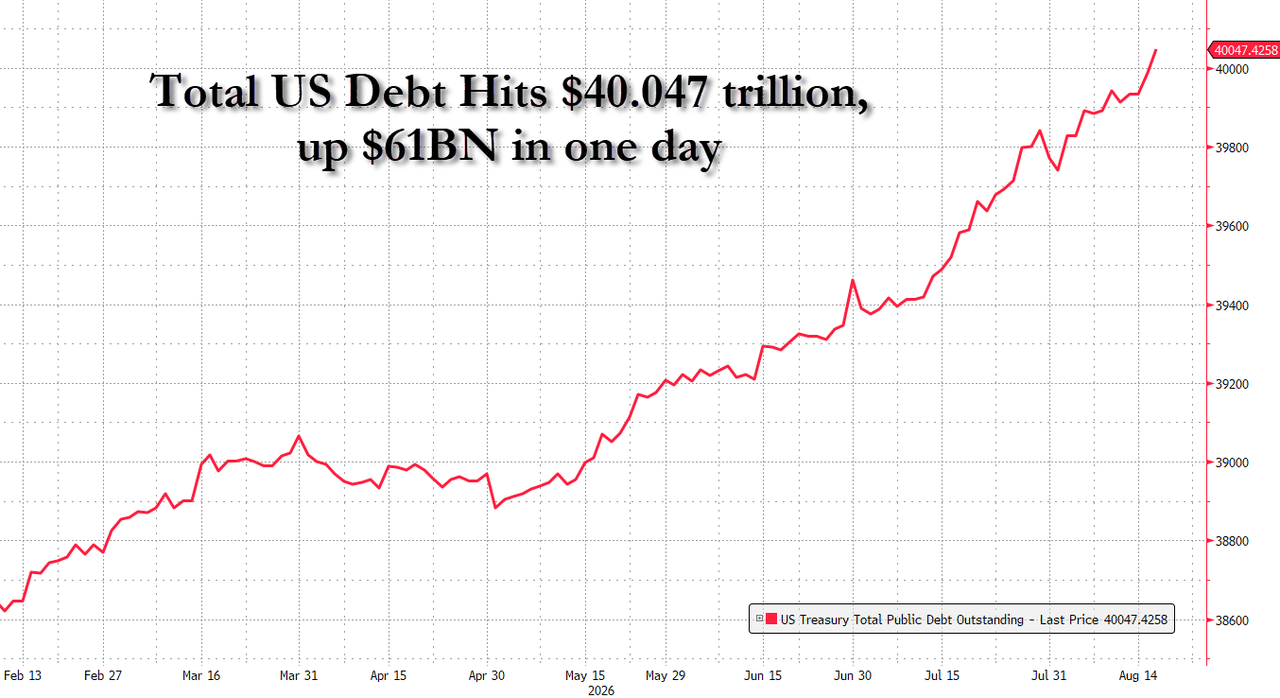
The largely expected news came just hours after Treasury Secretary Scott Bessent unexpectedly announced the Treasury’s latest attempt to rein-in long-term borrowing costs from multi-year highs, the most important component of the growth in debt. The Treasury stunned the market when it said, just two weeks after the latest Refunding Announcement where it should have made this change, that it was ramping up the support for longer-dated securities by “increasing, by at least double, the size of liquidity support buyback operations for longer-dated nominal coupon securities (the 10-year to 20-year sector and the 20-year to 30-year sector).”
Gold and Bitcoin are up

Both of these are sniffing out the upcoming QE operations in my view.
Benjamin Demase, aka the Royalty King, gives out the secret sauce on how he created and manages an option strategy or “business” to allow himself to live the life he chooses without being wed to the 9-to-5 grind.
This is by far the most common question I receive from readers who fancy building a borderless income stream of their own by running a one-man hedge fund, as I have. The answer to such a question is inherently personal and therefore necessarily nuanced, but nuanced does not mean unknowable. So today I am going to do something slightly unusual for this publication and write the answer as a recipe: from ingredients to step-by-step method along with a dash of my personal notes. By the end you will have your own number, and you will understand why each input belongs in the dish.
I retired from a 9-5 job a couple of years ago. I have adopted a similar strategy in my personal investments (I wish I had started earlier!). It has exceeded my expectations. It can work for you also if you so choose.
BP joins Big Oil return to post-Maduro Venezuela
Major development — Venezuela’s energy opening is accelerating. On August 14, BP secured a license to explore and develop Phase 2 of Venezuela’s offshore Loran gas field, partnering with the UAE’s XRG/ADNOC and Qatar-linked UCC. The project contains roughly 4 trillion cubic feet of recoverable gas.
Washington and Caracas Negotiate a Revival of Venezuela’s Oil Production
This follows a U.S. Treasury delegation traveling to Caracas on August 10 for talks specifically focused on reviving Venezuelan oil production.
Why this changes the strategic picture
The pattern is becoming clearer: Washington is moving beyond merely controlling Venezuelan oil flows after Maduro and toward reintegrating Venezuela into the Western-led energy system.
BP now joins Shell and Chevron in the reopening of the Venezuelan energy sector. The offshore gas projects are particularly significant because Venezuelan gas could ultimately be exported through Trinidad’s existing LNG infrastructure rather than requiring Venezuela to build an entirely new LNG system.
The geopolitical implication is more important than the individual BP project. The Trump administration appears to be implementing a three-part strategy:
U.S. political leverage → Western capital and technology → rapidly rising Venezuelan energy production.
How is this investable? I added a speculative position in the AIA Portfolio that has the potential to re-enter the Venezuelan oil industry by acquiring an existing producing oil field and applying capital and basic oilfield techniques to increase production. No exploration risk; just apply capital and know-how and rinse and repeat.
That’s it for this week.
John
Comments
Nothing yet. Say the first thing.
Sign in to join the conversation.