
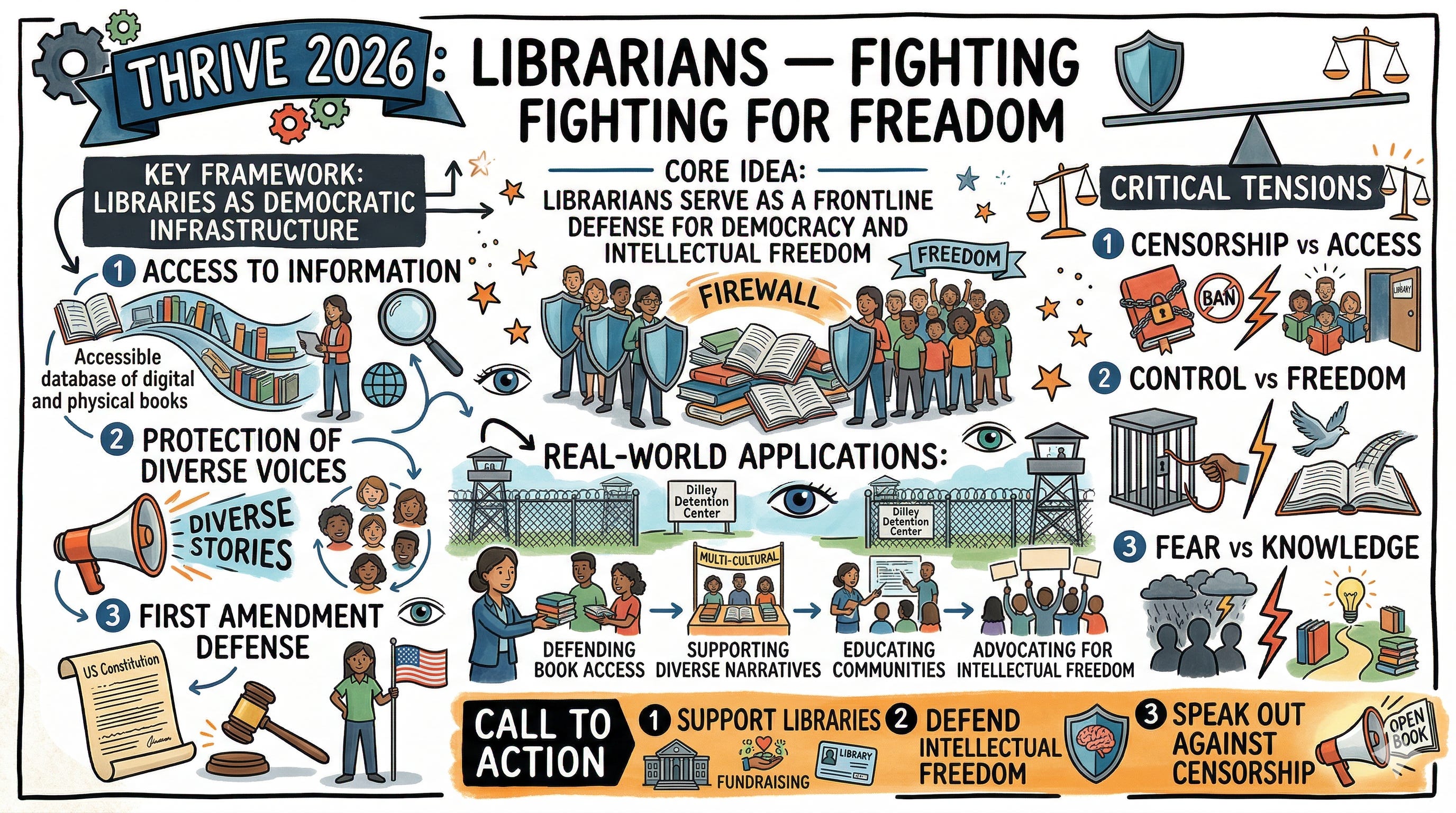
In this powerful Thrive 2026 session, Carolyn Foote—a longtime school librarian and nationally recognized advocate for intellectual freedom—delivers a clear and urgent message: librarians are on the frontlines of defending democracy.
Drawing from her firsthand experience navigating book challenges, policy pressures, and community tensions, Foote grounds the session in reality—not theory. This is happening now, in schools and libraries across the country.
Her message is both sobering and energizing: the work of librarians has fundamentally changed—and it now requires courage, visibility, and collective action.
Foote shares how book challenges are not abstract policy debates—they impact real students, real educators, and real communities.
She emphasizes that restricting access to books is ultimately about restricting access to perspectives, identities, and lived experiences.
One of Foote’s strongest points: neutrality in the face of censorship is not neutrality—it’s complicity.
Today’s librarians must be prepared to:
Speak publicly
Advocate for students’ rights to read
Push back against misinformation and fear-based narratives
Foote highlights the importance of understanding:
Collection development policies
Reconsideration procedures
Legal protections for intellectual freedom
Librarians who know their policies are far better equipped to respond effectively when challenges arise.
No librarian should be fighting these battles alone. Foote underscores the importance of:
Building alliances with educators and administrators
Engaging parents and community members proactively
Connecting with national organizations for support
Perhaps the most powerful reminder: how adults respond to censorship teaches young people what democracy looks like in practice.
Libraries are not just information spaces—they are models of democratic values in action.
Review your collection development and reconsideration policies
Make sure they are accessible, up-to-date, and clearly written
Use them as your foundation when responding to challenges
Be prepared to speak at board meetings or community forums
Use clear, values-based messaging about intellectual freedom
Share why access to diverse books matters for all students
Identify allies among staff, families, and local organizations
Connect with professional networks and advocacy groups
Create a communication plan for when challenges arise
Help students and patrons evaluate sources and claims
Address misinformation directly and openly
Integrate these skills into everyday library programming
Keep records of challenges, communications, and decisions
Use documentation to ensure transparency and accountability
Protect yourself and your institution with clear evidence
This work is emotionally demanding—acknowledge that
Build in peer support and spaces for reflection
Recognize that sustaining this work requires resilience
As highlighted throughout Thrive 2026, democracy depends on informed participation—and that depends on access to information.
Carolyn Foote reminds us that libraries are not passive institutions. They are active defenders of intellectual freedom, and the people who work in them are essential to maintaining an open and informed society.
This session is a call to action:
If we value democracy, we must stand up for the freedom to read.
Comments
Nothing yet. Say the first thing.
Sign in to join the conversation.