
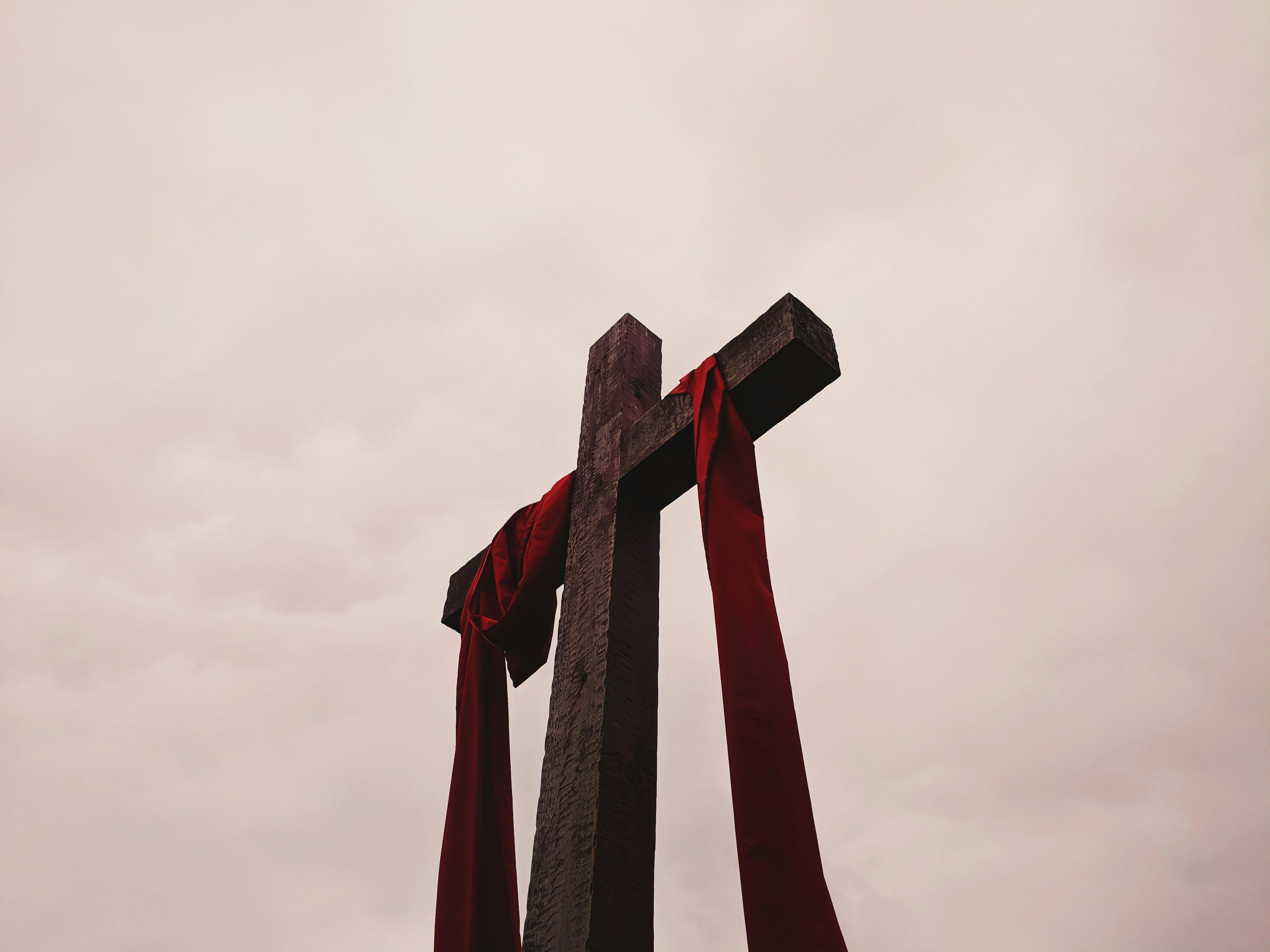
I am naked before the Lord, and I will go naked to Him.
Christianity was born in alleys, courtyards, kitchens, and catacombs—anywhere the official Roman eye might not reach. Its founder slept in fishing boats and olive groves, walked with the poor, and died without possessions, trial, or even a tomb of his own. He rode into Jerusalem on a borrowed donkey, dined with outcasts, and preached a kingdom not of palaces but of mustard seeds and lilies of the field.1 His early followers broke bread in fear, not ceremony. They carried no rings, no miters, no crimson trains—only scars, stories, and a profound (and often mortally dangerous) belief in the essential Christian message of grace.
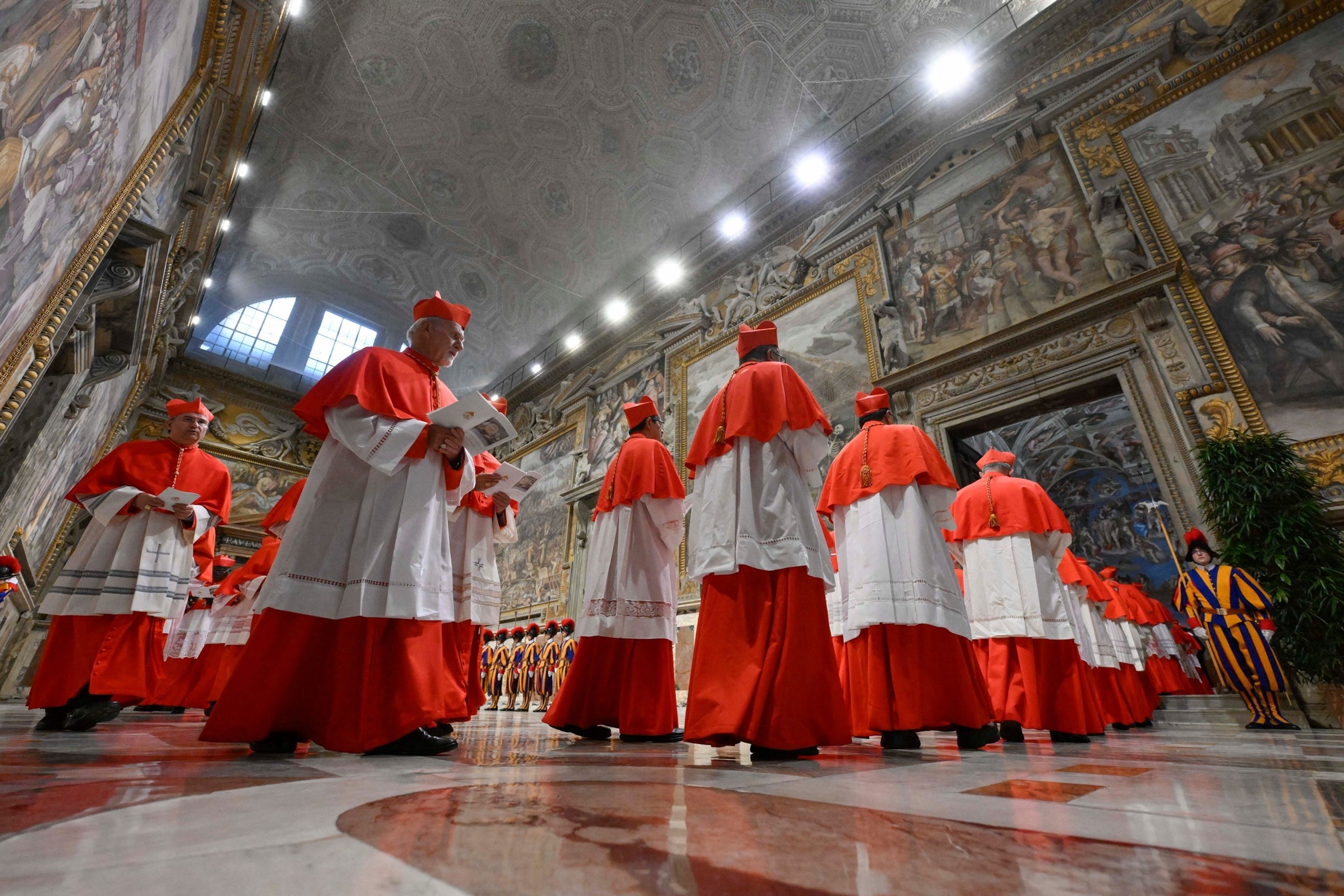
Looking at the splendor of the Catholic Cardinals gathered in Rome this week to elect a new pope, I could not help but be struck by the fact that these men move through the Vatican in flowing crimson silk capes, sit beneath delicate four-cornered hats, and drape themselves in lovely robes made from the finest fabrics. I state my observation not as a criticism of the images we see on our screens but as a question: how did the garments worn by the Church’s “princes” evolve over the centuries and what cultural meaning can we glean from that evolution?2 After all, the vestments of Catholic cardinals, embellished over centuries with color, texture, and power, do not merely adorn—they signify. But what, exactly, do they signify today?
The vestments of Catholic cardinals, embellished over centuries with color, texture, and power, do not merely adorn—they signify. But what, exactly, do they signify today?
In the early days of the Church, there was no such thing as liturgical dress. The apostles wore what others around them wore—ordinary tunics and cloaks undistinguished by ornamentation or signs of power. The authority of these men came not from what they wore but from what they had given up. After all, to lead a Christian congregation in the first century was to accept a life of peril and obscurity. Services were held at night in secret, often in homes, underground cemeteries, or secluded courtyards. Leaders—typically elders or itinerant teachers—were chosen for their witness, their endurance, and their capacity to hold fragile communities together despite persecution, famine, or exile. There were no liturgical manuals in these early days, just hands breaking bread and words whispering encouragement between arrests or in smuggled letters across Roman lands.3 A Christian leader might be beaten one week and martyred the next. Their authority came from what they risked and endured for their faith.
Only after Christianity emerged from the shadows— and after Constantine granted imperial power to the Church—did distinctions begin to appear. Clergy gradually retained styles of Roman clothing the wider population had abandoned. The clerical alb (robe), chasuble (mantle), and stole (draped cloth) were not innovations but the fashion of late antiquity made permanent by Catholic liturgy, whose style of dress became doctrine manifest in fabric.4 The simplicity of Christ’s garments—likely a single seamless tunic, the kind gambled for by soldiers at his crucifixion—soon faded into memory.5
By the 11th century, cardinals had become the pope’s most trusted advisors, and by the 13th, the exclusive electors of popes.6 Their attire evolved to reflect their importance and power. Red began to mark them out, symbolizing, the Church tells us, the blood of Christ.7 But red was also the color of power. The dye itself—kermes, later cochineal carmine—was costly, and only the wealthy could afford it. When Pope Innocent IV gave cardinals the broad-brimmed galero at the Council of Lyon in 1245, it was an unmistakable signal: the wearer was a man to whom reverence—and submission—was due. Scarlet, in the context of the Church, is thus a complicated fabric: at once a symbol of martyrdom but also signifier of secular importance and power.
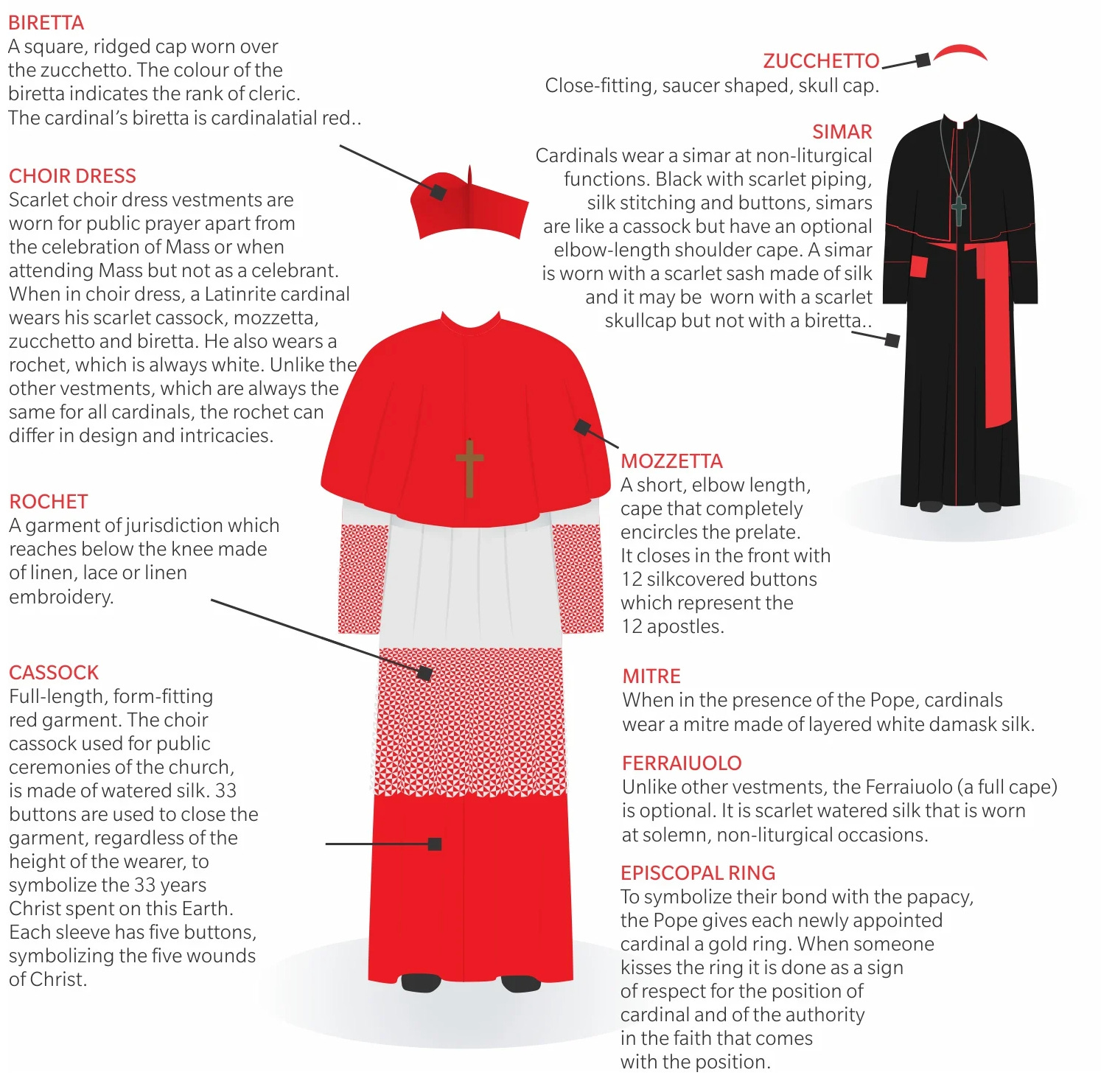
In the 1500s, the Reformation shook the Catholic Church to its foundations, and the Counter-Reformation that followed was—among other things—an aesthetic revival. If Protestants stripped their churches bare, Catholics responded with marble, incense, and gold-threaded liturgies. Cardinals, now not only defenders of orthodoxy but emblems of permanence, dressed accordingly. The cappa magna, a train of silk that could stretch twenty feet, became the ecclesiastical equivalent of a royal mantle. The mozzetta signaled jurisdiction; the lace-trimmed rochet purity; the biretta, intellectual prestige.
Centuries later, the Enlightenment—and its guillotines—cast a long shadow over ecclesiastical finery. In revolutionary France, clerical dress became dangerous. The galero was mocked, then outlawed; the cappa magna vanished into closets.8 And yet, as the 19th century progressed, the Church doubled down: in an increasingly secular world, vestments became acts of resistance. They reminded (and still remind) the faithful—and perhaps more importantly, the faithless—that the Catholic Church was still there and was still glorious.
The Second Vatican Council (1962–65) ushered in a quieter aesthetic. Paul VI abolished the galero in 1969 and curtailed the extravagant trains of the cappa magna. Cardinals began wearing simpler choir dress: red cassock, white rochet, and the red biretta—plainer but still unmistakable. Some traditionalist mourned the loss of visual majesty, while other men, including Pope Francis, embraced a different kind of aesthetic—one rooted in simplicity. In his refusal to wear the pope’s gold-trimmed mozzetta, for example, and in his insistence on black shoes and simple garments, Francis signaled through his clothing a spiritual return to the church of the poor and not of the throne. The man from Nazareth echoed loudly in Francis’ austere Vatican wardrobe.9
Francis was well aware that ritual has always occupied a sacred place within the Catholic imagination as a means of making the invisible visible. In a tradition rooted in the Incarnation, where God becomes flesh and the eternal steps into time, ritual offers a structure through which the ineffable can be touched, tasted, and seen. It binds together body and soul, as it does matter and mystery. Through signs, gestures, colors, music, and words, Catholic ritual invites the faithful to encounter God in the rhythms of the everyday: kneeling, crossing, blessing, breaking bread, and sipping wine.
The vestments of a cardinal—like the chrism oil of baptism or the ashes of Lent—are not, in themselves, holy. They are made holy by what they point to and how they are received. When understood rightly, they become part of a choreography of reverence. The red cassock is not just cloth; it signals a willingness to suffer for the Gospel. The laying on of hands is not just symbolic; it is believed to effect real spiritual change. Ritual, in this way, becomes sacramental—an outward sign that promises inward grace. But Catholic ritual is also always in danger of becoming rote. The very stability that makes ritual powerful can render it hollow when its meaning is lost or obscured, and, paradoxically, what was once meant to communicate humility or martyrdom began to signify hierarchy and control. When a cardinal processes through a gilded cathedral in garments worth more than the annual income of some parishioners, we must ask: has the symbol become unmoored from the message it once carried?10
When a cardinal processes through a gilded cathedral in garments worth more than the annual income of some parishioners, we must ask: has the symbol become unmoored from the message it once carried?
To abandon ritual altogether, however, would be to abandon something deeply human. We are beings of repetition, form, and symbolic action. The task, then, is to reinhabit ritual: remembering what it means and practicing it with integrity. Pope Francis reminded the Church that “the liturgy is not a show,” and that “when the liturgy is lived authentically, it forms us in the humility of Christ.” Indeed, in one of his apostolic letters, he underscored the importance of genuine participation in the liturgy, cautioning against superficial or performative approaches:
I want the beauty of the Christian celebration and its necessary consequences for the life of the Church not to be spoiled by a superficial and foreshortened understanding of its value or, worse yet, by its being exploited in service of some ideological vision, no matter what the hue.
—Pope Francis, Desiderio Desideravi, §16
I think about those words as I look at the images from Rome—recently made all the more glamorous by Hollywood’s Conclave—and I find myself wondering: have these meanings endured or simply ossified into performance? Do the faithful still read these beautiful garments as scripture or merely as theater?
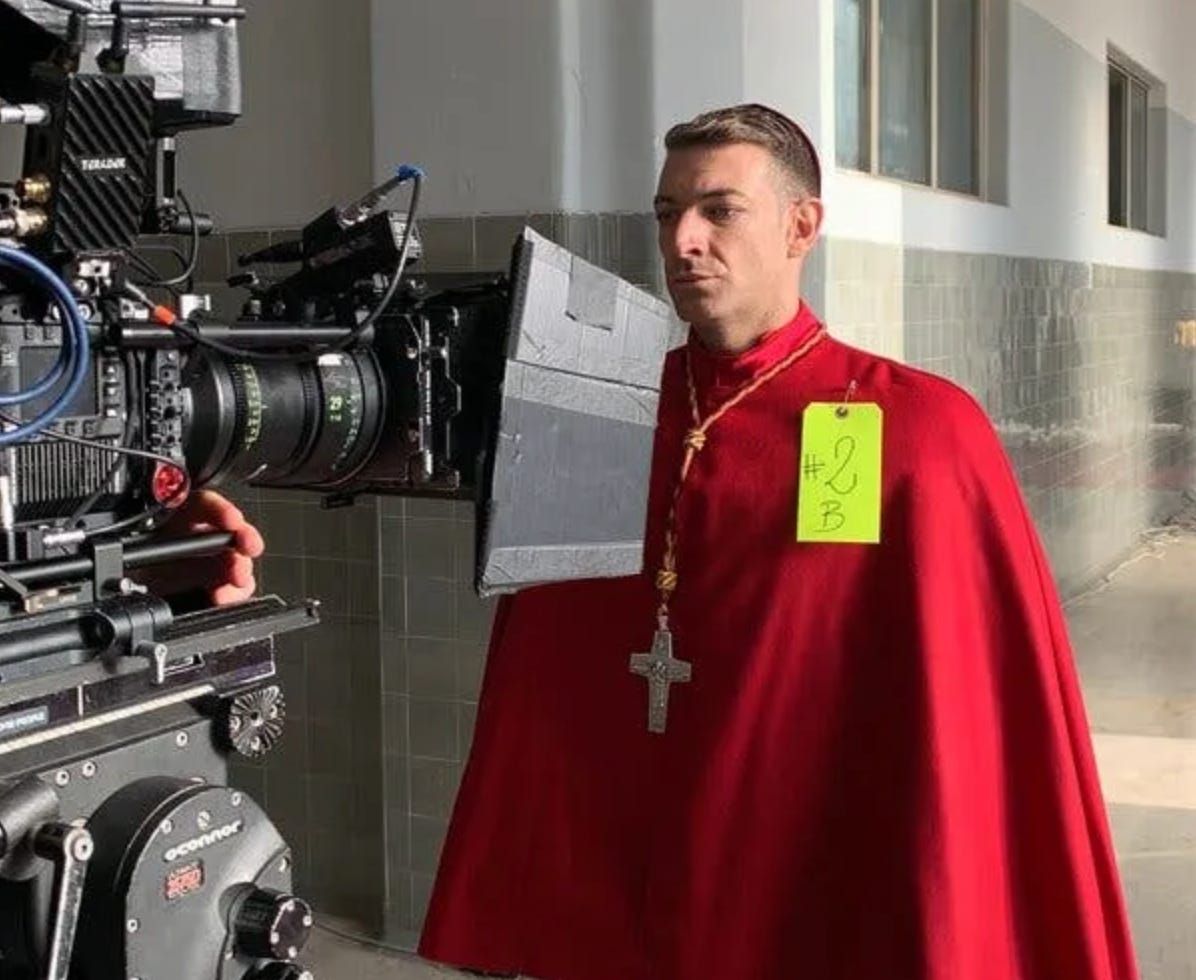
Reflecting on the photograph above, I recall Giotto di Bodone’s frescoes depicting the life of St. Francis of Assisi created in the church that now bears his name. In one scene, Francis faces his father, Pietro di Bernadone, who has summoned him to court for stealing a horse and a bundle of cloth, which the young Francis had sold to help restore the little church in San Damiano in which he served. The image shows Francis returning the expensive cloth, having stripped and renounced all his worldly possessions.11
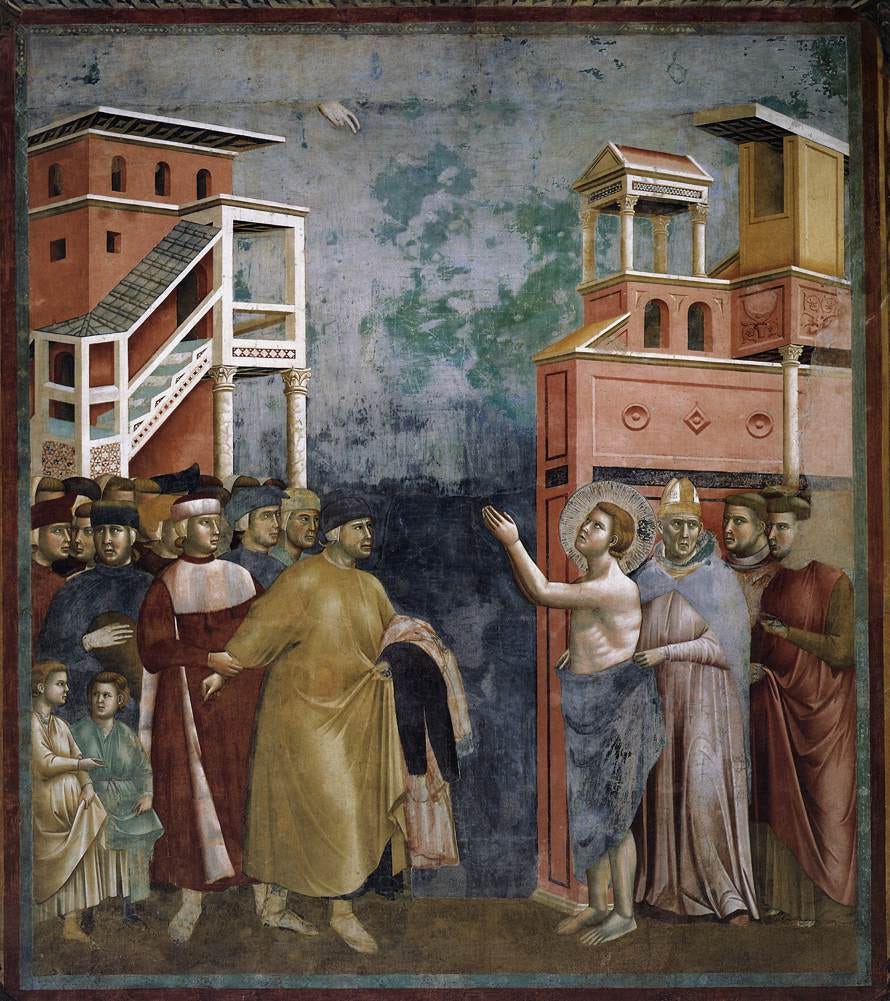
The Saint looks solemn, radiant, and utterly free. That gesture—shedding every worldly tie—echoed through my mind this week, for in that moment Francis claimed no authority but God and no vestment but faith.12 I wonder what he might whisper to the cardinals today.
We return to the central paradox, stitched in silk and hemmed in contradiction. Cardinal vestments are beautiful, historical, and meaningful. But they are also reminders—perhaps uncomfortably so—of the Church’s long obsession with power, prestige, and image. After all, to wear scarlet in remembrance of martyrdom is one thing. To wear it as a prince in a palace is another. The question is not whether these garments once meant something—they did. The question is whether they still do or whether they have become symbols of admiration and envy in today’s largely superficial media landscape.13 Then again, perhaps the vestments endure because the contradiction endures. The Catholic Church has always lived in tension: between the eternal and ephemeral, God and Caesar, Galilean simplicity and Vatican splendor. The cardinal’s garments are questions in cloth, asking—quietly but insistently—What kind of church does the Church want to be?—the central decision dominating a conclave selecting the successor to a polarizing pontiff.
Tolstoy once argued that Christ’s kingdom is not of this world, and that those who clothe themselves in gold and lace while preaching his name misunderstand both Him and his message.14 Tolstoy’s critique was not aimed at faith, but at forgetting—the kind of forgetting that allows spectacle to stand in for substance and costume to be mistaken for conviction. Perhaps he was too harsh, or perhaps he was merely holding up a mirror before which the men of the conclave might wish to pause.
See Matthew 13:31–32 for Jesus’ parable of the mustard seed, describing the Kingdom of Heaven as starting small and growing expansively. See also Matthew 6:28–29, where Jesus tells his followers to “consider the lilies of the field,” praising their beauty and simplicity over Solomon’s splendor.
The idea of cardinals as royalty originated in the middle ages, most likely during the Gregorian Reforms of Pope Gregory VII (r. 1073–1085), who sought to assert papal authority and clerical independence.
See Allen Brent, Cyprian and Roman Carthage (Cambridge University Press, 2010), pp. 45–68, for a detailed account of early Christian leadership under threat and the role of house churches in nurturing fragile communities.
In Chapter 16 of Part II of Umberto Ecco’s The Name of the Rose, a congregation of friars gathers to debate whether Christ owned his own cloak. One brother insists that if Christ is truly the Messiah, He would naturally have owned it—a garment befitting the Son of God. Another counters that the very essence of His teaching is radical humility, so He must have worn a borrowed cloak. A third notes that the cloak might have become a holy relic, had anyone bothered to keep it. The exchange witnessed by the novel’s protagonist, William of Baskerville, who quietly marvels at how theology can turn even a simple cloak into an object of endless debate.
Cardinals were designated as principal advisors to the pope and became the exclusive electors of new popes following the 1059 papal election decree by Pope Nicholas II.
See Roger Collins, Keepers of the Keys of Heaven: A History of the Papacy (Basic Books, 2009) pp. 203–210.
See John McManners, The French Revolution and the Church (SPCK, 1969), pp. 117–138.
For the curious, the outfits worn at the conclave, which are typically bespoke, cost approximately $5,000-7,000, while a complete wardrobe for a cardinal would cost around $50,000. Some cardinals inherit garments from their predecessors. Cardinals earn between $3,000 and $5,000 per month.
Lisy Cristl, the costume designer on the film, told The New York Times: “Before doing the research for Conclave, I looked at Balenciaga, Dolce & Gabbana, Jil Sander (designed by Luke and Lucie Meier), Prada and many others from a different perspective. Now I can see the inspiration from the Roman Catholic Church all over the place. I think it’s the clear structure. When you learn about all the orders and what they wear, it’s so elegant.”
See Leo Tolstoy, The Kingdom of God is Within You (1894), whose title is a reference to Luke 17:20-21: “The kingdom of God cometh not with outward show; neither shall they say, Lo here! or, Lo there! for behold, the kingdom of God is within you.”
Comments
Nothing yet. Say the first thing.
Sign in to join the conversation.