
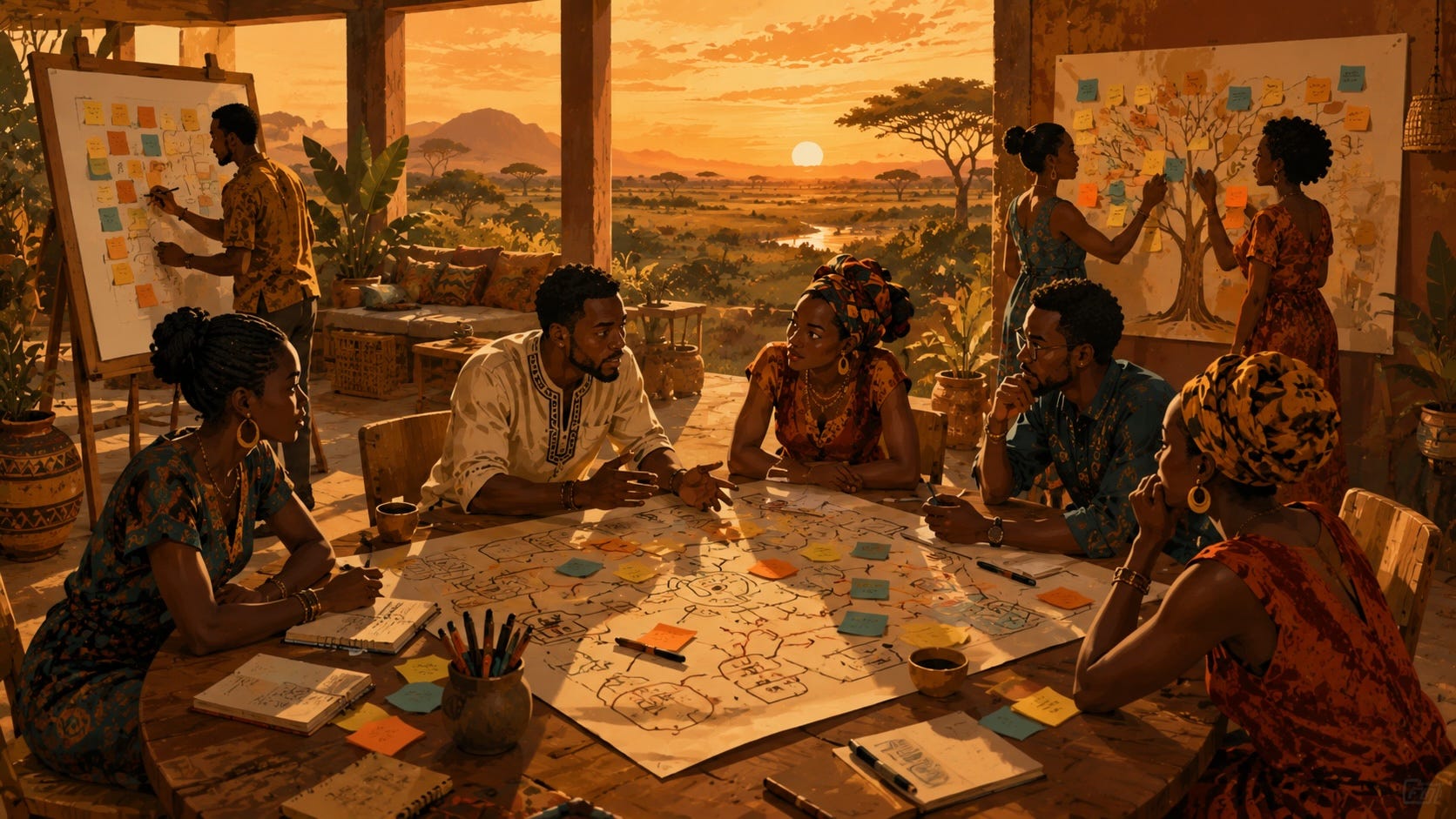
Many organisations invest enormous effort searching for creative individuals, hoping that a few exceptionally talented people will generate the ideas needed to solve tomorrow’s challenges. They recruit innovators, send employees on occasional creativity workshops and celebrate the occasional breakthrough. Yet despite these efforts, innovation often remains sporadic, unpredictable and dependent on a handful of individuals.
The organisations that thrive over the long term take a fundamentally different approach. They recognise that sustainable innovation is not created by isolated moments of brilliance. It emerges when creativity becomes a shared capability that is woven into the way people think, collaborate and solve problems every day. Rather than relying on gifted individuals, they develop environments where ordinary people consistently achieve extraordinary creative outcomes together.
Creative problem solving therefore reaches its highest level not when a single challenge has been solved, but when the ability to solve future challenges has become stronger. Building creative capability transforms creativity from an occasional event into a lasting organisational strength, enabling people to adapt, innovate and grow long after any single project has ended.
Why Building Creative Capability Matters
Every organisation eventually faces problems it has never encountered before.
Markets change. Technology evolves. Customer expectations shift. New competitors emerge. Economic conditions fluctuate. Solutions that worked yesterday gradually lose their effectiveness, while entirely new challenges appear with increasing speed.
In such an environment, success depends less on having the right answers today and more on developing the ability to discover better answers tomorrow.
This is why creative capability has become one of the defining characteristics of resilient organisations.
Many organisations mistakenly treat creativity as something that happens during brainstorming sessions, innovation days or strategic retreats. While these activities can be valuable, they rarely produce lasting change on their own. Creativity cannot flourish as an occasional event if everyday work rewards routine thinking, discourages experimentation or punishes intelligent risk-taking.
Capability is different.
Capability remains after the workshop ends.
It influences everyday decisions, conversations, behaviours and leadership practices. It enables people to approach unfamiliar problems with curiosity instead of anxiety, confidence instead of hesitation and experimentation instead of certainty.
The true competitive advantage is therefore not a single innovative product or process.
It is an organisation that continuously develops people who know how to think creatively.
Creativity Is Not a Talent Reserved for the Few
Perhaps the greatest barrier to building creative capability is the persistent belief that creativity belongs only to naturally gifted people.
Some individuals undoubtedly demonstrate exceptional creative talent, just as some people naturally excel in music or sport. However, decades of research in psychology, neuroscience and creativity demonstrate that creative thinking is also a learnable capability that improves through deliberate practice.
People become more creative when they learn how to observe differently, ask better questions, challenge assumptions, generate alternatives, experiment safely and reflect thoughtfully on their experiences.
Confidence grows through repeated success.
Skill develops through repeated practice.
Capability emerges when both become part of everyday work.
This understanding fundamentally changes the role of leadership.
Rather than searching endlessly for creative people, leaders begin creating conditions that allow creativity to develop in everyone.
What Does Building Creative Capability Mean?
Building creative capability means developing the knowledge, skills, attitudes and organisational conditions that enable creativity to happen consistently across an organisation.
It is not limited to generating ideas.
It includes developing people’s ability to:
Notice opportunities that others overlook.
Frame problems more effectively.
Challenge assumptions respectfully.
Think from multiple perspectives.
Collaborate across disciplines.
Experiment intelligently.
Learn rapidly from evidence.
Adapt confidently when circumstances change.
Creative capability therefore combines mindset, behaviour, practical tools and organisational culture.
It becomes part of how people work rather than something extra they occasionally do.
The goal is not simply to increase creativity.
It is to increase the organisation’s capacity to respond creatively whenever new challenges emerge.
Learning Cultures Create Creative Organisations
Creativity grows most naturally in environments where learning is valued more highly than certainty.
In a learning culture, people are encouraged to ask questions, explore possibilities and admit when they do not yet know the answer. Curiosity becomes a strength rather than a weakness.
This contrasts sharply with cultures where appearing knowledgeable is rewarded more than continuing to learn.
When people fear making mistakes or asking naïve questions, creativity quickly becomes constrained. Safe ideas replace bold ones. Familiar routines replace exploration. Innovation slows because psychological safety disappears.
Learning cultures recognise that uncertainty is not evidence of failure.
It is the starting point of discovery.
Leaders in these organisations model curiosity themselves. They seek feedback, acknowledge what they are learning and invite others to contribute perspectives that differ from their own.
When leaders learn openly, organisations learn collectively.
Developing Creative Confidence
Many capable professionals possess creative ability but lack creative confidence.
They hesitate to share ideas because they fear criticism.
They avoid experimentation because they worry about failure.
They remain silent because they assume someone else knows better.
Creative confidence is not believing every idea will succeed.
It is believing that you can contribute meaningfully to solving problems, even when outcomes remain uncertain.
This confidence develops gradually.
People become more willing to contribute when:
Their ideas are genuinely welcomed.
Experimentation is encouraged.
Constructive feedback replaces criticism.
Small successes are recognised.
Failure is treated as learning rather than personal inadequacy.
Creative confidence creates momentum.
As people experience that their contributions matter, they participate more actively, think more broadly and become increasingly willing to explore unfamiliar territory.
Confidence grows through action, not through waiting until fear disappears.
Coaching Creative Thinking
Traditional management often focuses on providing answers.
Creative leadership focuses on developing thinkers.
This shift is one of the most significant changes organisations can make.
Rather than solving every problem themselves, creative leaders coach people to think more effectively.
They ask questions such as:
What assumptions are we making?
What other perspectives exist?
What problem are we really trying to solve?
What might we be overlooking?
How could we test this idea quickly?
What can we learn from a small experiment?
Questions like these stimulate ownership rather than dependence.
Over time, employees begin asking these questions themselves.
The leader no longer becomes the source of every solution.
Instead, they become the architect of better thinking.
Coaching therefore develops capability rather than simply improving performance.
Everyday Innovation
Many organisations unintentionally reserve innovation for special projects.
Yet some of the most valuable improvements emerge from ordinary conversations and daily observations.
Everyday innovation means encouraging people to improve small aspects of their work continuously.
A receptionist notices a simpler customer check-in process.
A warehouse employee redesigns product storage.
A teacher discovers a more engaging learning activity.
A software developer simplifies an internal workflow.
Individually, these improvements may appear modest.
Collectively, they transform organisational performance.
When everyone becomes responsible for improving something, innovation stops depending on exceptional events.
It becomes part of everyday behaviour.
The cumulative effect of hundreds of small improvements often exceeds that of a handful of major initiatives.
Building Adaptive Capability
The future belongs to organisations that can adapt faster than circumstances change.
Adaptive capability is the ability to respond effectively when existing knowledge no longer provides sufficient answers.
It combines curiosity, resilience, experimentation and learning.
Adaptive organisations do not panic when uncertainty increases.
They investigate.
They explore.
They learn.
They adjust.
Instead of asking whether change can be avoided, they ask how they can respond creatively to whatever emerges next.
Building adaptive capability therefore requires more than flexibility.
It requires confidence in the organisation’s ability to keep learning, regardless of the challenges ahead.
That confidence becomes one of the most valuable assets any organisation can possess.
How to Build Creative Capability in Practice
Developing creative capability requires more than enthusiasm. It demands deliberate leadership, consistent practice and supportive systems that reinforce creative behaviours every day.
1. Make Creativity Everyone’s Responsibility
Position creativity as a capability expected across every role rather than the responsibility of a specialist team.
Encourage every employee to identify opportunities for improvement, solve problems proactively and contribute ideas that strengthen the organisation.
2. Create a Learning Culture
Reward curiosity as much as certainty.
Encourage thoughtful questions, reflective conversations and experimentation. Recognise learning even when an experiment does not produce the hoped-for outcome, provided valuable insight has been gained.
3. Develop Creative Confidence Through Practice
Provide frequent opportunities for people to use creative thinking tools on real organisational challenges.
Begin with manageable problems that allow individuals and teams to experience success before tackling more complex issues.
4. Coach Rather Than Direct
Equip leaders with coaching skills that develop independent thinking instead of dependency.
Replace immediate answers with thoughtful questions that encourage exploration, reflection and ownership.
5. Build Everyday Innovation Habits
Introduce simple routines that make continuous improvement part of normal work.
Encourage teams to identify one small improvement each week, celebrate practical ideas and share successful innovations across the organisation.
6. Strengthen Adaptive Capability
Expose people to unfamiliar perspectives, cross-functional collaboration and new learning experiences.
Regularly review changing customer needs, emerging technologies and evolving market conditions so adaptation becomes an ongoing capability rather than an emergency response.
7. Measure Capability, Not Just Results
Evaluate progress by looking beyond the number of ideas generated.
Consider indicators such as participation in innovation activities, psychological safety, cross-team collaboration, learning behaviours, experimentation rates and the successful adoption of improvements.
When capability improves, sustainable innovation usually follows.
What Becomes Possible When Creativity Becomes a Capability?
When creativity becomes embedded within an organisation, innovation stops being dependent on exceptional individuals or favourable circumstances. Instead, it becomes a reliable organisational strength.
People develop the confidence to contribute ideas without waiting for permission. Teams collaborate more effectively because diverse perspectives are welcomed rather than resisted. Leaders spend less time solving every problem themselves and more time developing others to think independently. Learning becomes faster, adaptation becomes easier, and change becomes less threatening because people trust their collective ability to navigate uncertainty.
Perhaps most significantly, organisations become increasingly resilient. Instead of fearing disruption, they recognise it as an opportunity to learn, improve and create new value. Every challenge strengthens capability, and every capability increases the organisation’s readiness for whatever comes next.
This is what sustainable creativity looks like. It is not a series of isolated breakthroughs. It is an organisation that becomes progressively more capable of creating them.
The greatest legacy of creative problem solving is not a successful project, an innovative product or a well-executed implementation. It is developing people who become increasingly capable of solving the next challenge, and the one after that.
Building creative capability transforms creativity from an occasional achievement into an enduring organisational asset. It creates learning cultures where curiosity flourishes, develops the confidence to explore uncertainty, equips leaders to coach rather than simply direct, encourages everyday innovation and strengthens the adaptive capacity needed to thrive in an unpredictable world.
In the end, organisations do not become innovative because they experience occasional moments of inspiration. They become innovative because they intentionally build the capability to think, learn and adapt every single day. When creativity becomes part of how people work rather than something they occasionally do, improvement becomes continuous, resilience becomes natural, and innovation becomes not an event, but a way of life.
Join us at ACRE30, Africa’s Premier Creativity and Creative Thinking Conference in 2026 at Klein Kariba, South Africa! https://acreconference.com
Comments
Nothing yet. Say the first thing.
Sign in to join the conversation.