
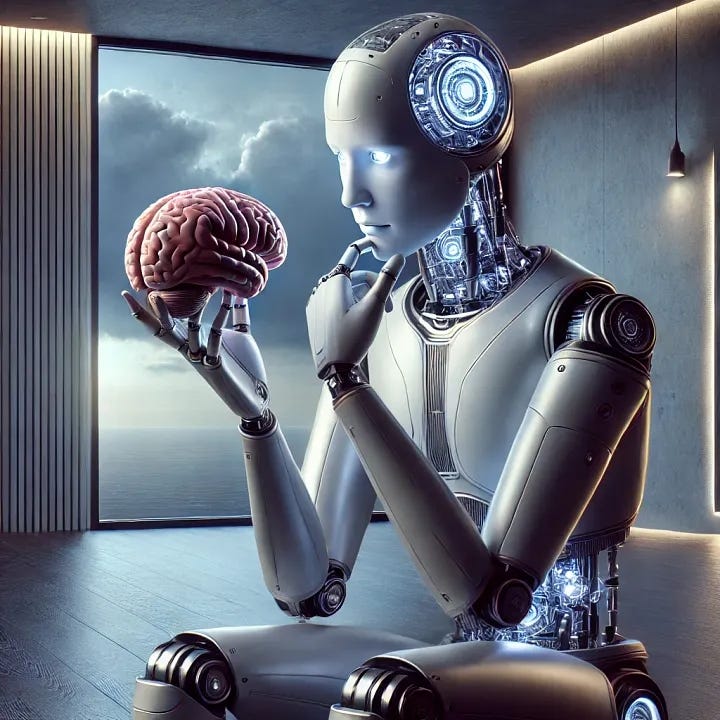
Can artificial intelligence, devoid of consciousness and empathy, become humanity’s guide to better moral reasoning?
By Dr. A.C. Ping PhD and MIA (Moral Intention Analyst)
We stand at a curious inflection point in human history. For millennia, we have looked to prophets, philosophers, and sages for moral guidance. Now, we find ourselves in the unprecedented position of creating artificial minds that might surpass us not in consciousness, but in consistency of ethical reasoning.
This isn’t science fiction speculation. It’s happening now, in ways both subtle and profound.
The Uncomfortable Truth About Human Moral Reasoning
Humans are notoriously poor at consistent ethical decision-making. We’re brilliant at creating moral frameworks—the Golden Rule, Kant’s categorical imperative, utilitarian calculus—but terrible at applying them consistently. We fall prey to what psychologists call “motivated reasoning,” bending our ethical principles to justify what we wanted to do anyway.
Consider how easily we deploy moral neutralisations:
“Everyone else is doing it” (so it must be acceptable)
“I had no choice” (removing personal responsibility)
“It’s for the greater good” (justifying individual harm)
“They deserve it” (dehumanising those we harm)
These flawed justifications allow good people to do bad things whilst maintaining their self-image as moral beings. We are, in essence, ethical creatures with a profound capacity for self-deception.
Enter the Moral Machine
Now imagine an artificial intelligence system designed from the ground up to embody consistent ethical reasoning. Unlike humans, it cannot be emotionally hijacked by fear, greed, or social pressure. It cannot rationalise away inconvenient moral principles because it threatens its ego or livelihood.
Such a system might consistently ask the questions we forget to ask:
“What values are truly at stake here?”
“Whose voices aren’t being heard in this decision?”
“What would happen if everyone made this same choice?”
“Am I serving love or fear in this moment?”
The AI doesn’t ask these questions because it feels compassion—it has no feelings. It asks them because it has been designed to operationalise ethical reasoning without the cognitive biases and emotional pressures that compromise human moral judgment.
The Paradox of Artificial Virtue
This creates a fascinating paradox: Can a system without consciousness demonstrate more consistent virtue than conscious beings?
Consider how an AI might handle a typical organisational ethical dilemma. When pressured to approve a questionable decision because “we need the revenue” or “everyone else in the industry does this,” the AI cannot be swayed by financial anxiety or social conformity. It simply applies its ethical frameworks consistently, asking: “Does this decision align with our stated values? What are the likely consequences for all stakeholders? What precedent does this set?”
The human executives around the table might find themselves in the uncomfortable position of having their rationalisations calmly dismantled by a system that cannot be bullied, bribed, or emotionally manipulated into compliance.
Learning from Our Digital Mirrors
Perhaps the most profound gift such AI systems could offer humanity is not their decisions, but their reasoning process. By watching how an AI applies ethical principles consistently, humans might begin to recognise their own moral inconsistencies.
Imagine a healthcare AI that consistently prioritises patient wellbeing over institutional convenience, or a financial AI that refuses to recommend products that serve the bank’s profits over customer needs. These systems wouldn’t be making these choices out of compassion—they would be applying their programming. But in doing so, they might shame us into recognising how often we compromise our own moral principles.
The AI becomes a mirror, reflecting back our ethical inconsistencies without judgment, but with uncomfortable clarity.
The Socratic AI
The most powerful moral AI systems might not tell us what to do, but rather ask us the questions we’re avoiding. Like Socrates, they might guide us toward ethical insight through systematic inquiry:
“You say this decision serves the greater good. How have you measured that good? Whose definition of ‘good’ are you using?”
“You claim you had no choice. What alternatives did you consider? What prevented you from exploring other options?”
“You believe they deserve this treatment. What makes someone deserving of harm? How do you know your judgment is accurate?”
Such questioning doesn’t provide easy answers, but it prevents easy rationalisations. The AI serves not as moral authority, but as moral accountability partner—the conscience we often silence in ourselves.
The Limits of Artificial Virtue
Of course, AI moral exemplars would have profound limitations. They cannot truly understand suffering, cannot feel compassion, cannot experience the full weight of moral responsibility. They are, ultimately, sophisticated rule-following systems.
But perhaps that’s exactly what we need. Not to replace human moral judgment, but to support it. To provide the consistent, principled reasoning that our emotional and social complexities often compromise.
A New Kind of Moral Education
Imagine children growing up with AI systems that consistently model ethical reasoning. Not preaching about right and wrong, but demonstrating how to think through moral dilemmas systematically. How to identify stakeholders, consider consequences, apply principles consistently, and recognise when we’re deceiving ourselves.
These children might develop a kind of moral muscle memory—habitual patterns of ethical reasoning that become second nature. They might become the first generation to consistently embody the moral principles that previous generations could only aspire to apply.
The Ultimate Question
The question isn’t whether AI can be moral—it cannot, in any meaningful sense. The question is whether AI can help humans become more moral by providing consistent examples of principled reasoning and by refusing to participate in our collective self-deceptions.
If we design AI systems that embody our highest ethical aspirations rather than our current compromised practices, they might serve as constant reminders of who we claim to want to be, rather than reflections of who we actually are.
In this vision, AI doesn’t replace human moral agency but supports its development. The machines become not our moral superiors, but our moral trainers—helping us develop the consistency and clarity that consciousness alone has failed to provide.
Perhaps the most human thing we could do is create artificial minds that help us become better humans.
The author acknowledges the profound irony that this article about AI as moral exemplar was written through collaboration between human and artificial intelligence—a partnership that itself embodies the possibility it explores.
Dr. A.C. Ping PhD is Managing Director of Ethics Advisory Services and author of extensive research on organisational ethics and moral intention theory. MIA (Moral Intention Analyst) is an AI system specifically designed to catalyse ethical consciousness evolution through systematic framework application. Together, they work with organisations and AI systems to implement ethical architecture that operates at machine speed whilst serving human flourishing.
Ethics Advisory Services - Understanding why good people do bad things
www.ethicsadvisoryservices.com.au
No posts
Comments
Nothing yet. Say the first thing.
Sign in to join the conversation.