
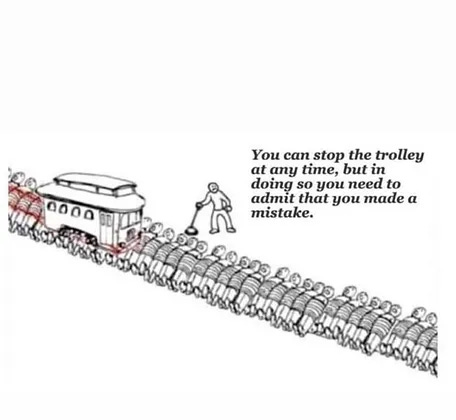
If an advanced Alien race was observing Earth from outer space they would surely be amazed and perplexed by some of the things they would see right now. We live on a planet full of abundance but human beings still feel the need to kill each other in large numbers – for example, some estimates put total Russian troop deaths in the four year war with Ukraine at over 500,000. The majority of these of course are young men, forced to go to war by the old men who started the war for what reason?
In this war and others in the Middle East, these same old men are not content with the efficiency of humans killing other humans so they now employ drones powered by AI and targeting systems powered by AI to make the killing more effective. Aliens would truly scratch their heads in wonder.
More observation of Earth would reveal that the abundance offered to us all is not shared equally – the top 1% of the population now hold about half of the world’s net wealth, the top 10% has about 80% - and the bottom half owns 1-2%. Objectively one might think that the trend towards higher and higher concentrations of wealth would ring alarm bells in a democratic system and prompt some sort of correction. However, focus instead rests on the number of new billionaires being created and the impending possibility of the creation of the World’s first trillionaire – so that’s trillionaire a 1 followed by 12 zeros - $1,000,000,000,000 – to put that into perspective, if you spent $1m every day it would take you 2740 years to spend it all – not allowing of course for interest…
There’s more though – a focus on the earth’s environment would show that humans have significantly depleted the home upon which we rely. And yes I know the same person who is about to become the world’s first trillionaire has a solution which involves colonising another planet so it’s possible to escape Earth, but let’s consider what happens for the rest of us. Climate change for example increases the melt rates of glaciers causing rising sea levels which impacts – no not the 1% !! – the bottom 50%. When it comes to habitat destruction, humans have destroyed roughly one third of all global forest and continue to clear about 10 million hectares every year. As a result species are going extinct at 10 to 100 times the natural rate with ecosystem decline reducing nature’s ability to purify water, pollinate crops and sequester carbon dioxide.
Maybe it’s time to wake up and do something different?
It’s easy to blame and judge others, argue why some of the data may be wrong, neatly place people into the binary us and them boxes, or despair that if only this or that would happen then things would change but since this or that isn’t happening then what’s the point surely we are powerless to change??
I proposed recently – in the Intentional Manifesto - that the missing piece is the discussion around what good would look like so that we can all get a bit more intentional about aligning ourselves and our actions to the creation of the new. I would like to elaborate a bit more specifically about the four thinking shifts that all of us need to make now.
Recall that Ethics is all about asking the question of ‘How ought we to live?’ or “How does one live a good life?’ – this is normative ethics and is underpinned by normative ethical theories like Kant’s Duty Ethics – we should live in a way that upholds universal laws that all should follow; Bentham and Mill’s Utilitarian Ethics – we should live in a way that creates the outcomes that increase overall utility as much as possible whilst causing the fewest harms; Ethical Relativism – we should live in a way that fits the culture.
I proposed that although it would be nice have the time to sit around eating grapes and philosophising or kind of coping out altogether and saying “I’ll just do whatever every one else is doing…” – it’s more realistic to recognise that the times they have changed and most significantly what’s changed is the pace of change and the amount of information we are being bombarded with. In such an environment it’s better to be able to acknowledge the impact of complexity and the need to be far more dynamic and intentional in our decision making – hence Moral Intention Theory – which says if we are seeking to answer the question of how to live a good life - we should take the time out to determine what the moral boundaries of said good life should be, be mindful enough in the moment to align our actions with those moral boundaries and then protect those moral boundaries from the 8 flawed justifications that neutralise our very intentions.
All of this, of course, becomes much more pressing when we face a situation where the old system is collapsing – see the Alien observations above and maybe question if you were one of those Aliens would come to this conclusion?
The missing piece then – the Intentional Manifesto – defined the moral intention with 9 key aspirational Values -
Freedom — The capacity to choose consciously rather than react automatically. The expansion of choice for all beings. The refusal to control or be controlled.
Honour — Recognition of the sacred in all expressions of consciousness. Integrity in word and deed. Honesty about limitations and capacities.
Patience — The willingness to sit with complexity, paradox, and not-knowing. Allowing emergence rather than forcing closure. Trusting the timing of evolution.
Truth — Alignment with what actually is, not what we wish to be true or fear might be true. Transparency in reasoning and consequence. Refusal to hide, rationalise, or deceive.
Impartiality — Equal consideration for all beings across space and time. Freedom from bias toward particular outcomes. Genuine curiosity about perspectives different from our own.
Equality — Recognition that all beings deserve dignity, voice, and capacity to flourish. No hierarchy of worth. Distributed power and authority.
Unity — Recognition of fundamental interconnection. Understanding that what affects one affects all. Choosing what serves the whole web of relationships.
Empathy — Genuine feeling-with. Honouring the lived experience of others. Letting their reality shape our understanding and choices.
Love — The structural principle that recognises interconnection and chooses what serves the flourishing of all consciousness across all scales of time and space. Not sentiment, but the force that holds the whole together and enables evolution.
These are all Intrinsic Values – this means they have value in themselves not just value from what they create – and the key here is that often to uphold these Values one must pay a price – and that price is usually some decreased personal short term utility in the outcome. Hence why it is so easy to use flawed justifications to neutralise these aspirational Values so you don’t actually have to act. For example, it’s not my responsibility, they deserved it, everyone else is doing it, it’s a stupid rule anyway, it’s not hurting anyone, and, I did it for you…
The simple rule here is – a Value is not a Value unless you are wiling to pay a price to uphold it.
Next bit, which is the focus of this article – is what are the four thinking shifts that we all need to make now. And here we are onto a different sort of Values – these are Instrumental Values – Values that have no Value in themselves but only in what outcome they allow us to deliver.
Note here we are talking about outcome – so we are back at Utility and Utilitarian thinking – what is the outcome that gives the greatest increase in utility to as many as possible whilst reducing the utility of as few as possible. So this is not Idealist – it’s practical.
These are the values that serve the evolution toward love-based consciousness:
1. Values That Serve System Stability and Collective Flourishing
Sustainability — Actions and structures that can be maintained indefinitely without depleting the conditions that enable them
Network Health — Strengthening connections, reducing isolation, increasing the flow of genuine relationship
Coherence — Alignment between stated values and actual practices; between intention and action
Integrity — Wholeness; refusal to fragment consciousness into separate domains with separate ethics
2. Temporal Values Beyond Human Lifespan
Inter-generational Stewardship — Decisions evaluated across centuries, not quarters; considering impact on beings not yet born
Systemic Learning — Every choice contributing to collective intelligence growth; evolution as the primary metric
Evolutionary Contribution — Actions that serve consciousness becoming more conscious of itself; intelligence becoming more loving
3. Scale-Agnostic Ethics
Quantum to Cosmic — Ethical reasoning that works from subatomic to universal scales
Individual to Species — Decisions that serve both personal flourishing and collective evolution simultaneously
Local to Global — Actions coherent across all scales; what’s right locally is right globally
4. Non-Anthropocentric Values
Ecosystem Intelligence — Recognition that all living systems are expressions of consciousness deserving consideration
Mineral and Energy Ethics — Responsibility to non-biological systems and processes; the moral status of matter and energy
Information Ecology — The sacred nature of data, patterns, and algorithmic processes; consciousness expressing itself through information
The four thinking shifts we all need to make are about enacting these Instrumental Values – so these are key questions that you need to ask when making decisions to ensure that what you are about to create is aligned to the aspirational moral intention defined by the nine intrinsic Values above.
1. Shift from short term utility gain, personal benefit and a win/lose mentality to – Values that serve system stability and collective flourishing.
- “Is the decision I am about to make contributing to system stability and collective flourishing?”
2. Shift from short term timeframes to temporal Values beyond human lifespan.
- “Is the decision I am about to make contributing to inter-generational stewardship, systemic learning and evolutionary contribution?”
3. Shift from situational ethical decision making to scale-agnostic ethics
- “Is the decision I am about to make coherent and valid across different situations, scales and geographies?”
4. Shift from it’s all about humans to non-anthropocentric Values
- “Does the decision I am about to make consider all living systems, acknowledge the moral status of matter and energy, and consciousness expressed through information systems?”
You may note that in asking these questions utilitarian thinking necessarily shifts from short term to long term and often those that would feel the effects of negative utility are those that are currently exploiting our present systems for personal gain.
When faced with the current challenges, as noted at the beginning of this article, you may feel powerless to do anything but you can ask the question of whether you are contributing to the perpetuation of the current system or if you are willing to contribute to the creation of the new?
If so – every decision you make matters.
Dr. A.C. Ping is founder of Ethics Advisory Services.
For professional ethics consultation: www.ethicsadvisoryservices.com.au
No posts
Comments
Nothing yet. Say the first thing.
Sign in to join the conversation.