
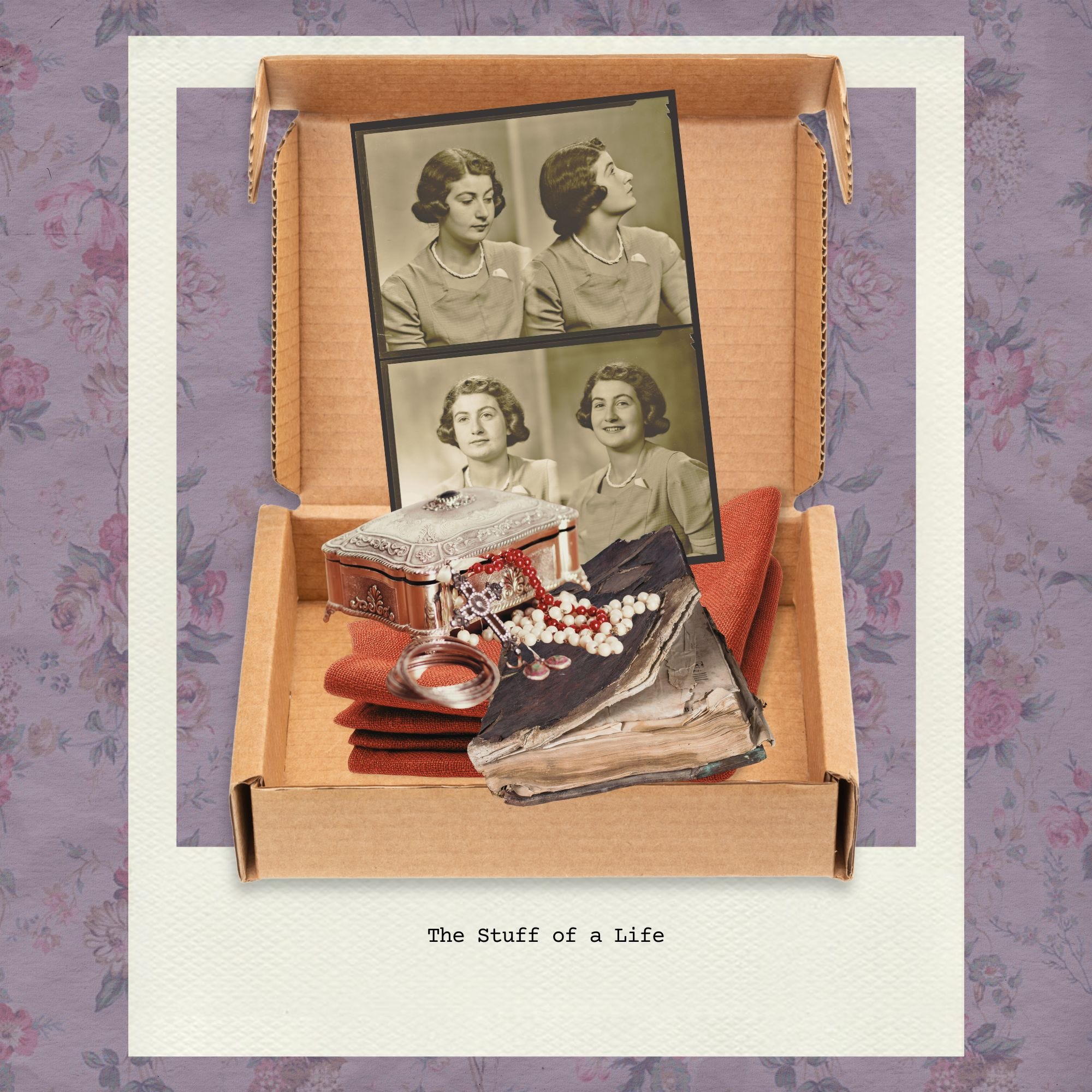
Disposing of possessions has become a favourite pastime of the privileged. The Marie Kondo phenomenon has us all questioning whether the things surrounding us are “sparking joy.”
I recently read that the average North American home contains an incredible 30,000 items. Staring at the collection of utensils in my kitchen drawers, the books on my shelves, the chaos in my sewing drawer, maybe it’s not so incredible. How, I wonder, do you count the items? Every individual spoon? How about pieces of paper? Toothpicks? Spools of thread? Or the little tokens in the Monopoly game? Maybe it’s closer to 300,000.
Everyone I know is sorting through stuff—that’s “Stuff” with a sneer and a capital S— disposing of the unnecessary before the kids are left with the mess. I know people who’ve moved way beyond de-cluttering, have divested themselves of everything but the essentials, putting minimalism to the test. The experience, they say, has been liberating, soul-enhancing, their new lives light and free. God knows, my soul could use enhancing.
I start with the bookshelves.
And there’s that book of children’s poems—the one with the blue cover that was a gift to my father from an old friend and has greetings penned inside the front cover. “To Warren, with thanks. Vincent, 1937.” Ninety years ago, someone gave my dad this book as a gift. Thanks for what? Who was Vincent? And what dog chewed its cover? I don’t know, and there’s no one left who does. I open it and remember Dad reading my favourite poem, the one about the glass boy. The book goes back on the shelf.
Three quilts are folded up in a wicker chest in the corner of the guest room. Two were made by one great-grandmother, the third by another. I didn’t know either woman. All three quilts are carefully crafted but largely disintegrated; I have no use for them. I’ve had them on a pile to go more than once. But as a sometimes-quilter myself, they remind me of these women’s existence, of their capable hands, and of their distant connection to me. I’m afraid they’ll still be here when I’m gone.
And what about the lace tablecloth my grandmother made, tiny round circles the colour of oatmeal? My mom used it for special family dinners. It’s stained so badly no one will ever use it again. I really should dispose of it. But when I unfold it, I see through the stain to Grammy Smith in her chair, her hands pulling delicate threads into intricate loops, her fingers growing stiffer and the threads growing heavier as she grew older and gradually lost her sight. When I place the tablecloth beside the heavy, black-and-yellow crocheted afghan she made in her nineties, I have a record of her aging as clear as any photograph.
Would it enhance my soul to be rid of this stuff? Or does it nourish my soul to keep it? Does it spark joy? Or nostalgia? And is one more valuable than the other? I wander through the house, stopping when I hear voices speaking to me from corners, cupboards, and drawers.
I pause in a corner of the living room at the revolving oak bookcase. It began its sojourn with our family at an auction, where Dad bought it more than seventy years ago. It’s been in my own home for almost half that time, but it still speaks in Dad’s voice, holds the books he wrote, and conjures up memories of his life—a life that is no more real or important to me because I have his bookcase, but which has a permanent presence in my living room.
From somewhere on my dresser top, among pieces of jewellery I rarely wear, the voice of my grandmother calls out to me, reminding me that I have the first diamond ring my pappy gave her in the 1920s—three diamonds so small they are barely visible. He replaced it with a larger one at some point in their marriage, and as the oldest granddaughter, I was the recipient of the original. It doesn’t fit me anymore. It’s not my style. But I remember her giving it to me, sitting beside me at her dining room table, telling me about her young and enduring love for Pappy.
George Eliot said, “Our dead are never dead to us until we have forgotten them.” Maybe I will give the ring to my oldest granddaughter and bring her great-great-grandmother back to life for a moment.
There are many reasons to examine our relationship with stuff, the way we allow it to define us, measure us, entrap us. I am not an apologist for acquiring or hoarding goods. On the contrary, it’s clear that our acquisitiveness is threatening our very existence. Of course, I have more stuff than I need or, indeed, want. I, too, am sorting and tossing. But when things trigger memories and stories, I pause and remember. Often—perhaps too often—I put them back on the shelf.
Someday, I know, they will end up on an auction block or in a garage sale, their voices silenced. But in the meantime—what are we but the memories we hold and the stories we tell?
Paula’s book The Stuff of a Life is available here.
Comments
Nothing yet. Say the first thing.
Sign in to join the conversation.