
Bahrain – March 2026. The port is in flames. The U.S. embassy has been struck. A drone has hit a desalination plant — the source of clean drinking water for thousands.
I turn off the news and close my eyes.
And then, unexpectedly, I smile. My memories of Bahrain are of pearls, porpoises, and cormorants.
It was October 1981. Despite Ian’s rosy promises, he had brought me to a 13-bedroom ramshackle house in the ancient village of Diraiyah — which we shared with a very opinionated and haughty Syrian man by the name of Safwan.
I needed an exit visa to leave, and this required the permission of my husband — who as I discovered had lost his job. No income, no home of our own, and now no trust. I do not recall ever before feeling such despair.
And yet – I found within me reserves of strength I didn’t know I possessed. Within a few months I had landed a job teaching French at the British School in Riyadh, much-needed camaraderie. In the staff room, talk centered on where the teachers were heading for the half-term holiday: Cyprus, Spain or Malta. But Ian and I were short on funds.
Then came an unexpected invitation: to house-sit for one of Ian’s friends in Bahrain, a very affordable holiday.
The house, rented to an American lawyer who travelled monthly to New York, offered more luxury than we were used to. My weekly letters home, carefully preserved by my parents, now make me smile. “All was very lavish, complete with video, washing machine and iron.” Such was my notion, then, of the epitome of modern convenience!
My letters to my parents do not reveal my anger and disappointment with Ian. My role in the family had always been to avoid causing my mother further anxiety. By October, I already had thoughts of returning to Canada at Christmas — for good.
Our only house-sitting responsibility was walking Tom’s dog, Monty, by the sea in the morning and evening. The name Bahrain means two seas, and I inhaled the scent of them: salt and drying fish, mingled with coffee, cardamom, and frankincense.
The island felt relaxed — a relief after the oppressive austerity of Riyadh, with its wandering matawaiin, or religious police, thwacking at women’s exposed calves. In Bahrain, I could breathe again and linger in the inviting cafes where women could sit anywhere and not be herded into the “family sections.”
One person we met proved the most memorable. Angela was an archaeologist writing a book on the islands of Bahrain. She invited us to accompany her for the day on a final pre-publication tour of the archaeological sites.
And so we spent a single glorious day bouncing on empty roads as Angela introduced us to the ruins of the ancient civilization of Dilmun, from 5,000 years ago.
“Many think it was the site of the garden of Eden,” claimed Angela.
“Hard to believe,” I said, studying the arid monochrome desert, and swatting away a fly.
“This was once lush and fertile,” she answered, laughing.
We explored the burial mounds or tulums of the Dilmun, an ancient Portuguese fort, and vast flint sites, scattered in abundance on the desert ground.
It was there I began to see Ian differently. In his old cords and blue shirt, he knelt easily in those arid places, brushing, sorting and identifying the prehistoric flints. His fluent Arabic opened doors. He spoke with ease to those we met, moving through this world with a confidence I had not seen. I watched as he focused his Nikon lenses to shoot photographs that would later appear in Angela’s book, The Islands of Bahrain.
I remembered then why I had given up my apartment, my job, my life in Ottawa — to follow this man to the Middle East.
We ended the week with a visit to the Manama Souq, in search of a memento. The lanes narrowed, gold glistened, Ian pointed to some Arabic script and pulled me into a small plain shop. Tea was offered, accepted and poured into tiny clear glass cups. The vendor pulled out shallow trays with small envelopes. The owner tipped out several pale, almost pinkish, luminous forms. Ian leaned in, asked questions, nodded. “Natural… from here,” said the vendor, pointing in the direction of the sea. We left with a tiny white envelope containing my own small, perfect pearls.
Our flight home coincided with the end of the Hajj holiday. The airport was overwhelmed — clogged with returning vacationers. The airline had overbooked.
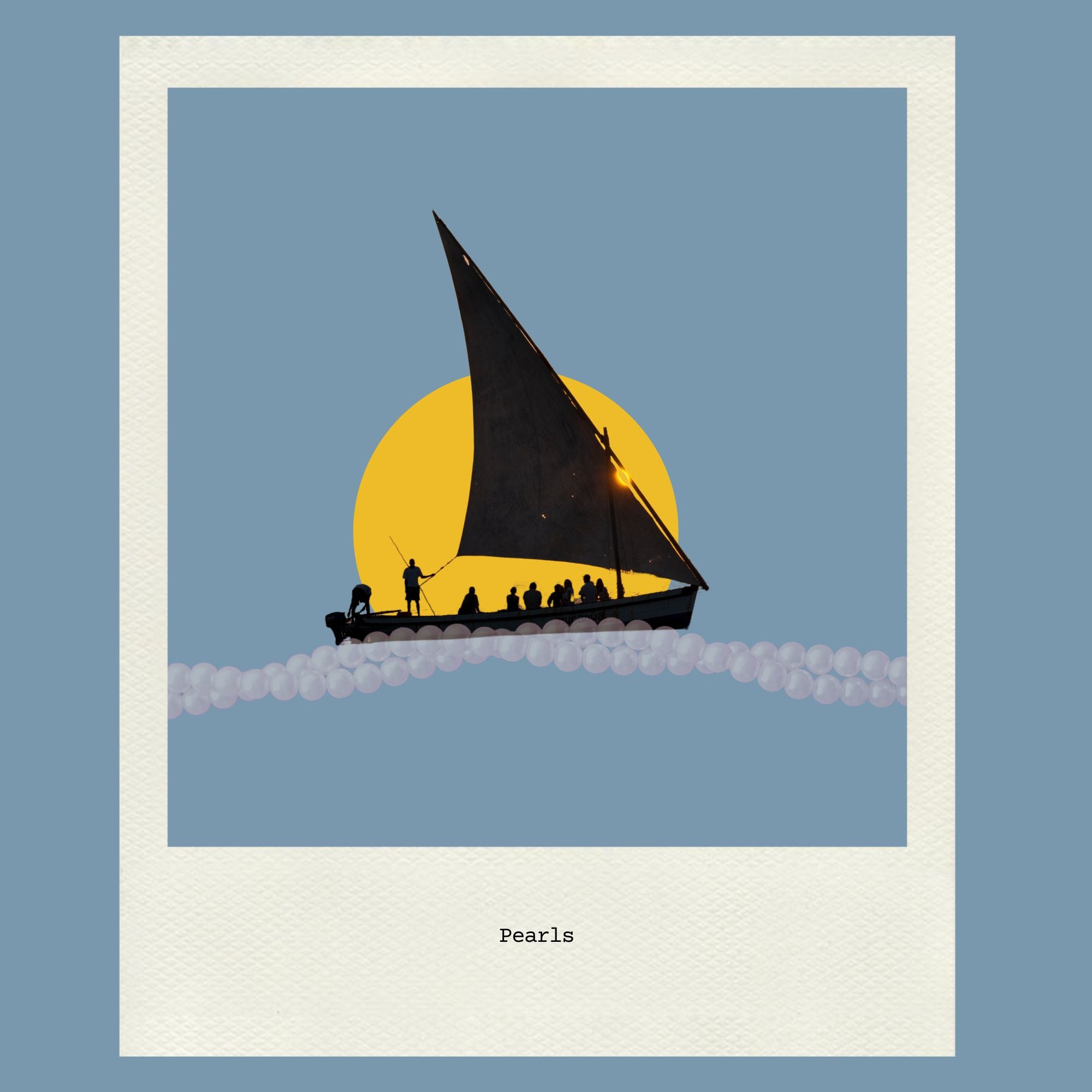
With no seats available, Ian and I took a traditional dhow from Bahrain to Al Khobar, across the Persian Gulf — known locally as the Arabian Gulf. It was a wooden boat of the kind long used for pearl diving. I sat cross-legged on the floor of the deck, along with about sixty passengers dressed in slim long white thobes and red and white checked ghutras; we were the only non-locals. We were surrounded by Saudi women — unveiled though in black abayas — their hands and feet patterned with henna; the air permeated with cardamom. Cheerful and generous, they offered us items from their picnic: labneh, flatbread, and slices of sweet melon.
Porpoises surfaced and disappeared alongside us. We took turns spotting cormorants perched on the mast.
About an hour into the two-and-a-half-hour journey, the diesel engine spluttered, faltered and died.
The captain launched into rapid Arabic, his hand and arm gestures wild and emphatic. A lively and excited debate broke out among the passengers. Ian explained that the captain was taking a vote as to whether to head back to Bahrain or press on to Al Khobar, using the backup triangular sail. Ill-informed though I was, I laughed and raised my hand to vote to press on.
Looking back, I see my trip to Bahrain as a turning point. The moment I raised my hand on the dhow was, in its small way, the moment I chose to press on — with my marriage, and with the life I found myself in, now seeing more clearly the man I married.
I did not return to Canada that Christmas. For a time, that was the right decision.
Thanks for reading A Considerable Age!
Comments
Nothing yet. Say the first thing.
Sign in to join the conversation.