
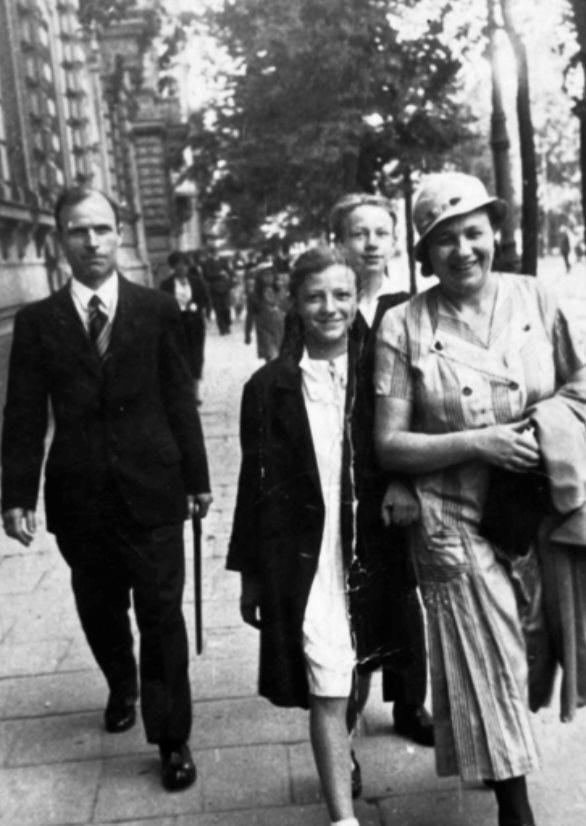
A family walks along the sidewalk of a city street: mother, father, daughter and son. It is a summer day and they are happy, dressed for the season, all smiling except for Papa. Maybe something he saw in the newspaper that morning was on his mind.
There were things to worry about. A few years later, the city – Warsaw – would be in ruins, and the parents would be dead.
Tracing what happened to the sunny family became a quest for Alice Switocz Goldbloom, who was to be the daughter of the young man in the photo. For many years her mother, Maria, and father, Edward, left unspoken what had happened when they were growing up in Poland and confronted with the cataclysm that was World War II.
Her parents’ silence was a way of protecting the three Switocz sisters. Raised in Sarnia, Ont., Alice Switocz’s concern was to fit in with other young people who led ordinary Canadian lives, in fact, to distance herself from the accents and foreign ways of her parents and their fervent Catholicism.
She was smart, energetic and ambitious, eager to break away from home. University was an escape route. Good jobs followed. She was assistant to a Liberal cabinet minister in Ottawa, and she started her own communications business in Montreal. She hired a man she would later marry, Jonathan Goldbloom, son of Victor Goldbloom, patriarch of the prominent Montreal Jewish family. Unable to have children of their own, they adopted two from Poland, the homeland her parents had fled.
All was going as Switocz Goldbloom wished. But the past, even a hidden one, has a habit of creeping out in unexpected ways. Her mother died in 2005, taking her memories with her, but in his final years, what her father recalled began spilling into Switocz Goldbloom’s consciousness.
Edward Switocz was by then an old man living in a Toronto care home where his daughter went often to visit. One day, to escape the tedium of the place, she asked him, “Do you remember the day the Germans bombed Warsaw?” “You should have asked me when my memory was sharper,” he replied.
But age does not dim such memories. Over the next months all that happened came tumbling out: the bombing of Warsaw in 1939, which left 10,000 dead, the uprising and subsequent liquidation of the Jewish ghetto, its population hauled off to death camps, life for Poles as “untermenschen” – sub-humans – under Nazi rule. Edward Switocz joined the Polish Home Army, which in 1944 rose up in resistance to the occupiers. Outgunned, it was defeated as the Soviet Red Army stood by across the Vistula River, waiting for the bid for freedom to be dashed. Two hundred thousand Poles died in the Warsaw Uprising.
Switocz became a prisoner of the Germans while his parents were sent to concentration camps, where they perished (his sister escaped to the countryside). As the Red Army rolled across Poland, the camps were evacuated – Jews, Roma, PoWs and other prisoners sent westward in tens of thousands on death marches. Switocz watched as most of the men he was with died while they trudged more than 800 kilometres into Germany, of fatigue and cold, shot by their captors when they could no longer walk. He had one keepsake with him, the picture of his family on that summer day in Warsaw.
After her father died, Switocz Goldbloom looked for her mother’s story. It was more of a sleuthing job. In archives and other sources, she traced Maria’s wartime days as a forced labourer, sent to Germany where she endured inhuman conditions, some particular to women that that would mark them for life. Her parents met in the Netherlands after the war, following stays in the Displaced Persons camps in Germany, and immigrated to Canada in 1951. Small wonder that in this country, they would want to shield their children from what they knew.
What Alice Switocz Goldbloom has learned about her parents compelled her to record their lives in the just-published book Family Secrets. The stories it contains are both revelatory and timely.
While the drama of the war and its trauma draw the reader’s attention, the book is also the story a woman’s journey, about how finding the missing pieces of a life were critical to the author’s understanding of herself.
Even as her parents kept the past from her, so too was occluded part of the story of what happened in Poland during the war. The massacre of the Jewish community has been recorded and is well-known, but the suffering of Polish Christians – 2.7 million died during Nazi rule – is a story that has been pushed into the shadows. This was the result of Poland’s new overlords, the Russians, supressing it. Moscow left no room for mention of what happened to Poles during the years a free nation was turned into a German slave state or, for that matter, one dominated by the Soviet Union.
There was also the contoversial tag of antisemitism and complicity borne by Poles for what happened to the country’s Jewish citizens. Only in recent years has this wound begun to heal in Poland and elsewhere in Eastern Europe.
Canada, too, has fostered healing. That Alice Switocz married into a Jewish family is central to the story. Having had to navigate between competing narratives of the past has led her to the kind of reconciliation between communities this country can offer.
Full disclosure: Alice and I became friends when she introduced me to Substack a couple of years ago. Earlier this week, I asked her what becoming a Goldbloom meant in the writing of Family Secrets. “I couldn’t have written the book without that happening,” she said.
The book’s timeliness comes from the understanding that we are once more in a moment when grievance and the hatred it promotes have infected societies that seemed immune from them. The price of immunity is commitment to the tolerance that protects the happiness of families like the one in the picture at the top of this post.
Family Secrets
Pottersfield Press, 164 pp
This review of Family Secrets was originally published on Bryan’s Substack Life Sentences on May 1, 2025. You can find where to buy the book here.
Comments
Nothing yet. Say the first thing.
Sign in to join the conversation.