
While being a novelist was something that I had started to think about as maybe a side thing for ages, one of my earliest “dreams” I remember having is wanting to develop video games. I grew up at a time when video games were starting to move from “niche" to something more mainstream, and I grew up with all sorts of Nintendo consoles. I’d get lost in games, and then I’d sit and come up with ideas for different things for games. Level designs, schematics, abilities, and the whole nine yards.
In particular, the Fire Emblem series really hooked me since I played the first western-released one in 2003. If you’re unfamiliar with the series, it’s a turn-based strategy game that has RPG-like progression (including growth rates for stats) and a tendency to be quite unforgiving (death is usually permanent in those games). I’d fill spreadsheets with characters, classes, statistical ideas, and even some very loose narrative ideas. Numbers came easily to me that way, and I’ve always been decent with them, so I stuck with them.
I’ve always wanted to make video games, especially my own game like Fire Emblem, but…I’m bad at coding. Like, really bad. I was never able to take classes in computer science, and while I know my way around computers decently enough, I could not code my way out of a cardboard box if you tasked me with this. So…that seemed to be consigned to being a dream, something to wistfully look back on.
Tools for the Trade
Around 2020, I started hearing about a program called SRPG Studio. It’s an engine program, similar to the many different iterations of RPG Maker, that allowed people to use a more tile-and-sprite style of editing to build out maps and get the game how they wanted it to be. I had known about RPG Maker’s various iterations for years; we had RPG Maker 2003 as a kid, and my brother’s had various iterations of it since (and never managed to finish anything).
I’d heard about it when I stumbled upon a little game called Vestaria Saga I: War of the Scions, a project done by the original creator of Fire Emblem, Shouzou Kaga. The game looked and felt like Fire Emblem, and I started to think that I could maybe have a hope of living out my game development dreams with it. Convinced that I could make something happen with SRPG Studio, I bought the license for it when it was on sale and jumped in, learning all of the particular quirks of the program and being reminded of my childhood fooling around with RPG Maker in the process.
This started in 2021, and it was sort of practice. Figuring out what I could do, how to make things work, and getting a feel for the ropes. I had tooled around for a couple of months before I took a break, partly because of my rewriting of what became my first two novels starting around then.
Second Start
In December of 2022, I had finished the drafting of the novel, and while I was starting to figure out what to do with it, I turned back to SRPG Studio for the time being. I decided that I was going to get something out, come hell or high water. I’d bought the license, and I was determined to at least make something out of it.
Thus, my goal was set: I was going to get a game out. It didn’t need to be the prettiest or most polished (though I wasn’t aiming for a deliberately bad game), but I was going to release something.
An idea I’d always had for a story was what I turned to: two brothers, one skilled with light magic and one skilled with dark magic. In such a story, you’d normally expect to follow the light mage, but I wanted to invert things and cast the dark mage in a more heroic role. I built the cast around this concept (dark magic isn’t necessarily evil, though some dark mages certainly are), and we were off to the races.
I did take a break in June to play through The Legend of Zelda: Tears of the Kingdom, coming back to the project when I was finished with it. To my surprise, I actually still liked it! So I doubled down and worked on finishing out what I had, and by September, I was getting ready to launch.
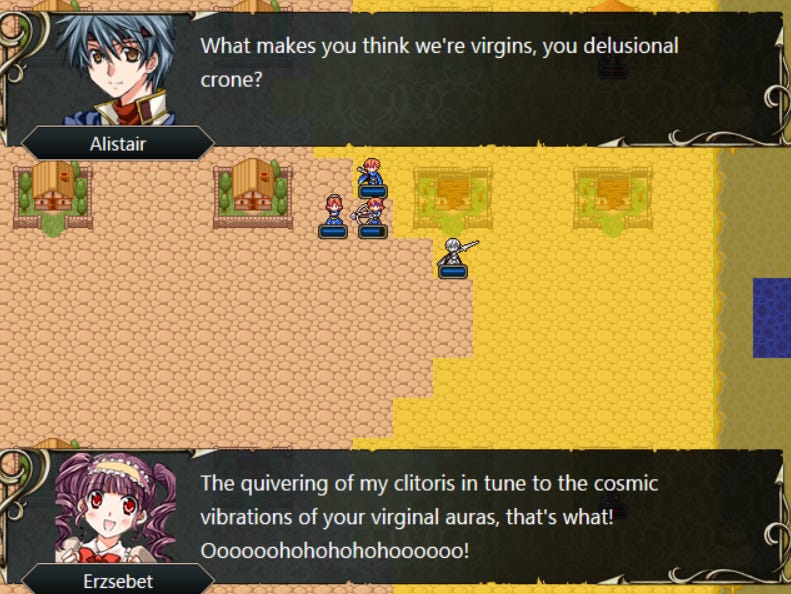
My first game went live on October 8, 2023, called Chronicles of Dramarith I: The kIng of Light and his Dark Heir. In all, it took me about 10 months to get the game from the blank, open project to properly released. I made use of art assets that I found that were free to use with attribution (to account for my artistic limitations), and while I definitely know it feels like a one-man project, I’m still proud of it. It’s actually the first full project I both releaed and publicized, and it was, if nothing else, meant as a proof of concept, that I could see something to the end.
So…I did one game. What next?
Back into the Madhouse
I feel like there’s always a bit of a desire to immediately hit the ground running on another project, and I maybe shouldn’t have…but I did. I started working on another video game almost immediately, as soon as I was clear of the “blast radius” of the first game’s release. A bit darker, a bit more mechanically unusual, and a bit bigger in scope.
I probably should have waited, because this was definitely a struggle to get through at times. Between starting my self-publishing pivot, ongoing patches for the first game to clean up problems, and life more broadly, this game definitely was subjected to a laborious process. Still, though, I wanted to get this one out as well, and while I knew I did have two main balls in the air, I wanted it out. I set a target of having a new game out by the end of 2024.
I did meet that target…if barely. Chronicles of Dramarith II: the Crownless Kingdoms came out on December 24, 2024.
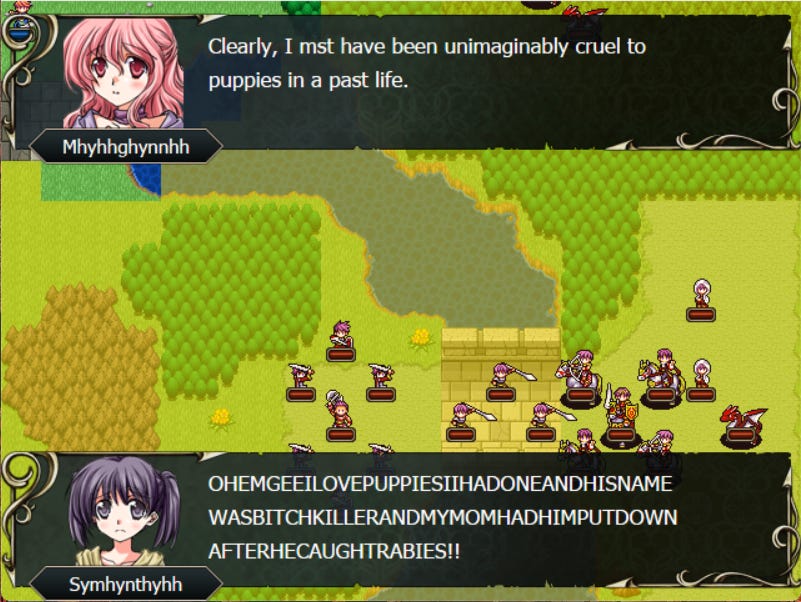
I did also start a third game, but that’s still a long ways off from seeing daylight. I’m hoping to have it out this year, but we’ll see. I didn’t want to burn out as badly as I did after the second game.
Novel Concepts and Game Design
The last thing to mention here is that there’s a fair bit of overlap between game writing and between novel storytelling, but there are a lot of little things you can tell through game mechanics that may not be easily captured throughwords (r as easily).
Take two characters: a rookie knight, and an experienced veteran. You look at their stats, and you should probably be able to tell that the veteran has…well, experience. Stronger, more capable, and just all-around competent. As the game progresses, though, you should notice the novice knight starting to catch up statistically, if not surpass the veteran. That’s a bit of non-verbal storytelling you can use, a bit of numbers to show where characters are stronger and when they are.
There’s also other and more subtle things, like different abilities and skills. Ideally, telling a story in a game should lean into what the game does well, using numbers, statistics, and situations to tell a story in a way words alone cannot.
I will say that working on the games did help me shapren a better sense of what words can convey and what’s harder to put across on a page. I know there are genres like Lit-RPG that thread the needle that way, but I’ve always felt that games are strongest when they lean into the things only they can do (while still hitting the common elements well enough).
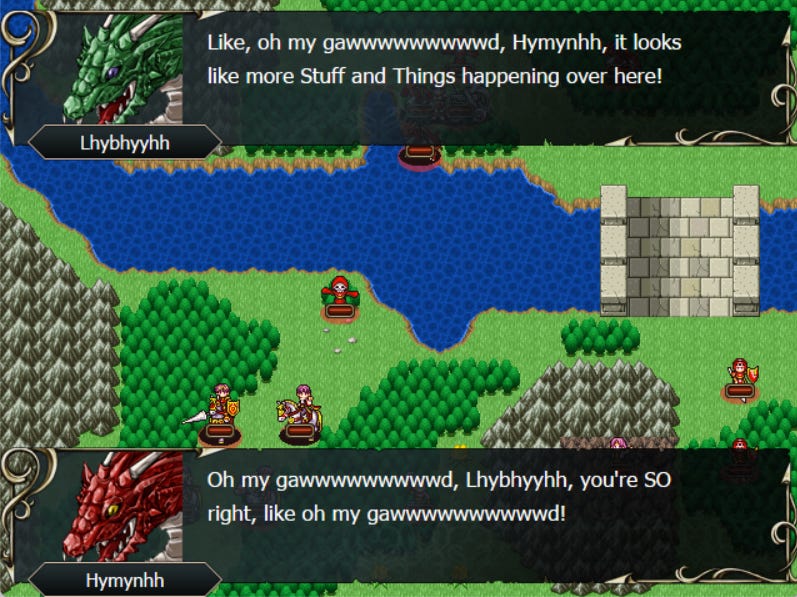
If you want to play my games, they’re both free on itch.io.
Thanks for reading this far! If you want more, I’d love to have you.
Comments
Nothing yet. Say the first thing.
Sign in to join the conversation.