
Read this article or listen and learn on the go:
0:00
-13:31
I still remember the exact moment my left leg stopped listening to my brain. One second I was getting out of bed to head downstairs to the kitchen, the next second a tsunami in my head started to wreak havoc with my balance. I started to drag my left leg and stub my toe and as I continued down the stairs holding on, I caught my toe again and fell down the last two stairs. Still in denial of what was happening I tried to walk through the door to the kitchen and smacked my left shoulder against the door jam. Standing at the kitchen counter, reaching for the milk to pour into my coffee mug I dropped it and milk scattered everywhere. I stumbled and fell again trying to clean it up. I didn't know it yet, but I was having a stroke. And that fall was the first of many.
Thanks for reading Achieve Balance with SmartMovesPT! This post is public so feel free to share it.
Over the next nine months, I stumbled in grocery store aisles, in hospital hallways, on my own front steps. Each fall carved away a little more of my confidence. I started planning my entire day around not falling — which stroller I could take to the bus stop to hide my balance issues, which stores had the sturdiest shopping carts to lean on, which rooms in my own house felt dangerous after dark. The world shrank as weakness and loss of sensation on my left side controlled me. And honestly? So did I. I was scared and felt alone.
It's not just a physical problem. It's an identity problem. Before, I was a physical therapist who spent my days helping other people stand steady. After, I was someone who couldn't trust my own legs. The gap between who I was and who I'd become felt like a canyon. And I had no idea how to build a bridge across it.
Share Achieve Balance with SmartMovesPT
So I did what I always do when I don't know the answer. I started measuring. Not with vague feelings or hopeful guesses — with actual tests. I timed myself standing up from a chair and how many times I could repeat it in 30 seconds. I measured how far I could walk before my gait got sloppy. I tracked how many seconds I could hold a tandem stance without grabbing the wall. That data became my anchor. It told me exactly where I was, and it gave me a place to start.
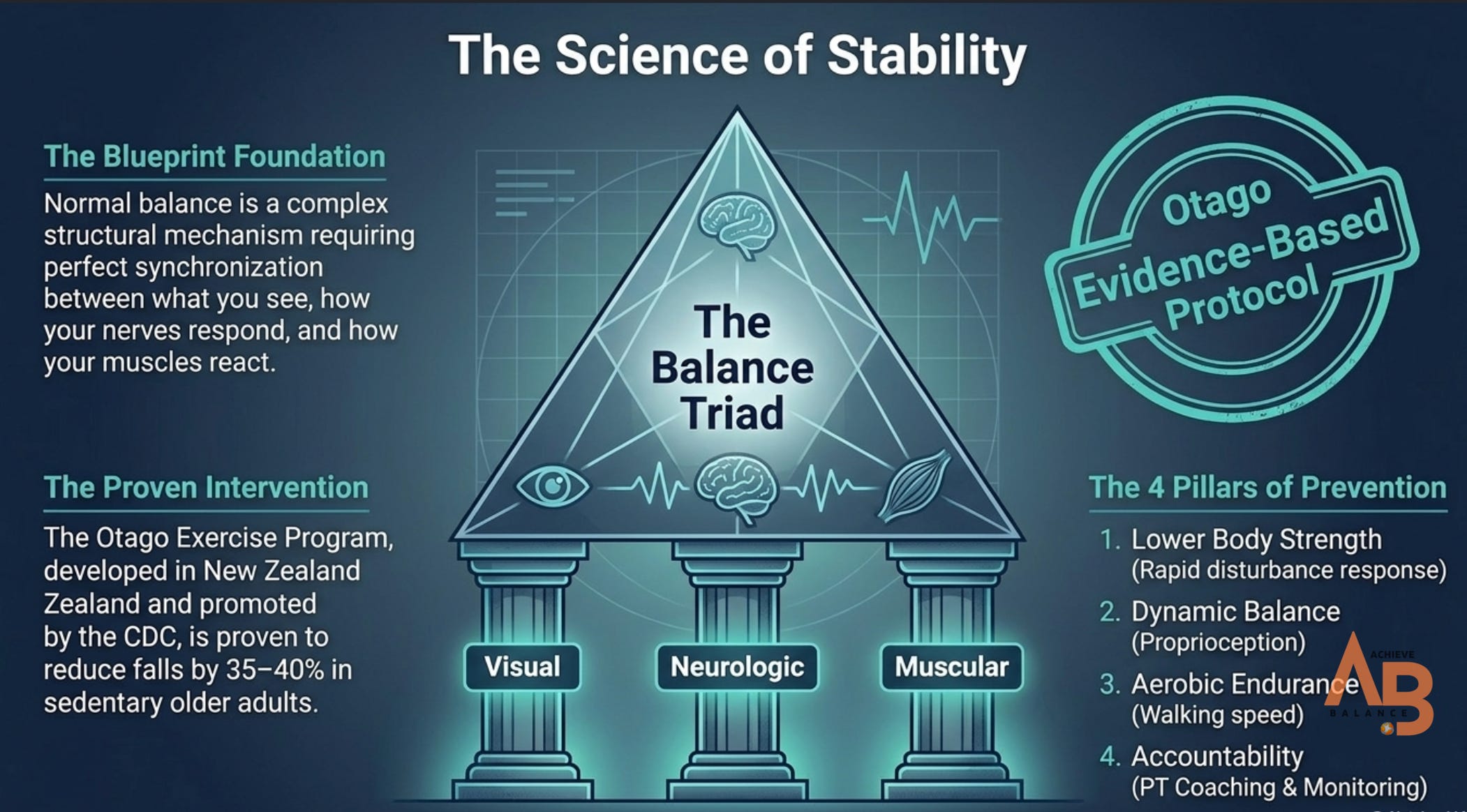
I also went back to the research. I'd known about the Otago Exercise Program for years — it's one of the most thoroughly studied fall prevention programs in the world, developed in New Zealand and tested with thousands of older adults. But I'd never thought of it as something for me. That changed fast. The program's core exercises, its slow progression, its emphasis on building real-world balance — it was exactly what I needed. And I suspected I wasn't the only one.
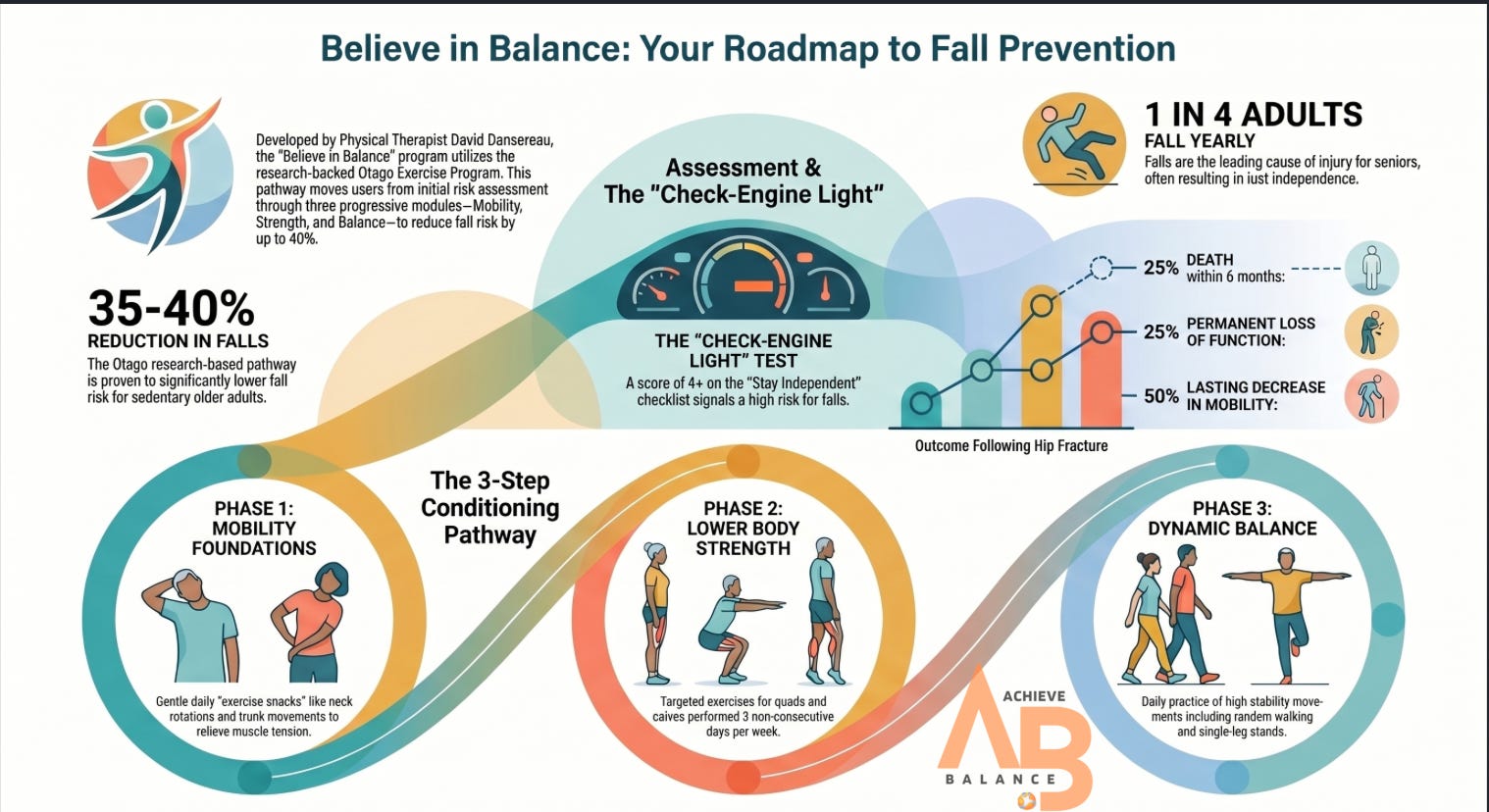
As I got stronger, I started weaving the Otago exercises into the framework I now use with every client I work with: Measure, Manage, Move. Three simple steps that turn a scary, overwhelming problem into something you can actually tackle. Measure where you are right now — no judgment, just numbers. Manage your plan based on what those numbers tell you. Then Move — progressively, safely, one day at a time. The 3 M's aren't a gimmick. They're the system that got me off the floor and back on my feet.
Today, in addition to my private physical therapy practice, I'm also a Certified Aging in Place Specialist (CAPS), and Certified Age Tech Specialist. Since my stroke, I've led fall prevention and digital age tech support workshops for hundreds of people — stroke survivors, older adults, anyone whose balance has started to feel like an enemy instead of an ally. I've watched people go from gripping walls to walking confidently across parking lots. I've seen the look on someone's face the first time they realize they just navigated a crowded room without once thinking about falling. That look never gets old.
My book and the companion balance course guide I wish someone had handed me the day after my stroke and the balance issues that followed. It's built on the Otago Program and organized around the 3 M's. It's not just a collection of exercise you can find those anywhere. It's a step-by-step system for rebuilding stability from the ground up, designed specifically for people whose balance has been disrupted by stroke or neurological changes. You don't need a gym membership, fancy equipment, or anyone's permission. You just need to be willing to start where you are.
Order Closure After Stroke on Amazon
Let me be clear about something right up front: this is not one of those glossy exercise books with smiling models doing perfect lunges on a beach. You won't find one-size-fits-all routines or cheerful promises that you'll be hiking mountains in six weeks. Those books have their place, I guess. But they weren't written for us. They weren't written for people who understand what it feels like when your body suddenly stops cooperating, when a limb feels weak, when standing up from a chair requires genuine courage, when the fear of falling has become louder than any motivational quote.
This is also not a replacement for working with your doctor or physical therapist.
If you're currently under medical care, the exercises and strategies in this book are designed to complement that work, not compete with it. I'll say more about how to coordinate with your healthcare team later on, but for now just know: this book respects the complexity of your situation. It doesn't pretend to have all the answers. What it does have is a clear structure, an evidence base, and a whole lot of hard-won understanding. As I say in my book, Closure After Stroke,
when you've seen one stroke, you've seen one stroke
Meaning, we survive with our own deficits and limitations, and the playbook you carve out in your own recovery is specific to you. My book and companion balance program is meant to give you a playbook to tweak and make your own.
Finally, this book is not about going backward. I'm not going to spend chapters helping you mourn the balance you used to have, or trying to restore some pre-stroke version of yourself that no longer exists. That chapter is closed. What we're going to do instead is build forward together. We're going to figure out what your body can do right now, and then we're going to make it capable of more — safely, systematically, and at your pace. This is not about recovery in the rearview mirror sense. It's about strength that moves ahead of you, clearing the path.
By the time you finish my course and book, you will know exactly where your balance stands today, not in vague terms, but in actual measurable numbers that you can track and improve. You will have a customized set of exercises, drawn from the Otago Program, that match your current ability level and progress as you do. You will understand how to manage the fear of falling so it stops running your life. And you will have a system — the 3 M's — that you can return to anytime your balance shifts, which it might. Bodies change. That's not failure; that's just being human.
More than any of that, I hope you'll walk away from these pages feeling something I desperately needed during my own recovery: hope that isn't fragile. Not the kind of hope that evaporates the first time you stumble. Real hope, the kind built on evidence and structure and thousands of small wins stacked on top of each other. That hope doesn't come from positive thinking. It comes from doing the work and watching yourself get stronger. That's what I want for you.
So here's where we start. Not with my story anymore, you've heard enough of that. If you want a deeper dive on my motivation and my foundation that fueled my recovery certainly order a copy of my book.
Now, we start with yours. In the next podcast episode of Believe in Balance, we're going to look closely at the science of stability: how balance actually works, why it breaks after a stroke, and why the standard advice falls so painfully short.
Then we'll dive into the 3 M's, and from there, into the program itself. Take your time. There's no rush. The floor isn't going anywhere, and neither are you — except forward, one steady step at a time. If you want to jump ahead and listen and watch a recorded balance workshop I did about the course, see the resources below for this podcast episode.
Comments
Nothing yet. Say the first thing.
Sign in to join the conversation.