
Hey friends —
Welcome back to the AlleyCorp Deep Tech newsletter. November delivered an exciting stretch of news across our portfolio with Valar Atomics achieving *two* major milestones, Portal Space Systems’ CEO Jeff Thornburg sitting down with Neil deGrasse Tyson, Halo Braid going viral, and compelling developments across the deep tech landscape.
We’re also introducing a framework we’ve been quietly refining over the last couple of years — The Rule of 50 — a deep-tech-specific performance heuristic designed to stand in for SaaS-centric metrics that don’t map well onto robotics, aerospace, energy, and advanced manufacturing. More on that below.
As always — if you’re building in deep tech (or want to talk about Rule of 50 value creation), reach out. We’re here to help.
~Brannon

It’s been a historic month for Valar Atomics.
The Raise: Valar announced a $130 million Series A led by Snowpoint Ventures, Day One Ventures, and Dream Ventures, with participation from AlleyCorp, Riot Ventures, Anduril founder Palmer Luckey, Palantir CTO Shyam Sankar, and Lockheed Martin. This brings total funding to over $150 million and positions Valar as one of the best-capitalized advanced nuclear startups in the country.
Read about it: CNBC | Bloomberg | American Nuclear Society
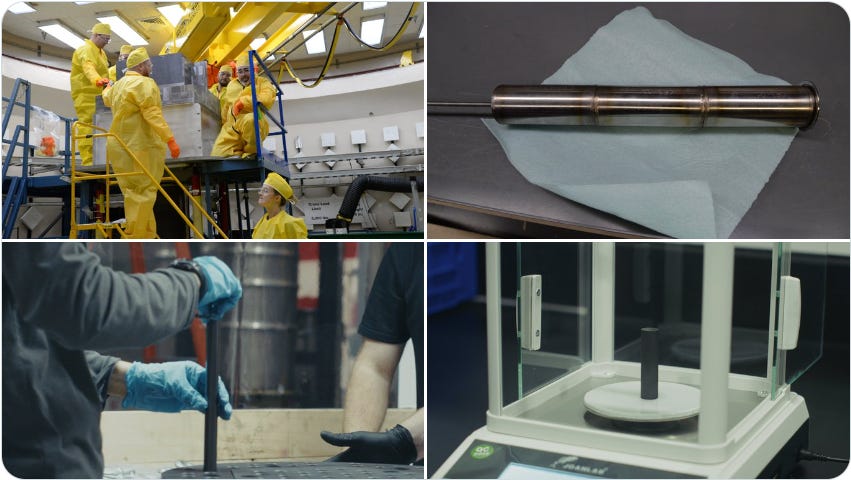
Project Nova Goes Critical: Just days after the funding announcement, Valar became the first venture-backed company in history to achieve criticality. On November 17th at 11:45 AM PT, their Nova Core achieved zero-power criticality at Los Alamos National Laboratory’s National Criticality Experiments Research Center (NCERC) in Nevada.
This is a foundational milestone — a self-sustaining chain reaction that validates the physics of their reactor design ahead of power operations. The Nova Core uses HALEU TRISO fuel and a graphite-moderated design that mirrors their Ward250 reactor, which is scheduled to begin power operations next year under the DOE’s Reactor Pilot Program.
CEO Isaiah Taylor put it well: “Zero power criticality is a reactor’s first heartbeat, proof the physics holds.”
The DOE Pilot Program, established under Executive Order 14301, aims for at least three test reactors to reach criticality by July 4, 2026 — and Valar just became the first to cross that finish line. Construction is already underway at Utah’s San Rafael Energy Lab for the Ward250, and the company is tracking toward full power demonstration next summer.
Read more: Valar Atomics Official Announcement | Wired | American Nuclear Society
We’ve been believers in this team from the beginning. Watching them go from incorporation to criticality in just over two years is a testament to what’s possible when exceptional founders tackle the most ambitious deep tech challenges of our time.

Portal Space Systems founder and CEO Jeff Thornburg joined Neil deGrasse Tyson on StarTalk for a wide-ranging conversation on the future of space engineering.
Here are the highlights:
On Portal’s Mission: Portal is building the most rapidly maneuverable spacecraft ever made. Their platform can move from mid-Earth orbit to low Earth orbit in under three hours, and from LEO to geostationary orbit in a day — speeds that aren’t routinely possible with existing satellite technology. As Jeff put it: “Our customers don’t care about how cool the tech is, they just want speed.”
On His Background: Jeff’s career spans the Air Force Research Lab (where he helped develop full-flow staged combustion engines), Aerojet, NASA, and SpaceX — where he architected the Raptor engine system for Starship. Fun fact: Elon personally called him at home in Huntsville to recruit him. “I think that counts as being cherry-picked,” Neil quipped.
On the Value of Failure: Jeff emphasized the cultural shift in aerospace: “Failure is not an option” leads to infinite cost and glacial timelines. The new approach — embraced by SpaceX and now percolating through the industry — is to actually break things and learn. “When you fail, you’ve given engineers a gift because now they have all the information.”
On Government R&D: While private industry chases value creation and stock prices, Jeff argued that FFRDCs and government labs remain essential for funding necessary technologies with no immediate business case. He’s watched R&D investment erode over his 30-year career and worries that current trends will have ramifications for American leadership in science and technology for decades.
On Integrity: Drawing from his time working for Paul Allen, Jeff emphasized “technology for the benefit of humanity” as a cultural touchstone at Portal. “If we had something so great and so beneficial to humanity, I wouldn’t want to hide that.”
Trust me, the full episode is worth your time:
Watch the full episode | Jeff’s LinkedIn post

Halo Braid is having a breakout moment. Fresh off winning the Harvard Innovation Startup Competition last month, videos of their pitch for their automated hair braiding technology racked up millions of views and nearly half a million likes.
It is a perfect example of deep tech solving real, tangible consumer pain points.
Check out the viral video: TikTok Link
Learn more about the tech: Halo Braid
Why deep tech needs its own performance metric
For the past decade+, SaaS companies have lived by the Rule of 40: a simple growth + profitability heuristic. Great for software, but does not properly capture the compelling growth profiles of early stage deep tech companies.
Deep tech exhibits different characteristics — physics-driven, often infrastructure-intensive, and built on nonlinear value creation. A company can be pre-revenue for years and still be building toward a trillion-dollar outcome. Blind application of SaaS metrics often misdiagnoses great deep tech companies as under performers.
So we built the Rule of 50.
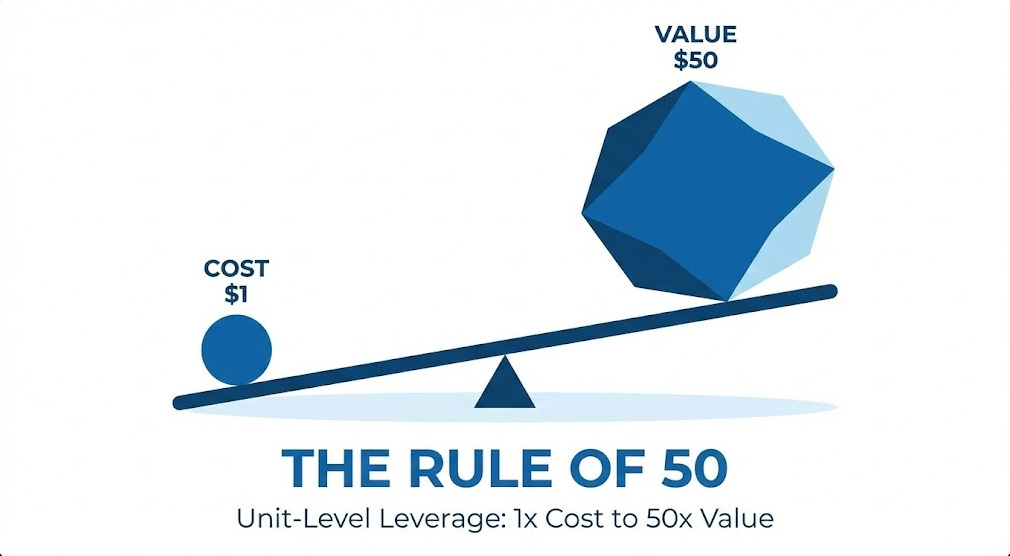
The Rule of 50 flips the lens from company-level optics (growth rates) to unit-level value creation. At the macro level, it asks a simple question:
For every $0.20 of cost the company incurs to deliver a product, does the customer receive at least $10 in value for their business?
To achieve a Rule of 50 score, a company typically needs to hit two aggressive targets simultaneously:
Extreme Customer Value: For every dollar the customer pays for a solution, they must unlock at least $10 in value (as revenue gained or costs saved).
Healthy Margins: The company must be able to deliver that solution with an ~80% contribution margin (costing them ~$0.20 to deliver that $1 of revenue).
When you combine these ($10 customer value ÷ $0.20 company cost), you get 50x value creation.
Deep tech founders often get trapped in “pilot purgatory.” But when a company hits this 10x multiple for a customer there is a meaningful demand shift and sales conversations shift from “convince me” to “how fast can we deploy?”. If that is delivered with high margins, you have a scalable and robust business. In our experience, if a company clears the 50x threshold:
Sales cycles compress
Operational complexity becomes survivable
Hardware becomes venture-scalable
Capital intensity stops being a bottleneck
You can price attractively and maintain real margins
It creates a buffer for operational friction and ensures that even if the technology is hard to build, the payoff justifies the deep tech risk profile.
The formula is simple, but the practical application (for both founders and investors) is nuanced. Not every unicorn takes the same road to 50x. In our upcoming full-feature article, we will unpack the specific mechanics of the Rule of 50, including:
Formulaic Evaluation and analysis: Quantifying the constituents of the heuristic for application across deep tech industries
The Three Pathways: We’ll detail the “Classic Path,” the “High-Value Path”, and the “High-Margin Path” — and how to know which one your business actually is.
Case Studies: We apply the math to SpaceX and NVIDIA (and other giants) to see exactly how they pass the test, and compare them to some our most beloved consumer hardware companies that fail to make the cut.
The Exceptions: We’ll discuss the specific exceptions and when it is ok to break the rule.
Keep an eye on your inbox later this month for the full “Rule of 50” White Paper, and if this subject is interesting to you, please reach out we would love to discuss (and/or have a friendly debate)!
Sunday Emerges with Memo: Stanford roboticists Tony Zhao and Cheng Chi emerged from stealth with Sunday, unveiling Memo — a home robot trained on 10 million episodes of real household routines from 500+ families. Sunday Blog | Interesting Engineering
Figure 02 Retires After BMW Deployment: Figure AI shared results from an 11-month deployment at BMW’s Spartanburg plant — the Figure 02 robots ran 10-hour shifts, loaded 90,000+ parts, and contributed to production of 30,000+ X3 vehicles. With Figure 03 now released, they’re officially retiring the F.02 fleet. Figure AI | Interesting Engineering
Tangible Robots Reveals Eggie: A new entry in the home robotics space worth watching. Tangible Robots unveiled Eggie, taking a different approach to domestic assistance. Mike Kalil’s breakdown
Physical Intelligence Hits $5.6B: The “robot brain” company raised $600M led by Alphabet’s CapitalG, with Jeff Bezos, Thrive, Lux, and T. Rowe Price participating. Founded by former DeepMind researchers and Stanford/Berkeley academics, Pi is building foundation models that can control any robot for any task. Their π*0.6 model uses reinforcement learning to let robots learn from their own experience — they demoed a robot bussing tables and making espresso continuously for 13 hours. Bloomberg | Axios
Rivian Spins Out Mind Robotics: The EV maker created another spinoff focused on robotics applications. TechCrunch
Flexion Raises for Robot Brains: Swiss developer of humanoid robot software raised $50M Series A from DST Global Partners, NVentures, Redalpine, and others. Crunchbase News
Parallax Worlds Raises $4.9M: Helping companies virtually stress-test industrial robots before deployment. SiliconAngle
SpaceX Starship Testing: The upgraded Starship experienced an explosion during testing — a reminder that iterating at the frontier means accepting failures as data. TechCrunch
Ursa Major Valued at $600M: The rocket engine maker secured new funding as aerospace supply chain demand continues to grow. Bloomberg
NestAI Lands €100M, Partners with Nokia: Finland’s defense AI company is building for NATO applications. TechCrunch
Google Explores Space-Based AI Infrastructure: A fascinating research piece on satellite-based compute. Google Research Blog
Anthropic’s $50B AI Infrastructure Bet: The Claude maker announced $50 billion in U.S. data center buildouts with Fluidstack, starting in Texas and New York. Sites come online in 2026, creating 800 permanent jobs and 2,400 construction jobs. This is the AI infrastructure arms race going physical. Anthropic | CNBC
Amperesand Raises $80M: Redefining power infrastructure for AI data centers — a space that’s becoming increasingly critical. BusinessWire
Sortera Raises for AI-Powered Aluminum Recycling: Clean aluminum is having a moment. Canary Media
Nanoramic Secures $54M: Accelerating commercialization of NeoCarbonix advanced materials. PRNewswire
Rare Earth Magnet Deal: Startups seal $1.4 billion deal with the Trump administration — critical minerals supply chain continues to be a strategic priority. WSJ
NVIDIA Q3 Results: Another blockbuster quarter. NVIDIA News
Luma AI Raises $900M: Led by Saudi AI firm Humain — generative video continues to attract massive capital. CNBC
xAI and NVIDIA Data Center in Saudi Arabia: The global AI infrastructure buildout continues. WSJ
Meta’s $600B U.S. Commitment: Planning to spend $600B over three years on domestic infrastructure. SiliconAngle
Google Hires Boston Dynamics CTO: Demis Hassabis is building something. Wired
Zeekr Partners with Waymo: New EV platform for autonomous operations. InsideEVs
Tesla Cybercab Regulatory Challenges: The path to selling robotaxis isn’t as straightforward as announced. Forbes
Tesla Shareholders Approve Musk Pay: The $87.8B compensation package finally cleared. Reuters
Three papers from Science Robotics caught our attention this month:
Thanks for reading — and as always, if you’re building in deep tech (or “software for hardware”), we want to meet you. Keep building! 🚀
— Brannon | AlleyCorp Deep Tech
Comments
Nothing yet. Say the first thing.
Sign in to join the conversation.