
A few weeks back we defined “Financial Transformation.” Now we are providing a breakdown of what it looks like in practice for accounting teams.
Despite every technology thus far, Accounting by nature has been stuck in the historical performance of the business.
Financial Transformation will not occur suddenly or eliminate finance teams in one fell swoop, as many technology predictions suggest. More likely, the transformation will happen gradually. First through productivity gains, then operational leverage, and eventually through financial systems that behave less like databases and more like active participants in the business.
Most organizations are already moving through this transition, whether formally or not. Over the past few months, we have spoken to several hundred accounting teams and the pattern is becoming increasingly recognizable to us at TenKey.
Like most, AI may be a thought partner for your team. If it is, you are standing on the tip of an iceberg with so much more automation possible below!
The first stage is already widespread across finance organizations, though many companies still treat it informally.
Controllers use ChatGPT to organize accounting memos. FP&A teams summarize earnings transcripts with Claude. Audit professionals test technical positions through Gemini before meetings. The workflow itself remains human-led, but the speed of knowledge work changes materially.
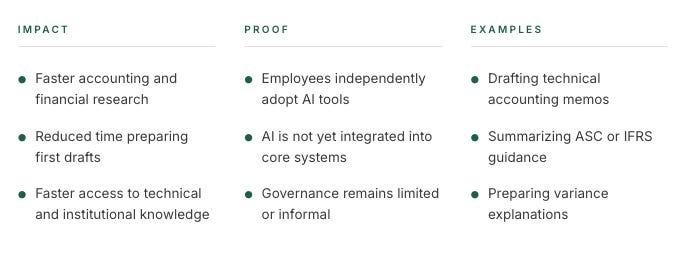
The important shift at this stage is compression of hours. Work that previously required several hours of research and drafting can often be completed in thirty minutes. The accountant still exercises judgment. The starting point simply improves.
The second stage begins when AI moves from research into execution. This is where the economics of finance operations start changing more visibly. The accounting team has started to trust AI at this point, but still limits it to specific actions within the broader accounting workflows.
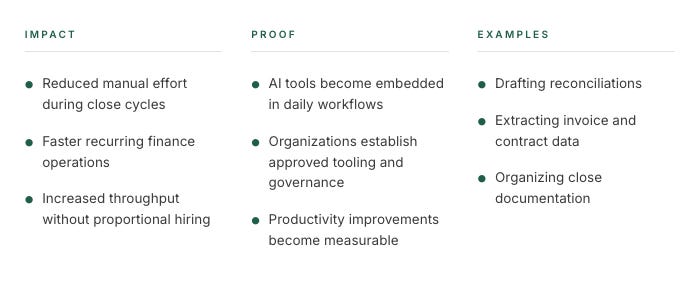
Many accounting departments still depend on labor-intensive coordination processes: collecting support, following up on approvals, updating reconciliations, preparing close packages and managing recurring review cycles across fragmented systems. AI assistants increasingly absorb portions of that work.
"The monthly close is less of an accounting problem than a coordination problem."
That observation, from a controller at a mid-market software company, increasingly reflects reality across the profession. The bottleneck inside many finance organizations is no longer technical capability. It is operational friction. AI assistants reduce that friction first.
At the third stage, AI systems begin operating continuously inside workflows rather than responding only when prompted. This is where the conversation shifts from productivity software to operational infrastructure.
Instead of helping individuals complete tasks, AI systems begin monitoring transactions, coordinating across systems and surfacing exceptions automatically.
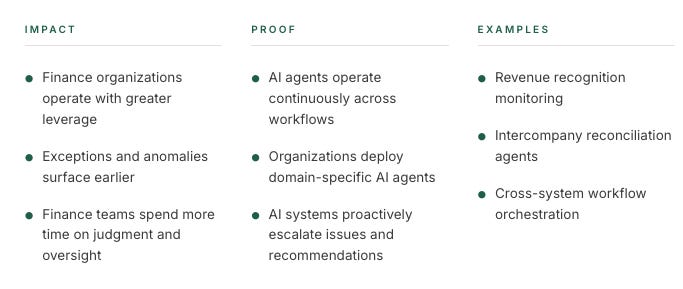
This is also the stage where organizational structure begins changing. Historically, finance scale required headcount scale. More entities meant more accountants. More transactions meant more coordination layers. More reporting complexity meant larger close teams.
The leverage compounds quietly at first, then suddenly becomes difficult to ignore.
The evolution of the ledger itself. The ledger begins moving from passive recordkeeping toward active financial intelligence.
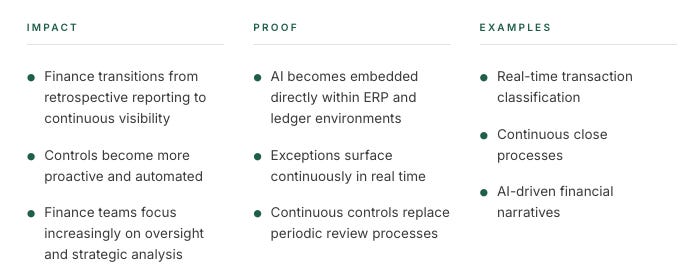
The broader implication is difficult to overstate. For most of modern corporate history, finance teams have operated reactively. Data collection came first. Analysis followed later.
It raises the importance of experienced finance professionals who understand controls, materiality, incentives and risk.
No posts
Comments
Nothing yet. Say the first thing.
Sign in to join the conversation.