
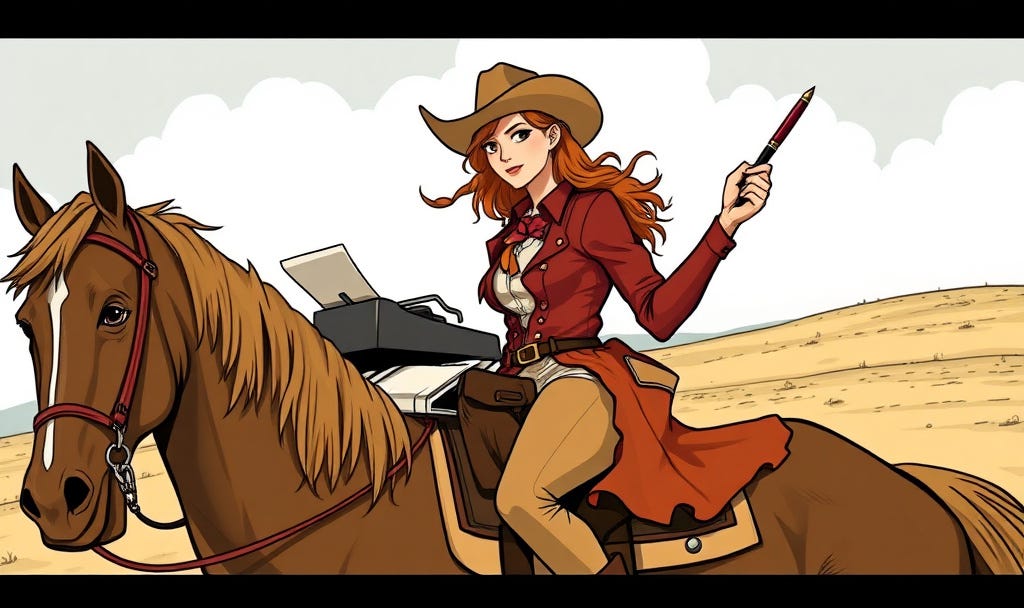
Ever ask yourself what in the heck you're doing?
I do, sometimes. Heck, a lot of times.
I gotta be honest here…I’m floundering. I’m working on a story with two plotlines (a first for me) that initially started so far apart I had to question my poor little creative voice, only to have her laugh at me when I finally learned where they’re coming together.
Naughty wench…🤣
However…I still have no clue where this story is going. I have hints, but that’s it. And I don’t even have a title for it yet, dang it! In Scrivener, it’s called “short stories for March”. Yes, I’ve been playing around in this story for 3 months now.
Ugh. It’ll come to me…
Learning to trust my writing instincts has been quite a journey. Even though I’ve written short stories that people like, this is the second of a longer piece of fiction (13,000+ words so far), and I’ve still not gotten used to the uncertainty.
I may never get used to it, and that’s fine; it’s still fun to write when I get in the flow.
That said, I’m not above searching for more ways to improve my writing process. I think it comes with the territory. I’ll never know it all when it comes to fiction writing, and that’s one of the things I love most about it…I love to learn.
So, as I was considering my process, I chose Ellen Brock’s video for people she calls “intuitive plotters” on a whim to see if there were any tips that could help me.
Oddly enough, I think I might be on the spectrum of intuitive plotter to methodological pantser, as both videos really spoke to me. I was glad I took the time to watch.
Here are some tips she shares for “intuitive plotters”. I’ve highlighted the tips that I think might help me in my writing process.
Plot using summaries — Write scene-level summaries AND an overarching plot summary; also create separate summaries for side plots and character emotional arcs
Plot using keywords — Use simple phrases or single words to trigger your intuitive sense of each scene, then “play through” them like musical notes
Plot using notecards — Shuffle and rearrange physically (or use PowerPoint for multimedia); try keywords on one side, summary on the other
Plot using visualization — Close your eyes and watch the story like a movie; optionally record yourself reading your summary and listen back
General Tips
Plot in a way that sparks intuition — Use flexible, visually pleasing tools (OneNote, Scrivener, Pinterest boards, notebooks) rather than rigid spreadsheets or bullet lists [I’ll try pen & paper with my fountain pens. 😉]
Explore your idea freely — Daydream and free-write before jumping into plotting; let the idea breathe [Something she also recommends for methodological pantsers…need to try for myself.]
Find your right amount of plotting — If you lose interest after plotting, you’re over-plotting; if you keep getting stuck while writing, plot more
Write down what you intuit — Never skip over a vague problem; note it and build on it each pass (”something goes here” → “something spooky” → specific idea)
Turn vague issues into defined problems — Articulate what’s wrong specifically so you can brainstorm targeted solutions
Write in chronological order — Helps maintain emotional continuity and avoid missing plot/emotional steps [already do this. 😉]
Allow yourself to deviate from the outline — Flexibility is key; if your intuition says deviate, deviate [I like this tip! 😁]
Edit the outline before the novel — After your first draft, update your summaries/notecards, then revise those before touching the manuscript
Read the whole novel at once (or in as few sittings as possible) — Take notes in a separate document; don’t edit as you go; focus on big-picture flow first, then scene-level issues
Polish front to back — Edit chapter by chapter in order so you can track emotional and tonal progression
Know when you can’t intuit the answer — Don’t be afraid to use structural methodologies when intuition stalls; it’s a tool, not a failure
Have you tried any of these ways to get words on the page? I’d love to know…leave a comment and tell me your writing process.
Comments
Nothing yet. Say the first thing.
Sign in to join the conversation.