
Sometimes, when the weight of online discourse has sufficiently pressurised me, I wish I could cut out my brain and eat it.
I wish I could take the thumping mass in my chest and crush it. I wish I could stop trying to challenge myself. I wish I could ignore microaggressions, brush past strange but isolated incidents that inevitably culminate in patterns of systemic behaviour, but I can’t. I am not the one who trained myself to do this. I don’t have the privilege of being gullible. Whilst I actively try to utilise critical thinking, its weight is sometimes more overwhelming than comforting myself with illiteracy. I think many people find comfort in illiteracy. In purposefully misunderstanding and compartmentalising nuance into neatly defined boxes that can be categorised based on one’s individual morals. How interesting it is, then, that when it comes to something real, the matters of our current world that rely on each one of us being capable of having a backbone and trying our best to take care of one another and the planet we inhabit, it is much easier to take the simpler route. A path that does not interrupt the bubble of frictionless ease. We are living in Omelas, and we should all be afraid.
Understanding the world of Ursula K. Le Guin’s ‘The Ones Who Walk Away From Omelas.’
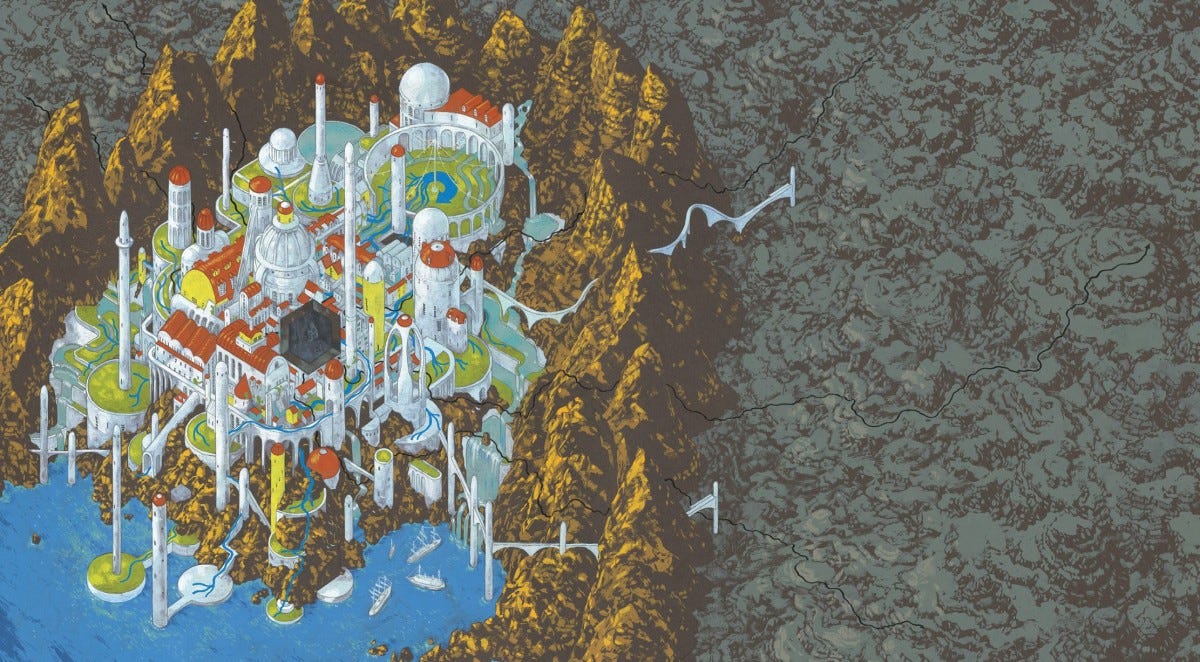
In Omelas, the residents are living amongst comforts like no other. The city is being prepared for the Festival of Summer, decorated with sparkling flags, raucous with “a shimmering of gong and tambourine”, the old people and women with prams filling these streets. Children excitedly breezing through beautiful gardens across the city, “a cheerful faint sweetness of the air that from time to time trembled and gathered together and broke out into the great joyous clanging of the bells.”
This joy is embedded in the heart of Omelas. Le Guin makes it clear that the reason for this is the lack of a power structure in Omelas, no monarchies, slavery or wars. There is no pain to elevate the suffering, no darkness to balance out the light. “The trouble is that we have a bad habit, encouraged by pedants and sophisticates, of considering happiness as something rather stupid. Only pain is intellectual. Only interesting.”
This pain-free Elysium, as Le Guin puts it, sounds like a fairy-tale city that truly exists only in the mind’s most utopian illusion. She even suggests in the narration that the reader imagine their own Omelas, “for certainly I cannot suit you all.”
Interestingly, this understanding of happiness, Le Guin writes, “is based on a just discrimination of what is necessary, what is neither necessary nor destructive, and what is destructive.” The middle category—‘unnecessary but undestructive’—is where she defines comfort, luxury and exuberance; central heating, public transport, washing machines, the kinds of things that we have evolved to needing now in our frictionless existence.
What do you imagine the limitless happiness of this city’s people is built upon? Did you guess a neglected child in a random basement? If you’ve read the story, then yes. If you haven’t, well, there it is. The source, one could say, of the Omelas’ prosperity is a living being that lies shivering in a basement covered in its own excrement. Guin describes in quite morbid detail how this child, who “looks about six, but actually is nearly ten”, has been left there for an interminable amount of time. People sometimes come into the basement and kick the child to make ‘it’ stand up; some only look on in disgust or discomfort.
Nevertheless, the child remains there. All the people of Omelas know it is there. Some are content to know the child is there, as though it is necessary. It has to be there. Le Guin does not tell us why, only that “the beauty of their city, the tenderness of their friendships, the health of their children, the wisdom of their scholars, the skill of their makers, even the abundance of their harvest and the kindly weathers of their skies, depend wholly on this child’s abominable misery.”
I suppose that is the task of the short story: Le Guin has created, with all the expansive, descriptive language the English dictionary will allow, a world that exists on the misfortune of a singular being and gives no reason for it. No great purpose or arc. She doesn’t give any explanation as to the origin of these terms or where this child came from, only that if they were to save the child, to give it care and comfort, all their joy would “wither and be destroyed”. She leaves you with this truth, the searing fact of it, your own undeniable questioning.
But the people of Omelas have resigned to the fate of ignorance. To save this child would be to give up their comfort and happiness, to allow pain and suffering past their gates, a concept already foreign to them. The choice, then, must feel passive. They are merely victims. How could they possibly risk everyone else’s joy for a child’s?
Freedom vs equality, and what we can learn from the residents of Omelas who chose to ignore those who suffer for their comfort.
A while ago I watched a video from a creator that I can no longer remember, about how, at the beginning of her lectures, she’d ask her class if they’d rather choose equality or freedom. As I’ve come to learn, this is quite a common philosophical question, and much like how Le Guin urges the reader to envision their own Omelas, it poses a foundation for understanding what it is we’ve truly come to desire as a human race. With all the evolution we’ve undergone and world-class innovation at our fingertips, a decision between freedom and equality is equally philosophical and political enough to measure where your values and beliefs lie. If you don’t believe me, answer the question for yourself: Would you choose freedom or equality?
As you can imagine, the utopia of a poor man is not the same as that of a rich man. What does freedom look like for someone who has never had it, and what does equality mean to someone who has never had to fight for it? We are asking questions that disrupt the subconscious existence that hierarchical civilisation primes us for, which is why, when the creator says that many of her students choose “freedom”, I was disappointed, but not surprised.
From my understanding, freedom means to be the one unchained, regardless of who suffers at the expense of your freedom. It’s why intraracial discrimination continues to happen: the goal is not a dismantling of racism; it is to appease those who deem you free. A boy who suffers rejection from women based on his appearance grows up to believe that he can only escape the shackles of unattainable beauty standards by becoming the man’s man, a symbol of masculinity that towers over everyone else. A woman who suffers at the hands of the patriarchy believes that her freedom rests in a complete deference to the system to be spared. Both believe that by giving in to the standard, they are protected from its wrath. But it has been famously said that “until all of us are free, none of us is free.” Which is why, in every instance, I believe equality is the only answer.
Is it longer? Yes. Does it require self-sacrifice? Of course. But at the core of something like, say, feminism, is the belief in full advocacy for the social, political and economic equality of all genders. The patriarchy may benefit men who desire individual freedom by way of undercutting others, but not those who desire equality, which is why it remains a system even now, because our desire to fight amongst ourselves is stronger than the desire to right what continues to be wrong.
Wilful ignorance, choosing to ignore the obvious bad in favour of the selfish good. Whether this selfishness is human nature or a product of our environment, and how we can instead choose the discomfort of radicalisation.
“To throw away the happiness of thousands for the chance of the happiness of one: that would be to let guilt within the walls indeed.”
A fear of the unknown is such a fascinating thing to unpack. Much of the world’s bigotry and oppression is born from either a refusal to know or a deep, shameful understanding that is ignored. You should be ashamed of your ignorance. It is not enough to simply not know. For many who are marginalised, it is much more difficult to turn a blind eye to bigotry because you exist in it. A Black woman cannot fully embrace white feminism because how it ostracises her is too obvious. A queer person cannot fully embrace non-queer spaces where compulsory heterosexuality is baked into the walls. When your existence is inherently oppressed, you do not get rose-tinted glasses. You can choose to ignore it, but it will never ignore you. It will follow you around your Omelas, mirroring your shadow until it manages to fall in line .
This idea of being “awake” to how blind ignorance is woven into so many pieces of media, particularly in the Wachowski sisters’ 1999 film The Matrix. The film follows Neo, a computer programmer and hacker, who has always questioned the reality of the world around him. His suspicions are confirmed when Morpheus, a rebel leader, reveals to Neo that he is one of many cogs in a machine—the titular “Matrix”—and he can either choose the blue pill, which will keep him ‘asleep’ and none the wiser to the knowledge of this machine, or the red pill, which will awaken him to the real world, which is actually a dystopia ruled by AI.
In both The Ones Who Walk Away from Omelas and The Matrix, two versions of utopia are described. Smith, an agent from the matrix, says, “Humans define their reality through misery and suffering” as opposed to the “batteries” who live without sentience. “You are a plague, and we are the cure.” Ignorance is the cure. The utopia. Guin says that the balance of light and dark does not exist in Omelas because there is no need for it. Both messages are saying something different, though Smith himself eventually admits that he believes the Machine to be a prison he wants to be free from. This understanding of utopia as a place free from misery or fear permeates across both stories as a paradox; for happiness to exist, someone or something must suffer, but you cannot acknowledge the suffering otherwise there is no happiness.
Ignorance works on a lack of knowledge, a neutral condition at best, but if the information to learn is so readily available, why don’t we pursue it? If happiness and joy can only exist in states of unawarness, then what is the point?
Many people consider joy to be an act of resistance, especially since we’re living and working through global unrest. We’re waking up to news of war, eating lunch whilst scrolling past unfettered hate speech, going to bed with the knowledge that somewhere else in the world, sleep is a luxury. It isn’t as though I’m advocating for misery and suffering. But being aware of it, choosing to acknowledge the reality of pain and sacrifice, is where we navigate how to continue living. Walking away from idealism and embracing reality has never been an easy task, even for the strongest of activists. But being aware of the world’s worst parts is what breeds compassion.
It isn’t easy to be honest. If anything, it costs much less to scroll past. I still do it. It becomes overwhelming to know that there is so much burning right before you. But there is no real effort in that, is there? The heart will bleed and pump, and the brain will throb, and I wish to hold more comfort in my ability to actively dissuade evil. To sit comfortably in your blind ignorance does not make me envious of you. It makes me angry.
Thanks for reading Accident Prone! This post is public so feel free to share it.
Comments
Nothing yet. Say the first thing.
Sign in to join the conversation.