
A couple of weeks ago I hit yet another one of those ‘real author’ milestones: my very first ‘AI’ accusation!
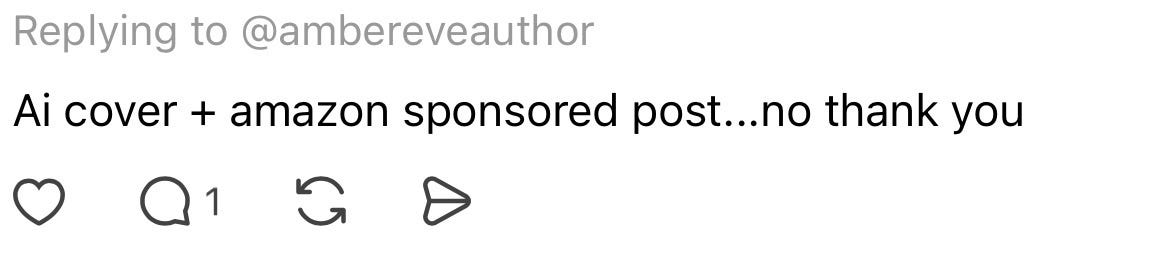
I knew this was coming, obviously: not because my book cover is AI (it absolutely isn’t) or because my publisher paid to advertise the book on Amazon (totally standard marketing for books, really weird comment to make about it…), but because we’re firmly in the era of the AI witch hunt, and it increasingly feels like being accused of using AI, either to write or market your book, is some kind of weird rite of passage as an author. I’d say the only surprise here is that it took so long for it to happen, but I suspect that’s only because it took so long for anyone to even notice me/my books, so … yes.

For the record, I’m as anti-AI as anyone. AI, after all, basically ‘killed’ my blog, which, in turn, destroyed the livelihood I’d been making from it for over a decade at that point. AI steals artists’ work and turns it into strange, ‘uncanny valley’ images, or meaningless blocks of text in which people have ‘quiet’ realisations that something is ‘not this, but that’ all the time. I despise it. A little bit of me dies inside every time someone I follow on Instagram posts a photo with a clearly AI-written caption. I don’t understand how any writer or artist can be OK with it, and it’s genuinely strange to me that I even have to say this, because who would want their industry to be taken over by robots?
Who, though?
You know what I hate even more than I hate generative AI, though?
Witch hunts.
I cannot stand witch hunts… which is unfortunate for me, really, because the internet loves a good witch hunt — maybe even more than anything else. I sometimes wonder if some of the people I see on Threads really even care about the issues they claim to be so passionate about, or if they just get off on subjecting other people to purity tests, because that’s often what it feels like.
And it’s not just random people on Threads, either. This week, The Atlantic took it upon themselves to publish an article accusing Daggermouth author H.M. Wolfe of using AI to write her book. The author of that article admits there’s no real evidence of this, and H.M. Wolfe and her publisher have both denied it, but that doesn’t matter, because as the person who accused me of using AI on my book cover earlier this month proved, people are now so sensitive to the very idea of AI, that it feels entirely reasonable to them to ‘shoot on sight’ and ask questions later: if even then.
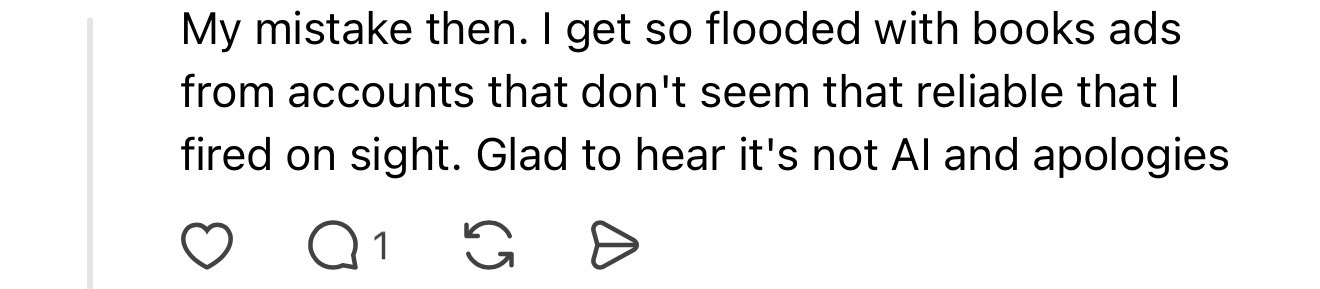
In this case, the person did apologize, and we ended up having a perfectly reasonable conversation, which I appreciated. But he did still ‘shoot on sight’, and that’s a problem for authors like me, who now find themselves scared to post anything in case they’re accused of something they can’t possibly defend themselves against — because how can we?
Well, here’s one suggestion, courtesy of Threads:
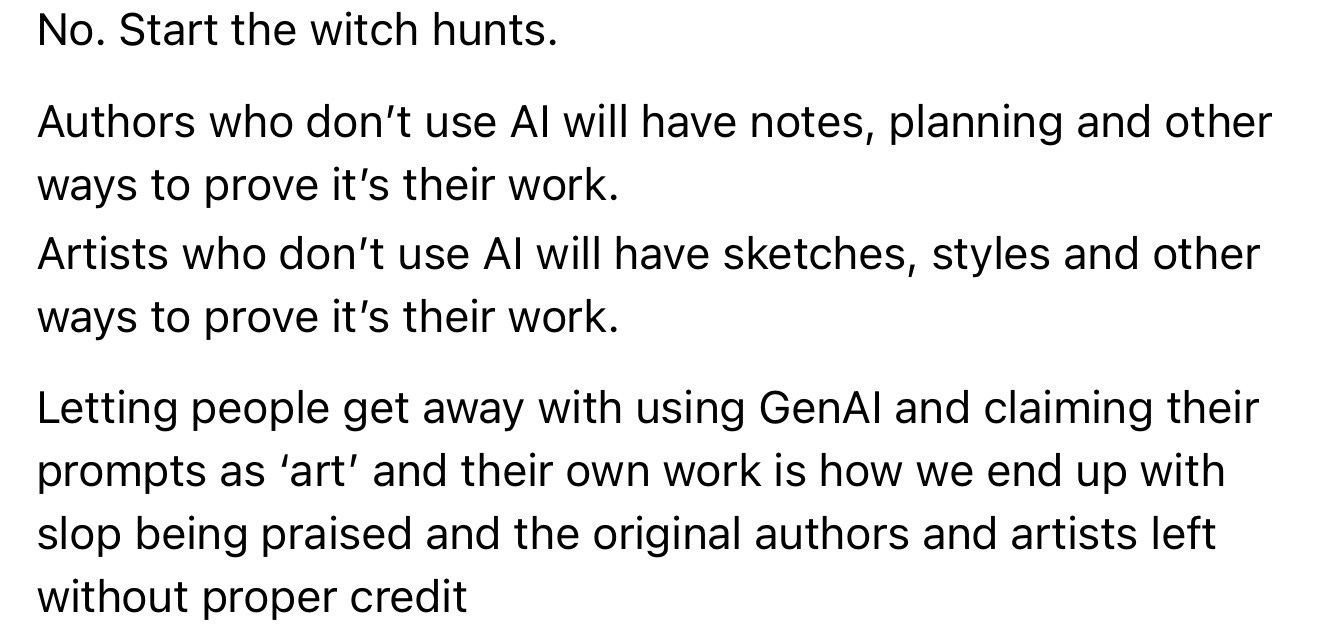
And, I mean… sure, I could show you my notebooks, filled with my indecipherable handwriting (and which I’m sure you’d say I could easily have pulled together after the fact). But most of my ‘planning’ is done in my head (in fact, most of it’s done in the shower, and trust me, you don’t want to see that…), and takes the form of a couple of very rough outlines (which, again, I suppose would be easy enough to fake). I don’t write ‘drafts’ as such: all of my rewrites are done in the same document, and while the Reedsy editor I use does create a writing timeline, which tracks which changes have been made and when, that still won’t prove that I made those changes myself, and didn’t just copy and paste them from ChatGPT, will it?
Which leaves me… where? I know some artists and illustrators have started to literally film themselves working, or screen record their output, but honestly, the idea of having to set up a camera to film every writing section is genuinely wild to me. I shouldn’t have to feel like I’m on trial every time I sit down to write. I shouldn’t have to turn every writing session into some strange kind of public performance, or be forced to make my private notes, containing all of my inner thoughts and personal experiences, available to any member of the public who decides I need to prove I wrote my book myself. If I thought I was going to have to do all of those things I would give up right now: not because I have something to hide, but because when you’re as awkward and introverted as I am, it’s hard enough showing up on social media every day, without having to essentially livestream your entire life just to prove you aren’t a filthy AI user.
But, incredible though it may seem, this genuinely seems to be where we’re headed. Because if the witch hunts don’t stop, the writing will. If people keep on braying for blood, like the person yelling ‘start the witch hunts’ on Threads, AI will be all you’re left with, because I can’t imagine there will be many creatives out there willing to subject themselves to the level of scrutiny and invasion of privacy that will apparently be required to ‘prove it’s their work’. We’ll just stop doing the work.
Sure, AI is a growing problem: you don’t need to convince me of that. But this… this isn’t the solution, folks. As someone much cleverer than me pointed out in response to that thread, no actual ‘witches’ were killed in the witch hunts: it was just ordinary people. The people doing the so-called ‘hunting’ were the bad guys … and yet here I am, scared to use an em dash (my most beloved form of punctuation!) in this post in case someone accuses me of having written it with AI.
Is this really the future of publishing?
Hi, I’m Amber: I’m a Scottish romance author living in a tiny village which is nothing like the books led me to believe it would be, and I’ve been documenting my life online for over 20 years now. Want to know more?
Comments
Nothing yet. Say the first thing.
Sign in to join the conversation.