
“Until you make the unconscious conscious, it will direct your life and you will call it fate.”
“The privilege of a lifetime is to become who you truly are.”
~ Carl Jung
Dear one, I can only imagine you might be tired of reading about the slog of nervous system rewiring. If you are, I understand. I was tired of living it. And I have to be honest that I’m tired of writing about it.
I’m ready to move on, ready to share other parts of my story in the chapters to come.
But there’s an important piece that I need to share before moving on: how hitting a wall in my recovery was an invitation to discover—and heal—parts of me that had long been hiding in the shadows.
It was a piece of the puzzle that I literally couldn’t move on without, and therefore a piece of my story that you and I, dear one, can’t move on without.
And good thing, because it might be the single most important part of this memoir.
So let’s hold hands and do this together.
Let’s start with a look back on a November morning in 2022, approximately 1000 days since it all began and 180 days since I started rewiring.

I open my eyes and I know. It’s happened again.
It feels like a switch has flipped, and gremlins have taken over my body.
I slept poorly, tossing and turning in my sweaty sheets. My body feels heavy with an ugly exhaustion. My stomach is churny and irritable before I’ve even started the day. And of course there’s the pain—for no good reason, an uptick in pain in my neck and the base of my skull.
I want to scream.
NO. NO. NO.
NOT THIS AGAIN!
I thought I was done with this. How long will this keep happening?
I want to ignore it, carry on with enjoying my days, enjoying the activities and delights that I’ve reclaimed these past six months. I can do so much more now than I could a few months ago!
But not today.
Today, I have to dig deep and do the work of “flipping” my system back to safety. Again.
I peel myself out of my bed and I head down to the kitchen. Jason doesn’t even need to ask me what’s going on. He knows. He’s seen enough of these kinds of mornings.
He holds me in a long hug. Some part of me desperately wants him to fix it, to save me, to lend me his strength to do the work. Which, of course, isn’t possible. This is mine to do.
So a grim determination seeps into me. Something hard and unyielding that says:
“No. I won’t give in. I won’t give up.”
The trajectory of my health, my life, depends on the choice I make at these inflection points, and I’ll be damned if I fail.
I stomp into my little office, close the door and get on the floor.
I start a breathwork practice.
In for 4. Hold for 2. Out of 10.
In for 4. Hold for 2. Out for 10.
I keep going until I feel the relief of a small shift in my body and in my mind.
I emerge from my office and say, “I’m ok, J. I’ve got this.”
I’ve taken the edge off the panic. The relief washes over us both. But I still have my work cut out for me over the next few days.
Breath. Meditation. Gentle movement. Painting. Moments of delight. Anything that brings me joy without asking too much of Tante Sumaya. That will be my regimen for as long as it takes to flip the switch back to safety.

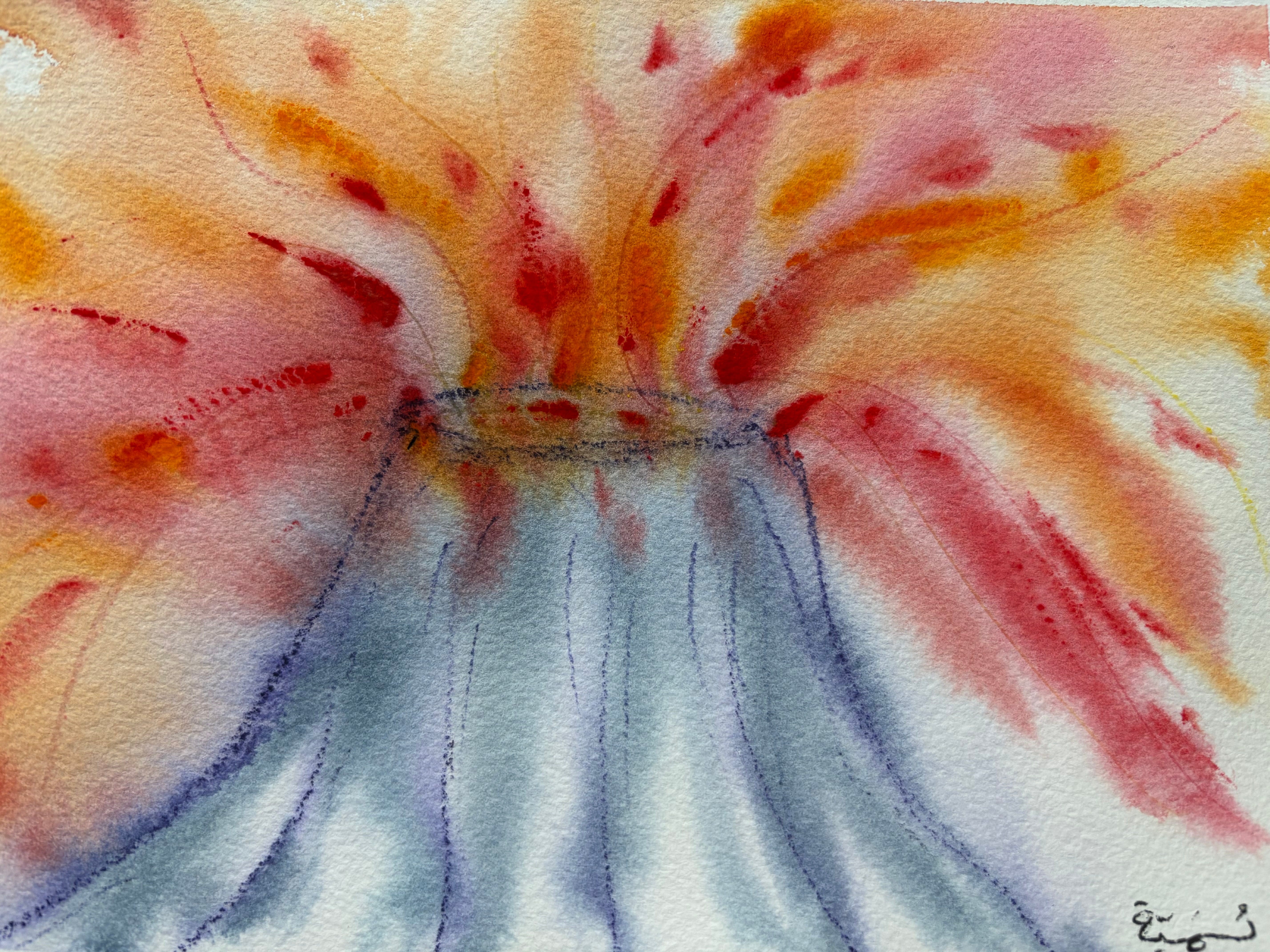
“I popped.” “I overflowed.” “I flipped.”
These were the phrases I used to describe the way a switch flipped when I pushed too hard or when life threw more at me than I could handle. I never knew exactly what tipped the scales and sent my system into that all-too-familiar mode. I was always tempted to trace it, figure out where I “went wrong”, so I could avoid it next time.
Did I exercise a little too hard? Did I push my neck’s range of motion a little more than my brain—my Tante Sumaya—could tolerate? Was it because of that stressful conversation Jason and I had that brought up challenging emotions? Or maybe it was because I really spread my wings and spent a little more time chatting with a friend?
As tempting as it was, the impulse to try to pinpoint when exactly the scales tipped was not only fruitless but counterproductive. First, because it was never one thing but “all the things,” and second, because “popping” was an inevitable part of the process. I needed to welcome it rather than avoid it.
What’s most important to know about all this, dear one, is that “popping” is more than dysregulation, more than “danger mode” (see chapter 14).
It’s a traumatic stress response.
When I finally understood that, I started calling it “traumatic stress mode” (for simplicity’s sake, but also because I love to name things, I’ll call this TSM from now on).
I recently read through my journal entries from that time, and saw entry after entry written on TSM days. The same phrases float up at me from each page, like little breadcrumbs leading to the same awful pile of symptoms.
“Shitty, disturbed sleep”
“My neck hurts more today”
“Irritable stomach”
“I feel uncomfortable prickling sensations in my whole body”
“So anxious today”
“Super sensitive to everything”
“My brain feels dull and slow”
“I can’t think”
“I’m so so tired”
This is what my brain did—and, in one form or another, all our brains do—whenever it determined that the threat level was so high that sending my body into “danger mode” was insufficient to keep me safe, and it needed to take drastic measures (i.e. debilitating symptoms) to get me to stop everything and avoid the “danger”.
Which begs the question: what exactly was the perceived danger? How could my brain perceive such a high level of threat when I was safe in my home doing mundane, everyday things?
There was only one possible answer: unresolved trauma (or traumas). And repressed emotions related to that trauma (or traumas).
While I had taken big leaps forward in my capacity and had widened my “window of tolerance” enough that I could imagine eventually reclaiming a full, vibrant life, I kept hitting a wall—a wall built of unresolved trauma that led my brain to perceive certain emotions and experiences as more painful than I could handle and therefore “dangerous.”
It was time to look more deeply at the trauma patterns holding me back.
The most obvious trauma keeping symptoms alive was the depth of the darkness I experienced in the spring of 2020 and then again in the spring of 2022. If you’ve been walking beside me on this adventure, dear one, that won’t surprise you. You know just how dark it was.
But there was a question lurking behind that obvious trauma: why did this happen to me in the first place? Why was my brain wired in such a way that I was susceptible to a DUNC (see chapter 15) given a traumatic enough series of events (i.e a concussion that wouldn’t resolve, a virulent strain of Covid, and a global pandemic that had the whole world contracted in fear)?
It was time to look further back in my story.
It was clear that I had long-standing patterns lurking in my unconscious, affecting my life in ways I didn’t yet understand. But I had gotten away with ignoring them because the ways they tried to get my attention were quiet. Ignorable.
The irritable stomach, the shoulder tension, the chronic pain in my right hip, my low tolerance for stress, my impulse to run when things got hard. Didn’t everyone experience and do these things? Weren’t they “normal”?
I thought so. I didn’t think there was anything to be gained by digging into the past. I thought it was enough to orient to the present, to my underlying spiritual ok-ness, and to transcend all that “muck.”
In other words, I had rocked the spiritual bypass.
And I got away with it because the physical consequences of that bypass were ignorable. At least most of the time. And when they weren’t ignorable, I didn’t understand what they were or the invitation they offered me.
Until now. Now, I had no choice.
The symptoms I was experiencing were directly linked to all that remained undiscovered and unresolved in my deepest self, in the depths of my brain’s unconscious workings. And they were neither quiet nor ignorable. They were screams that I had to listen to and understand if I wanted to continue healing.
I had come as far as I could alone. I needed help.
So I asked for it. I asked the Great Mystery, the Great Mama, the Universe, or Bella, as I sometimes affectionately called her. So let’s call it what it is: prayer. I prayed.
Dear one, I still have no idea how prayer works, or why it works, but I do know that something powerful happens when I ask for what I want. Not out of fear (that doesn’t seem to work for shit) but out of a true, joyful, honest want. In other words, a want predicated first on acceptance of things exactly as they are.
I already knew I was ok no matter what, that my life could be vibrant and worth living, no matter what my body did. But I wanted more. I wanted to say “yes!” to the invitation to know myself and to heal in ways I didn’t yet know were possible.
So that’s what I did. I surrendered and I prayed.
And my prayers were answered. Not right away, not all at once. Not in ways I could have planned or controlled. But they were answered.
The first answer came in the form of a therapist named Meagan. It happened like this:
When it became clear that unresolved trauma stood between me and my continued healing, I knew I needed a therapist. And not just any therapist, but one trained in a somatic approach that rewires trauma rather than just managing it, and one who understands neuroplastic symptoms and nervous system rewiring. Oh, and I needed her (because she had to be a her) to be licensed in Colorado and offer telehealth because I still couldn’t travel very far.
As if that wasn’t enough, I also needed her to show up at the very top of my google search so I wouldn’t have to scroll for too long (or at all because scrolling was still almost impossible for me), and so I wouldn’t have false starts with the wrong therapist, as often happens on the search for the right one (because I didn’t have the capacity for that either).
So that’s what I prayed for: a unicorn. Or the moon. Or maybe a unicorn on the moon.
You might not believe this, dear one, but the right person appeared at the very top of my Google search. Her name is Meagan. She is a whiz at somatic trauma therapy (Somatic Experiencing to be specific), she understands neuroplastic symptoms and how they relate to trauma, she’s licensed in Colorado, and she offers telehealth. Oh, and she’s a lovely person to boot.
I started working with her in December of 2022. I still work with her. I’m pretty sure she’s a witch. In all the best ways.
For the last three years, Meagan has lovingly and expertly guided me to bring light to memories and patterns long hidden in my unconscious. And to hold and love them in ways that have healed and rewired them. And healed my body.
That alone seems miraculous and would have been more than enough of an answer to my prayers. But there were other answers that also offered important pieces of my healing puzzle: Internal Family Systems work; another gifted somatic therapist that Jason and I worked with together; books, articles, lectures, and other unexpected resources that showed up unbidden in my inbox, my podcast app, or in a conversation with a friend.
As long as I surrendered to my cosmic curriculum, resources kept showing up when I was ready for them. And it’s still happening.
Because I’m still in it. I’m still discovering, still growing, still healing. I don’t think there’s a ceiling or a finish line, so I don’t think I’ll ever stop. The inner freedom on offer is just too delicious. I can’t imagine saying “no thank you, that’s quite enough unfurling and inner freedom for me.” I can only imagine saying “yes please” until the very end.
That’s the invitation at the heart of neuroplastic symptoms. And the magic at the heart of my story.
Which is why, dear one, I’d like to share my story of that inner healing and unfurling. Not all of it. That would take too long and would be unkind to people I love and don’t want to hurt, but at least the key parts that tie the whole adventure together.
Like the part in June of 1982 when I spent fourteen days huddled in a basement with my family as bombs fell all around us. The part where my brain was wired by a moment of pure terror. And also the funnier, weirder part where we escaped during a cease-fire and spent a surreal summer on a lake in Maine.
That’s what I’ll share in my next chapter. It explains a lot about what happened to me in 2020, so stay tuned.
But first, my third “Signpost for Remembering.”
Signpost #3: How neuroplastic symptoms invite us to deeper healing
[“Signposts for Remembering” are a collection of reminders that I wrote to and for myself (but also for you!) to help me synthesize and revel in all that I’ve learned. And to remind myself when I forget (which I do often). Click here for Signpost #1 and Signpost #2].
Dear one, remember….
Pain is a danger signal. It’s not in the body. It’s in the brain.
We might as well call it “fear by another name” (as the father of Pain Reprocessing Therapy, Alan Gordon, does call it).
Your brain is always trying to predict possible danger and give you a danger signal (i.e., pain or physical symptoms) so you can avoid it. But it doesn’t always get it right.
And this doesn’t just apply to physical danger, but also to emotional danger.
Here’s how this works: our brain is wired by our life experiences, especially our early ones. What were we taught was ok to do, ok to feel? What did we learn was never ok to feel? What experiences were so scary that our brains never want us to feel them again? And, importantly, how were we held through them (or not) and how well were we able to shake them off, to heal from them, and move on in a healthy way?
None of us had perfect childhoods or perfect parents. And we don’t live in a perfect world or society. So we were shaped by expectations, experiences and messages that taught us more than words ever did. Maybe we absorbed fear and shame from our families or our communities like the little emotional sponges we were, and they were painful and confusing. Maybe we learned early never to express anger—or even to feel it. Or maybe we had truly terrifying experiences that nobody helped us process, and even a little whiff of those experiences sends us into a spiral even now.
Our brains were trained on all of it, from the mundane to the traumatic.
Each of us is a unique internal ecosystem with a lot happening below our conscious level, deep down where the unconscious parts of our brain are trying to help us stay alive, navigate our complicated lives and avoid danger, both physical and emotional.
Which brings us back to neuroplastic pain and symptoms: we all have them. Most of us just don’t know that that’s what they are.
They might be chronic headaches, stomach upset, insomnia, fatigue, or that niggling joint pain that seems to have no cause but flares up when we’re stressed. Nobody tells us that these likely have emotional causes rather than physical ones. So we either just live with them or see every doctor and specialist we can, often with disappointing outcomes.
For most of us, this goes on for our whole lives. And it’s a huge missed opportunity, because these “symptoms” are actually our brilliant bodies pointing us to what we need to feel, and what we need to heal.
Which is why those of us with severe or debilitating neuroplastic symptoms might actually be the lucky ones. We don’t have the luxury of ignoring the wisdom and guidance they offer.
I know that sounds crazy, dear one. But it’s true. Or at least true if we get pointed in the right direction and get the right support.
That’s when the magic happens—the magic of self-discovery and healing that can transform our experience of life and help us unfurl into a freer version of ourselves.
Dear one, this is the magic the world needs most. The magic we need most.

If you’re new here, welcome!
However you made your way here, I’m grateful you found me and happy to have you pop into my little world, whether it’s for a brief visit or a longer hangout around my campfire.
Accidental Alchemy is a serial memoir, so if you’re curious and have the time, I recommend starting with the Prologue and reading chapters in order for the full experience. You can access all chapters on my Substack homepage.
For the best reading experience, I recommend reading in a browser and on a larger screen. It makes it easier to enjoy the art and navigate through the chapters with the buttons at the bottom of each post.
If you’re enjoying this memoir, please share with someone you love!
Share Accidental Alchemy by Sumaya Abuhaidar
PS.. All art and poetry included in this memoir are my own unless I specifically credit another author or artist.
Comments
Nothing yet. Say the first thing.
Sign in to join the conversation.