
Flipping through the endless scroll of social media, you may have encountered videos pertaining to one’s journal ecosystem, notebook set up, or journaling practice. You may have also encountered dissertation and research journals or recommendations to start a commonplace book. Each mention leads on to a series of questions and curiosities: should I get a journal? should I start common-placing? what even is common-placing? am I journaling correctly?
The truth of the matter is: there are numerous ways to engage with journaling as a practice. Each person's practice, set up, and relationship to journaling is unique. There is no one size fits all approach to journaling because it is, to its essence, a self-determined and self-reflective practice. One which, over time, takes a shape which looks much like its creator. Both in aesthetic and in practice, our journals reflect our evolution. And for the lifelong learner, the self studier, and the scholar, our journals become repositories of our knowledge. Ideas jotted down, drawn, scratched out, connected, and manipulated over time.
We asked some of the members of Accepted Society (an online intellectual community for lifelong learning) to share how they use their journals to transform and capture their ideas. Here is what they said:
M: “I use my notebooks to free write my thoughts when thinking through assignments and essay plans. It's so freeing to be able to just get all my messy thoughts on the page and figure out if they make sense!”
Start a timer for a short, manageable window of time and dedicate pen to paper. Not sure where to start? Write down “I don’t know what to say.” Follow your thoughts from there. The goal here is to remove the filter which often self-corrects our words before they meet the page. Allow the words and ideas to flow without judgement.
Starting a study session? Here are a few free-writing prompts you can try out:
What am I looking forward to learning today?
How could I make this session more enjoyable?
What am I curious about?
Where am I meeting resistance? Why might that be?
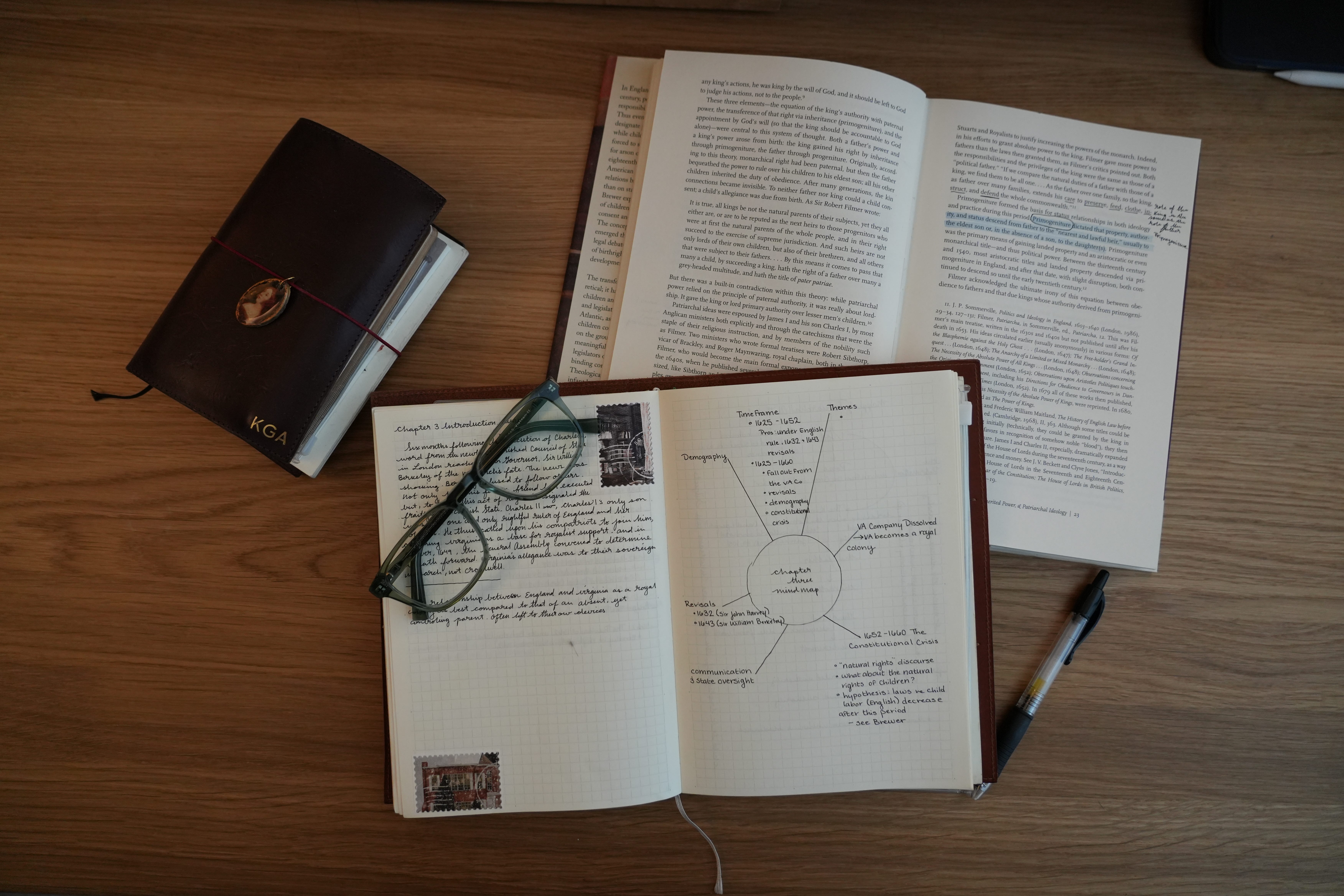
T: “A local atelier made me a leather notebook cover that also includes binder rings, and it’s my external brain. Anything and everything goes in here so I can keep track of all my thoughts without my head feeling full to bursting!”
You might be familiar with the “second-brain” concept as it relates to digital capture on Notion or a Notes App but what is stopping you from creating a physical second brain? A space where you capture everything from To Dos, to your random shower thoughts, and research ideas? What might be possible if you were to stop considering how your notes look and, instead, allowed your ideas, lists, and reflections to take hold in a physical notebook? Something you can look back on week on week to see the manifestation of your thoughts colliding?
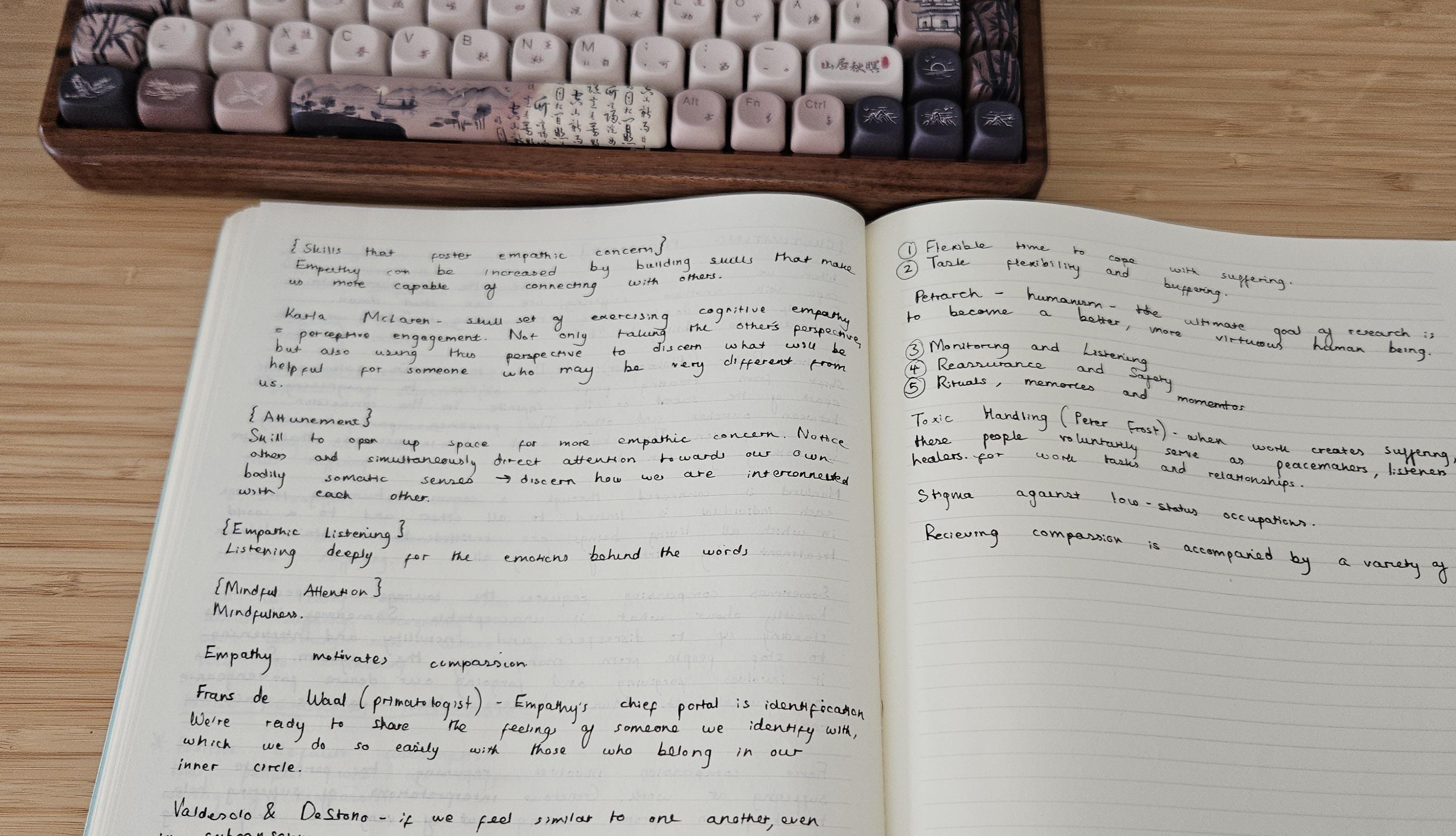
S: “Welcome to my thesis journal! This is where I keep track of literature I want to dive into, my word count for the day, and any notes and reflections I have throughout the process!”
Beyond the copying of quotes, your literature repository should embody your reactions to the text, ideas which form as you encounter the ideas and arguments of another. Perhaps consider including notes on articles or books you encounter in a structured report or review. Some things you might include:
A table of contents at the beginning of your notebook to keep track
A summary of the book/article in your own words
The main argument of the text
Supporting arguments of the text
Comparison to previous scholarship or similar works
Evidence used to support the author’s argument
A statement of how convinced or unconvinced you may be by the author’s position
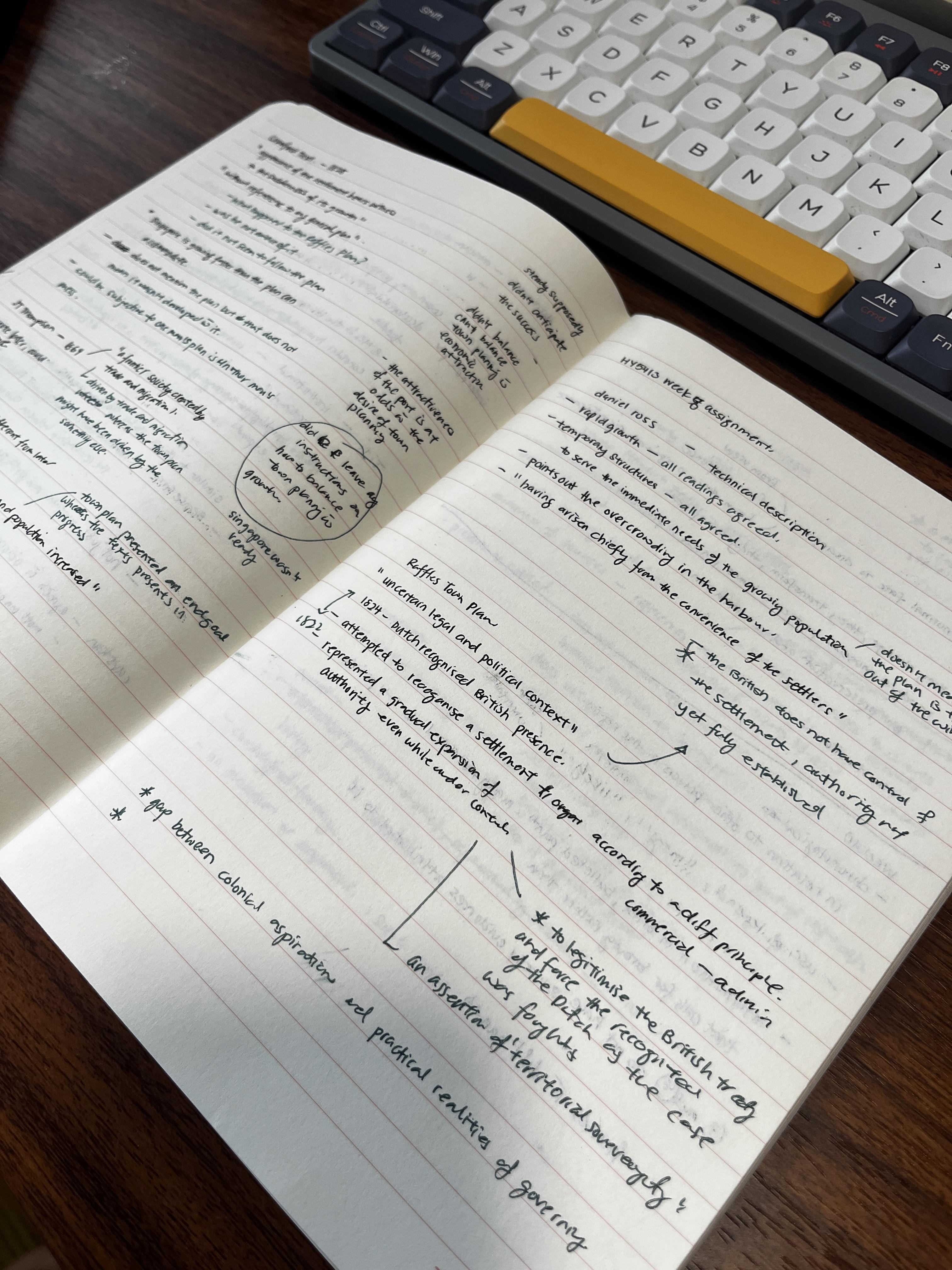
M: “My absolute favorite notebook time is when I have printed material and no screens in front of me. It feels like it’s just me and my own mind in harmony.”
When we divorce ourselves and our brains from continuous sources of external entertainment, we are left with the ebb and flow of our own imaginations. Seize it. Allow your brain to ping pond between ideas and daydreams but instead of having them exist solely in your head, write them down. What emerges when we are no longer entertained by screens and must take account of what we see, think, feel? What curiosities emerge which deserve inquiry? Maybe an idea for a book? A question which requires a bit of research? Maybe just a fond memory?
Some prompts to get you started:
What do I see?
What to I feel?
What do I think?
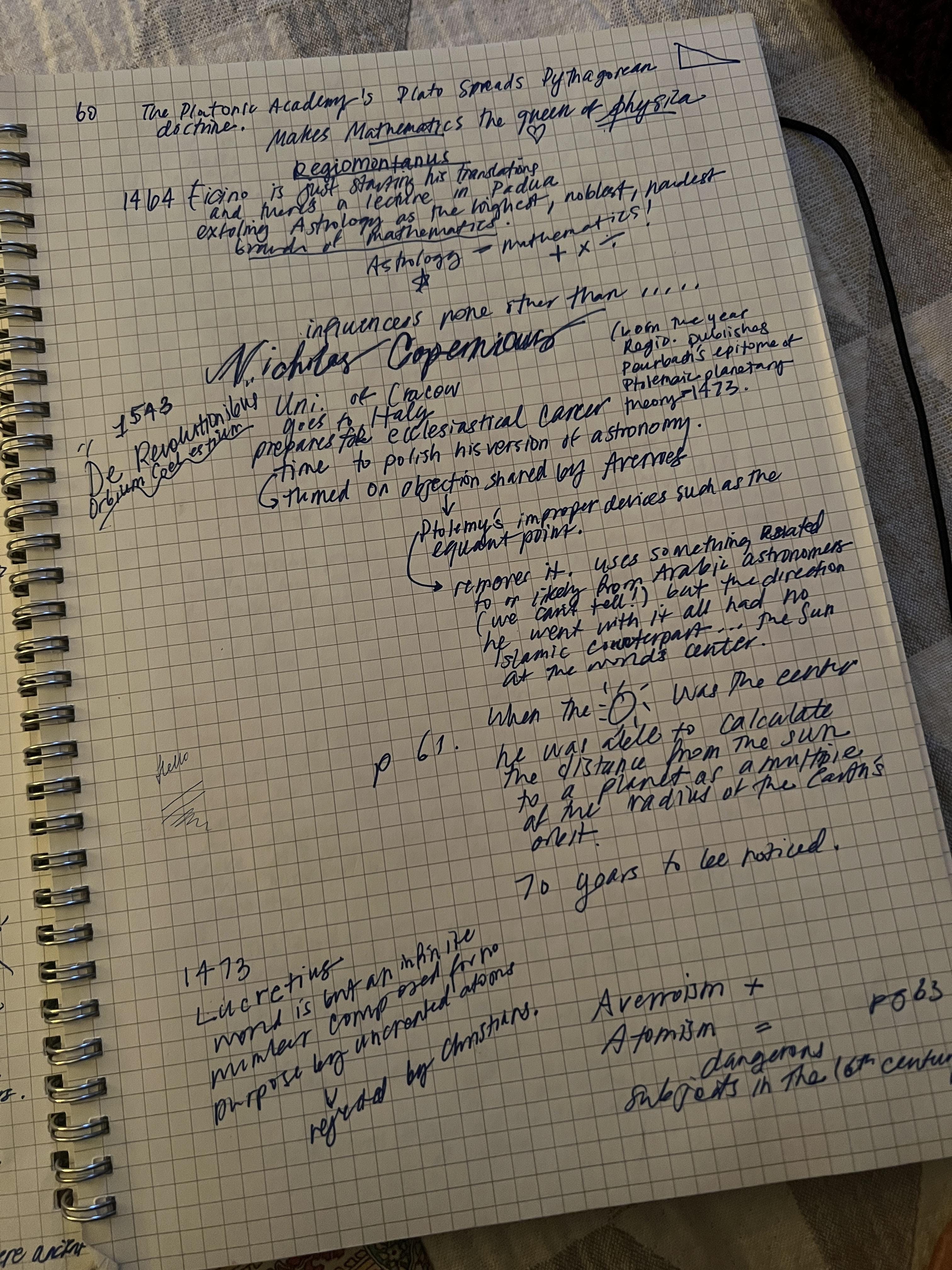
V: “I use it to takes notes from books, webinars, leaflets etc. and also to just brain dump reflective, exploratory thoughts relating to my studies. Sometimes I will hear a really inspiring quote or take which I will also make a note of, typically at the back of the notebook.”
The best possible way to retain information and form connections is to take notes down by hand. This applies to lectures just as much as it does to an intentional consumption of YouTube videos, documentaries, films, books, etc. Everything we encounter has the potential to light a spark; to give our minds something new to chew over. Perhaps use your journal as a space for the capture of these notes. A singular place where new knowledge can be noted and pondered. You never know, these notes may contain a new research idea.
The images above and quotes have been thoughtfully provided by members of Accepted Society. They represent the notes and practices of students, educators, documentary film-makers, and self-study enthusiasts who have come together as a collective for the shared passion of learning.
If you are a lifelong learner and could use support, encouragement, and community, Accepted Society just might be the place for you.
Members of Accepted Society have access to community-led silent and interactive study sessions (available in all time zones), as well as dedicated skills & support group calls (such as Funding & Grad Applications, Neurodivergent Support, and our Weekly Reset for goal planning and weekly reflection)
*below are some of our interactive events. This list is not a complete list of all the events offered :) adding everything would make this article far too long
Monday
Tuesday
5am Club Silent Accountability with Cait (Tuesday 5-8am BST)
Primary Sources & Data Analysis with Ezra (Tuesday 10am-1pm BST)
[PhDone Coaching] Community Connection: Integration (Tuesday 4-5pm BST)
Self-Directed Study & Creative Writing with Cree (Tuesday/Wednesday1-3am BST)
Wednesday
Thursday
Friday
Saturday
Sunday
Accepted Society is a small business led and supported by lifelong learners dedicated to creating spaces and opportunities which run parallel to traditional academia. All are welcome to a community with open arms <3
No posts
Comments
Nothing yet. Say the first thing.
Sign in to join the conversation.