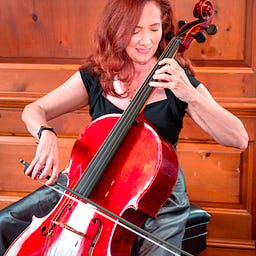
For eight decades, the Cheltenham Music Festival has been a cornerstone of Britain’s classical music calendar, nestled in the heart of the Cotswolds in Gloucestershire. This storied festival has built its reputation not only by presenting world-cla
Ming, a Music and Philosophy student at the University of Pittsburgh, used our cello lesson time this week to videotape an interview for his “Music Culture and History” course. The class explores classical concerts in Pittsburgh and discusses
Sonja Thoms is expanding the Wheeling Symphony Orchestra’s community presence through an innovative outreach strategy. Building on her decades of experience with the League of American Orchestras, Thoms recently established the WSO Community Choir,
A twelve minute composition in seven movements has been dubbed “Very Little Night Music” and added to the catalogue of Mozart’s work, it is now KV 648. Scholars believe it was a work of Mozart’s youth, maybe as young as ten years
Live music is increasing in our post-covid world. Gen Z-ers are outpacing Millenials for the first time as ticket buyers. It’s an exciting time to be a professional musician, and Juan Jaramillo gives us a look at the Candlelight concerts featuring
Beethoven became gravely ill in the Spring of 1825. When he recovered he continued writing his fifteenth String Quartet. This third movement gives us special insight into Beethoven’s belief that he dodged death for at least a few years. Sean Neukom finds
The Germans had the word for centuries. In Ancient times, they even thought a bug ground up could treat ear diseases. Today it simply means the music that gets stuck in your head More in the show notes at https://accelerandocast.com/show_notes/ The post
People often get a repulsion to sounds. Chalk, dentist drills, even bagpipes. Is this the same as Misophonia? What about ASMR: is it a subset of Misophonia? Today we find out. More in the show notes at https://accelerandocast.com/show_notes/ The post S2.
Over the course of your lifetime your auditory complex learns your preferences in terms of what you want to focus on in environment and music. We can make a lot of technical comparisons like the way AI learns our likes and dislikes: Music, Shopping, Food
Perhaps the most distinctive element of music is the one that gives nuance to our daily lives. Our ears never really sleep. They interpret the world, keep us safe, and give ongoing descriptions as we make our way through the day. When you ask yourself wh
The Camera can’t be equated with the Phonograph if you consider artists were capturing images and likenesses for centuries. The phonograph is more like the first canvas that can hold a performance or a moment in perpetuity. It came sixty years after the c
This week’s episode makes a wide arc from classical musicians and how they determine authenticity in an orchestral audition scenario, to how non musicians listen to music and determine which artists earn the badge of “authentic” in a variety of genres. Mo
Its for sale: our time and attention. And it’s time to turn off the doomscroll and get back to real culture. More in the show notes at https://accelerandocast.com/show_notes/
What better way to mark 100 episodes in the Accelerando Podcast than to feature Pittsburgh’s son Henry Mancini. I also talked to another great musician who hails from Aliquippa- George Perilli, when he performed for Chambersite’s Diamante Jazz Quartet thi
The Italian word, sprezzatura, was invented in the sixteenth century by Castiglione, a writer. His book: The Book of the Courtier describes the perfect courtier, and uses the word to define and group the qualities that exemplify him. The word is popular t
Daniel Kahnemann wrote about how we make decisions, and he won s Nobel Prize for his work on Behavioral Economics. With his passing last week we are thinking about his impact, and contribution to the world. When I began this podcast in April 2022 it was K
Composers often use a single repeated note in a piece of music, and it usually tends to get the attention of the audience in a particular manner. Sometimes it’s soft, other times loud, but it’s always persistent. Today we talk about some well known pieces
It seems appropriate to post a podcast about the masterpieces Bach dedicated on the same date (March 24) a little over three hundred years ago, 1721 to be exact. They were first published in 1850, one hundred years after Bach’s death. The original scores
Muzio Clementi was respected and praised by most of his contemporaries, especially Beethoven. Mozart paid respects by quoting or borrowing some of his themes, as composers did often in the classical era. Mozart may have been envious of Clementi’s techniqu
The three violin makers that shaped the violin we know today lived in Cremona in the late seventeenth to the mid eighteenth century. Amati, Stradavari and Guarneri Del Gesu may have influenced each other and their influence reaches violin makers today. Da