
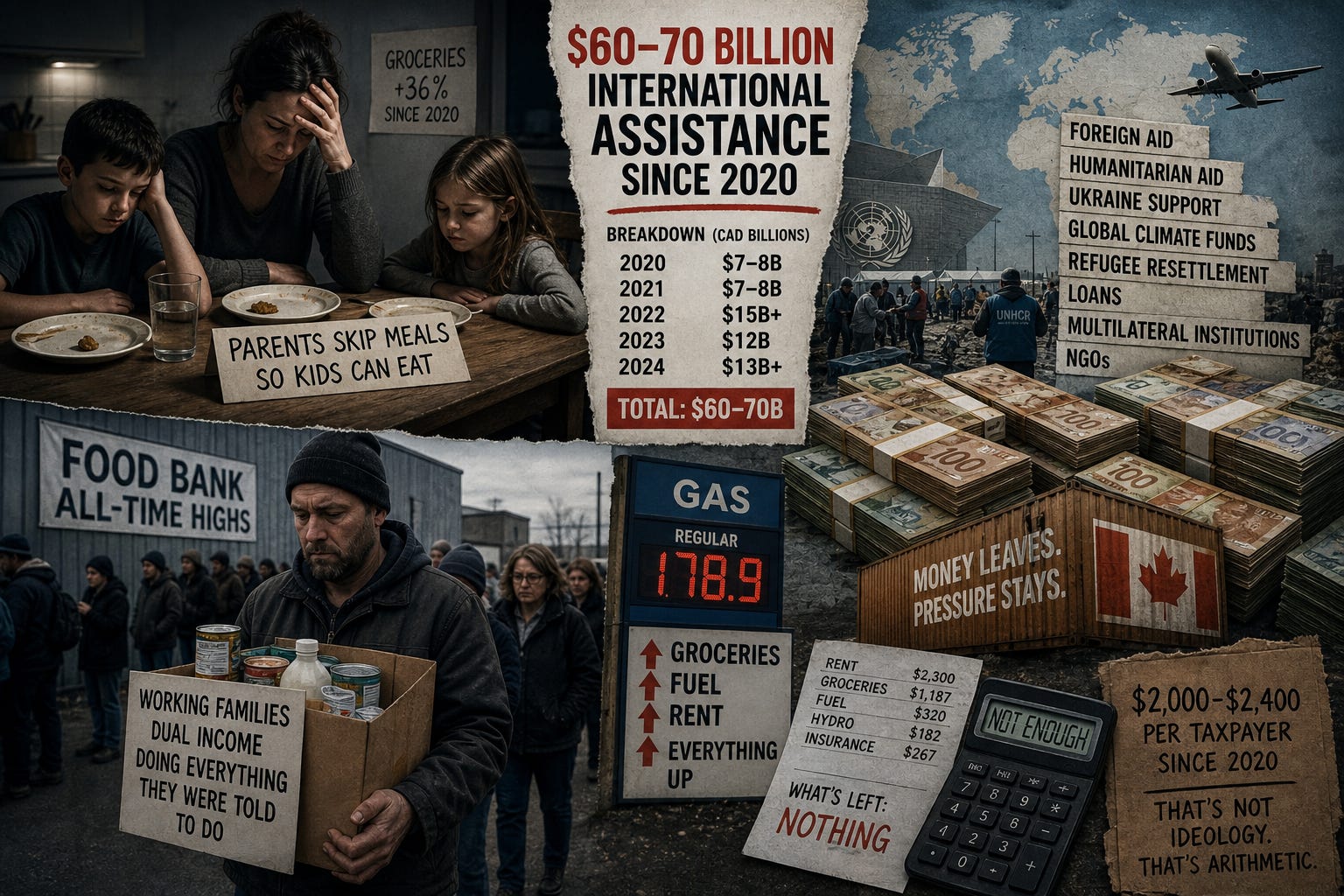
Parents are skipping meals so their kids can eat. Not in some edge case, not buried in a StatsCan footnote, this is becoming normal across the country. Food banks are hitting all-time highs and the faces in line aren’t who you think. Working families. Dual-income households. People who did everything they were told to do and still ended up standing there.
Vacations are done. Not postponed, gone. Gas costs too much, groceries cost too much, and a week off now means falling behind on something that can’t wait.
That’s Canada right now. Not ten years ago, not some projection. Right now.
And while all of that is happening, this country has pushed somewhere between 60 and 70 billion dollars out the door in international assistance since 2020. Not over decades, in roughly four years.
Foreign aid, humanitarian spending, loans, global climate funds, refugee resettlement costs, money flowing through Global Affairs Canada, Finance Canada, multilateral institutions, NGOs. However you slice it, the number lands in that range.
It stacks up fast. Around 7 to 8 billion in 2020 during COVID. Roughly the same in 2021. Then a massive spike, over 15 billion in 2022, driven by Ukraine, with military, financial, and loan commitments layered on top. After that it stays elevated: about 12 billion, then over 13 billion again. It never really comes back down.
Yes, some of that is loans. Yes, some gets counted differently depending on who’s doing the reporting and which line items they include. Those distinctions matter in policy circles. They don’t mean much to the guy standing in a food bank line wondering what happened.
Money is money when it leaves.
Break it down simply. Canada has roughly 30 million tax filers. Spread that 60 to 70 billion across them and you’re looking at about 2,000 to 2,400 dollars per person since 2020. That’s not ideology, that’s arithmetic.
Now stack that beside what’s actually happening inside the country. Groceries up sharply and consistently. Fuel costs rippling through everything — food, transport, basic goods. Rent crushing people in every major city and most of the smaller ones too. Home ownership functionally gone for a massive and growing chunk of the population. Wages not keeping pace with any of it.
People adjust. They tighten. They cut things. And then they start cutting meals.
And the whole time, billions keep moving out the door.
Here’s where the tension gets real, because this isn’t about whether foreign aid is good or bad. Most Canadians aren’t arguing the principle. What they’re arguing is priorities and timing. Why does a government that can’t stabilize things at home always seem to find capacity when it looks outward? Why is there never enough for housing, never enough for infrastructure, never enough to ease what’s breaking domestically, but always enough for the next international package, the next commitment, the next announcement?
And most of that money doesn’t move in a way anyone can follow. It flows through multilateral organizations, layered financial instruments, global funds that read well in reports but feel completely disconnected from the lives of people trying to keep the lights on. That disconnect matters more than people in Ottawa seem to understand, because Canadians don’t experience policy, they experience outcomes. And the outcome right now is pressure from every direction.
Food bank numbers don’t lie. Usage is climbing faster than population growth, faster than wages, faster than anything that would suggest this is a temporary blip. This is structural. And it’s accelerating.
So people start asking questions, quietly at first, then louder.
Why is a country this wealthy producing this kind of strain at home?
Why does everything feel like it’s getting harder, more expensive, and more restrictive all at the same time?
And why, in the middle of all of it, does the money keep flowing out as if nothing is wrong?
You can call it global responsibility. You can call it “leadership”. But to the people actually living this, it doesn’t look like either.
It looks like a system that has lost track of who it’s supposed to serve.
Because when parents are skipping meals in a country that just moved 60 to 70 billion dollars offshore in a few years, the gap between what we’re told and what we’re living becomes impossible to ignore. Not abstract, not ideological, practical. And once enough people see that clearly, the conversation stops being polite.
Darren Grimes
No posts
Comments
Nothing yet. Say the first thing.
Sign in to join the conversation.