
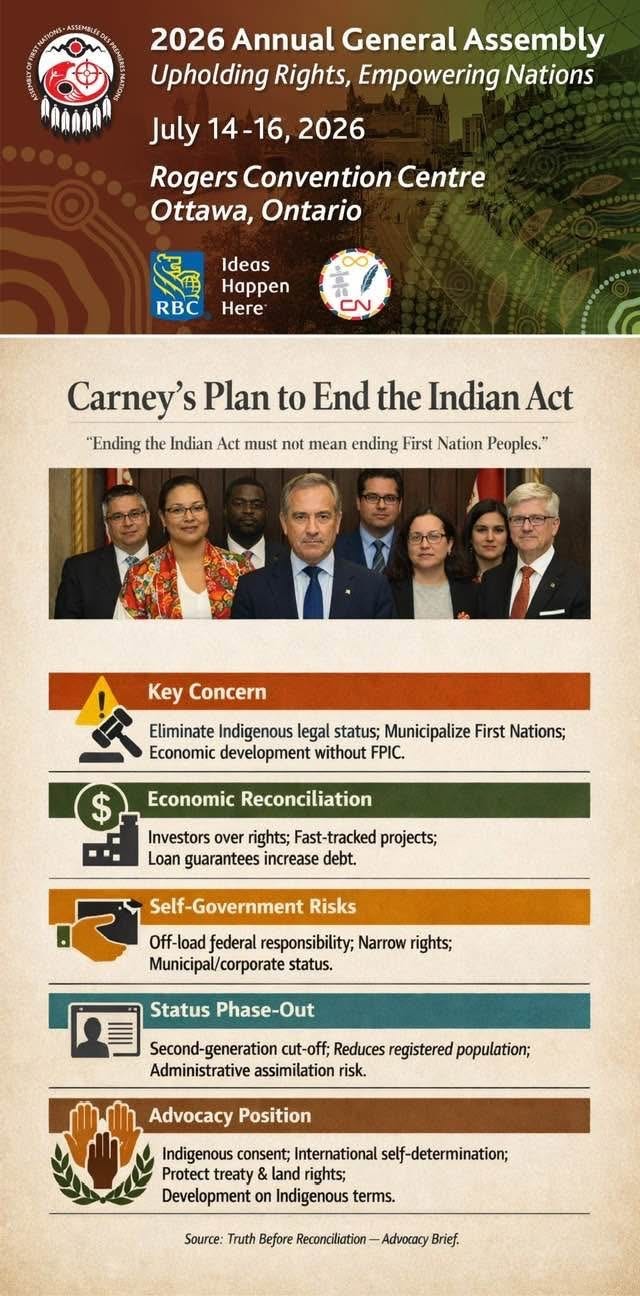
The Assembly of First Nations just released an advocacy brief warning that Mark Carney’s plan to end the Indian Act poses an existential threat to First Nations legal status, self-government, and the registered population itself. The brief is being circulated ahead of the 2026 Annual General Assembly in Ottawa next month. The language is urgent. The framing is alarmed.
Where was this alarm a year ago?
While Indigenous leadership spent the better part of the last eighteen months locked in performative combat with Danielle Smith over Alberta jurisdiction, search and rescue, and consultation rights, Ottawa was doing something far more consequential. Carney’s government was quietly restructuring the legal and economic architecture that Indigenous institutional power is built on. And the people whose salaries, authorities, and political relevance depend entirely on the Indian Act’s continuation were too busy holding press conferences about provincial overreach to notice.
I noticed.
The concerns in the AFN brief are not wrong. Municipalizing First Nations, reducing nations-to-nations relationships to something resembling a rural county with a land base, is a genuine threat. Eroding legal status through second-generation cutoffs is administrative assimilation by spreadsheet. Fast-tracking resource projects without FPIC isn’t economic reconciliation, it’s the same extraction model with better branding.
These are real dangers.
But here’s what the brief doesn’t say: the Indian Act is the source of AFN’s institutional power. Band councils exist because of it. Chief and council authority flows through it. The entire apparatus of Indigenous political representation in Canada — the AFN itself — derives its legitimacy from a colonial statute that the same leadership has been promising to replace since before I was born. They never actually wanted it gone. They wanted it reformed, endlessly, on their terms, in perpetuity. That process kept them relevant. It kept the funding flowing. It kept Ottawa at the table and the grassroots at a distance.
Carney may be the first Prime Minister willing to end it on his terms instead of theirs.
That’s what panic looks like in an advocacy brief.
The quote on the infographic, “Ending the Indian Act must not mean ending First Nation Peoples”, is doing enormous rhetorical work. It implies that reform equals elimination. But the Indian Act has been eliminating peoples for a century and a half.
Slowly.
Through dependency, through second-generation cutoffs, through the very administrative assimilation the brief now warns against. The statute they’re defending is the mechanism of the harm they’re describing.
They handed Ottawa this opening. Every year spent managing the Indian Act instead of dismantling it on Indigenous terms was a year Carney’s team spent watching and waiting. Every press conference about Alberta was a press conference not held about federal legislative reform. Every “cricket” moment I wrote about, leadership silence on the issues that actually move the needle, was space Ottawa filled quietly with its own agenda.
The AGA is in Ottawa on July 14th. Carney’s people will be watching. The question isn’t whether the Indian Act ends.
It’s ending.
The question is whether Indigenous peoples have any hand in what replaces it, or whether they show up to the Annual General Assembly having spent their political capital on the wrong fight.
The scorpion stings. Every time.
Darren Grimes
No posts
Comments
Nothing yet. Say the first thing.
Sign in to join the conversation.