
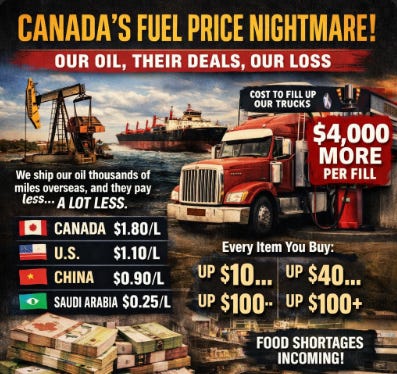
Canada sits on about 171 billion barrels of proven oil reserves, almost all of it in Alberta’s oil sands. Depending on the source, that puts us around third or fourth in the world. Either way, we are not some energy-poor backwater. We are one of the most resource-rich countries on Earth.
And yet Canadians keep getting hammered at the pump.
National gasoline hit a low of about $0.91/L in March 2020 and then blew out to about $2.30/L in June 2022. As of March 23, 2026, Canada-wide gasoline was about C$1.75/L, while diesel was about US$1.65/L, or roughly C$2.28/L at current exchange rates. That means even after the 2022 spike cooled, a huge chunk of the country is still paying far more than what people had normalized before 2020.
Now scale that up to the real economy.
A big rig can take hundreds of litres in one shot, and linehaul fleets burn through diesel like oxygen. When diesel is around C$2.28/L, fuel becomes one of the biggest cost drivers in the entire supply chain. And unlike some abstract tax buried in a spreadsheet, this one gets passed through fast. Food, lumber, steel, consumer goods, farm inputs, construction materials, everything that moves gets hit. In a country as spread out as Canada, fuel is not a side issue. It is the multiplier.
So when a truck costs thousands more to run over a route, that cost doesn’t vanish. It gets smeared across every pallet, every crate, every case, every item. If you’re hauling 4,000 things and fuel adds another few hundred or a few thousand bucks to the trip, the unit cost goes up. Maybe it’s ten cents. Maybe it’s forty. Maybe it’s a buck. But once that same pressure hits the producer, the distributor, the warehouse, and the retailer, the customer gets buried under it by the end. That’s how inflation actually feels in the real world.
And this is the part that should make people furious.
We ship our oil thousands of miles out of this country and the people buying it often still pay less than we do. On March 23, 2026, the U.S. regular gasoline average was US$3.961/gallon, which works out to roughly C$1.46/L at an exchange rate around 1.39. In other words, the Americans are paying less than our current Canadian gasoline average, and in many lower-tax U.S. states they’re well below it, even after refining, transport, and profit. Meanwhile, Canada’s diesel average is about C$2.28/L. We produce the stuff, export it, discount a lot of our crude because of pipeline constraints, and then Canadians still get nailed harder at home.
That is not scarcity. That is structure.
We’ve built a country where abundance does not translate into affordability. We have the resource. We have the expertise. We have the refining base. Alberta alone holds the overwhelming majority of Canada’s reserves. And still the domestic customer gets punished with global pricing plus layered domestic taxes, carbon costs, regulatory costs, and infrastructure bottlenecks.
Then people wonder why we keep losing our best and brightest.
Why do job creators leave? Why do skilled tradesmen, engineers, founders, and investors drift south? Because capital goes where margins survive. Talent goes where effort still pays. If you make it harder and more expensive to build, transport, refine, hire, and expand here, then don’t act shocked when the people who actually drive the economy move somewhere cheaper, faster, and less hostile.
And while all of this is happening, Ottawa still behaves like fiscal gravity is optional.
Canada’s broad money supply ballooned after 2020. Bank of Canada monetary-aggregate data and Bank-sourced series show broad money growing into the high-30% range in a very short period, with M2 now around C$2.78 trillion. That kind of expansion doesn’t magically create real wealth. It dilutes purchasing power unless real production keeps pace, and it didn’t.
So no, we are not printing our way out of this. We tried that already.
If you take that post-2020 broad-money jump, call it roughly $800 billion to $1 trillion for illustration, and compare it to a rough Canadian lifetime after-tax income stream, the number gets ugly fast. Statistics Canada puts median after-tax income for Canadian families and unattached individuals at $74,200 in 2023. Stretch that over a 40-year working life and you get about $3 million. On that rough math, the money expansion alone represents something in the ballpark of 270,000 to 340,000 lifetime income streams. That’s not a literal theft formula. It’s an illustration of scale. But the scale is the point.
And that’s before you even layer in foreign commitments.
As of early 2026, Ottawa says Canada has committed over $23.5 billion in multifaceted assistance for Ukraine on the Global Affairs page, and National Defence put the broader figure at more than $25.5 billion overall, including $8.5 billion in military assistance. You can support that policy or oppose it, but you cannot pretend the money is trivial while Canadians are being told to absorb permanent domestic pain with a smile.
This is what the political class still doesn’t seem to understand: fuel is not one more annoying bill. Fuel is the base layer under your food supply, your freight system, your farm economy, your construction costs, and every shelf in every store. When diesel stays elevated, food follows. When transport rises, everything follows. And if energy spikes again, another 20% to 30% on a lot of essentials is not some wild fantasy. In a country this large, with supply chains this long and growth this weak, it is the logical next hit. That last part is an inference, but it’s grounded in the same forces already squeezing the system: elevated transport costs, modest growth, and structurally expensive energy.
So that’s the story.
We are an energy superpower that made energy expensive.
We export raw strength and import domestic weakness.
We subsidize failure, punish production, and then act confused when food, freight, and everyday life keep climbing.
This country cannot tax, regulate, and print its way back into affordability.
And until somebody in power remembers that abundance is supposed to benefit the people living on top of it, Canadians are going to keep paying more for the privilege of living in a country that should have been cheap to run.
Darren Grimes
No posts
Comments
Nothing yet. Say the first thing.
Sign in to join the conversation.