

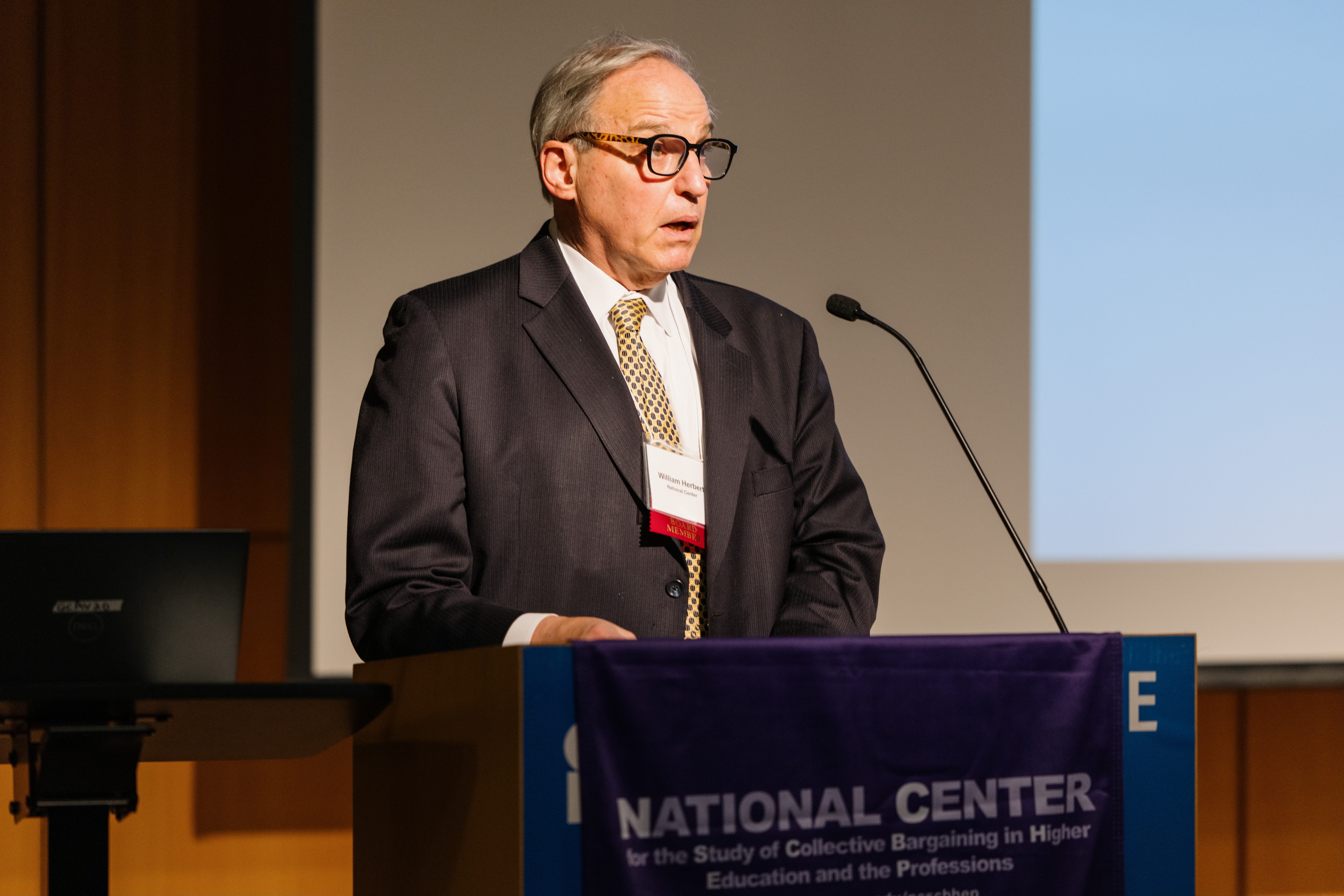
William A. (Bill) Herbert, “the executive director of the National Center for the Study of Collective Bargaining in Higher Education and the Professions at Hunter College, a distinguished lecturer, and a faculty associate at the Roosevelt House Public Policy Institute — died unexpectedly of natural causes on April 19 at his home in Delmar, New York. He was 70.”
The remainder of the obituary published by Hunter College, details a life of hard work, significant accomplishment, and well-justified recognition for a national leader on issues of academic labor and academic freedom.
Herbert was a friend and collaborator with a number of those working at AAUP and in the Center for the Defense of Academic Freedom, including his groundbreaking work on the contract language around academic freedom in collective bargaining recently released by Hunter College and AAUP/CDAF.
Bill’s passing was sudden and unexpected, and with any loss, has left a void which cannot and will not be filled. In honor of Bill and his work, we are collecting remembrances of Bill as a living memorial to a figure who touched so many lives.
If you would like to contribute your memories to this page, please email them to cdaf@aaup.org with a subject line: “Remembering Bill Herbert” or leave them as a comment on this post, and we will add them to the main text.
Tim Cain - CDAF Fellow
Just over two weeks ago, we received the devastating information that William A. Herbert had suffered a fatal heart attack at age 70. Bill had been the director of the National Center for the Study of Collective Bargaining in Higher Education and the Professions and a Distinguished Senior Lecturer at Hunter College, City University of New York, since 2013. In that role, he directed the National Center’s research efforts, convened annual conferences, and otherwise worked to improve both understandings of higher education labor and the functioning of higher education. His own research examined historical and modern issues related to faculty and student unionization, arbitration, and labor law.
Each of us knew Bill well. I first met Bill nearly a decade ago and grew closer when Bill insisted that I join him and group of labor leaders for dinner while in New York City in 2018. Over the years, our shared interest in the labor history of higher education and modern campus unionization kept them connected and in conversation. Isaac and Kate interacted with Bill in multiple venues around work related to the defense of academic freedom. Throughout, we were impressed by Bill’s knowledge, dedication, kindness, and uncanny ability to bring people together. He understood that work in higher education can be improved by getting people with diverging interests and ideas together into the same room and into conversation. As such, he made sure that the National Center was a space for labor and administration to meet and a resource for both.
Over the past year, we worked closely with Bill and a few others on a project on collective bargaining and academic freedom, meeting weekly in online calls. The project developed out of a shared interest in understanding how academic freedom has (and has not) been protected through union contracts. It built on an amazing database of more than 900 union contracts that Bill and his team gathered as part of the creation of the National Center’s 2024 Directory of Bargaining Agents and Contracts in Institutions of Higher Education. Bill led a team of students coding those reports for institutional and bargaining unit characteristics, then invited us and AAUP Senior Program Officer Anita Levy to help refine, contextualize, and make sense of what they had started to see. It was a productive and affirming partnership that included deep dives into literature, wrestling with how to interpret contract language, and true sharing of ideas. And, moving line-by-line through a marked-up draft of a 100-page report on Zoom with Bill was a unique process that we will now always remember both fondly and with melancholy.
We released the first product of that partnership, Academic Freedom and Collective Bargaining, in March, and Tim discussed it with John here. The report was aimed to help those involved in bargaining understand the range of ways in which academic freedom has been addressed in contracts bargained by faculty, graduate students, and postdoctoral worker unions. Tim, Anita, and several co-authors then presented and discussed the report at the National Center’s annual conference, for which Bill provided organization and intellectual leadership; Bill was in the front row. He was scheduled to join them on a panel discussion of the report at the AAUP’s convening in Chicago in June.
We had planned to return to the data this summer to refine some coding and undertake a different type of analysis to add to the scholarship of collective bargaining in higher education. It is hard to imagine that work without Bill as he was central to all of it. Perhaps we will move forward because the work is important, but if we do it won’t be the same, intellectually or spiritually, without Bill.
There are people in your life that you later realize you were lucky to have known but did not realize it at the time. Bill was a person you instantly recognized you were lucky to know. He was smart. He was funny. He was genuine. He loved people, and he loved music. He looked for any slight window to name a journal article with a song lyric—just before his passing, “Forever Young: Student Employee Unionization in Higher Education” appeared in the New York State Bar Association Journal. We miss Bill for what he shared with and brought to us as colleagues, co-authors, and friends; the field will miss his intellect, his scholarship, and his ability to bring people together for the common good.
Isaac Kamola - CDAF Director
I have two memories that I often use to explain the singularity that is, or was, or continues to be, Bill Herbert.
During the summer of 2025, we were in the early stages of planning the work for what would become the “Academic Freedom in Collective Bargaining” report. Bill was already thinking ahead to the proposal for the panel for the National Center’s conference. I had only met Bill a few times, and only once in person. That time was at the National Center conference a few months before, when I proposed the idea of writing a joint report based on the 2024 Directory. I wasn’t yet accustomed to Bill’s, shall we say, very specific opinions about how this should proceed. He had clearly thought a lot about both the report and how the panel (still ten months out) should be organized, and had already strong opinions. It became very clear that he was not particularly compelled by my not-yet-formed ideas about framing or invitees. By the end of the meeting, we had agreed to do it Bill’s way. Not an uncommon outcome, I would learn. I also learned that Bill’s was usually also the best and best thought-out, outcome as well. At the end of the conversation, I mentioned I was in the Adirondacks for a few days. Bill immediately lit up and proceeded to talk for another twenty minutes about the many important abolitionist historical locations in the area that I should see. He gave me detailed directions to, if I remember correctly, a farmstead that was donated and sold, with the proceeds used to fund John Brown. Another location that was an important safe house on the Underground Railroad. And there were many more. I remember logging off Zoom and thinking to myself, “Seriously, who the hell is this guy?” I spent the next week in the Adirondacks telling everyone who would listen what I had just learned about the region’s radical abolitionist history, and nobody had heard anything about it before.
Another experience that I keep coming back to occurred at the end of the writing of the collective bargaining report. We were all doing a lot of work in a very short period of time. There were many late nights, including many in which I would send the drafted pages I had promised sometime in the wee hours of the morning. I’d wake up, get the kids off to school, and open the file only to find that Bill had been in the document for hours and had already marked it up, sometimes nearly rewriting whole passages. And, again, doing so in ways that were always more precise and more compelling than what I had come up with. One day, after such an experience, I had to level with Bill: “How the hell do you do it?” I asked. He gave an answer about union work being endless and all-consuming, saying if nobody does it, the work doesn’t get done. Then Bill concluded by saying something that has become all too poignant in this moment. He said he always thought his gravestone should read: “Getting shit done since 1956.” Then we all laughed, because we knew it was true.
Rest in power, my friend. The world is a diminished place without you in it. But we will continue the fight. Inspired by your memory, as a hard worker, happy warrior, and true believer in the power of the union to make a more beautiful world.
Kathryn Taylor - CDAF Program Coordinator
I had the privilege of knowing Bill for less than a year and only virtually. As Tim noted, “Bill was a person you instantly recognized you were lucky to know.” He was one of those people who had an outsized impact. Setting aside all of his wildly impressive labor and academic achievements, he left an immediate impression. You ended every interaction having not only been inspired by his dedication to his work and meticulous attention to detail but also having laughed and learned together. His thoughtful care for each individual's contribution in the space was unparalleled. Isaac and I met with Bill late on the Friday afternoon before his death, coming away, enthusiastically, as usual, with all sorts of meaningful next steps for the ongoing work. It's rare to end a work Zoom with such deep admiration, human connection, and enjoyment of someone you've never met in person, and it's a small but powerful testament to his ethical code and enduring impact.
Comments
Nothing yet. Say the first thing.
Sign in to join the conversation.