
Please support my work by becoming a free or a paid subscriber to the newsletter. Paid subscribers are vital to me being able to continue producing and expanding this newsletter.
You can also support my work by making a one-off payment, at a price you consider affordable.
This post is part of the regular ‘One Take’ series analysing the politics of a film currently showing at the cinemas.
Content warning: Racism; Antisemitism; Homophobia; AIDS; Death and bereavement.
Note: Given that, at time of writing, Wham! 10 Days in China is still showing in some UK cinemas, and awaiting its television premiere, this analysis only lays out as much of the documentary’s scenario as is necessary so as to avoid spoilers. It is therefore suitable to be read either before or after watching the film, while hopefully still enriching the viewer’s appreciation of it either way.
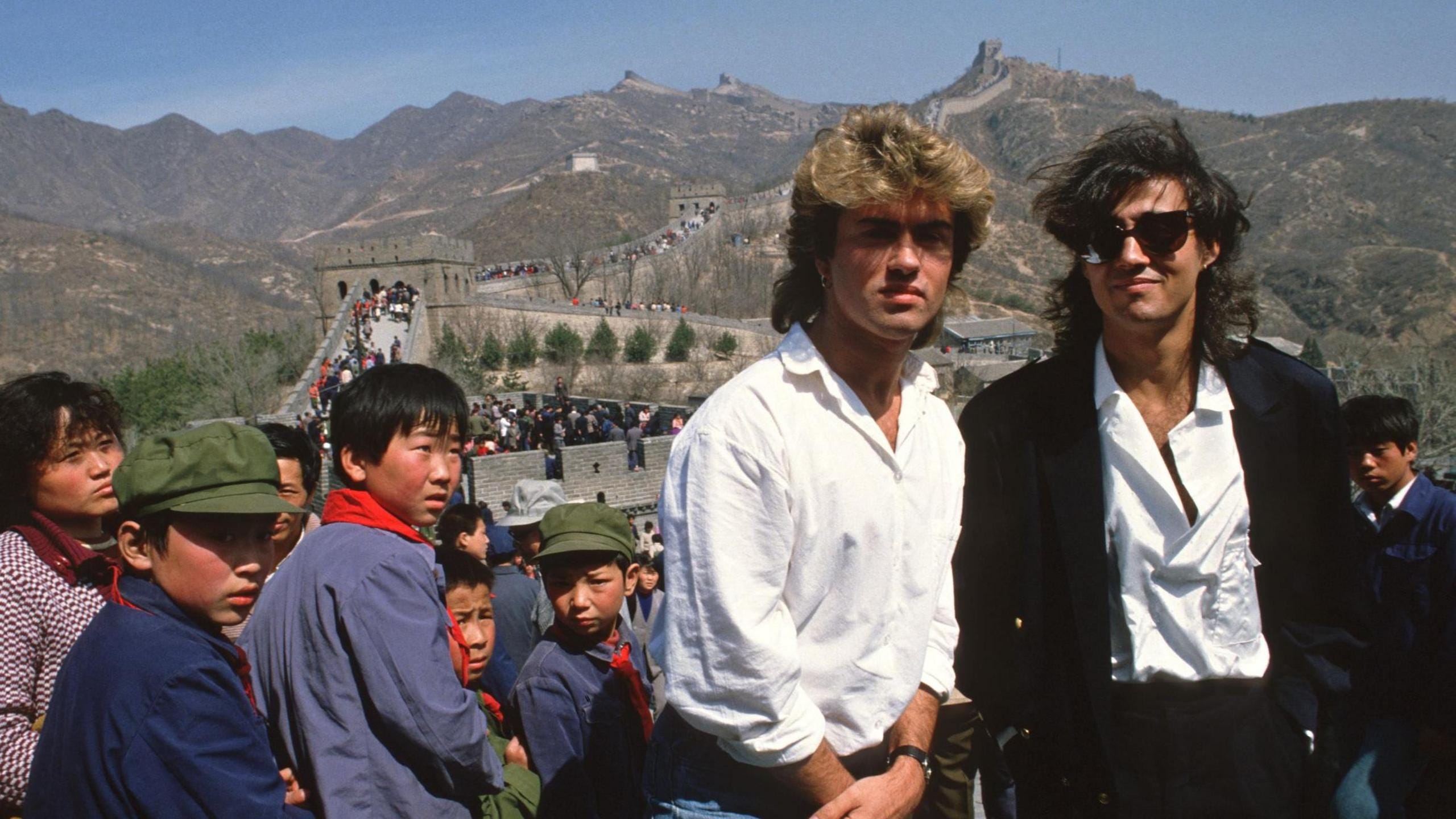
Wham! 10 Days in China takes us back to April 1985.1 Wham!, the British musical duo comprising George Michael and Andrew Ridgeley (then aged 22 and 21 respectively), accompanied by backing singers Helen “Pepsi” DeMacque and Shirlie Holliman, and their touring band, that month became the first ever Western pop group to play in communist China, which under Deng Xiaoping was increasingly opening up economically and, hesitatingly, culturally to the capitalist world. The real objective behind the visit, however, was not to capture the Chinese market. Rather, we learn, in order to fulfil Michael’s ambition of making Wham! the biggest band in the world, their manager Simon Napier-Bell had come up with the ploy of exploiting the intrigue surrounding China to capture the imagination of the American media in particular.
The documentary makes it clear that the visit, which comprised two concerts – in capital Beijing on 7 April, and Guangzhou on 10 April – as well as a lengthy series of diplomatic and promotional engagements, was wracked by tensions. Both Michael and Ridgeley were articulate and engaging media performers, but their relationship with the British tabloid press was already tempestuous, and they arrived in Beijing deeply wary of the retinue of journalists and photographers accompanying them. Moreover, Napier-Bell had recruited a filmmaking team, led by the legendary British director Lindsay Anderson, to produce a documentary about the venture. This further exacerbated the goldfish-like nature of the band’s experience in China; moreover, they did not see eye-to-eye at all with Anderson about the project at all.
Nonetheless, we see Wham!’s arrival provoking huge excitement among Chinese youth, eager to embrace Western popular culture after decades of isolation. 10 Days in China demonstrates the weighty impact the experience of seeing Wham! had on many contemporary teenagers, some of whom went on to become important figures in China’s own burgeoning music industry. The Chinese state, meanwhile, was eager to use the band’s visit to make a positive impression on a global media hitherto used to reporting on the country at much greater remove. Yet further strains emerged as the event revealed the extensive cultural exchanges and generational attitudinal divergences accompanying economic liberalisation, while heavy-handed policing of the concerts provoked additional controversy and scrutiny.
A Cold War gamble
Wham!’s China visit took place at the height of the shifting circumstances of the late Cold War era. The collapse of the post-Second World War economic order and a perceived crisis of democracy in the 1970s had fuelled the rise of the New Right in Britain and the US.2 The latter’s aggressive pursuit of neoliberal policies destabilised the economic model of the Soviet bloc states and re-established US global economic hegemony, but also created opportunities for East Asian economies, like China, within an increasingly integrated global economy.3 This was accompanied by the accelerating globalisation, but not homogenisation, of consumerism, cultural specificity persisting alongside fusion and hybridity.4
10 Days in China offers something of a microcosm of these trends. The convoluted situation arose that for a British pop group, worldwide success meant becoming household names in the US, and the best place to do that was in China. Wham! had already enjoyed two Billboard No. 1 hits with ‘Wake Me Up Before You Go-Go’ in November 1984 and ‘Careless Whisper’ in February 1985, the latter coinciding with the US leg of the band’s 39-date ‘The Big Tour’, of which the two China dates were the finale.5 Yet as Napier-Bell told the BBC World Service in 2005: ‘Biggest group in the world means biggest group in America – and you cannot do it in two years, it takes four or five to break, even when you’re having constant number ones.’ The band’s management decided that the shortcut there ran through Beijing.
You cannot help but be struck, watching the documentary, by how much was going on, the various agendas that had brought Wham! to China, the competing interpretations at the time of what was taking place. This frequently culminates in mutual miscomprehension, as the various actors in this drama are flung into places and spheres of activity alien to them. With jaded amusement, Michael and Ridgeley try and compose an address for a state banquet while sitting in the back of a car, and make small talk with dignitaries at the home of British ambassador Richard Evans. Yet 10 Days in China also shows them flummoxed by the Beijing concert audience’s passiveness, not grasping that this owes as much to heavy-handed policing as cultural mores. When Ridgeley is asked about reports of this suppression at a subsequent press conference, and dismisses it as typical of the hostile media agenda he is used to confronting, he comes instead across as denying evidence of state authoritarianism.
‘China had been closed for hundreds of years’, we hear uttered at one point in the documentary – a gross simplification of the country’s actual history (glossing over a century of aggressive external interference there prior to the establishment of the People’s Republic in 1949). Yet beyond the façade of a secluded society out of time, the documentary (including through present-day interviews with Chinese music industry figures like Cheng Fangyuan and DJ Paul), increasingly makes clear the fissures within. While the Chinese state sought uncertainly to manage and exploit the visit, archival footage captures younger Chinese music fans’ not just enthusiasm for, but increasing familiarity with, Western culture. Along with these generational divides, 10 Days in China! also makes clear the geographic differences within this vast country, given Guangzhou’s proximity to Hong Kong and the resultant liberalising cultural influences there not so pronounced in Beijing.
Wham! and 1980s Britain
Arriving in China with their bloated and hardly entirely welcome entourage, Wham!’s visit equally encapsulated the tensions and contradictions of their homeland. This was partly a divide in the Britain of the 1980s itself, in the myriad forces facilitating and facilitated by Thatcherism as an economic and political project, and yet in different ways markedly at odds with its moral core. On the one hand, you had Wham!, whose apparent clean-cut apoliticism concealed a hedonistic but often acute approach to social commentary (as in dole queue anthem ‘Wham Rap!’) that preceded Michael’s more explicit political stances later in his career. On the other was a tabloid press who traded in the prejudices pronounced among the New Right, but also in a gleeful prurience that departed from Thatcher’s neo-Victorian moralism. 10 Days in China offers a window into how, in their respective pursuits of cultural centrality and economic success, the band and newspapers fed off even as they denigrated each other.
There is equally a class-based division between and old and new Britain, and their values, at play. Ridgeley’s wry description of the British ambassador’s home and the elite crowd there as a patch of ‘1930s Blighty’ transplanted to China is one intimation of this. Yet it manifests most clearly the disjuncture between Wham! and Lindsay Anderson. The director had captured the rapidly changing mores of a previous generation in films like This Sporting Life (1963) and If… (1969), but some forty years older than the two young men whose travails he was ostensibly in China to document, seems an almost incongruous presence. The gap between what he considered of worth in the endeavour, a window on China as pristine, socialist society, and what Wham! considered of worth, their own artistry, is also one between the cultural priorities of the upper and lower middle classes to which they respectively belonged.
Nonetheless, 10 Days in China also captures Michael’s and Ridgeley’s own aptitude at code-switching, affecting gentility and ordinariness by turns. This knowingness suggests a desire to maintain distance between themselves as media performers and as private individuals, when their stardom owed much to ostensibly denying such a distinction. There are other hints, albeit not fully explored in the film, of Wham!’s dissonance as ambassadors for Britain. Ridgeley’s frequent addressing of his friend as ‘Yog’ is a reminder of Michael’s migrant background: real name Georgios Panayiotou, son of a Cypriot restauranteur. Ridgeley himself was the son of an Egyptian-Jewish migrant, while their wider touring band was also multiracial, including Pepsi, born in London to St Lucian parents.6 This oscillation between ethnic ambiguity and racial diversity is all the more noteworthy given the ruling Conservatives’ recurring nativist dalliances in word and deed.7
The divide between public and private self and its national ramifications is also palpable in Michael’s sexuality. This is outwardly ubiquitous, in his on-stage evocation of sexual desire and desirability, and his own frequent salacious referencing of this. Yet beyond suggestions of Michael’s feyness, subtly contrasted with Ridgeley’s more overtly heterosexual masculinity, the documentary does not explicitly comment on the fact of his being a then closeted gay man, integral as it is to the audience’s understanding of what they are watching. 1985 was, for context, at a point when the AIDS pandemic was rapidly escalating, over 3,000 cases of HIV being diagnosed in Britain that year alone. It was accompanied by resurgent homophobia, not least in the British press, and indulged by the government in the passing of Section 28, banning councils and schools from ‘promoting homosexuality’.8 It is the unspoken current in Michael’s trepidation at the costs of fame, even as he simultaneously pursued greater stardom.
Ghosts and legacies
The gap between Michael’s private and public selves also draws our attention to 10 Day’s in China’s own history, which dates back to the tour itself. Wham! were dissatisfied with Anderson’s completed film, If You Were There, which they felt reduced them to an almost incidental presence; it languished thereafter in Anderson’s own archive.9 Andy Morahan, who had directed several of Wham!’s previous music videos, including 1984’s Last Christmas, was brought into rework the material into a more conventional tour film, Wham! in China: Foreign Skies, premiered in 1986 at Wham!’s farewell concert at Wembley. Since Michael’s death in 2016, Ridgeley has more assertively pursued the revisitation of the duo’s legacy, and in 2024 he and Michael’s estate approved director Mike Christie’s project for a new documentary about on the trip, utilising vast quantities of unused archival footage Anderson’s team shot on 16mm cameras, as well as extensive new interviews with Ridgeley and others.
10 Years in China operates as a kind of dialogue between the archival material and the new interviews, visuals from the former often being overlapped with voices from the latter. The film footage from 1985 is frequently insightful, laying out many of the conflicting agendas and imperatives discussed above in all their breadth – and yet is also characterised as much by concealment and revelation. Its subjects, whether the band themselves or young Chinese music fans, were clearly conscious of, and to varying degrees self-censoring themselves in response to, the multiple forms of surveillance, state and media, underway – of which the film cameras were but one. It is a thin and clearly permeable surface, but surface nonetheless.
By contrast, the present-day material offer a belated interiority, a more assured account of what was actually taking place. The interviewees explain the emotions they had felt at the time, the contexts necessary to explain their actions, the implications of what was happening, from the privileged vantage point of posterity and maturity. Those now working in China’s music industry illustrate it subsequent expansion and globalisation as creative legacy of the youthful excitement the visit sparked at the time. Ridgeley himself is shown revisiting China today, musing on the ripples they had set in motion, blinded to it as they were by their own cynicism and ambition, and on what his deceased childhood friend would have made of it. Michael himself is of course present only in the archive footage, speaking mostly only digetically, and absent in the interviews save for the traces remaining in his friends’ and colleagues’ own memories – an elusive protagonist, familiar and distant, sensual and ghostly.
If you’ve enjoyed this post, please consider supporting my work by becoming a free or a paid subscriber to the newsletter. Paid subscribers are vital to me being able to continue producing and expanding this newsletter.
You can also support my work by making a one-off payment, at a price you consider affordable.
Otherwise, please show your appreciation by sharing this post more widely, and referring the newsletter to friends.
You might also enjoy these posts from the Academic Bubble archive:
Rewound
Pride (2014)
·
April 16, 2024

Based on real events, Pride offers a message of solidarity between oppressed groups, albeit while centring a whiggish narrative of gay rights and evading some of Thatcherism’s consequences.
Rewound
Doubt (1991)
·
August 3, 2024

Jesus Jones’ breakthrough second album combines post-Cold War optimism, a rejection of moral certainties, and a multivalent response to postmodernity.
One Take
Springsteen: Deliver Me from Nowhere
·
December 8, 2025
This biopic frames the making of Bruce Springsteen’s 1982 album Nebraska in the context of his own psychological turmoil, at the omission of the broader social and political strife it also channelled.
See Jan-Werner Müller, ‘The Cold War and the Intellectual History of the Late Twentieth Century’, in Melvyn P. Leffler and Odd Arne Westad (eds.), The Cambridge History of the Cold War: Volume III: Endings (Cambridge: Cambridge University Press, 2010), pp. 1–22.
See Giovanni Arrighi, ‘The World Economy and the Cold War, 1970–1990’, in Melvyn P. Leffler and Odd Arne Westad (eds.), The Cambridge History of the Cold War: Volume III: Endings (Cambridge: Cambridge University Press, 2010), pp. 23–44.
See Emily S. Rosenberg, ‘Consumer Capitalism and the End of the Cold War’, in Melvyn P. Leffler and Odd Arne Westad (eds.), The Cambridge History of the Cold War: Volume III: Endings (Cambridge: Cambridge University Press, 2010), pp. 489–512.
‘Careless Whisper’ was released as a George Michael solo single in Britain, as his first step towards an eventual solo career, but in the US market, where Wham!, let alone Michael himself, were less established, it was marketed as ‘Wham! featuring George Michael’.
Ridgeley’s father, Alberto Mario Zacharia, was expelled from Egypt after the Suez Crisis, and chose Ridgeley as his new surname in order to aid his assimilation into British life – an act of nominative masking that preceded Georgios Panayiotou’s stage name by some twenty-odd years.
Thatcher infamously remarked on television in 1978, as Leader of the Opposition, that ‘people are really rather afraid that this country might be rather swamped by people with a different culture’; in government, the Conservatives subsequently introduced the 1981 British Nationality Act, ending birth-right citizenship.
See Health Protection Agency ,‘30 years of HIV in the United Kingdom’, Health Protection Report, Vol. 5, No. 22 (3 Jun. 2011), pp. 2–5; Ben Clements and Clive D. Field, ‘Public Opinion toward Homosexuality and Gay Rights in Great Britain’, Public Opinion Quarterly, Vol. 78, No. 2 (2014), pp. 523–547. Michael’s own boyfriend, the Brazilian fashion designer Anselmo Feleppa, died of AIDS-related illness in 1993.
Comments
Nothing yet. Say the first thing.
Sign in to join the conversation.