
Please support my work by becoming a free or a paid subscriber to the newsletter. Paid subscribers are vital to me being able to continue producing and expanding this newsletter.
You can also support my work by making a one-off payment, at a price you consider affordable.
This post is part of the newsletter’s ‘Rewound’ series of analyses of objects or episodes from cultural and political history.
Content warning: Death; Bereavement; PTSD; Descriptions of violence; Anti-Asian racism.
Spoiler alert: This analysis of the film Rambo: First Blood Part II and its themes reveals plot details for the purpose of enhancing that analysis.
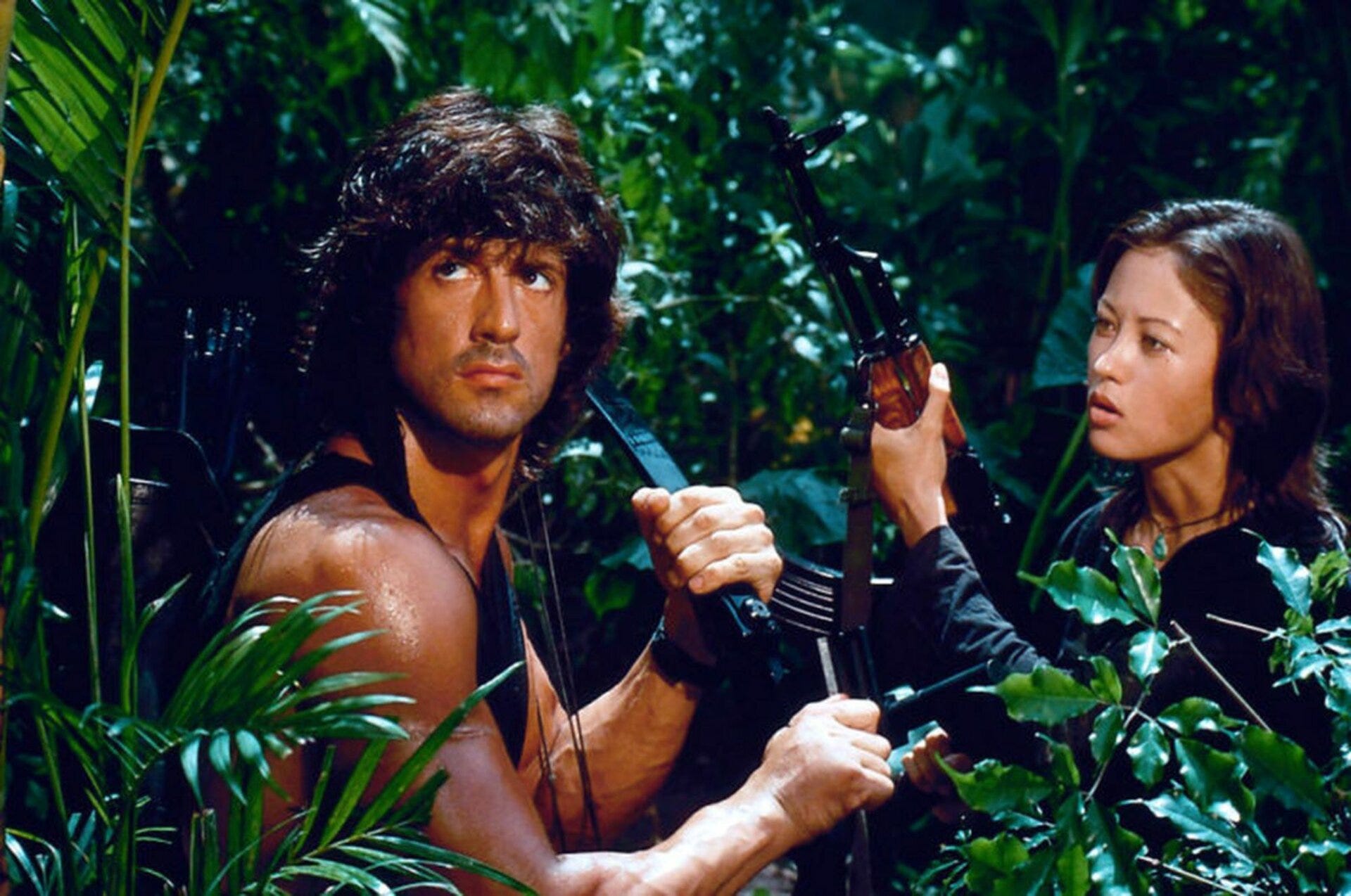
In 1985, Vietnam special forces veteran John Rambo (Sylvester Stallone) is serving time for a violent spree he had gone on three years earlier in Hope, Washington, in revenge for being victimised by the local police – as depicted in First Blood (1982). He is visited by his former commanding officer, Colonel Sam Trautman (John Crenna), who informs Rambo that he has been identified by the government as the ideal candidate to undertake a reconnaissance mission in Vietnam. If he accepts, he will covertly infiltrate the camp he was once himself imprisoned in to investigate rumoured continued detention there of American combatants reported missing in action during the previous war, with the possibility of a pardon for his previous crime if the operation succeeds.
Rambo agrees and is taken with Trautman to Thailand, from where the operation is being launched. There he and Trautman meet Major Marshall Roger Murdock (Charles Napier), who is overseeing the mission. Murdock instructs Rambo he is merely to infiltrate and take photographs of the facility in question, and not engage the enemy or seek to conduct any rescues himself. Rambo is suspicious of inaccuracies in Murdock’s account of his own service in Vietnam and confides his doubts about him to Trautman.
Helicopter crew Ericsson (Martin Kove) and Lifer (Steve Williams) fly Rambo over Vietnam where, despite a near disastrous disembarkment, he parachutes into the jungle, to be met by his contact, female Vietnamese intelligence agent, Co Bao (Julia Nickson). They travel with pirates downriver to the camp, commanded by Captain Vinh (William Ghent) and Lieutenant Tay (George Cheung); during the journey, Co and Rambo begin to bond. Rambo sneaks into the camp and finds POWs imprisoned there in horrendous conditions. Disregarding his orders, he frees one of them, Banks, (Andy Wood) whom he finds shackled outside, before departing with him and Co.
The three attempt to return with the pirates, who betray them; they kill the pirates, destroy the boat, and escape, under pursuit from Vietnamese forces. Rambo and Banks part ways with Co and head to the agreed extraction point, where Ericsson and Lifer, along with Trautman, are to retrieve Rambo by helicopter. When they realise he has a POW with him, a panicked Murdock orders them to abandon the retrieval and Ericsson and Lifer comply, despite Trautman’s protests. Rambo and Banks are captured by the Vietnamese forces and returned to the camp. Back in Thailand, Trautman confronts Murdock, who insists the US government could not brook the diplomatic, economic, and military implications of the confirmed presence of POWs.
A cohort of Soviet forces arrive at the Vietnamese camp, led by the cruel Lieutenant-Colonel Podovsky (Steven Berkoff), who demands Rambo reveal the details of his mission. He informs Rambo of the intercepted radio conversation between Murdock and the helicopter crew, in which Murdock ordered his rescue be aborted. Rambo nonetheless refuses to talk, even as Podovsky has his henchman, Sergeant Yushin (Voyo Goric), brutally torture him. When they threaten to torture Banks as well, Rambo folds and agrees to radio a message back to his base in Thailand on behalf of his captors. However, he instead threatens Murdock that he is coming back for revenge; Co springs an ambush, and Rambo successfully escapes with her.
Rambo and Co plan to make their way to Thailand and from there to the US, and share an embrace. However, Co is shot dead by one of the posse of Soviet and Vietnamese troops tracking them. An enraged Rambo conceals himself in the jungle terrain and kills the soldiers one by one, before boarding and – after overpowering Yushin and throwing him overboard to his death – commandeering a Soviet helicopter. He flies back to and attacks the POW camp, before landing and freeing the prisoners, whom he loads onto the helicopter. They are pursued by Podovsky, in another helicopter, who fires upon and damages their aircraft, apparently forcing them into an emergency landing. However, it is merely a trap by which Rambo lures Podovsky in, before blowing his pursuant up with a handheld rocket launcher.
Rambo flies the damaged helicopter and POWs back to Thailand, landing at the military base. As his wounded passengers are tended to by paramedics, Rambo storms off in search of Murdock. He furiously unloads a machine gun on the the computing and filing equipment surrounding Murdock’s desk, before confronting Murdock himself, warning him to find the other POWs in Vietnam, or else Rambo will find him. Trautman asks Rambo to return to the US with him, but Rambo refuses and departs alone.
Refighting the Vietnam War
First Blood Part II centred on a conspiracy theory that had become increasingly potent in the decade after the Vietnam War, despite official insistence on its baselessness. The 1973 Paris Peace Accords that ended US military involvement in Vietnam stipulated the release of all American POWs in North Vietnam and Laos, with some 591 being transferred into US custody that year. Yet with over 2,600 American troops who had served in Vietnam still unaccounted for at the end of the conflict, and the severance of diplomatic relations between the two countries inhibiting further retrieval of remains, the idea there remained live POWs concealed in Vietnam persisted in public opinion, organised advocacy by veterans, relatives of the missing, and politicians, and popular culture – with First Blood Part II perhaps its most impactful cinematic manifestation.1
The film’s entire premise seems to exist almost nakedly as an extension of Rambo’s, but not only Rambo’s, inability to accept both the Vietnam War’s horrors and outcomes, as encapsulated in a conversation between Trautman and Rambo before the latter flies out from Thailand:
TRAUTMAN: John, I want you to try and forget the war; remember the mission. The old Vietnam’s dead.
RAMBO: Sir…if I’m alive, it’s still alive, isn’t it?
First Blood had treated Rambo’s post-traumatic stress disorder as a literally destructive force, albeit one born as much from the social marginalisation of veterans in the present as the psychological harms of the past. Despite Trautman’s advice, the logic of the sequel is with Rambo’s urge to re-enact. He is sent back into the Vietnamese jungle because of the knowledge and skills he honed there. The war dead who haunted Rambo in First Blood are actually live prisoners to be liberated and returned. Rambo asks Trautman upon accepting the mission ‘Do we get to win this time?’ – and they do, precisely because this time he overcomes the treachery of the political elites who lost the last war.
War is central to Rambo’s understanding of himself and his place in the world, as he reveals in dialogue with Co:
RAMBO: When I...came back to the States, I found there was another war going on
CO: What war?
RAMBO: Kind of like a quiet war, a war against...all the soldiers returning. That’s the kind of war you don’t win.
This allusion to the anti-war protest movement, whom Rambo previously referenced in First Blood, comprises another component of the stab-in-the-back myth, that alongside politicians it was civilian society, conceptualised as another type of enemy combatant in a more underhand form of conflict, who lost the war. When Co tells him that a situation of war still exists in Vietnam, he reflects: ‘To survive war, you gotta become war.’ It is a line that recalls, albeit with less relish, a remark from the memoir of former German Freikorps member Friedrich Wilhelm Heinz: ‘We laughed when they told us that the war was over, because we were the war.’2
Having demonstrated his capacity to endure cruel and gratuitous levels of violent torture himself (being submerged to his neck in swamp water by his Vietnamese captors, and then electrocuted by his Soviet interrogators), Rambo does indeed become ‘war’ after Co’s death. Tying a strip from her red dress around his head, and donning her ‘good luck charm’ necklace, he silently but furiously assails and murders at close hand the posse of troops pursuing him. Again, this echoes a scene from First Blood, in which Rambo captures and disables a group of police officers tracking him across wild terrain in similar fashion. Yet whereas the first film gave his pursuers sufficient interiority to lend that scene a degree of ambiguity, here his enemies are so dehumanised as to wholly legitimise their elimination, in keeping with the generic shift from violent thriller rooted in interpersonal conflict and psychological trauma to all-out military action film, with a more explicitly fascistic political underpinning.
Soldiering and the nation
When Trautman laments at the outset of the film that Rambo has been incarcerated in ‘such a hellhole’, his former charge equanimously muses: ‘In here, I know where I stand.’ It sets up a recurring equation of the prisoner’s and soldier’s lot, ultimately melding in the figure of the POW. Rambo appreciates the certainty of his admittedly lowly status in jail, the overt rigidity of its order, by contrast with the fickleness and nebulous freedoms of life in the American society beyond it. He exchanges it only for a return to military service in the familiar but unforgiving Vietnamese jungle, trading his unfree prison labour to labour for his freedom. When Murdock voices his doubts about the aloof Rambo’s capacity to undertake the mission, Trautman swiftly rebukes him:
Let me just say that Rambo’s the best combat vet I’ve ever seen. A pure fighting machine with only a desire to win a war that someone else lost…and if winning means he has to die, he’ll die. No fear. No regrets.
Even the fatherly Trautman talks about Rambo as something both less and more than human, valued for extraordinary capabilities that include indifference to the worth of his own life. As Rambo more prosaically puts it to Co, he’s ‘expendable’.
Whereas First Blood set Rambo in opposition to the petty local civil authority of small-town America, its sequel pitted him in implacable antagonism with the country’s political establishment, epitomised by Murdock. Despite his military rank and affectation of veteran status, his dress and manner betray his allegiances as career government official, while the surrounding assemblage of filing cabinets, computers, and other equipment embodies his bureaucratic spirit. Murdock tries unsuccessfully to impress and flatter a wary Rambo upon their first being introduced, deploying this technology to highlight his extensive familiarity with Rambo’s record, and assure the soldier of the likelihood of the mission’s success. He also insists upon the sincerity of his commitment to the combatants that underpins the operation: ‘Now, maybe the government didn’t care, maybe certain segments of the population didn’t care...but my committee cares.’
Murdock nods to the idea that the war was lost because of political indifference and popular hostility, in order to distinguish himself as authentic. Yet he later reveals himself indifferent to this mission’s likely outcomes, treating it as a matter of due process, and minimising his own responsibility:
TRAUTMAN: Think he’ll find someone?
MURDOCK: POWs? Doubtful...but there’s people to satisfy. Questions that have to be answered.
TRAUTMAN: You don’t sound too emotional about it.
MURDOCK: Wasn’t my war, Colonel. I’m just here to clean up the mess.
Murdock’s abandonment of Rambo and Banks exposes precisely what ‘cleaning up’ entails, and where his allegiances lie. Trautman decries the operation, claiming: ‘Just like the whole damn war, it was a lie!’
TRAUTMAN: That camp was supposed to be empty. Rambo goes in...a decorated vet. He finds no POWs. The Congress buys it, case closed. And if he happens to get caught, no one knows he’s alive except you and your computers…(meaningfully) and you can reprogram that, can’t you?
MURDOCK (with quiet menace): Who the hell do you think you’re talking to, Trautman?
TRAUTMAN: A stinking bureaucrat trying to cover his ass.
MURDOCK (tauntingly): No, not just mine, Trautman; we’re talking about a nation’s. Besides, it was your hero’s fault. Now if your ‘warrior’ had gone in, done what the hell he was supposed to, now we’d be out of this clean and simple. He was just supposed to take pictures.
TRAUTMAN: And if those pictures showed something, they would have been…lost, wouldn’t they?
Murdock, as Trautman has gleaned, is engaged solely in a project of official image and narrative management, rooted in a conception of national interest that identifies with power over combatants:
MURDOCK (losing his temper): What if some burnt-out POW shows up on the six ‘o’ clock news – what do you wanna do, start the war all over again, you wanna bomb Hanoi; start everyone screaming for armed invasion? You think somebody is gonna get up on the floor of the United States Senate, and ask for billions of dollars for a couple of forgotten ghosts!
TRAUTMAN (roaring): Men, goddamn it! Men who fought for their country!
Rambo, by contrast, has a soldier’s grudging commitment to the mission, to following orders, and to serving his country – but one that he overrides out of a sense of obligation to his fellow soldiers. He deviates from his initial instructions in order to rescue Banks; he is willing to endure excruciating pain without revealing details of the operation, but not to let similar suffering be inflicted on a fellow soldier; and he returns to liberate the POWs from the camp rather than simply escape himself.
When Rambo returns to the base and fires crazedly at Murdock’s equipment, it is in denigration of the version of the mission they stand for, the printed out official reports and on-screen abstractions that disguise the realities of war, and disregard the lives at stake in it. Speaking to Trautman at the end, he identifies himself wholly with a wider community of combatants and veterans, living and dead, that the POWs epitomise; he laments their asymmetric relationship with the nation that marginalises them, and refuses to be individually integrated back into it while this inequity persists.
TRAUTMAN: You’ll get a second Medal of Honor for this.
RAMBO: You should give it to them... (looking over to the POWs; Banks gives him a weary wave of acknowledgement in response) They deserve it more.
TRAUTMAN: You can’t keep running, John. You’re free now...Come back with us.
RAMBO: Back to what? My friends died here...part of me died here.
TRAUTMAN: The war, everything that happened here may may have been wrong, but dammit, don’t hate your country for it.
RAMBO (in a hoarse whisper): Hate? I’d die for it.
TRAUTMAN: Then what is it you want?
RAMBO (with restrained fury): What do I want? What they want... (gesturing towards the POWs) and every other guy who came over here and spilled his guts and gave everything he had, wants...for our country to love us…as much as we…love it. That’s what I want.
Race, geopolitics, and the Cold War
Rambo embodies an American-ness that is not only socially peripheral to America itself, but geographically and racially too. He is, as Murdock notes, ‘born 7.6.47, Bowie, Arizona, of Indian-German descent…that’s a hell of a combination.’ The description marks Rambo, and his warrior capabilities, as the product of a sparsely populated, semi-arid part of the American West, and of a blend of European migrant and indigenous heritage that is both other and uniquely American. It highlights another contrast between Rambo and the unambiguously WASPy Murdock, who repeatedly complains about the hot, humid Southeast Asian climate, which Rambo is distinctly unbothered by.
When Murdock asks Trautman if Rambo ‘might crack under pressure in that hell’, meaning the Vietnamese jungle, the Colonel replies that ‘What you choose to call hell…he calls home.’ This trope recurs through First Blood Part II, and later Rambo III (1988): that it is only in exile, in the apparently inhospitable climes of the Asian continent, that this unabashedly uncivilised but also unequivocally American hero can belong. After Co’s death, he atavistically becomes almost one with the jungle as he hides within it and preys upon his pursuers, at one point emerging camouflaged from a mud bank to knife a Soviet soldier to death.
However, this does not extend in any way to a sense of identification with the Vietnamese themselves, mainly. The Vietnamese military leadership are brutal, while the soldiers are lecherous; the pirates untrustworthy mercenaries; and aside from a sex worker who visits the camp, we only encounter Vietnamese civilians when they are trying to evade being caught up in the battle between the soldiers and Rambo. The sole exception is Co, who – despite being an intelligence agent – offers a still fairly two-dimensional, highly orientalised characterisation of Vietnamese femininity. She addresses Rambo in broken English (the only Vietnamese character to speak any English in the film at all), communicating a resultingly simplistic subjectivity that complements his own brooding inexpressiveness.
Having succeeded, we learn, her deceased father in the job she now occupies, Co embodies a lineage from the South Vietnam that has been lost, loyal and subservient to the American hegemon, mirrored romantically in her relationship with Rambo. She rehumanises and reaffirms him, telling him, in contradiction of his earlier interpretation of the US government’s view of him: ‘Rambo…you not expendable.’ Co temporarily wins him over to her own dissident dream of escaping the perpetual wartime of Vietnam for a better life in the US; yet the possibility of Rambo’s domestication within an interracial relationship is necessarily scuppered by her death, facilitating his reversion into pure warrior, perennially emotionally wounded, an eternal fugitive.
The current Vietnamese regime is characterised as essentially a proxy of the Soviets, epitomised by the way in which the Vietnamese forces deferentially welcome Podovsky and his men to the base, and turn Rambo over to be interrogated by them. This racial and cultural superiority is encapsulated by Podovksy’s addressing of Rambo in accented but perfect English, telling him, while using his knife to remove a leech that had attached itself to his prisoner’s torso in the swamp: ‘These people are so vulgar in their methods.’ Yet while he mockingly addresses Rambo as ‘comrade’, further implying a degree of civilisational parity between Americans and Soviets, this is just a sheen for an equivalent level of brutality as the Vietnamese’s, highlighted by their more technologically advanced but no less inhumane torture techniques.
Ultimately, the Soviets in First Blood Part II are barely any more rounded in characterisation than their subservient allies. Indeed, Podovsky’s use of the term ‘comrade’ is the only hint of any ideological dimension to the combined Soviet-Vietnamese enemy’s motivations in the film for continuing to keep prisoners and otherwise act as antagonists to the Americans in the region. Nor is the film much interested with the promotion of American liberal democracy, characterising the US political system as duplicitous and placing crude, vested interests over the welfare of its combatants.
Yet while not engaged with the Reaganite national optimism and self-belief that fuelled and justified much American military adventurism and brinksmanship during the 1980s, it is in its way even more hard-line. It does not celebrate the Vietnam War as an historical event, but fantasises about carrying on fighting it in the present: partly because it treats war as an inevitable and ubiquitous state of human affairs; and partly because if it believes in anything, it is in the superior worth of the men who would kill, suffer, and die for their country, and for each other.
If you’ve enjoyed this post, please consider supporting my work by becoming a free or a paid subscriber to the newsletter. Paid subscribers are vital to me being able to continue producing and expanding this newsletter.
You can also support my work by making a one-off payment, at a price you consider affordable.
Otherwise, please show your appreciation by sharing this post more widely, and referring the newsletter to friends.
You might also enjoy these posts from the Academic Bubble archive:
Rewound
Demolition Man (1993)
·
October 15, 2023

Demolition Man’s cryogenic motif served as a metaphor for its treatment of issues of time, progress, crime, and punishment.
Rewound
Rambo III (1988)
·
January 15, 2024
In Rambo III, the eponymous soldier hero exhibits a strained relationship with the country he serves, and forms a far warmer one with the Afghan mujahideen he becomes allied with.
Rewound
First Blood (1982)
·
October 22, 2024
The increasingly destructive competition between Vietnam veteran John Rambo and small-town Sheriff Will Teasle is at essence a battle between two rival, right-wing visions of America.
This subject is discussed in depth in Michael J. Allen, Until the Last Man Comes Home: POWs, MIAs, and the Unending Vietnam War (Chapel Hill, NC: University of North Carolina Press, 2009).
Quoted in Maarten Van Alstein, ‘Front 14-18. The Experience of Battle in WWI and the Fascist Culture of Violence in Post‑War Germany’, Témoigner. Entre Histoire et Mémoire, Vol. 127 (2018) [online], DOI: https://doi.org/10.4000/temoigner.7800.
Comments
Nothing yet. Say the first thing.
Sign in to join the conversation.