
Please support my work by becoming a free or a paid subscriber to the newsletter. Paid subscribers are vital to me being able to continue producing and expanding this newsletter.
You can also support my work by making a one-off payment, at a price you consider affordable.
This post is part of the ‘Research and Reflections’ occasional series, consisting of pieces based on my ongoing academic research, as well as on my musings on and responses to current affairs and personal developments.
Content warnings: Chronic illness; Institutional ableism.
I’ve written previously for this newsletter about my all-time favourite novel, Dashiell Hammett’s The Maltese Falcon (1930), about a San Francisco detective, Samuel Spade, who becomes entangled in an international heist of the hugely valuable titular statuette. It is, as I wrote then, a book that presents a perilous moral and legal order, in which its hero strives to control the narrative around the events he finds himself caught up in, and a code by which to justify his personal and professional conduct.
This got me thinking about how Hammett himself had narrated the multiple professional identities he held in the decade or so prior to The Maltese Falcon’s success: as a private detective himself, then as a soldier and subsequently disabled veteran, and finally as a writer for hire, firstly of short crime stories, and later novels. In this two-part post, I will explore these themes, including Hammett’s attitude to money, to detective work, and to writing, as set out in:
His correspondence during the 1920s and early 1930s, a selection of which was compiled by Richard Layman and Julie M. Rivett for publication in 2001.1
His article ‘From the Memoirs of a Private Detective’, published by Black Mask in 1923.2
His two-part article ‘Suggestions to Detective Story Writers’, published by The New York Post (for whom he briefly served as a crime fiction reviewer) in 1930.3
I will discuss Hammett’s professional identities more specifically in the second part. Here, I want to set out his career trajectory and the personal circumstances that intertwined with it, focusing in particular on how he navigated and narrated the financial challenges he faced during the 1920s.
Dashiell Hammett’s life and career
Hammett was born in 1894 and grew up mostly in Baltimore. In 1915, he joined the Pinkerton National Detective Agency as an operative based in the city. Following the US’s entry into the First World War, he took leave from Pinkerton to enlist in the US Army in 1918, being stationed with the Ambulance Service at Camp Mead in Maryland, with the role of transporting wounded soldiers returned from Europe. During this time Hammett contracted influenza, and subsequently tuberculosis, which would have a detrimental impact on his health through to his death in 1961.
Having left the Army, Hammett returned to working for Pinkerton in Baltimore, later transferring to Spokane in Washington, where in 1921 his tuberculosis flared up again and resulted in his being hospitalised. This was how he met his future wife, Josephine Dolan, who was a nurse in the Tacoma hospital where he was sent to recuperate; they married in 1921, and had two children. The potentially contagious nature of his illness required Hammett to live apart from his family in San Francisco; his marriage soon broke down, although he and Josephine did not divorce until 1937, and he continued to support his family financially.
Hammett’s poor health compelled him to give up his work as a detective for good, and in 1922, he began writing crime stories for publication. He became an especially regular contributor to the pulp magazine, Black Mask, which during the mid-1920s carved out a particularly strong reputation for hard-boiled fiction under the editorship of Philip C. Cody. Hammett fell out with Cody in 1926 over money he was owed for previous stories, and took a hiatus from writing for the magazine to work full-time as an advertisement copywriter for the Albert S. Samuels, but returned to write for Black Mask under Cody’s successor Joseph Thompson Shaw.
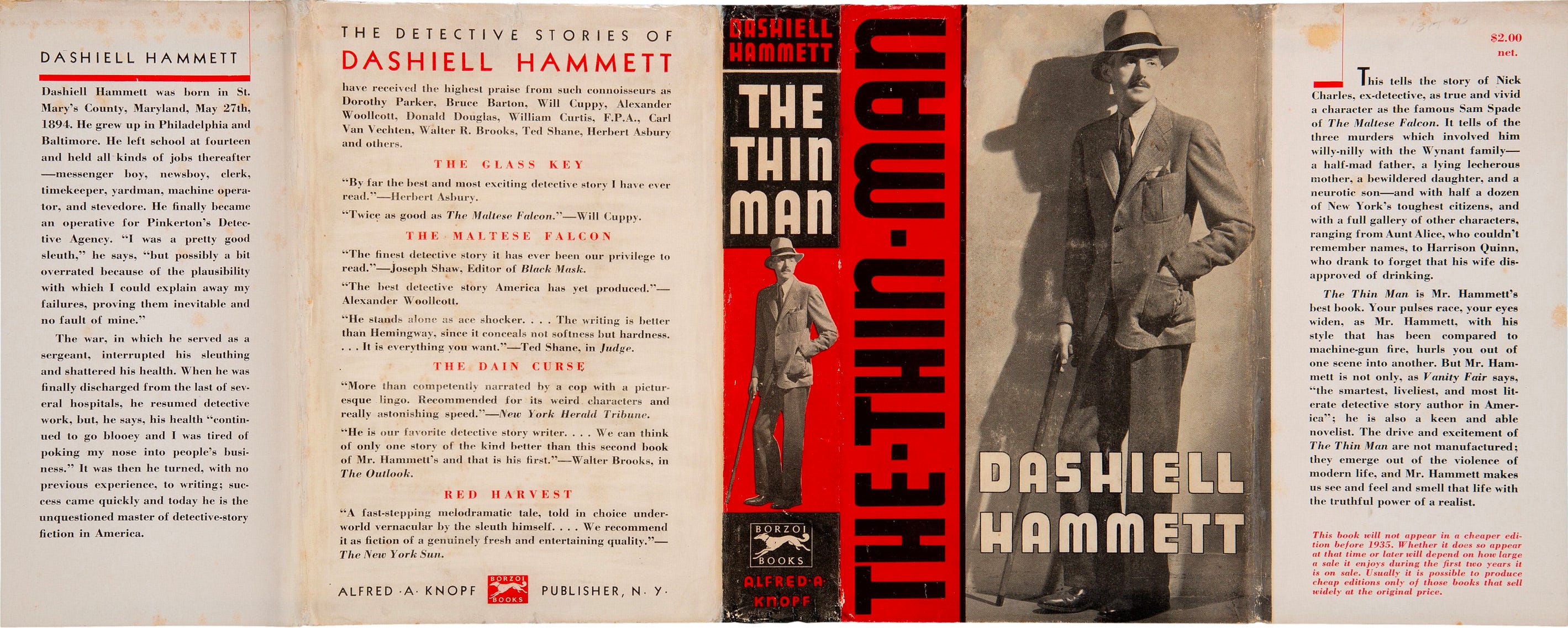
Hammett’s most commonly recurring character was a nameless detective, the Continental Op, who would subsequently become the central figure in his first two novels, Red Harvest and The Dain Curse, both published by A. Knopf in 1929, having previously been serialised in Black Mask in 1927–28 and 1928–29 respectively. Knopf would subsequently publish Hammett’s novels The Maltese Falcon in 1930 and The Glass Key in 1931 (serialised in Black Mask in 1929–30 and 1930 respectively), and finally The Thin Man in 1934. Hammett’s work was also routinely adapted for cinema and radio during the 1930s and 1940s. However, he ceased to write fiction from the mid-1930s, dedicating himself instead to left-wing activism and the Communist Party of the USA, along with his long-term partner, playwright Lillian Hellman. This would result in Hammett being blacklisted, and for a time imprisoned, during the Cold War.4
Hammett, disability, and financial insecurity
Hammett’s tuberculosis left him increasingly dependent on an Army pension that partly compensated him for the chronic health problems he had incurred during his service. Upon his discharge in 1919, he was allocated only $7.50 a month, which acted as supplement to the $105 a month he received upon his return to working for Pinkerton. Six months later, the continued deterioration in his health meant he was hospitalised again, and assessed as 50% disabled, resulting in him being provided with a pension of $40 a month, which he was to complement with his wages from this continued work for Pinkerton, although he could now only perform this work part-time. After his 1921 hospitalisation in Tacoma, he was reassessed as 100% disabled, entitling him to the full $80 a month pension which, even with additional income from occasional detective work, was scarcely sufficient to sustain a family of three.5
This precarity was exacerbated by the fluctuating nature of his illness and therefore of his disabled status, requiring him to perform his disability in deed and word. In May 1923, Hammett was deemed following a physical assessment to have been rehabilitated, and his pension stopped. He promptly wrote to Allan Carter at the US Veterans Board to protest this decision:
I do not feel that my condition at this time—which is certainly no better than it was before I entered training—justifies this rating and I wish to appeal from it.
If possible I should like another examination, preferably by a lung specialist, so that we may know definitely where we stand without putting me to the expense of getting the opinions of outside specialists.6
Having commenced work as an advertising manager at Albert Samuels in 1926, Hammett collapsed in the office, haemorrhaging blood from his lungs. He wrote again to the Veterans Board to ask them to reconsider restoring his pension, which had been stopped again two years previously.
Hemorrhages, weakness and the rest of the things that go with tuberculosis forced me to give up my work a couple of months ago.
I enclose an affidavit to that effect from my former employer.
I should like to have my case reopened so that I may be awarded compensation again.7
He insisted in a letter to Josephine shortly after that he was confident his pension would be reinstated, and downplayed the severity of the situation:
And don’t be worrying about my financial affairs. God knows we always staggered through somehow in the past, and I still can. I haven’t missed any meals.8
Making writing pay
Money was, however, a recurring theme of his letters to Josephine, albeit in a usually offhand manner, in keeping with their broader tone. Financial considerations clearly drove Hammett’s writing career, even if he at times feigned disinterest in them. When Shaw asked him in late 1926 to return to writing from Black Mask, he insisted on being repaid the £300 he felt he was owed from Cody’s time at the magazine. Shaw sent a telegram agreeing to this request, of which Hammett wrote to his wife:
It was all about how glad he was to have me back in the flock and so on. The only important thing in it was that he’s sending me $300. That’s what the fight was about in the first place, and so I won after all.9
He was hopeful that the regular work meant ‘you won’t have to be economical any more. We’ll pay off the debts gradually and everything will be great until I decide to quit again.’10 The following year, having received several letters from Black Mask staff praising his recent work for the magazine, he bluntly remarked to her: ‘Overwhelmed by this applesauce I’m wiring them to shoot me some dough and I’ll do them some more of the shots-in-the-dark.’11
Hammett by now perceived possibilities in more lucrative literary ventures. Musing in 1926 on his idea for a novel, he told Josephine: ‘It’s time we were trying prosperity for a while.’12 Having had Red Harvest and The Dain Curse accepted and published by Alfred A. Knopf in quick succession, Hammett was eager to secure the monetary gains from the relationship as swiftly as possible. After completing The Maltese Falcon, he asked Knopf editor Harry Block:
Like most of the world most of the time I am just now rather desperately in need of all the money I can scrape up. If there is any truth in these rumors that one hears about advances against royalties, will you do the best you can for me? If my appreciation equals my need I can promise to quite overwhelm you with gratitude.13
In the same letter, he peppered Block with an assortment of other ideas, including a theatrical adaptation of The Maltese Falcon, another novelisation of previous series of short stories, and a compendium of existing short stories about the Continental Op, justifying the latter in crudely economic terms:
I know you’re not likely to be wildly enthusiastic about the short-story idea; but don’t you think that something profitable for both of us could be done with them by making a quite bulky collection of them—selling it by the pound, as it were? I don’t know anything about the manufacturing costs—how far bulkiness could be carried at a fairly low price without eating up the profits.14
A month later, Hammett told Block he had abandoned most of these ideas to focus on what would be his fourth novel, The Glass Key. He somewhat coolly received Block’s offer of a three-book contract with Knopf with a £1,000 advance, unabashedly telling the editor:
About the advance: I’ve no objections at all, of course, to drawing up a new contract for three more books, but I need more than a thousand dollars. As a matter of fact I’d like to have twenty-five hundred. This doesn’t seem an at all unreasonable figure to me, since, after all, it would be actually, from my standpoint, an advance against six books.15
The author had also already identified the remunerative opportunities offered by another medium. His correspondence in 1928 with Blanche Knopf – who also worked as an editor for husband Alfred’s firm – around the impending publication of Red Harvest illustrates that he was simultaneously trying to shop the rights to the novel to the Fox Film Corporation.16 While this did not come to anything, the advent of the sound film favoured cinematic treatment of Hammett’s works, with their snappy, argot-heavy dialogue. He subsequently received a share of royalties when Paramount drew loosely on Red Harvest for the 1930 film Roadhouse Nights, which he jokingly told Alfred Knopf ‘arrived at a time when I was considering hocking my typewriter’.17 He was equally active in trying to get film deals for both The Maltese Falcon and The Glass Key, adapted by Warner Bros in 1931 and Paramount in 1935 respectively.18
Beset by debilitating illness and the financial precarity that accompanied it, Dashiell Hammett adopted differing rhetoric strategies in discussing money matters in his letters and telegrams. He moved between registers of indifference, gratitude, neediness, and entitlement, depending upon both the identity of the recipient and the specificity of the circumstances. While these were clearly motivated by material considerations, they also signalled something affective and ideological beyond that: a mode of emotional management and self-possession, of meaningfully calculating one’s own worth at the fragile apex of American free-market liberalism.
If you’ve enjoyed this post, please consider supporting my work by becoming a free or a paid subscriber to the newsletter. Paid subscribers are vital to me being able to continue producing and expanding this newsletter.
You can also support my work by making a one-off payment, at a price you consider affordable.
Otherwise, please show your appreciation by sharing this post more widely, and referring the newsletter to friends.
You might also enjoy these posts from the Academic Bubble archive:
Rewound
A Family Affair (1937)
·
March 15, 2024
This drama championed the values of classical jurisprudence and traditional family life in face of the economic and social challenges of the 1930s.
Rewound
The Maltese Falcon (1930)
·
February 8, 2025
Dashiell Hammett’s renowned novel sees its inscrutable private detective protagonist seeking to impose some sort of order on a chaotic world.
The Selected Letters of Dashiell Hammett 1921–1960, ed. Richard Layman with Julie M. Rivett (Washington D.C.: Counterpoint Press, 2001).
Dashiell Hammett, ‘From the Memoirs of a Private Detective’, in Dashiell Hammett, Crime Stories and Other Writings, ed. Steven Marcus (New York, N.Y.: The Library of America, 2001), pp. 905–909.
Dashiell Hammett, ‘Suggestions to Detective Story Writers’, in Dashiell Hammett, Crime Stories and Other Writings, ed. Steven Marcus (New York, N.Y.: The Library of America, 2001), pp. 910–912.
For a fuller account of Hammett’s life and career, see Richard Layman, Shadow Man: The Life of Dashiell Hammett (New York: Harcourt Brace Jovanovich, 1981).
Layman, Shadow Man, pp. 15–21.
‘To Allan Carter, U.S. Veterans Board’ (11 Jun. 1923), in Selected Letters of Dashiell Hammett, pp. 20–21.
‘To Veterans Bureau Claims Division’ (27 Sep. 1926), in Selected Letters of Dashiell Hammett, pp. 29–30.
‘To Josephine Dolan Hammett’ (4 Oct. 1926), in Selected Letters of Dashiell Hammett, pp. 30–32.
‘To Josephine Dolan Hammett’ (Nov. 1926), in Selected Letters of Dashiell Hammett, pp. 34–37.
‘To Josephine Dolan Hammett’ (1 Jun. 1927), in Selected Letters of Dashiell Hammett, p. 39.
‘To Josephine Dolan Hammett’ (Nov. 1926)'.
‘To Harry Block’ (16 Jun. 1929), in Selected Letters of Dashiell Hammett, pp. 49–50.
‘To Harry Block’ (14 Jul. 1929), in Selected Letters of Dashiell Hammett, p. 51.
‘To Blanche Knopf’ (6 Apr. 1928), in Selected Letters of Dashiell Hammett, p. 47; ‘To Blanche Knopf’ (9 Apr. 1928), in Selected Letters of Dashiell Hammett, p. 48; ‘To Blanche Knopf’ (25 Jun. 1928), in Selected Letters of Dashiell Hammett, p. 48.
‘To Alfred A. Knopf’ (12 Sep. 1929), in Selected Letters of Dashiell Hammett, p. 52.
‘To Manley Aaron’ (19 Jul. 1930), in Selected Letters of Dashiell Hammett, p. 55; ‘To Alfred A. Knopf’ (14 Aug. 1930), in Selected Letters of Dashiell Hammett, p. 55.
Comments
Nothing yet. Say the first thing.
Sign in to join the conversation.