
Please support my work by becoming a free or a paid subscriber to the newsletter. Paid subscribers are vital to me being able to continue producing and expanding this newsletter.
You can also support my work by making a one-off payment, at a price you consider affordable.
This post is part of the ‘Research and Reflections’ occasional series, consisting of pieces based on my ongoing academic research, as well as on my musings on and responses to current affairs and personal developments.
Content warnings: Murder; PTSD; Narcotics.
Spoiler alert: This analysis of the films The Living Daylights and Rambo III and their themes reveals plot details for the purpose of enhancing that analysis.
As far as action heroes go, James Bond and Rambo could not seem more different. Suave, sophisticated, womanising secret agent versus traumatised outcast veteran commando. A suit and bowtie versus a tank-top and khaki trousers. A fantasy of continued British influence in contemporary global affairs versus a dystopian product of America’s actual pre-eminence in them.
Yet when the two latest instalments in these film series appeared in 1987 and 1988 respectively, they featured one strong parallel. The Living Daylights was set partly, and Rambo III mostly, in Afghanistan – the site of a by then drawn-out, hugely destructive conflict between occupying Soviet forces and Islamist guerrilla fighters, the Mujahideen, who sought to expel them and their ideological influence from the country.
These two films then, viewed side by side, are valuable for the insights they offer into how the war and its combatants were viewed within the West. Yet more than this, the way both films integrate this conflict into their own wider, imagined worlds sheds light on the respective series’ narrative conventions and protagonists, and the way these were steeped within particular understandings of the Cold War.
The Soviet-Afghan War
In 1978, the People’s Democratic Party of Afghanistan (PDPA), with Soviet support, overthrew the autocratic regime of Mohammad Daoud Khan and established a new Democratic Republic of Afghanistan along Marxist-Leninist lines. The PDPA were, however, riven by factional infighting, lacked broader legitimacy in Afghan society, and faced staunch opposition from influential Islamist groups. In September 1979, president Nur Muhammad Taraki was deposed by his second-in-command Hafizullah Amin, who sought rapprochement with the US and with the Islamists. Alarmed by these developments just across the border, the Soviets invaded in December, deposing Amin, and replacing him with the more moderate Babrak Karmal.1
The invasion sounded the death knell for the already waning détente that had existed between the US and the Soviet Union during the 1970s. The situation was further exacerbated by domestic economic and ideological malaise and political instability in the Soviet Union – which had three elderly leaders die in office between 1982 and 1985 – and the election of the hawkish Ronald Reagan as US president. Tensions in the early 1980s reached their severest levels in two decades.
Reagan’s government channelled aid via Pakistan to various Mujahideen groups – who were themselves divided on ethnic, tribal, and personal (and to a lesser extent religious) lines – as well as funding the transportation of Islamist fighters from elsewhere in the world to Afghanistan, and (with Saudi Arabia) the education of Pakistanis and Afghan refugees in jihadist Islam. They fought a hugely effective guerrilla war against the Soviets and the Afghan government, who failed to win the support of either the Afghan people or the international community, and to maintain effective control of territory. Civilian casualties and displacement occurred on a huge scale, while death toll among military personnel was also high.
As with so much else, Mikhail Gorbachev’s appointment as Soviet leader in 1985 proved a watershed for the conflict. Committed to implementing economic and political reforms in the ailing Soviet Union and establishing far more harmonious relations with the US, he wanted to end the war in Afghanistan as soon as possible, albeit while saving Soviet face. He signed the 1988 Geneva Accords, which set the timeframe for Soviet withdrawal. In their absence, the (now renamed) Republic of Afghanistan only survived until 1992, when the Islamic State of Afghanistan was established by some of the Mujahideen groups. With the Soviets gone and the Cold War coming to an end, the US was disinterested in the transition process, but Pakistan and other neighbouring states backed different Mujahideen factions who continued to battle for control of the country throughout the 1990s.
The Living Daylights
Partly based on a short story of the same name, The Living Daylights was Timothy Dalton’s first of two outings as Bond. It begins with him overseeing the defection to the West of the Soviet General Georgi Koskov (Jeroen Krabbé), who warns MI6 that the KGB is adopting an increasingly harsh counterespionage policy, before apparently being snatched from his safehouse in England by the KGB. Bond tracks down Koskov’s girlfriend in Bratislava, Kara Milovy (Maryam D’Abo), who escapes with Bond to Vienna, where the two become closer. Learning that Koskov has been working with US arms dealer Brad Whitaker (Joe Don Baker), Bond travels to Tangier, again accompanied by Kara, to meet with new KGB head General Leonid Pushkin (John Rhys-Davies) and find out more about Koskov’s and Whitaker’s relationship.
Koskov and his henchman Necros (Andreas Wisniewski) then kidnap Bond and Kara from Tangier and transport them to a Soviet base in Afghanistan, from which they subsequently escape along with Oxford-educated local Mujahideen leader, Kamran Shah (Art Malik). Shah and his men are selling opium to Koskov to fund their anti-Soviet activities, but Bond explains to him that Koskov is buying the opium with embezzled Soviet funds, selling it at a profit, and then using the proceeds to buy arms from Whitaker for Soviet usage in Afghanistan, enriching both men. Bond, with the assistance of Kara and the belatedly arriving Mujahideen, manages to infiltrate the Soviet base and abscond with Koskov’s purchased opium purchase, while also helping his Afghan allies to escape the pursuing Soviet Army. Bond travels back to Tangier, where he confronts and – after a fight between the two – kills Whitaker; Pushkin then arrives and arrests Koskov.
Rambo III
Rambo III completed the original trilogy of Rambo films, following First Blood (1982) – adapted from David Morell’s 1972 novel of the same name – and Rambo: First Blood Part II (1985), centred on PTSD-afflicted Vietnam veteran John Rambo (Sylvester Stallone). In the third film, Rambo is tracked down in Thailand by his former commanding officer, Sam Trautman (Richard Crenna), who tries unsuccessfully to persuade him to join him on a mission to Afghanistan to supply the Mujahideen with weaponry to help their resistance against the Soviets. When Trautman is himself captured by the brutal Soviet Colonel Alexei Zaysen (Marc De Jonge), Rambo travels to Pakistan to meet arms dealer Mousa Ghani (Sasson Ghabbi), with whom he travels over to Afghanistan to make contact with the Mujahideen themselves, and secure their help in rescuing Trautman.
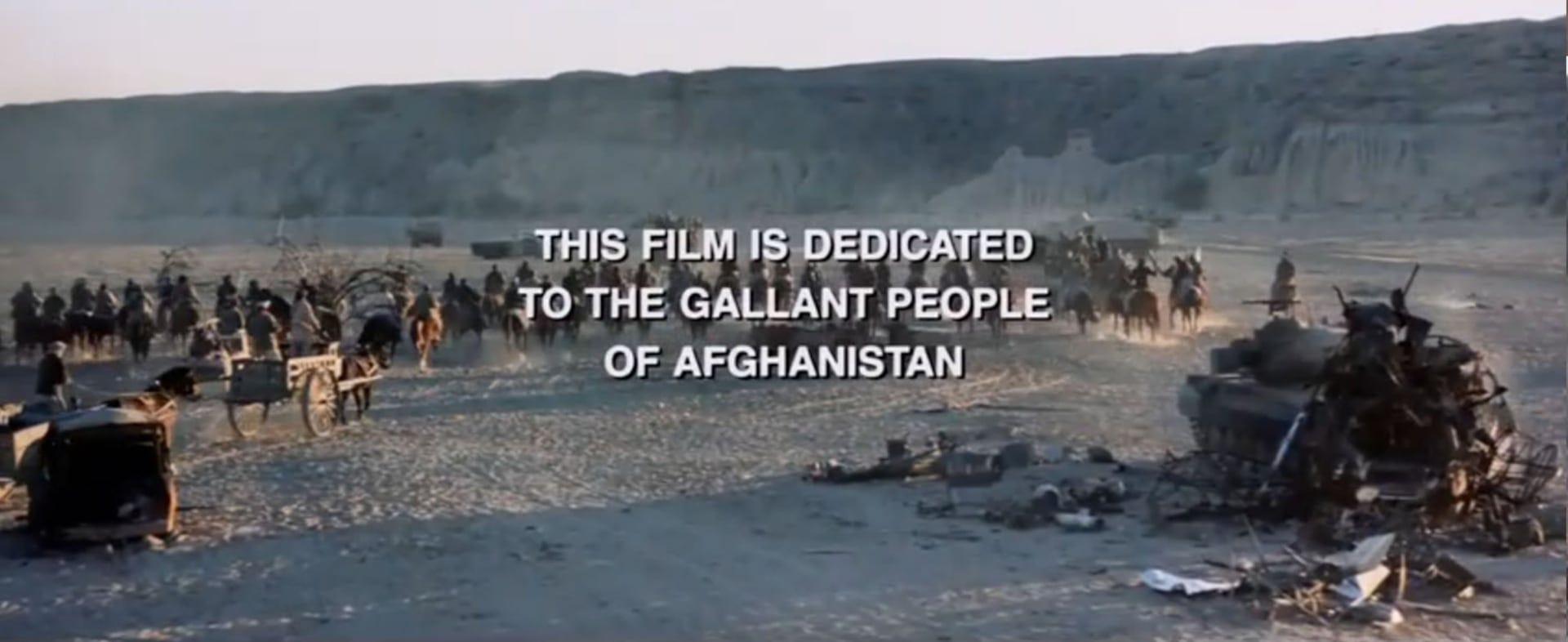
Rambo swiftly makes himself at home among and ingratiates himself with the Afghan fighters and their community, especially orphaned child soldier Hamid (Doudi Shoua). However, their leader, Chieftain Masoud (Spiros Fokas), is reluctant to commit scant resources to aid Rambo’s mission. After witnessing and helping repel a brutal Soviet attack on the Afghan camp, Rambo travels to the Soviet camp, from which he frees Trautman and some Afghan captives. Having ensured the other prisoners’ safe escape, Rambo and Trautman successfully kill the Soviet commandos sent in pursuit of them, but then find themselves faced by Zayden and the rest of his men. At that point, however, the Mujahideen arrive and defeat the Soviets in a pitched battle, in which Rambo kills Zayden. Mousa and Hamid try to persuade Rambo to stay and help them fight the Soviets, but he reluctantly departs the camp along with Trautman. The film ends with a dedication to ‘the gallant people of Afghanistan’.
Bond, Rambo, and the Cold War in the 1980s
Though the qualities Bond and Rambo embody are starkly different – one suave, wisecracking, and subtle in his methods; the other unpolished, terse, and unrestrained in his violence – they function in similar ways as national heroes, particularly in The Living Daylights and Rambo III. Their characteristics are patently associated with the cultures they are born from, and yet they are required to epitomise those cultures almost entirely in foreign contexts. They ostensibly operate in the service of their national governments, and yet do so with only limited obedience and untrammelled independence, and where they form alliances, these cut across national lines.
There are also marked differences between the films’ principal antagonists. Where Koskov is charming and duplicitous, Zaysen is just straightforwardly cruel. Moreover, Koskov is explicitly treacherous towards the Soviet Union, and Bond ultimately collaborates with Koskov’s superior, Pushkin, the head of the KGB, to defeat him. Yet just as Koskov is motivated entirely by greed, there is no indication in Rambo III that Zaysen is ideologically motivated, and there is at least the implication that he operates zealously free from any chain of command.
The Soviet-Afghan War is the most obvious common thread between the two films, and yet there are distinctions here too. Rambo III is far more centrally about that conflict, and most of the action takes place in Afghanistan. In Living Daylights, Bond only arrives in Afghanistan in the second half of the film, and the conflict’s topicality is rather at odds not only with the wider Bond oeuvre to that point, but also somewhat with the preceding scenes. The viewer is introduced far more fully to several Afghan characters in Rambo III, compared to just Kamran Shah in The Living Daylights, and is invited to care far more deeply about their plight, and identify far more fully with them against the Soviets.
Yet there are parallels with how the films’ plots play out once the protagonists are in Afghanistan. There are processes of mutual recognition. The audience is shown similar qualities in the Afghans as in British and American culture, as exhibited by Bond and Rambo respectively, and from this a sense of respect and camaraderie emerges. Then Bond/Rambo and the Mujahideen recognise the compatibility of their respective missions, in both cases culminating in the Mujahideen coming to Bond’s/Rambo’s aid. Thereafter follow remarkably similar battles against the Soviet forces, who – detached in this particular setting from any broader geopolitical, geographical, or humanistic mooring – can be safely slaughtered.
Film, genre, and the war in Afghanistan
The presence of the conflict in the two films demonstrates something of how the relationship between the Cold War and popular culture worked. There is a degree of delay between an event and its representation. By the time these films were released, regional and global dynamics were shifting. Under Gorbachev’s leadership, the Soviet Union was moving towards withdrawal from Afghanistan. More generally, and with cautious but reciprocal moves from counterparts like Reagan and Thatcher, he was also rapidly moving the Soviet Union towards genuine rapprochement. The Cold War frameworks depicted in The Living Daylights and Rambo III were rapidly coming apart.
The way that the Soviet-Afghan War was worked into the films’ plots also illustrates how they operated according to their own cinematic logics, with their own histories. There are the particular requirements of the action thriller (albeit in quite different iterations in these cases) that the conflict fitted well: exotic locations; high suspense; unlikely masculine alliances; spectacular violence.
On the other hand, the James Bond and Rambo film franchises had developed out of and away from their literary source material into very different beasts tonally. The tongue-in-cheek nature of the Bond films, albeit more restrained in The Living Daylights than in earlier iterations, was less suited to dealing in depth with as horrendous a war as that occurring in Afghanistan than the more relentlessly dark Rambo ones.
Moreover, whereas the Bond films were ideologically rooted in the relaxation of East-West tensions that eventually culminated in détente, the Rambo ones were the product of both the humiliation and trauma of America’s Vietnam experience and its rightward, anti-communist turn of the early 1980s. Paradoxically, being much less of its time in this way also meant The Living Daylights captured the coming zeitgeist, looking towards a post-Cold War world, less centred on ideological and moral divides, in a manner that Rambo III certainly did not.
If you’ve enjoyed this post, please consider supporting my work by becoming a free or a paid subscriber to the newsletter. Paid subscribers are vital to me being able to continue producing and expanding this newsletter.
You can also support my work by making a one-off payment, at a price you consider affordable.
Otherwise, please show your appreciation by sharing this post more widely, and referring the newsletter to friends.
You might also enjoy these posts from the Academic Bubble archive:
For a more detailed account of the Soviet-Afghan War, and the broader intersection between radical Islamism and the late Cold War, see Amin Saikal, ‘Islamism, the Iranian Revolution, and the Soviet Invasion of Afghanistan’, in Melvyn P. Leffler and Odd Arne Westad (eds.), The Cambridge History of the Cold War: Volume III: Endings (Cambridge: Cambridge University Press, 2010), pp. 112–134.
Comments
Nothing yet. Say the first thing.
Sign in to join the conversation.