
The Fast of the Virgin Mary, Shunoyo, or Dormition Fast, is quickly upon us. For Syriac Orthodox Christians, it begins on August 10. For Eastern Orthodox believers, it began today, August 1. Both of our traditions agree: we celebrate the Virgin Mary's falling asleep, i.e., her repose, which in church terms is called her Dormition or Assumption (depending on the ecclesiastical expression predominantly used between the two), on August 15. Interesting side note: my spiritual father, who is a Coptic Orthodox monk, doesn’t start the fast until August 7 and celebrates the Dormition on August 22. Different Orthodox traditions, different expressions of the same truth: the Mother of God died and was translated into Heaven by her Son, the Lord Jesus Christ.
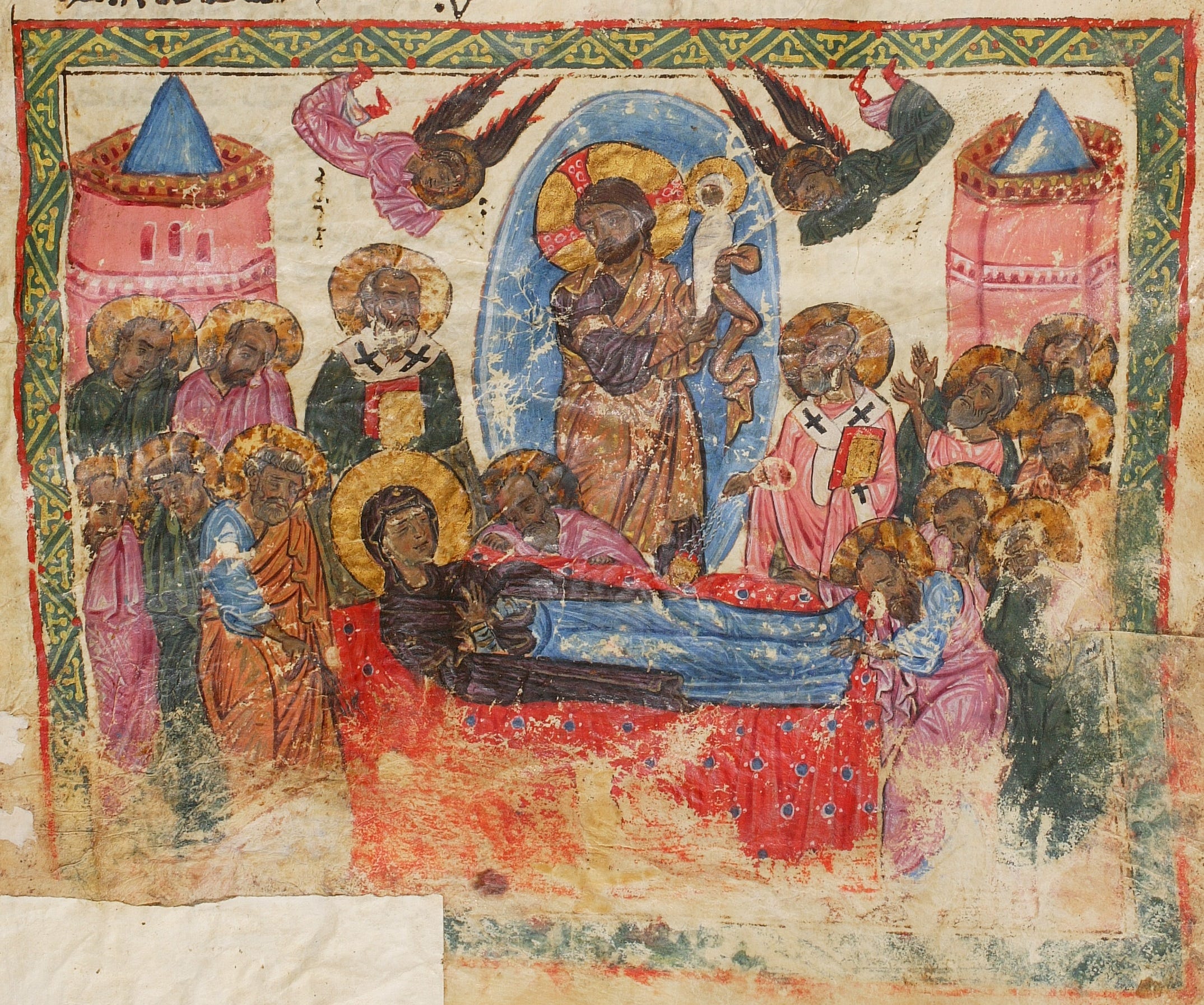
The Dormition Fast is an odd one for our Protestant friends. In the Protestant church, Mary plays a minor role except at Christmas. Then her image (icon?) is prominent in nativity sets and church plays. So how does she become so prominent that Orthodox declare to know about her death and translation to Heaven? Dionysius the Areopagite gives us a clue:
"For even among our inspired Hierarchs, when as thou knowest, we with him [i.e. an Athenian priest named Hierotheos] and many of our holy brethren met together to behold that mortal body [i.e. of Mary], Source of Life that received the Incarnate God, and James the brother of God [i.e. James of Jerusalem] was there, and Peter the chief and highest of the Sacred Writers, and then, having beheld it, all the Hierarchs there present celebrated, according to the power of each, the omnipotent goodness of the Divine weakness [i.e. that God should become man]. On that occasion, I say, he [i.e. Hierotheos] surpassed all the Initiates except for the Divine Writers, yea, he was wholly transported, was wholly outside of himself, and was so moved by a communion with those Mysteries he was celebrating, that all who heard him and saw him and knew him (or rather knew him not) deemed him to be rapt of God and a divine hymnographer." -- On the Divine Names, 3, 2
In the Odes of Solomon, a collection of 42 odes written between AD 70 and 125, most likely by a Jewish convert from the Essene community to Christianity, and arguably written in Syriac in the original, we read in a precursor to later writings:
The son is the cup
And the father is He who was milked;
And the Holy Spirit is she who milked him...
The womb of the Virgin took it
And she received conception and gave birth.
So the Virgin became a mother with great mercies.
And she labored and bore the Son, but without pain,
Because it did not occur without purpose.
And she did not require a midwife,
Because He caused her to give life.
St. Ephrem the Syrian, who reposed in AD 373, wrote in a number of his hymns about the Virgin. Here are a few passages:
Mary has given us bread of rest
In place of that bread of toil which Eve provided.
…
Your womb escaped the pangs of the curse.
By means of the serpent came the pains of the female;
Shamed be the Foul one, on seeing that his pangs
Are not found in your womb!
…
In its brightness I beheld the Bright One Who cannot be clouded,
And in its pureness a great mystery,
Even the Body of Our Lord which is well-refined:
In its undividedness I saw the Truth
Which is undivided.
…
Thy goodly conception was without seed,
And without wedlock was thy pure generation,
And without brethren was thy single birth.
Her parents Joachim and Anna are known to us because of the Protoevangelium of James, written around AD 150. This text is not considered canonical, yet it gives insights into the early life of the Mother of God. You can read it here. It is truly a fascinating read. While not in the Bible, it shaped Orthodox understanding of the perpetual virginity of the Virgin Mary.
This also is something that my Protestant friends cannot comprehend. The Bible talks about siblings of Christ. In Matthew 13:55-56 we read: “Is not this the carpenter’s son? Is not his mother called Mary? And are not his brothers James and Joseph and Simon and Judas? And are not all his sisters with us? Where then did this man get all this?” Likewise, Mark 6:3 tells us: “Isn’t this the carpenter? Isn’t this Mary’s son and the brother of James, Joseph, Judas and Simon? Aren’t his sisters here with us?” And they took offense at him."
In Orthodox teaching, St. Mary stayed a perpetual virgin, i.e., her marriage to Joseph indeed remained chaste. What are called brothers and sisters in the Middle East are often cousins since there were no distinct words for those familial relationships in that day. This page discusses some of the difficulties in understanding.
This is just the tiniest tasting of what is available in writings on the Virgin Mary. But discussing these fineries of hermeneutics is really not the point of this post. I want to circle back around to the Virgin and why we fast. To us, she is the one we seek out for help right after Christ. Think about who was at the right hand of the king in the Old Testament. It was his mother. The same with Christ. He specifically sought out the Virgin Mary. She was not a random girl. Everything had prepared her to receive and bear the holy Seed, Christ our King.
Today, we received an email with a reflection by Metropolitan Gerasimos of the Greek Orthodox Archdiocese of San Francisco (my husband’s bishop). You can see it in its entirety here. In it, he writes about this feast and fast season:
We come to this feast in a world that is exhausted. In 2026, we do not need to look far to find suffering: wars that have dragged on for years continue to take innocent lives; divisions within nations and between peoples grow sharper with each passing season; the pace of change, technological, social, and cultural, leaves many feeling disoriented, as though the ground beneath them has shifted. Anxiety has become the defining condition of our age. It is in precisely this moment that the Church holds before us the icon of the Dormition of the Theotokos, and she says to us: Do not be afraid.
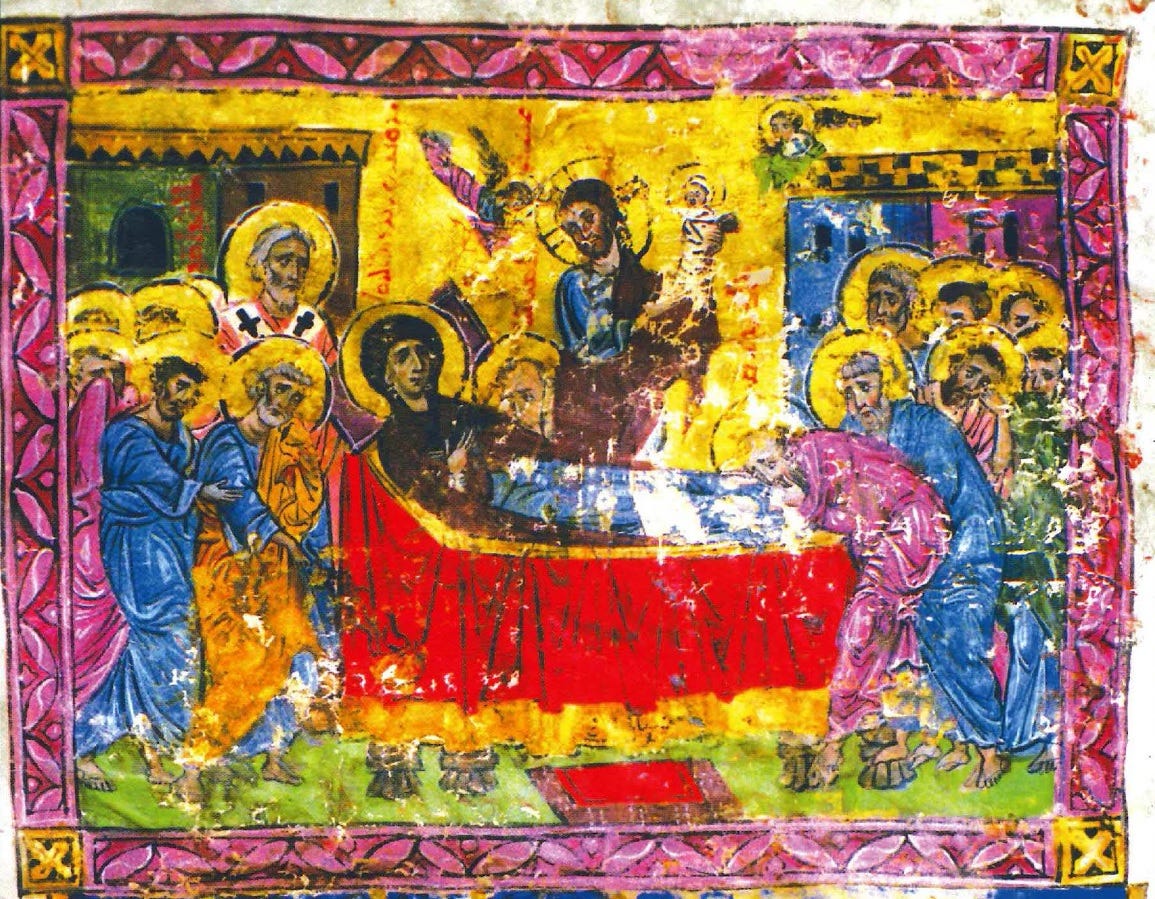
Look at the icon. The Apostles, scattered throughout the world, have been gathered miraculously to Mary’s side. Surrounding her, they weep, they pray, they incense her body. In the center of the icon, Christ Himself stands in radiant glory, holding a small child clothed in white, the soul of His Mother, pure and luminous. The imagery is deliberate: this is not a scene of defeat. It is a scene of divine escort. She who bore the Light of the World is now borne into that same Light. The Church, in all its scattered members, is drawn together around her. Unity, love, and prayer prevail. In a year when so much in our world pulls us apart, this icon speaks to us of a different kind of gathering, one we are called to embody.
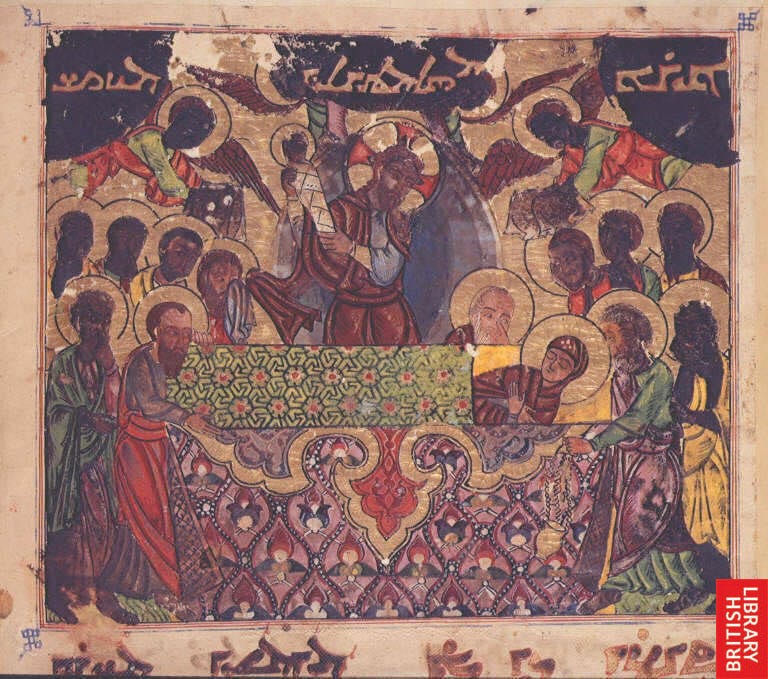
There is so much more I haven’t shared about the miraculous events around her falling asleep, how the Apostles were called back by Christ to Jerusalem, and how He received her bodily into Heaven. If you want to learn more about the Virgin Mary, read this by the late Patriarch of the Syriac Orthodox Church, H.H. Zakka I Iwas.
As a Syriac Orthodox Christian, I love St. Mary with all my heart, mind, and soul, and I treasure this period of fasting that leads me to the heart of God. I began on Wednesday with a visit to two monasteries here in Arizona, where I was able to participate in prayers. On Friday, I had my confession with my spiritual father. That evening, our godson and another young man came over to our house, and we sang the Paraklesis of the Dormition of the Mother of God (a beautiful Eastern Orthodox set of prayers) in our icon corner.
I want to invite you to take this fast seriously if you are Orthodox. I notice that many of my brothers and sisters seem to have slacked off in their ascetic practices, and it is urgent that our Church teach again the essence of why we do this. The spiritual growth we can derive from fasting is immense. Glory to God! Christ is in our midst. He is and ever shall be.
No posts
Comments
Nothing yet. Say the first thing.
Sign in to join the conversation.