
Author’s Note: I recently participated in an offsite gathering of U.S. government policy makers and think tank analysts discussing the future of the country and the world, and it deeply troubled me. At the same event a year ago, on and off stage, I heard a sense of hope and the potential for cooperation across borders. This time, the tone and the narrative have shifted to the opposite and AI (and related technologies) was at the center of it. Zero-sum thinking and competitive narratives have risen more than a few notches. It certainly doesn’t help that popular AI related forecasts on the near future such as Citrini’s 2028 Global Intelligence Crisis, AI 2027, and the Situational Awareness papers have all predicted catastrophic AI outcomes leading to global economic collapse or war. Just as I was finishing this piece, the AI 2040: Plan A paper dropped, purportedly offering a hopeful path, but after closer reading, sadly it still misses the transformative potential of AI to fundamentally alter the architecture of society and the world. Historically, ideas we read often manifest as self-fulfilling prophecies and the world needs hopeful narratives now, more than ever!
I’ve spent the last 35 years researching, developing and deploying solutions in all five layers of the AI stack, from data centers, to chips, to models, to devices and the application layer. What follows runs the near future forward on evidence that is already visible, and then, at the point where the data runs out, it splits into two paths: the hopeful one I believe we can still choose, and the darker one we could stumble into instead if we let the default path go forward. We are approaching a fork to a protopia and an anti-utopia drawn from the same starting facts.
The farther out you read, the more you are reading my hopes and analysis backed by the evidence I found. Where I make a specific bet, I will say so, and I will tell you why I believe it is possible. Given other papers have detailed the various downside scenarios, the bulk of my analysis will relate to how things may go right…even if they don’t start that way. As a father of two daughters, I don’t want to see the future play out like what I have read in the previously mentioned depictions, and this document is my attempt to show you why that future is NOT inevitable. Even when I share the path forward, many will argue that the rich and powerful won’t act altruistically or even rationally. Thus, I will include explanations on why they may ultimately do the right things for the world…even if for the wrong reasons. Now is the time we need to move beyond the zero-sum winner-takes-all strategy and embrace a “winners-share-all” mindset.
Given the attention span of the average reader, I know the length of this essay will be challenging. But given the gravity of this topic, I promise you the payoff will be worth it if you can stick with me to the end. If you agree or disagree, please comment and tell me why or what I’ve missed. Only through constructive dialogue can we find workable solutions that can help us avoid a future no one wants, but so many are pushing us towards.
“What we do as individuals and as a species in the coming decade may very well help determine the ultimate destination of humanity as a whole for the rest of time.”
A. Graylin - Our Next Reality (Hachette, 2024)

Icarus did not fall because he flew; he fell because his hubris blinded him to the warnings, transforming a triumph of human engineering into a tragedy of unchecked ego.
That is roughly where the American AI industry sits in the summer of 2026. We have built something genuinely miraculous, and we have financed it in a way that cannot hold. This essay is about what happens when the wax gives way, and about the strange and hopeful thing I believe will grow from the fall. My claim, in one line: the Great AI Reckoning will bring about Five Reconnectings.
I am not saying AI lacks value. In fact, I spent my whole career trying to bring its value to society and wrote a whole philosophical framework arguing how we can leverage it to transform our world for the better. I am saying that how we got here, the capex arms race, the leverage, the circular deals, and the belief that the first lab across an imaginary finish line captures everything, was never sustainable and was never necessary. In The AGI Windfall Mirage I described driving across the Mojave toward a silver lake that kept dissolving as we approached. The industry is still chasing that lake. This is the story of the moment the road turns to salt flats, and what we choose to do next.
Before we begin, one honest observation about human nature that the rest of this essay depends on. People and governments are loss averse and change averse. We rarely make hard structural decisions until a shock forces our hand. The uncomfortable truths about our AI economy, that growth is propped up by unsustainable spending, that the labor transition needs a real safety net, that the US and China cannot manage the most powerful technology in history while refusing to speak, are all decisions our leaders keep deferring because deferral is politically cheaper than action. A market correction is painful. But set against the alternatives that usually force civilizations to change, war, famine, financial ruin that lasts a generation, ecological collapse, a major market correction is remarkably gentle. It may be the least painful wake-up call we can ask for that still carries enough force to shift the minds of the people in charge but is still reasonably recoverable. I just hope it carries enough weight to change the minds that matter in time, as the alternatives get dark fast.
As I argued in the final chapter of Our Next Reality, if the promise of a better world is not motivation enough, then honestly contemplating the depth of the catastrophe of our current path may be what ultimately moves us. The Reckoning described, in that sense, is a mercy.
“You never want a serious crisis to go to waste. It’s an opportunity to do things you think you could not do before.”
Rahm Emanuel, November 2008
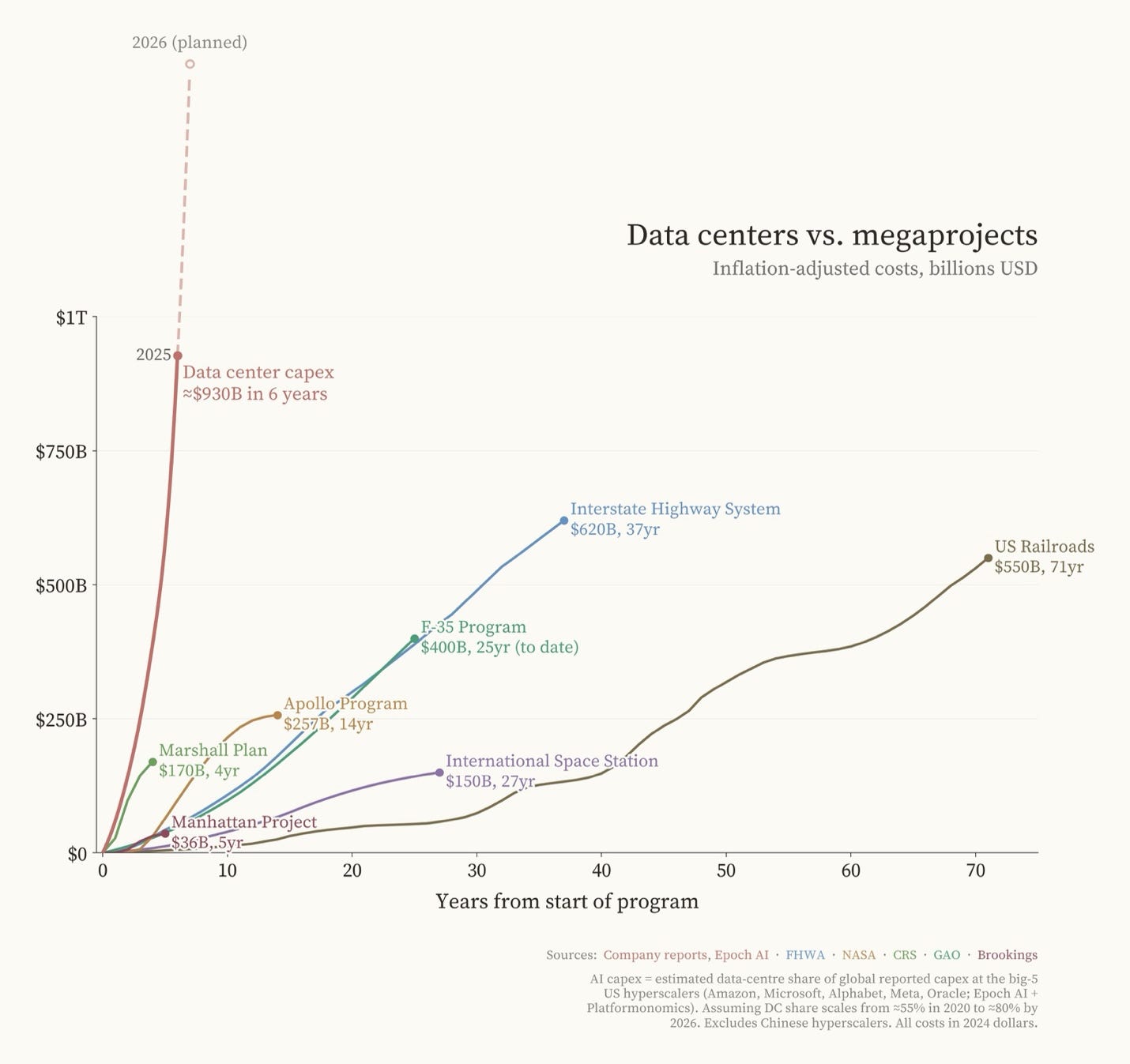
Figure 1: Scale of AI capex spend vs. historical megaprojects. (source: Fin Moorhouse)
Let’s start with a number that should stop you cold. Harvard economist Jason Furman calculates that information processing equipment and software made up about 4 percent of US GDP in the first half of 2025 but 92 percent of GDP growth. Strip out the AI buildout and annualized growth was 0.1 percent, a hair above stall speed. Even Jeff Bezos calls it an industrial bubble. When this much of a 31 trillion-dollar economy’s growth comes from a single investment theme, there is clearly extraordinary and unhealthy dependence. An economy that needs capex to accelerate forever just to hold up its growth numbers is an economy balanced on one leg.
The same story repeats one level up, in the equity market that sits on top of the real economy. From May 2024 to June 2026, the S&P 500 gained 142 percent with its AI stocks and just 16 percent without them, and AI related names now make up 45 percent of the index’s entire market capitalization, an all-time high for any single theme. The seven largest companies have swelled from 20 percent of the index at the end of 2022 to more than 35 percent by the end of 2025, roughly double the 17.5 percent share the top seven held at the peak of the dot com bubble. Apollo’s chief economist Torsten Slok is blunter still: by his concentration measures, the AI trade today is far bigger than the IT bubble of the 1990s. Two years of American wealth creation ride on one thesis. When the Reckoning arrives, it will not stay inside the tech sector.
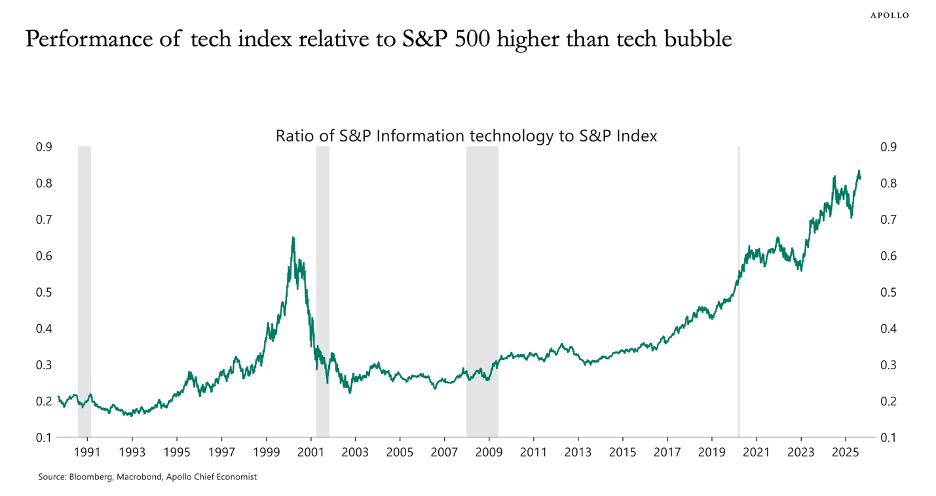
Figure 2: Ratio of S&P Info Tech vs. S&P 500 performance 1990-2025. (Apollo Global Management)
Now look at how this entire edifice is financed. A web of what analysts politely call circular deals now exceeds 800 billion dollars and by some counts a trillion: Nvidia invests in OpenAI, OpenAI commits to Oracle, Oracle buys Nvidia, and the same revenue gets counted at three stops around the loop. AMD handed OpenAI warrants for roughly 10 percent of the company at a penny a share in exchange for purchase commitments. Jensen Huang himself signaled that Nvidia’s 30 billion dollar bet on OpenAI might be its last. OpenAI is reportedly on track to lose around 14 billion dollars in 2026 on a favorable accounting basis, with GAAP estimates running far higher.
There are still bull case analysts like Janus Henderson, who calls this a virtuous circle that lines up scarce supply, and Acadian makes the sharp point that in a real bubble you see equity sold to outside shareholders, which most of these deals do not do. Vendor financing built the railroads and the early internet backbone too. So the honest question is not whether this is fraud. It is whether end demand justifies the commitments. On that question the bears have the better of it, because the closest analog is the late 1990s telecom buildout, where equipment makers financed their own customers, demand fell short of the fiber laid, and leveraged carriers went bankrupt while capacity sat dark for years. My read: the structures are legal, the leverage is real, and the demand assumptions are heroic. That does not require malice to unwind. It only requires growth to disappoint.
And growth will disappoint, because of a force the leveraged players cannot stop: commoditization. This is the argument I made in America Is Running the Wrong AI Race. First to scale wins, not first to invent, and scale is exactly what open weight models are collapsing in price. DeepSeek, Qwen, Kimi, MiniMax and their successors keep delivering frontier adjacent capability at a fraction of the cost, and each efficiency breakthrough drains pricing power from the pure play labs whose valuations assume the opposite.
This is the export control fracture I was pointing to in Lawfare: the harder we squeeze, the faster Chinese labs innovate around the constraint, and the more the global market tilts toward cheap, capable, commoditized intelligence. Export controls have slowed domestic semiconductor production capabilities in China near term, but it simultaneously pushed massive innovation in Chinese full stack capabilities that makes it a stronger long-term competitor. It’s also forced the Chinese AI labs to innovate in algorithms, techniques and architectures to squeeze additional capabilities out of less performant hardware systems, making them much more cost efficient and ready for global diffusion.
If racing to AGI guarantees dominance, why are the frontier labs the least profitable companies in AI? We got an early taste of the fragility of these players in June 2026, when frontier model access was briefly curtailed under US export control rules. In recent months, the proportion of tokens being routed to open source vs. closed models has skyrocketed.
I think the first tremor arrives within twelve months (give or take six months), and you can already feel it. The tell is simple. The pure play lab IPOs, the ones meant to prove to public markets that this business model works, get delayed or priced down. Watch it in real time. SpaceX priced at 135 dollars in June 2026, quickly spiked to 225, then slid back to its IPO price as of this writing. The AI IPO market watched that retracement and blinked. OpenAI, which had eyed a fall listing, is now leaning toward 2027, citing volatility and Sam Altman’s insistence on a trillion-dollar price. Anthropic still targets an autumn debut. My forecast is that as diligence forces real revenue quality into the open, one or both of those listings slips or reprices, and that is the starting gun. Secondary market marks crack. The correction spreads from the labs to the chipmakers to the hyperscalers whose capex guidance suddenly looks like a liability. A market crisis becomes a recession. And the recession accelerates the very job displacement everyone feared, because firms under margin pressure automate faster, not slower, to survive.
The endgame of Act I is consolidation. The IPOs that do not materialize become down round acquisitions. The hyperscalers, Microsoft, Amazon, Google, and the large private equity firms, divide up the labs at a fraction of today’s marks, and early investors take the loss. The highflyers flew too close to the sun.
China is not spared. Of the ten or so serious Chinese labs today, I expect three or four to survive, the rest folded or absorbed. Z.ai and MiniMax, which were the first pureplay AI labs in the world to go public (ahead of OpenAI/Anthropic), are now trading near 800x and 100x revenues respectively, showing investor irrationality isn’t isolated to the US markets. But Beijing has a tool Washington does not. Through the National Development and Reform Commission’s (NDRC) drafted 295 billion dollar national compute grid, funded by sovereign debt and built on 80 percent domestic chips, the state can operate the substrate directly and steer compute to the labs it wants to keep alive. Not nationalization of the labs exactly, but a state operated grid that functions as a national backstop. Where America’s buildout is a leveraged bet by private balance sheets, China’s is a patient bet by a sovereign one. In a downturn, patience wins.
Then there is Elon, whose story deserves its own beat because it is half real already. SpaceX went public in June 2026 at 1.77 trillion dollars, the largest IPO ever, and it was lucky in its timing, listing before the worst of the private labs’ operating data leaks out. It survives, because underneath the hype is a real terrestrial hyperscaler and rocket company: Starlink alone earned 11.4 billion of its 18.7 billion in 2025 revenue. What I do not think survives is the science fiction layer sold alongside it. The one million satellite orbital data center constellation and the Terafab plan to manufacture a terawatt of space hardened AI compute per year are, in my view, unlikely to take off on anything like the promised timeline. Sam Altman called the space data center idea ridiculous for current needs, and Musk has a long history of over promising on exactly this kind of moonshot. As those plans slip and the compute story deflates, here is a bet I will offer as speculation, though it is grounded in clear historical evidence: SpaceX and Tesla merge, framed as synergy, functioning as rescue. Why plausible? Because it is the pattern. Tesla absorbed a struggling SolarCity in 2016, xAI absorbed X in 2025, and SpaceX absorbed xAI in early 2026. Musk merges companies to move problems where the market cannot see them and to give early investors an exit before the reckoning lands. Call it a micro reconnecting of the Musk empire, a preview of the larger consolidation to come.
That is the Reckoning. I am fairly confident in its shape and reasonably confident in its timing. So what is America’s Plan B if the AGI bet does not pay off before the debt comes due? Everything after this point is where the road forks.
Here is the branch point. Crises are forks, not funnels. They do not automatically bend toward the light.
The dark branch is just as real. A crash this size could just as easily produce authoritarian retrenchment, deeper concentration of capital and AI power in limited hands, mass scapegoating of the displaced, hardened decoupling, and safety nets that never arrive because the politics ferment into blame. History gives this branch plenty of precedent. The Great Depression produced the New Deal, yes, but it also produced fascism. The 2008 collapse produced TARP and recovery, and also the populist nationalist decade of trade wars and walls that followed. Anyone who promises that a crisis reliably enlightens us has not read much history. This is the anti-utopia, and it is a live possibility…in fact, the more likely possibility.
So why do I spend the rest of this essay on the hopeful branch, the protopia? Three reasons, and none of them is naivety.
First, because the point of writing a scenario is to steer toward it. In Our Next Reality, the entire abundance question is framed as managed well versus managed poorly. The destination is not guaranteed, and our actions this decade decide it. The future is not a forecast you passively receive. It is a choice you argue for and act on.
Second, because crises also build. Bretton Woods, the Marshall Plan, and the European Coal and Steel Community that became the EU were all constructed out of rubble by people who decided that shared institutions beat repeated ruin. That is the functionalist insight at the heart of my Beyond Rivalry framework: cooperation gets built in the domains where interdependence is undeniable, and then it spreads. The reconnecting branch is not the default. It is the New Deal branch, and it requires the same deliberate choosing. Economic historian Carlota Perez showed that every major technological revolution passes through a speculative installation frenzy, a crash, and only then a deployment golden age when its benefits broadly spread across society. Canals, railways, electricity, automobiles and the internet all followed this arc. The crash is not the end of the story. It is the hinge.
Third, and this is genuinely new, we now have a tool that the leaders of 1929 and 2008 did not. AI itself, used as a decision support partner rather than an oracle or a master, can widen the option set that panicked humans collapse under pressure. I made this case in Should We Be Returning to Philosopher King Rule: AI is uniquely good at surfacing second order effects, checking incentives and biases, and asking what would have to be true for a plan to fail. In a crisis, the failure mode is misperception and fear driving nations toward the worst mutual outcome. A well-designed advisory layer makes the positive sum option legible when instinct hides it. The crash is the inflection, the moment the cost of the old path becomes undeniable and the incentive to build the new one finally exceeds the incentive to defend the old one.
What follows are five “reconnectings”, roughly in the order I expect them, over the coming decade and in some cases a bit longer. They are, in a word each, how we reconcile, reform, realign, renew and reawaken a more peaceful and prosperous world order.
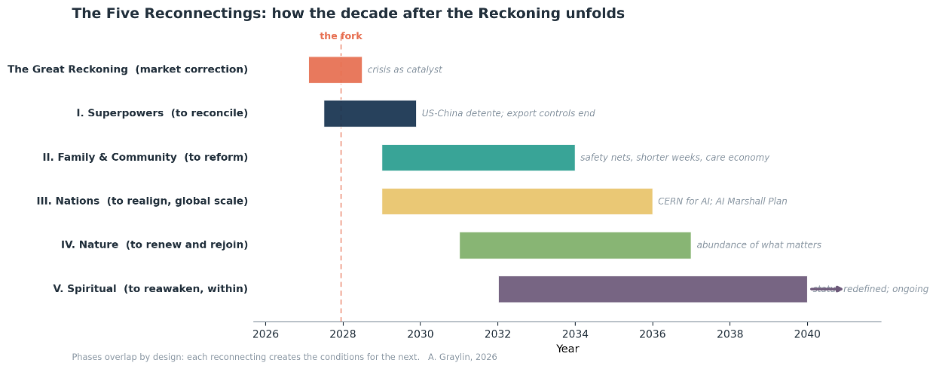
Figure 3: The Five Reconnectings unfold in overlapping waves, each enabling the next
The first and fastest reconnecting is between the United States and China, and it happens not out of virtue but out of necessity.
The mechanism has a partial precedent. In 2008 during the Great Financial Crisis (GFC), China played a significant role to help stabilize the global economy by sustaining demand and continuing to hold US debt. I will be candid that the straightforward version of China rides to the rescue by buying our bonds runs against a multi-year trend of Beijing trimming Treasuries and diversifying away from the dollar. So, this is a place where I am betting on a reversal, and here’s why. The logic is that a deep enough crisis flips the payoff matrix. This is the core argument of Misdiagnosing the US-China AI Race: we are not in a simple zero-sum race, we are in a multi turn Stag Hunt, and the worst outcome for America is exactly the one we occupy now, the U.S. betting it all on AGI, a stag none can catch alone, while China keeps collecting real world wins, taking home the hares. The overleverage on the AGI push is making the American economy highly fragile. A significant crash makes the errors of the stag-focused strategy suddenly clear.
The deepest systemic leverage is not financial; it is geopolitical. Faced with an immediate market collapse and an unserviceable debt load from its domestic AI expansion, at a crisis point where federal interest outpaces the entire defense budget, a compromised United States possesses the ultimate chip: trading its historic strategic ambiguity over Taiwan to secure financial solvency, effectively resolving the issue on Beijing’s terms.
I offer this next turn as speculation and not endorsement. A weakened US administration trades non-interference on Taiwan for Chinese help stabilizing the US economy. Export controls halt, which may actually have more real-world impact on China’s economy than the politically motivated Taiwan ask. Two way sharing and détente resumes. China supplies low-cost energy technology and low-cost goods, exactly the deflationary force a recovering economy needs. Chinese FDI is allowed to flow into troubled sectors to help prop up ailing US firms, bringing in technology and process transfers that once went the other way just a decade or two ago. The smooth execution of the deal quickly stabilizes the markets (which seems to be the key barometer for the current administration) giving much-needed reprieve to DC for planning out the recovery process and provides a positive story heading into the important 2028 election cycle. Both countries see renewed economic growth and quality of life rise as friction falls.
Some may doubt this path is possible given the bipartisan alignment against China today, but Trump’s response to press on the Air Force One post the May Beijing summit already hints at this possibility. There, he said he had made no commitment either way on defending Taiwan. If it happens, the US will likely ensure the trade is paired with explicit security reassurances to Japan, South Korea, and the Philippines. It will also require that Beijing not disrupt U.S. chip supply and commit to pursuing reunification only through peaceful means, which has always been Beijing’s publicly stated preference for resolving cross-strait tensions. Beijing is in no rush.
At this point, US media, which spent a decade painting China as the enemy to defeat, begins repainting China as a new valued partner instead. It is worth remembering that the US and China were allies against Japan in the Second World War. We have been on the same side before. The China hawks will hate this, and the credibility costs to US alliances are real, which is the honest counterargument. But cornered great powers have traded away commitments they swore were sacred many times before.
The second reconnecting happens at the kitchen table.
First, the wealth concentration problem has to be solved, and I think the crash itself forces the solution. Left alone, downturns concentrate capital, the strong buy the distressed cheap. So the pivot from concentration to sharing does not happen by magic. It happens through national regulation and, where necessary, nationalization, deployed as part of the AI crash rescue, the same way governments took stakes in banks and automakers in 2008 to keep a sector’s collapse from taking down the whole economy. When a single sector accounts for the bulk of the economy’s growth and nearly half its stock market value, letting it fail is not an option, and the price of rescue is public stake and public rules.
The trillion-dollar yearly capex that was flowing into speculative compute build outs gets redirected into social services and safety nets that were politically impossible the day before the crisis and become inevitable the day after. The funding lever already exists in the Pigouvian automation levies I proposed in the AGI Windfall Mirage: tax the substitution, fund the transition. A GI Bill for AI will need to be formed to help support and retrain the tens of millions (in the US alone) who will be affected by AI job displacement, the same way we took care of returning soldiers post-WWII.
“If the machines do the work, what is a human life for?”
the question Aristotle asked, twenty-three centuries before the transistor
With that foundation, the human transition begins. Automation accelerates under margin pressure, and regulation responds by shortening the work week, which hands families something they have not had in generations: time. Time that can help mend the family fractures born of scarce face-to-face hours between spouses, parents, and children, hours prior generations enjoyed in abundance.
Displaced office workers move into the roles where we have enormous unmet need, nursing, elder care, teaching, the human-to-human work that no robot does well. At first these jobs carry low status and low pay, a real problem I do not want to gloss over. But status is not fixed, and here I take on one of the strongest objections to this entire essay.
The objection is Keynes. In 1930 he predicted that abundance would give his grandchildren a fifteen-hour work week, and he was wrong, because human desire for wealth and positional goods never satiate, especially when combined with media’s push for materialism. If status continues to be attached to money and power, my hopeful future is a fantasy. My answer, which I developed in The Post-Labor Prophecy, is that the thing that changes is not the amount of stuff we have but the definition of status itself. And here my own research cuts to the heart of the Keynes problem.
In Our Next Reality, I dug into the happiness data and found that beyond a point, more income stops buying more happiness, the income indifference point that Daniel Kahneman first measured. But the deeper finding was that what drives happiness is not absolute wealth at all, it is relative standing. People want to be above average compared to their neighbors. That sounds like it confirms the positional goods trap, until you realize what it actually implies: if status is relative and socially constructed, then a society can choose what the ladder measures. We can anchor status to service and contribution rather than accumulation and dominance. We can celebrate the nurse and the teacher the way we once celebrated the bankers and oligarchs. When we do, the care economy stops being a consolation prize and becomes the point. That is not utopian hand waving. It is the most practical lever we have.
Meanwhile the automatable goods keep getting cheaper, food, energy, medicine, electronics, trending toward the near zero marginal cost I described in Abundanism. AI becomes a global public good rather than a platform’s private moat, and the GI Bill for AI described above scales globally, starting with the developed markets hit first and hardest. Life satisfaction, lifespan, and measured wellbeing rise, which is exactly why I keep arguing we should steer by GDP-B and the OECD Better Life index alongside GDP, not GDP alone. My own reading of the data suggests that redistributing even a few thousand dollars a year per capita from the richest economies to the poorest could nearly equalize global happiness, at least in the near term. Abundance makes that arithmetic practically affordable.
Demographics shift in a hopeful direction. In emerging markets, birth rates continue their long decline as lifespans lengthen, child mortality approaches zero, quality education democratizes, and the deflating cost of a good life reduces the old economic logic of large families. This is the demographic transition, well established, not speculation. In the developed world, my claim is softer: fertility does not fully recover to replacement, the Nordic experience shows money and leave alone do not do that, but it rebounds partway, lifted by reclaimed family time, the revaluation of caregiving, and cheaper living. As local prospects improve, the pressure for mass migration eases, communities strengthen where people already are, and paradoxically the ties between nations strengthen at the same time.
The third reconnecting is of the global system built over the last 80 years and fractured over the last decade. In 1948, the US deployed the Marshall Plan to help rebuild Europe (with parallel aid programs doing similar work across East Asia), committing about $13.3 billion over four years, roughly $150 billion in today’s dollars. Many historians call it one of the best investments America ever made, yet the inflation number understates it: the plan consumed about five percent of US GDP, and the same share of today’s economy is nearly $1.5 trillion.
The dollars were never the secret: Marshall aid averaged only about 2.5 percent of recipients’ national income. The outsized return came from everything the money carried with it: conditionality that forced trade liberalization, institutions like the OEEC that matured into the OECD and seeded the EU, and procurement that cycled mostly through American factories, rebuilding US industry’s customers. An AI Marshall Plan should copy that design, and the Reckoning makes it affordable. Within two or three years of the correction, distressed GPU fleets, half-built data centers, and desperate equipment vendors can be bought for pennies on the dollar, and the build-out becomes the countercyclical backstop for the industries the crash gutted. The crisis does not just create the political ripeness for cooperation. It creates the discounted asset base that pays for it.
What would it cost? Far less than the objectors assume. The plan funds durable infrastructure, not handouts: regional inference data centers, energy generation and grids, telecom backbones, and the people trained to run them. It includes no frontier training clusters and no advanced chip transfers. Everyday intelligence runs on small open models at the edge, with modest cloud capacity behind them, keeping the program outside dual-use territory and openly verifiable. My estimate is $150 to $280 billion over seven to ten years across all funders, and the bill shrinks while you read this, because the price of a fixed level of intelligence is falling roughly fifty-fold per year. America’s five largest hyperscalers plan to spend over $800 billion on AI infrastructure in 2026 alone. One year of Big Tech capex funds the entire program twice over. Devices need no subsidy: handset prices fall on their own, and billions of newly connected consumers become the growth market the plan’s partners will compete to serve.
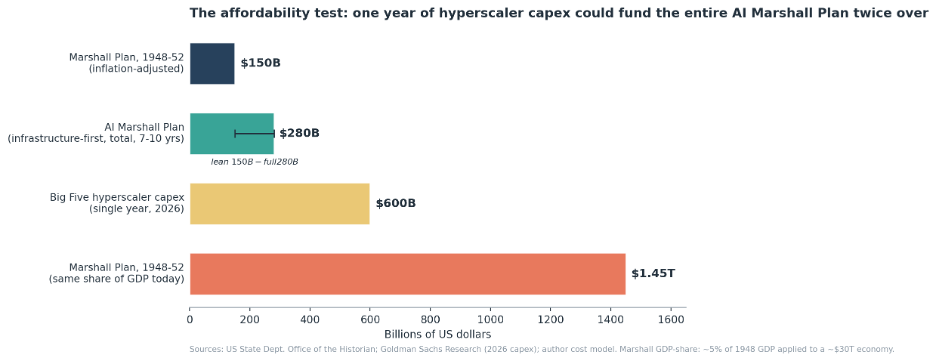
Figure 4: An infrastructure-first AI Marshall Plan against historical and current benchmarks.
Why would rivals fund it together? Because, like the original, it is not charity. Marshall dollars were spent overwhelmingly on American goods and shipping, a purchase order for US industry that Congress found easy to ratify. The same engine runs here. American firms supply the cloud, the models, and the developer ecosystems. China supplies low-cost solar, grid equipment, and build-out muscle honed across these geographies, this time on grant-heavy terms rather than the loans that earned the Belt and Road its debt-trap reputation. Europe brings development finance and its regulatory trust brand. The Gulf states join too: sovereign funds like MGX, HUMAIN, and G42 are already converting oil wealth into compute at hundred-billion-dollar scale, and co-funding the plan is the surest way to stay indispensable after fossil fuels. Nobody has to pool money with a rival: parallel national vehicles under one shared standards and transparency framework, the structure of the Montreal Protocol’s Multilateral Fund, which phased out CFCs, lets Congress fund American vendors while Beijing funds its own. What each funder buys is participation: whoever helps build the stack four billion people adopt gets a voice in the standards that govern it, and whoever abstains forfeits that voice. The resulting interdependence is not a cost. It is the point: the mechanism that made Franco-German war unthinkable within a generation.
“What is long divided must unite, and what is long united must divide. Thus it has ever been.”
Luo Guanzhong, Romance of the Three Kingdoms
The architecture matters, and it’s documented in Beyond Rivalry. We need to build a CERN for AI, an international consortium modeled on the organization that pooled dozens of former enemies after the Second World War to do open, peaceful science, and invented the World Wide Web along the way. That consortium trains a base Guardian AI on a Global AI Data Cloud, a globally representative pool of data so the system understands every culture rather than one. The base Guardian model is open sourced and shared with all nations. Each nation then fine tunes its own Sovereign AI on top of that shared foundation: local values on a common safety floor. Underneath it all runs an AI Marshall Plan that deploys reasonable cloud infrastructure everywhere, while highly capable distilled personal models run locally on our glasses, phones, and PCs, in service of the individual and not the platform, which is the whole spirit of the Bill of Rights for the Age of AI. And because none of these runs without power, clean energy cooperation becomes strategy rather than charity, the physical substrate for shared prosperity, with China’s low-cost energy technology, the source of over 80 percent of global solar manufacturing, helping electrify the transition.
This is also where I part ways with AI 2040: Plan A, the safety community’s most rigorously argued cooperation scenario. Its verification toolkit, compute accounting, declared-cluster inspections, and inference-only monitoring, is the most concrete in the field, and the architecture above should adopt the parts that make sense. But two of its load-bearing assumptions fail. It presumes a fast, winner-take-all takeoff based on raw scale, when commoditization keeps collapsing exactly the moat that assumption requires. And it cannot say where the political will for its bargain comes from; its own authors give it a less than 15 percent chance of success. The Reckoning is that missing catalyst. Where it finally reaches for a doomsday deterrent, mutual assured compute destruction, the Stag Hunt logic says rivals need assurance, not another gun on the table. Its plan is overly focused on state-to-state risks and runaway AI gods, when the real risks in front of us are non-state bad actors and societal instability. These are shared threats we must cooperate on to resolve.
When presented with the preponderance of evidence, our leaders internalize how interdependent and positive sum the world actually is. They stop reaching for conflict as a tool. Better informed populations become harder to frighten into false narratives and refuse to fund wars sold on lies. This is not just a hope. When I researched the most authoritarian versus the most respected national leaders of the last century, the pattern was stark: the authoritarians had far less formal education and most had dropped out before finishing their studies, while the respected leaders were, almost without exception, lifelong learners and avid readers. Knowledge and rationality correlate with better leadership, which is one reason I came to trust that informed, rational AI guidance could improve on human governance acting alone.
Which brings us to the decision support layer, now matured into something bigger. This is where the Guardian AI concept does its real work. Guardian AI guides and informs leaders, it does not rule them. It surfaces the second and third order consequences that human leaders miss under pressure, the misperceptions that turn a Stag Hunt into a tragedy.
For the world to truly progress, we have to move away from “America First” or “China First” to “Humanity First!”
The fourth reconnecting is with the planet itself, and it requires resolving a tension in my own philosophy that a careful reader will have already caught.
“The difficulty lies not so much in developing new ideas as in escaping from old ones.”
John Maynard Keynes, The General Theory (1936)
Abundanism promises abundance through exponential technology. This reconnecting asks us to stop the endless drive for growth. Those sound contradictory, so let me reconcile this conflict: the goal is abundance of what matters, health, knowledge, connection, time, and satiation of what does not, raw material extraction on a finite planet. In a genuine abundance economy, the driving force is no longer the supply and demand curve of scarcity but the law of diminishing marginal value, the recognition that every good and service has a point past which more adds nothing. Once we accept that we have enough, the compulsion to hoard and to grow for its own sake relaxes, and we come back into balance with the natural systems we depend on. We rediscover that the most important things were always free: kinship, music, art, health, sport, culture, knowledge, community and love. And these are things that grow in value and bring status when shared, not hoarded.
I want to defend the claim that this is our nature and not wishful thinking, because the standard objection is that nature is red in tooth and claw and so are we. That view is the result of a selection bias. Nature contains predation and parasitism and death, but cooperation is more foundational than the caricature admits. The mitochondria powering every cell in your body were once free-living bacteria we absorbed in the great symbiotic merger, and roughly half the cells you call you are microbial partners. A human being is not a fortress. It is a symbiotic, self-balancing system, a small ecosystem maintaining homeostasis. Scale up and the pattern holds: the major transitions in evolution, described by John Maynard Smith and Eors Szathmary, are a history of smaller units cooperating into larger wholes. Symbiosis is the rule at every scale, from the cell to the coral reef to the biosphere. We are built for it. We are built by it!
The last reconnecting is the hardest to write about without sounding like I have left the data behind, so let me ground it too.
Every major tradition arrived independently at the same ethical core. The Golden Rule, the ethic of reciprocity, appears in Christianity and Judaism, in Islam and Hinduism, in Buddhism and in Confucius, in almost identical form. Ubuntu says it plainly: I am because we are. In Chinese philosophy, the concept of reconnection is beautifully captured by the idiom Tian Ren He Yi (天人合一), which translates to ‘Heaven and Humanity Awakening as One’. The enlightened among us understand that we are all part of a greater whole, and that our fundamental purpose on this planet is to serve one another rather than to blindly pursue wealth and power.
“I am because we are.”
the southern African concept of ubuntu
These are not coincidences. They are different cultures discovering the same truth about a cooperative species. And this is my actual position on the oldest debate, whether humans are good or bad. We are neither. We hold both capacities, and which one expresses depends on the environment we build. An environment of scarcity selects for hoarding and conquest, which is the world our institutions were designed for. An environment tending toward abundance selects for our better angels. This is the Bonobo Lesson at the root of Abundanism: we are products of our conditions, and we finally have the power to change the conditions.
Borders themselves will soon start to feel like what they always were, man-made lines that keep people apart, meaningless to a form of intelligence that can be everywhere at once. It takes time for the world to transition its thinking, but it is all a matter of time, especially as we get closer to abundance. AI, used well, helps each of us reconnect with the wisdom, understanding, and compassion that were always there, buried under the survival logic of a scarcer age. This reawakening gives our leaders, and all of us, the wisdom to see the futility of conflict, creating a self-reinforcing loop that tightens the bonds among all five reconnectings.
Icarus fell. But imagine if the fall had taught the villagers below not to fear the sky, but to build wings that would not melt, for everyone.
That is the inversion I am proposing. We flew too close to the sun on wax and hubris, and we will fall. But the fall is what makes the case for building something sturdier and shared. When we finally see AI as a global public good and stop fighting each other, we can combine our efforts and turn them outward, toward discovery and exploration, toward understanding the universe at every scale. And the more we learn about how small we are against that vastness, the closer it pulls us together, because the work ahead is too large for any individual or nation to do alone. Power over others was never the goal. We should replace the current “winner takes all” mentality with a “winners share all” mindset. Harnessing the power within each of us, and throughout all of us, is what brings the long-term flourishing we actually seek.
A static, perfect world was never on offer. What is on offer is a protopia, a world that gets better for more people over time, if we keep choosing it. The Great Reckoning is coming. I think it starts within the year. And if we choose well at the fork, it will be remembered not as the moment the miracle collapsed, but as the moment we finally reconnected: nation to nation, worker to family, human to nature, and each of us to the better part of ourselves.
Together we are not only stronger. We are better.
If these ideas resonate, or if you think I have the fork exactly wrong, tell me. A scenario only works as an argument, and arguments only improve when someone pushes back. If there are others who would benefit from reading this, please share it with them.
Acknowledgement: Much thanks to those who took time to review and provide feedback on the early drafts (Any remaining errors are solely my responsibility)
Andy Rothman, Erik Brynjolfsson, Peter Diamandis, Lizzi C. Lee, Jing Qian, Gary Rieschel, Chris Varleas, Will Graylin, Grace Shao, Peter Noszek, Brian A. Wong, Jens de Buhr, Nick Rhoads, Kristy Loke and others.
No posts
Comments
Nothing yet. Say the first thing.
Sign in to join the conversation.